Biology · Enzymes and Digestion
Measuring the Energy in Food
How much energy is stored in a peanut or a slice of bread? This lesson is for separate Biology only: Combined Science students do not need it. It covers calorimetry, the calculation of the energy released when food is burned, and why a school experiment always gives a value lower than the true one.
Learning Objectives
- 1Describe how calorimetry is used to measure the energy contained in a food sample.
- 2Calculate the energy transferred to water using mass of water × 4.2 × temperature change.
- 3Calculate the energy content of a food in joules or kilojoules per gram.
- 4Explain why the energy measured in a school experiment is lower than the true value, and suggest improvements.
Retrieval practice
-
1
Which three groups of large molecules in food can be used by the body as a source of energy?
Show answerHide answer
Carbohydrates, proteins and lipids.
-
2
What are carbohydrates broken down into by digestion?
Show answerHide answer
Simple sugars, such as glucose.
-
3
What is the name for a reaction that releases energy to the surroundings as heat?
Show answerHide answer
An exothermic reaction.
-
4
What do we call the substance that an enzyme acts on?
Show answerHide answer
The substrate.
Why measure the energy in food?
Food labels give the energy in each product, but someone had to measure it. The energy stored in food is chemical energy, and the body releases it by respiration. A simple way to find out how much a food contains is to burn it and see how much it heats up a known mass of water. The more energy the food releases, the bigger the rise in temperature. This method is called calorimetry, and the apparatus used to do it is a calorimeter. Energy is measured in joules (J) or kilojoules (kJ), and 1 kJ is 1000 J.
The calorimetry method
A boiling tube is often used as a simple calorimeter in school. Follow the steps in order.
-
1
Measure the water
Use a measuring cylinder to put a known volume of water in a boiling tube. Each 1 cm³ of water has a mass of 1 g.
-
2
Record the starting temperature
Clamp the tube and measure the temperature of the water with a thermometer before heating.
-
3
Weigh the food
Find the mass of a small piece of dry food, such as a nut, then mount it on a mounting needle.
-
4
Set the food alight
Light the food in a Bunsen flame, then quickly hold it directly under the boiling tube so that the flame heats the water.
-
5
Keep the flame going
Relight the food if it goes out, until it will not burn any more, and stir the water gently with the thermometer.
-
6
Record the highest temperature
Note the highest temperature that the water reaches, then work out the temperature rise.
A simple calorimeter
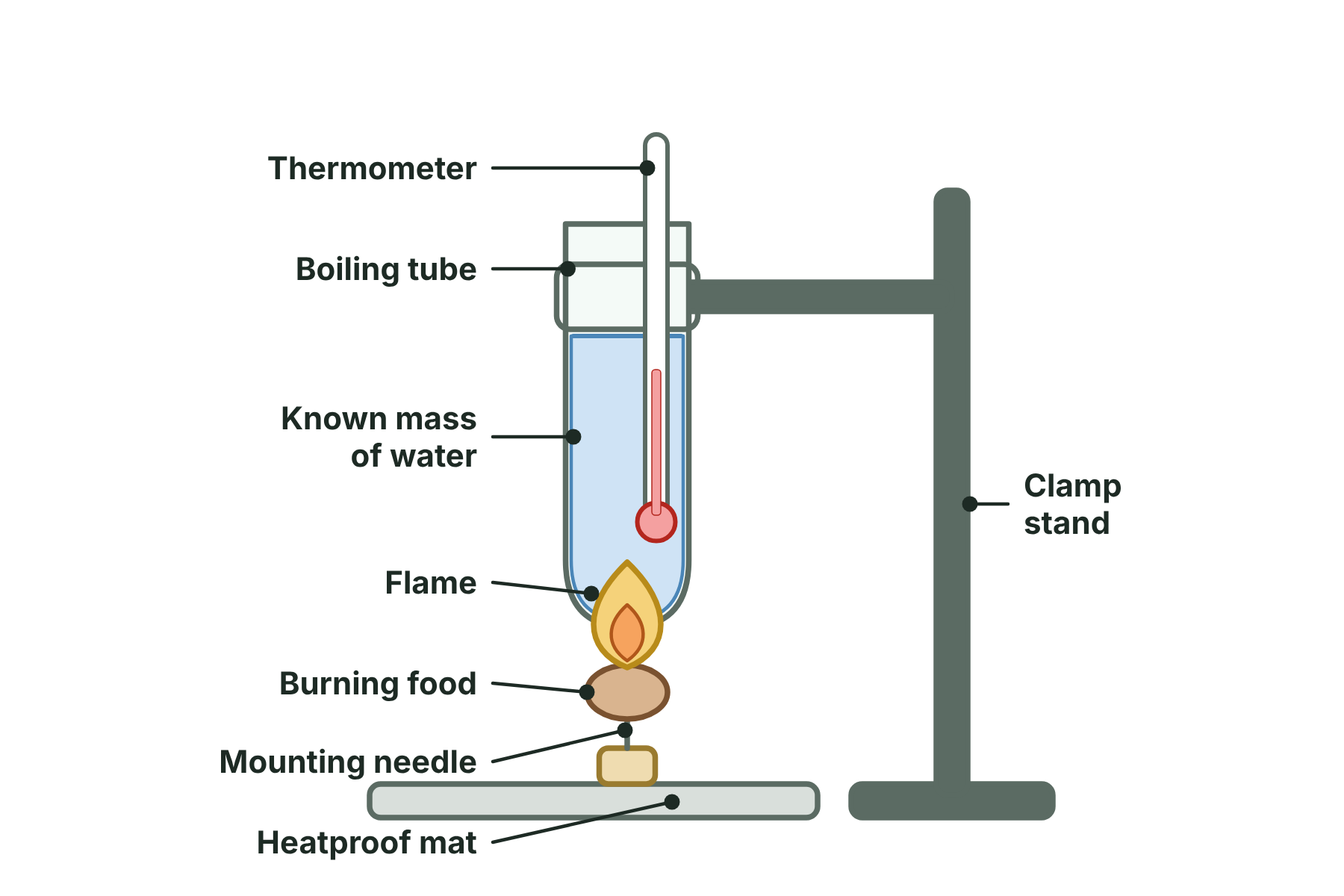
The energy released by the burning food heats the water, and the temperature rise shows how much energy there was.
Calculating the energy released
The energy transferred to the water is worked out from three measurements.
-
The formula
Energy transferred to the water (J) = mass of water (g) × 4.2 × temperature change (\(^\circ\)C). The number 4.2 is the energy in joules needed to warm 1 g of water by 1 \(^\circ\)C.
-
The energy per gram
Energy per gram of food (J/g) = energy transferred to the water (J) divided by the mass of food burned (g). This lets you compare foods of different masses fairly.
-
Joules to kilojoules
Divide by 1000 to change joules to kilojoules. For example 3000 J is 3 kJ.
-
Why use the mass of food
A bigger piece of the same food releases more energy, so the energy has to be given per gram before foods can be compared.
Energy content of a cashew nut
A cashew nut has a mass of 0.60 g. It is burned under a boiling tube containing 20 cm³ of water. The water temperature rises from 20 \(^\circ\)C to 56 \(^\circ\)C. Calculate the energy released per gram of nut, in J and in kJ.
Show the solutionHide the solution
- 1 Work out the mass of water 20 cm³ of water has a mass of 20 g.
- 2 Work out the temperature change \(56 - 20 = 36\) \(^\circ\)C.
- 3 Work out the energy transferred \(20 \times 4.2 \times 36 = 3024\) J.
- 4 Divide by the mass of food \(3024 \div 0.60 = 5040\) J per gram.
- 5 Convert to kilojoules \(5040 \div 1000 = 5.04\) kJ per gram.
Answer5040 J per gram, which is 5.04 kJ per gram.
Why the result is too low
The energy measured in a school experiment is always lower than the true energy content of the food. This is the main evaluation point for the topic.
-
Heat lost to the surroundings
Hot gases and the flame warm the air, the clamp and the table instead of the water, so the water gains only part of the energy.
-
Incomplete combustion
The food may not burn completely, so some of its energy is never released and some is left behind as soot.
-
Heat absorbed by the tube
The glass boiling tube and the thermometer also warm up, so not all the energy reaches the water.
-
Heat lost from the water
The water loses heat to the air from the top and sides of the tube while it is being heated.
Improving the investigation
Each source of error can be reduced, though never removed completely.
-
Reduce heat loss
Use a draught excluder or heat shield around the apparatus, and keep the food close to the tube. A proper calorimeter, or a copper can that conducts heat well, loses less energy.
-
Stir the water
Stirring spreads the heat evenly, so the thermometer reads the true temperature of all the water.
-
Repeat and take a mean
Repeat the experiment several times with fresh pieces of the same food, then calculate a mean to reduce the effect of random errors.
-
Control variables
Use the same volume of water, the same starting temperature and the same distance between the flame and the tube every time.
-
Use a bomb calorimeter
In a sealed bomb calorimeter, a sample burns in pure oxygen inside a container surrounded by water, so almost all of the energy is captured.
Comparing the energy in foods
Not all nutrients hold the same amount of energy, which is why some foods are called energy dense.
-
Lipids
About 37 kJ per gram. Lipids store roughly twice as much energy as the same mass of carbohydrate or protein, which is why fatty foods are so high in energy.
-
Carbohydrates
About 17 kJ per gram. They are the body's main and quickest source of energy.
-
Proteins
About 17 kJ per gram. They are used mainly to build and repair tissues, with energy as a second job.
-
Water and fibre
They provide no useful energy, so foods that contain a lot of water, such as fruit, release very little energy when burned.
Case study
Burning a peanut
A peanut is a good food to burn because it is dry and rich in lipids and protein. It burns with a steady flame for long enough to heat a tube of water noticeably. Tables of food data give peanuts about 24 kJ per gram, but a school experiment usually measures only a fraction of this because most of the energy is lost to the surroundings. Comparing the two numbers shows how large the error from heat loss can be.
Summary and exam focus
- Calorimetry measures the energy in food by burning it and measuring the temperature rise of a known mass of water.
- Energy transferred (J) = mass of water (g) × 4.2 × temperature change (\(^\circ\)C).
- Energy per gram = energy transferred divided by the mass of food burned.
- The result is lower than the true value because heat is lost to the surroundings and burning may be incomplete.
- Insulation, stirring and repeating the experiment make the results more accurate and reliable.
Exam focus
A student burns a 0.50 g sample of a biscuit under 25 cm³ of water. The temperature of the water rises from 18 \(^\circ\)C to 46 \(^\circ\)C. Calculate the energy released per gram of biscuit. The energy transferred to water (J) = mass of water (g) × 4.2 × temperature change (\(^\circ\)C). (4 marks) (4 marks)
Show every step of the calculation, because marks are given for the method as well as the answer. Write the units (J or J/g) with each number, and do not forget to divide by the mass of the food at the end.
Key terms
The words this lesson expects you to use. Each one is linked from the first place it appears above.
- Calorimetry
- A method of measuring the energy released by a reaction, by finding out how much it heats a known mass of water.
- Calorimeter
- The apparatus used to measure the energy released when a substance is burned.
- Joule
- The unit of energy, abbreviated J. There are 1000 J in a kilojoule.
- Kilojoule
- A unit of energy equal to 1000 joules, abbreviated kJ.
- Energy content
- The amount of energy stored in a given mass of food, such as kJ per gram.
- Specific heat capacity of water
- The energy needed to raise the temperature of 1 g of water by 1 \(^\circ\)C, which is 4.2 J.
- Combustion
- Burning: a reaction with oxygen that releases energy as heat and light.
- Incomplete combustion
- Burning that does not use up all the fuel, so less energy is released.
- Insulation
- A material that reduces the loss of heat from the apparatus to the surroundings.
- Mean
- The average of a set of repeated results, found by adding them up and dividing by how many there are.
You've finished the notes
Check your understanding
Test yourself while it is fresh. Start with the flashcards, then try the exam questions.
Something here looks wrong?
Tell us what and we will go and look. It goes to whoever writes these pages, nobody else, and we do not ask who you are — so there is nothing to sign and nothing comes back to you.