Biology · Enzymes and Digestion
Knowledge organiser
The whole chapter on two pages. Print it on A4 — they are already landscape — or cover a box and see how much of it you can say from memory.
Biology · Edexcel Paper 1
Enzymes and Digestion
Levels of Organisation and the Digestive System
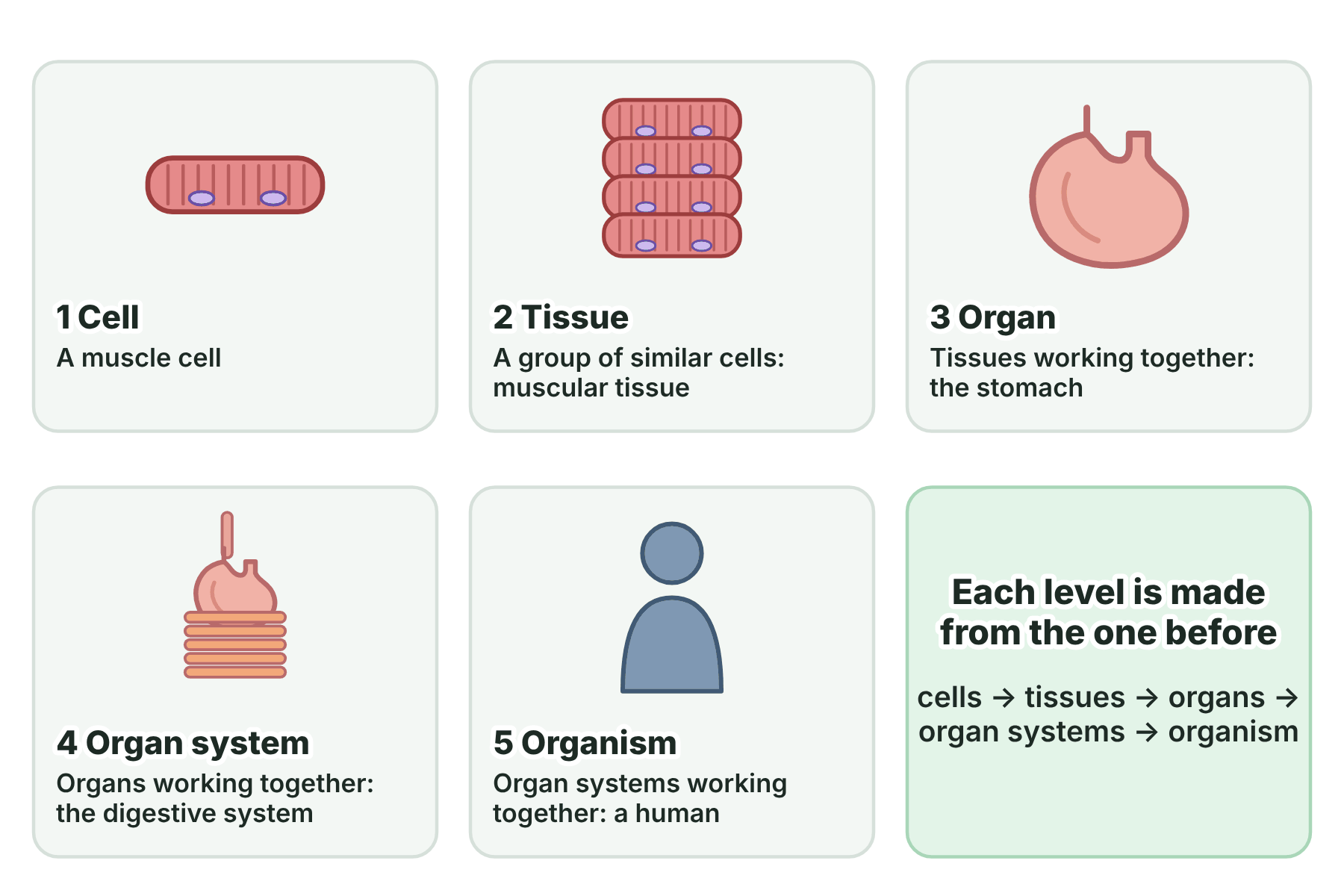
An organ is made of different tissues, and an organ system is made of different organs, all working together to do a job.
- Tissue A group of similar cells that work together to do a particular job.
- Organ A group of different tissues that work together to do a particular job.
- Organ system A group of organs that work together to do a particular job.
The journey of a meal
- Mouth Teeth cut and grind the food. Saliva wets it and starts to digest starch.
- Oesophagus Muscles squeeze the food down to the stomach.
- Stomach The food is churned with acid and protease, which starts to digest protein.
- Small intestine Bile from the liver and enzymes from the pancreas and the small…
Enzymes
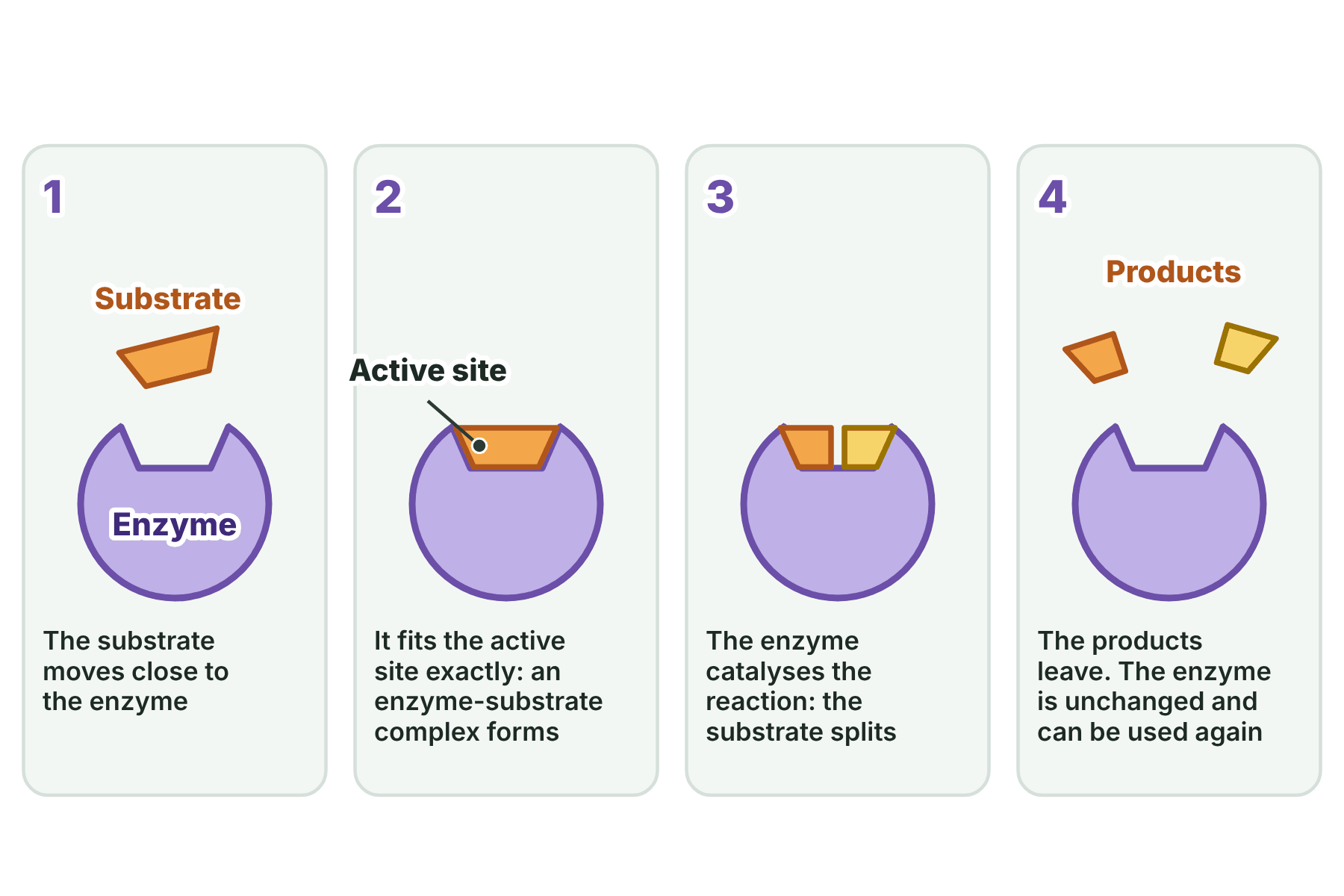
An enzyme is a biological catalyst. Its active site fits only its own substrate, and a denatured enzyme cannot catalyse the reaction.
- Enzyme A biological catalyst, made of protein, that speeds up a reaction in a living thing.
- Catalyst A substance that speeds up a chemical reaction and is not used up.
- Substrate The substance that an enzyme acts on.
Below and above the optimum temperature
- Below the optimum The rate rises as the temperature rises; The particles move faster and collide more often; The enzyme keeps its shape
- Above the optimum The rate falls as the temperature rises; Bonds in the enzyme break; The active site changes shape: the enzyme is denatured
Digestive Enzymes and Bile
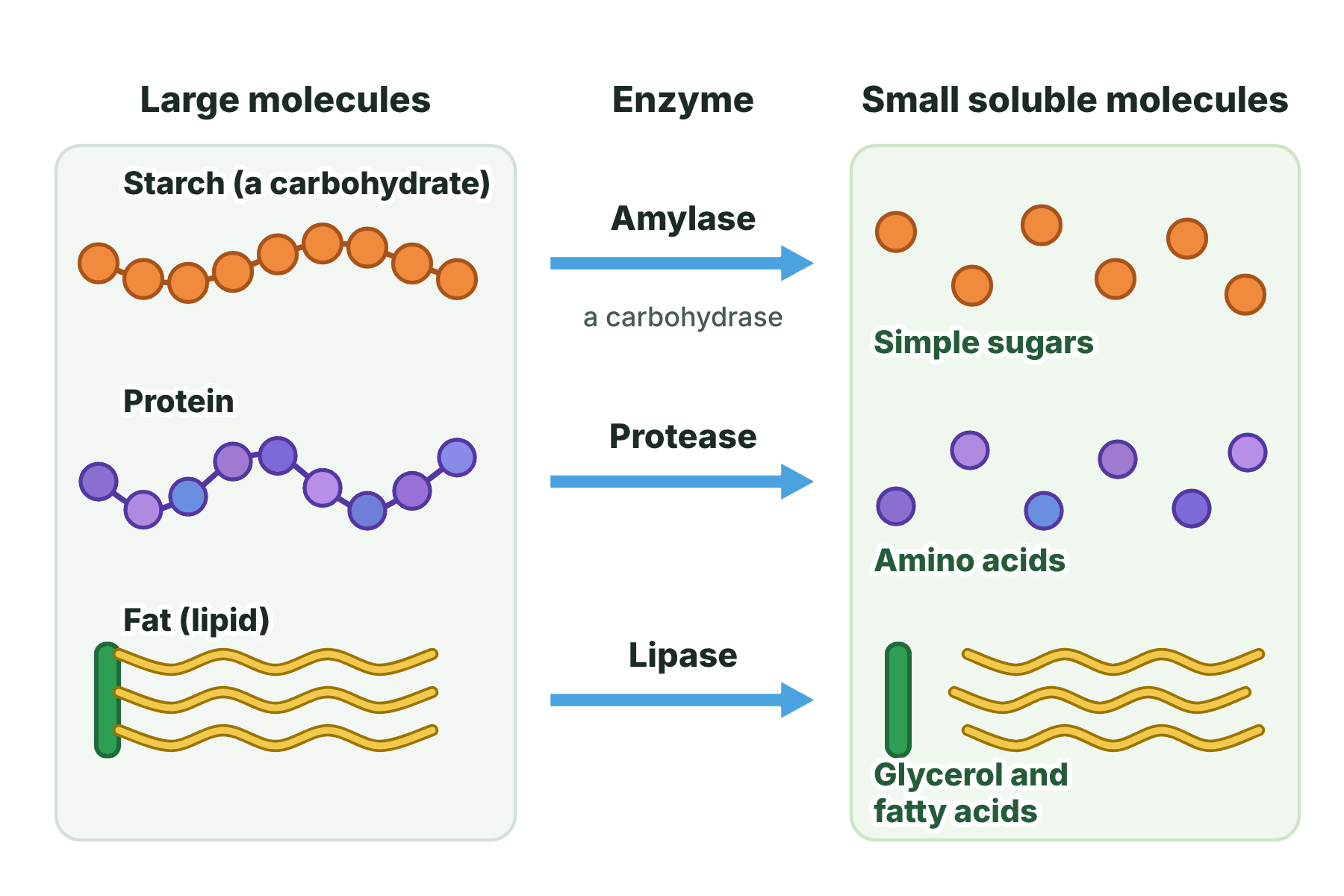
Carbohydrases break down carbohydrates into simple sugars, proteases break down proteins into amino acids.
- Carbohydrase An enzyme that breaks down carbohydrates into simple sugars.
- Amylase A carbohydrase that breaks down starch into simple sugars.
- Protease An enzyme that breaks down proteins into amino acids.
Digestive enzymes and bile
- Digestive enzymes Made by glands and by the lining of the gut; Are catalysts that break down large molecules chemically; Specific: each one works on one type of molecule
- Bile Made in the liver and stored in the gall bladder; Is not an enzyme, and does not break down molecules; Alkaline, so it neutralises the acid from the stomach
Biology · Edexcel Paper 1
Enzymes and Digestion continued
Food Tests (Separate only)
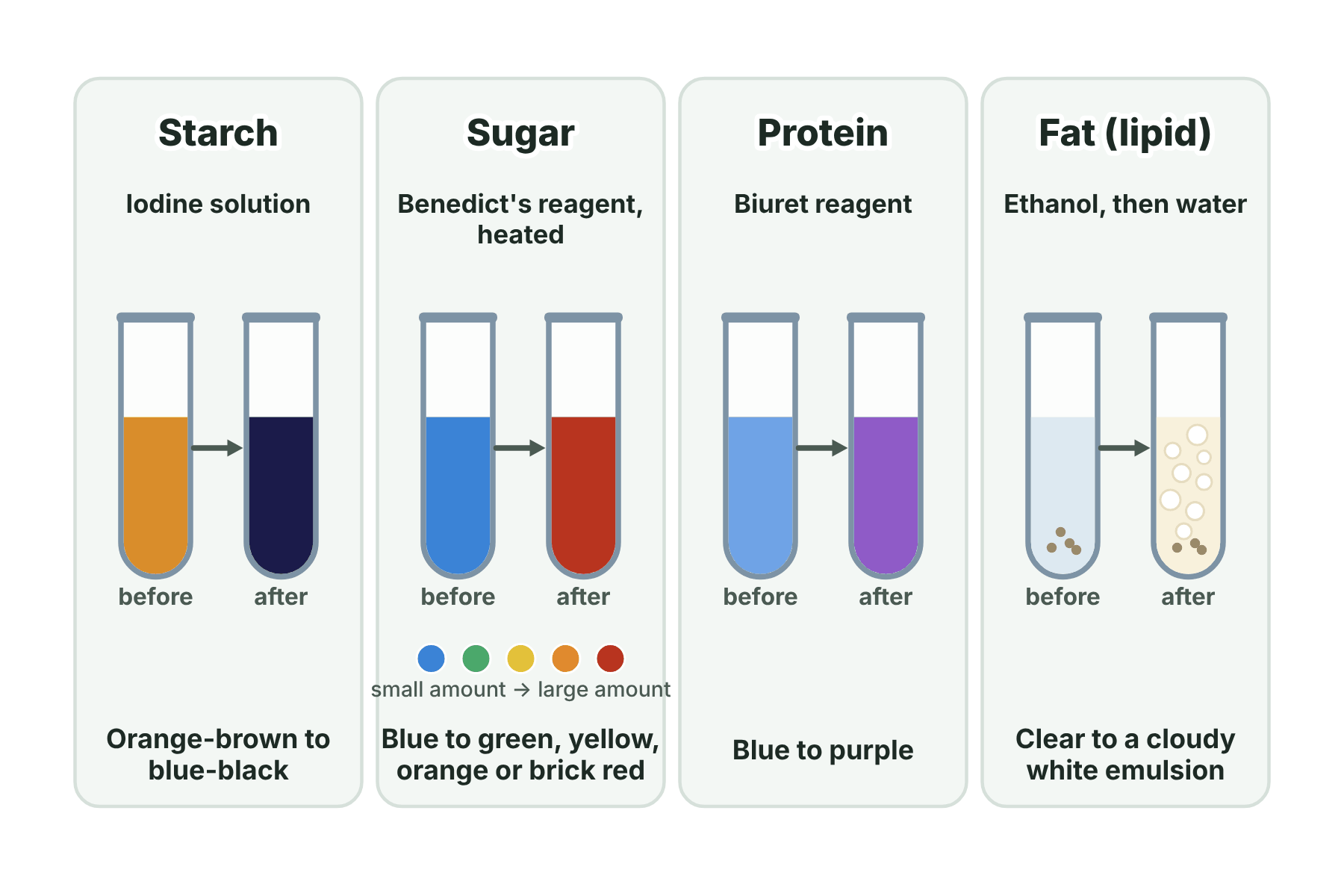
Iodine turns blue-black with starch. Benedict's reagent, heated, turns from blue to brick red with sugar.
- Reagent A chemical used to detect another substance because it changes colour or appearance.
- Qualitative test A test that shows whether a substance is present, but does not measure how much.
- Iodine solution The reagent that turns blue-black when starch is present.
Carrying out Benedict's test for sugar
- Add the sample Put about 2 cm³ of the food sample into a test tube.
- Add the reagent Add about 10 drops of Benedict's reagent. The mixture is blue.
- Heat it safely Put the test tube in a hot water bath, at about 75 °C.
- Watch for a colour change If there is sugar the mixture goes green, yellow, orange or…
Measuring the Energy in Food (Separate only)
How much energy is stored in a peanut or a slice of bread?
- Calorimetry A method of measuring the energy released by a reaction, by finding out how much it heats a known mass of water.
- Calorimeter The apparatus used to measure the energy released when a substance is burned.
- Joule The unit of energy, abbreviated J. There are 1000 J in a kilojoule.
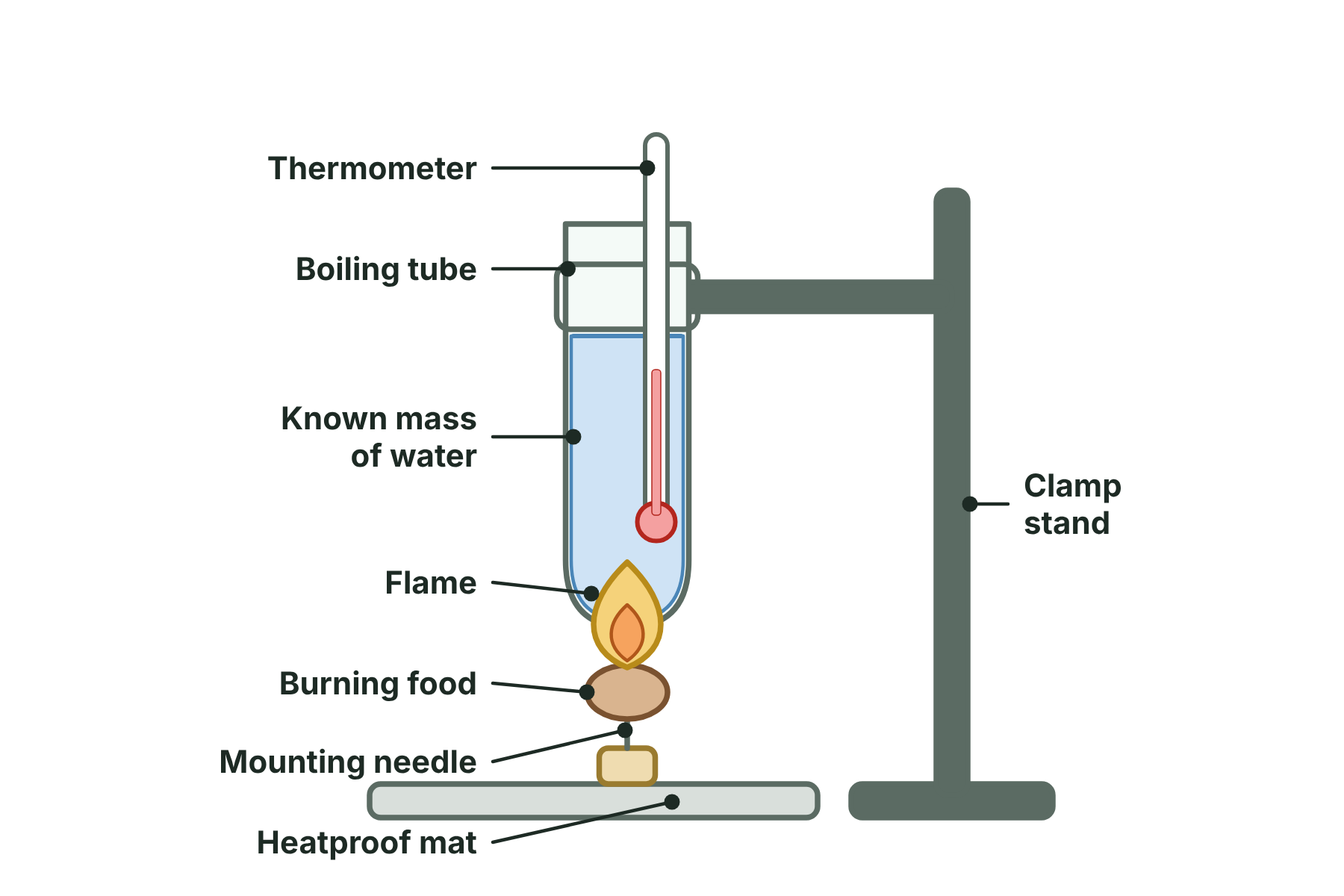
The calorimetry method
- Measure the water Use a measuring cylinder to put a known volume of water in a…
- Record the starting temperature Clamp the tube and measure the temperature of the water with a…
- Weigh the food Find the mass of a small piece of dry food, such as a nut, then…
- Set the food alight Light the food in a Bunsen flame, then quickly hold it directly…
Investigating the Effect of pH on Amylase
The rate of an enzyme-controlled reaction is fastest at the optimum pH.
- Continuous sampling Taking a small sample at regular intervals during a reaction and testing each one.
- Buffer solution A solution that keeps the pH constant at a particular value.
- Spotting tile A tile with small wells, used to test many small drops one after the other.
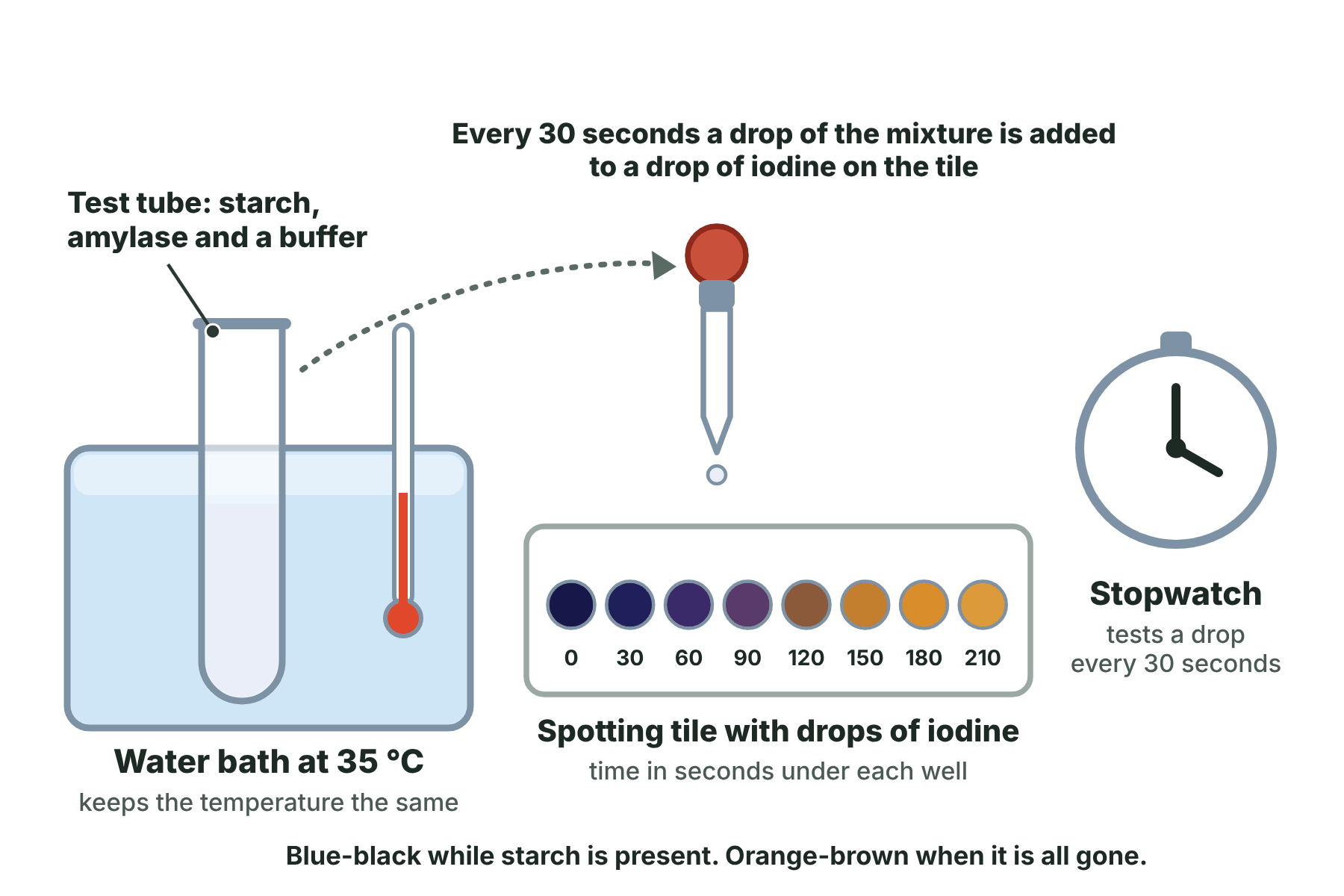
The variables in this investigation
- Independent variable What you change; The pH of the buffer solution; Five values: pH 5, 6, 7, 8 and 9
- Dependent variable What you measure; The time for the starch to be digested; Used to work out the rate of reaction
The method
- Prepare the tile Put a drop of iodine solution into each well of a spotting tile.
- Set up the tubes Put 2 cm³ of amylase solution and 2 cm³ of the pH 5 buffer into…
- Start the reaction Pour the starch into the amylase and buffer, mix.
- Sample every 30 seconds Use a dropping pipette to take a drop of the mixture and add it…