Biology · Evolution and Natural Selection
Knowledge organiser
The whole chapter on two pages. Print it on A4 — they are already landscape — or cover a box and see how much of it you can say from memory.
Biology · Edexcel Paper 1
Evolution and Natural Selection
Darwin and Wallace (Separate only)
Two naturalists reached the same idea almost at the same time.
- Evolution The gradual change in the inherited characteristics of a species over many generations.
- Natural selection The process by which individuals with features that suit their environment survive and reproduce more than others.
- Theory An explanation, supported by evidence, that has been tested many times.
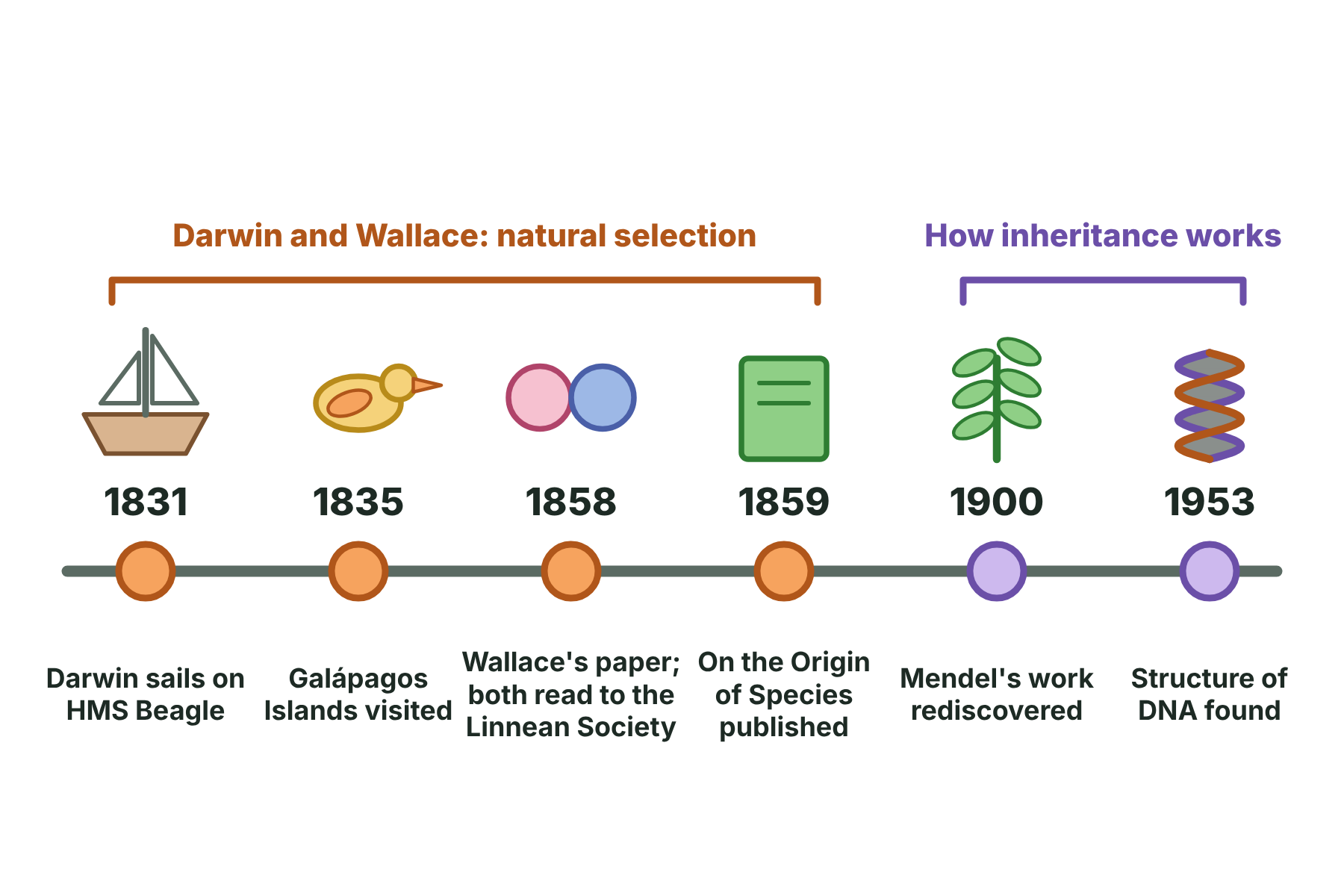
Key dates
- 1809 Charles Darwin is born in Shrewsbury.
- 1831 Darwin sets out on HMS Beagle, a voyage of five years round the world.
- 1835 Darwin visits the Galápagos Islands and studies the animals there.
- 1858 Wallace sends Darwin a paper with the same idea, and both are presented to the Linnean Society.
- 1859 Darwin publishes On the Origin of Species.
Darwin and Wallace
- Darwin Collected evidence over many years on the Beagle voyage and at home; Studied selective breeding as a model; Had a draft of the theory for about twenty years
- Wallace Collected specimens in the Amazon and South-East Asia; Studied the distribution of animals; Wrote down the idea in a few days in 1858
Natural Selection
Why are there so many different species, each suited to where it lives?
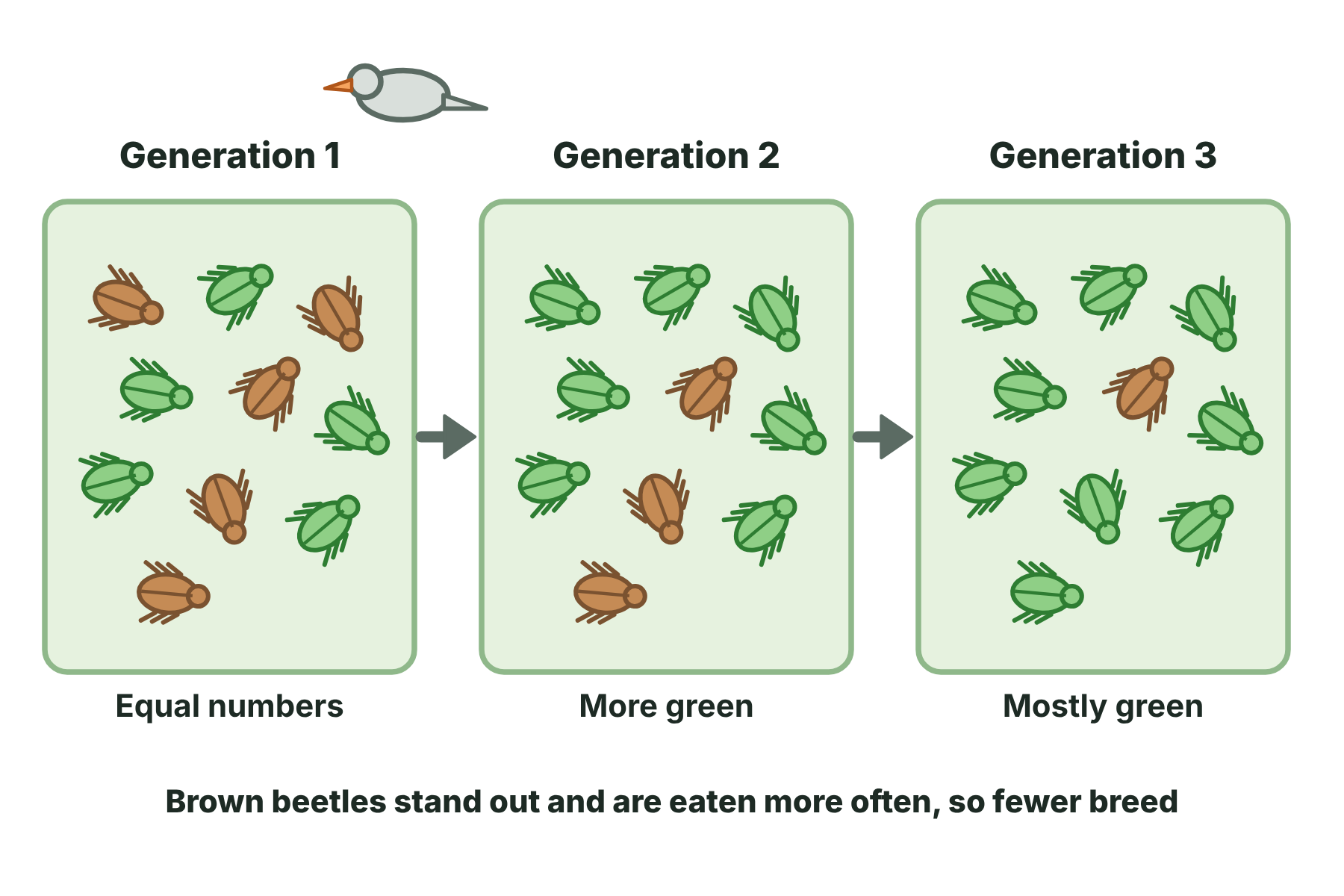
- Natural selection The process in which better adapted individuals survive and reproduce, passing on their alleles.
- Adaptation A feature that helps an organism to survive and reproduce in its environment.
- Competition The struggle between organisms for the same limited resources.
Darwin and Lamarck
- Natural selection (Darwin) Individuals vary because of their genes; Better adapted individuals survive and breed; The alleles that give an advantage become more common
- Inheritance of acquired characteristics (Lamarck) Organisms change during their lifetime by using or not using parts; The changes are passed to offspring; For example, a giraffe stretching its neck gives long-necked offspring
The steps of natural selection
- Variation Individuals in a population differ from each other.
- Competition More offspring are born than the environment can support.
- Survival of the best adapted Individuals with characteristics that give an advantage are more…
- Reproduction The survivors breed and pass on the alleles for the useful…
Antibiotic Resistance
Natural selection is happening right now, in the bacteria that cause disease.
- Antibiotic A drug that kills bacteria or stops them from growing.
- Antibiotic resistance The ability of bacteria to survive an antibiotic that would normally kill them.
- MRSA A strain of bacteria that is resistant to many antibiotics, including methicillin.
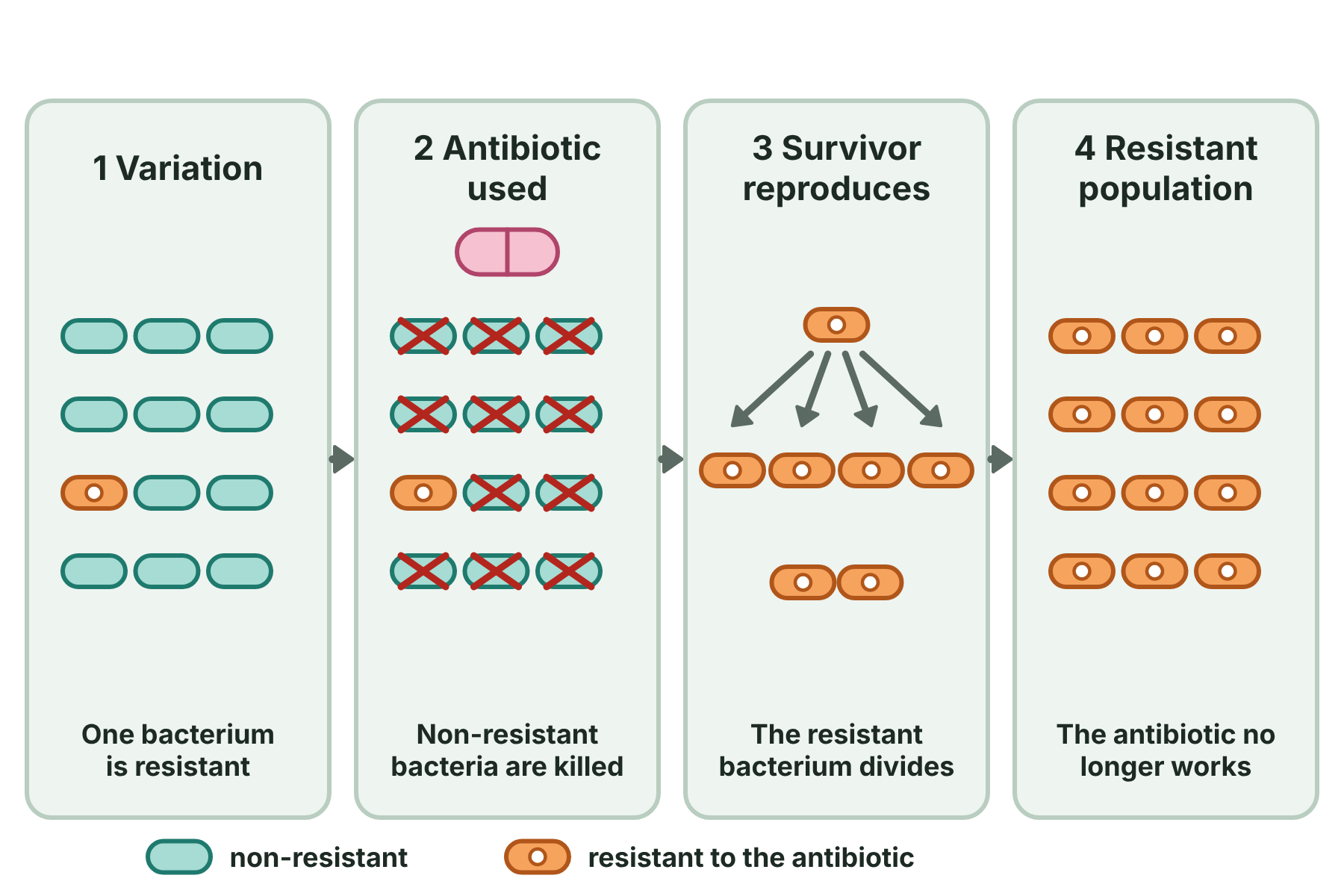
Resistant and non-resistant bacteria
- Non-resistant bacteria Killed or stopped by the antibiotic; Make up most of the population at first; Cannot survive when the antibiotic is used
- Resistant bacteria Not harmed by the antibiotic; Very rare in the population at first; Survive and reproduce when the antibiotic is used
How resistance evolves
- Variation A population of bacteria contains variation.
- Antibiotic used The antibiotic is taken, and kills most of the non-resistant bacteria.
- Survival The resistant bacterium survives, since the antibiotic cannot harm it.
- Reproduction It reproduces rapidly, dividing about every 20 minutes.
Biology · Edexcel Paper 1
Evolution and Natural Selection continued
Fossil Evidence for Human Evolution
Fossils show how our ancestors looked and moved. This lesson covers three key fossil finds, Ardi, Lucy and the fossils found by the Leakey family.
- Fossil The preserved remains or traces of an organism that lived long ago.
- Hominid A member of the group that includes humans and their ancestors, and the great apes.
- Ardi Ardipithecus ramidus, a hominid that lived about 4.4 million years ago.
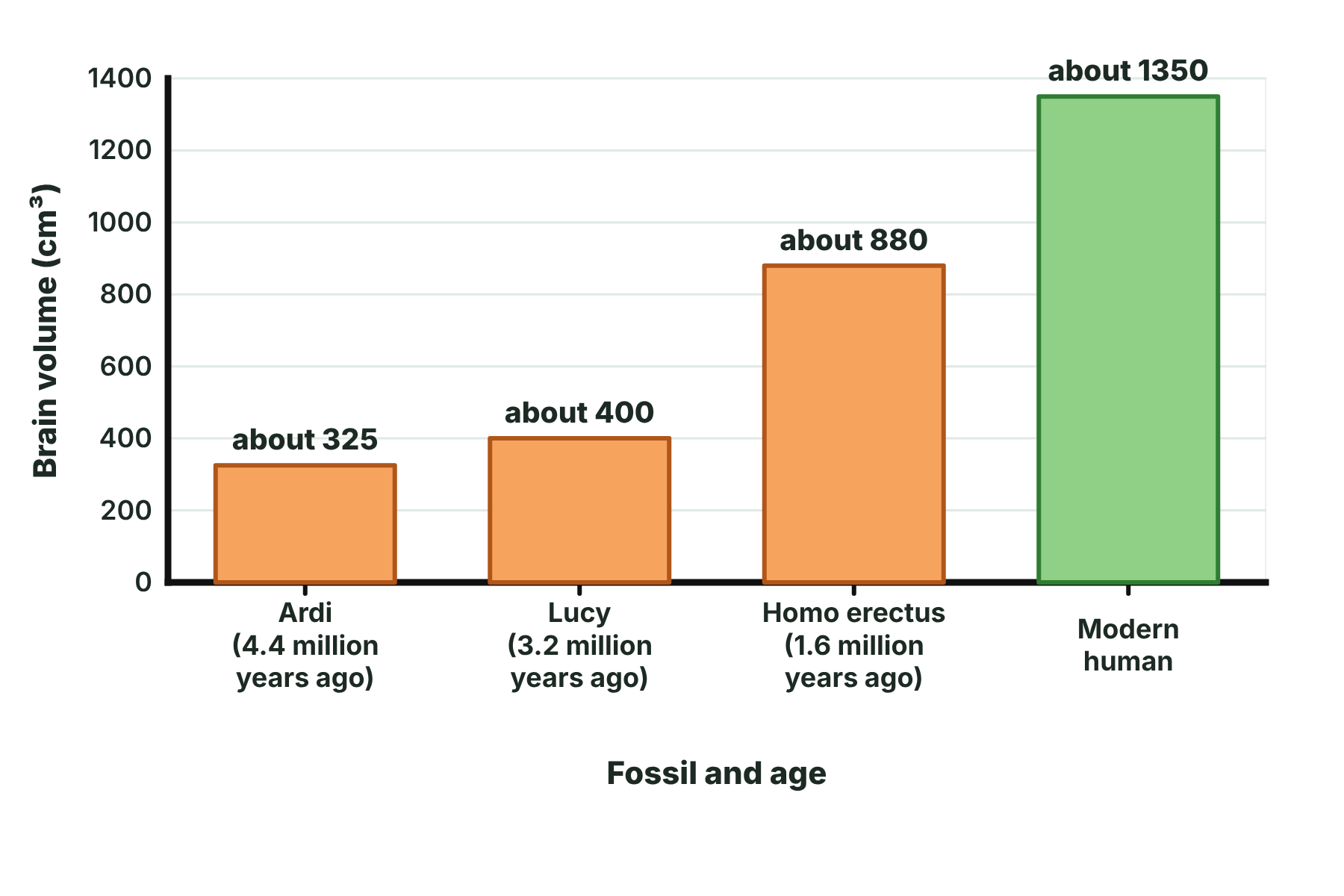
Comparing the fossils
- Ardi and Lucy Small brain, about 325 to 400 cm³; Walked upright, but could also climb trees; Smaller bodies, about 1.1 to 1.2 m tall
- Homo erectus (Leakey fossils) Larger brain, about 880 cm³; Walked upright efficiently, with body proportions like ours; Taller, about 1.6 m
Stone Tools and Human Evolution
Stone is one of the few materials that survives for millions of years.
- Stone tool A tool made by shaping stone, to give a sharp edge.
- Oldowan The oldest well-known stone tool culture, made up of simple choppers and flakes.
- Hand axe A symmetrical stone tool shaped on both sides, made by Homo erectus.
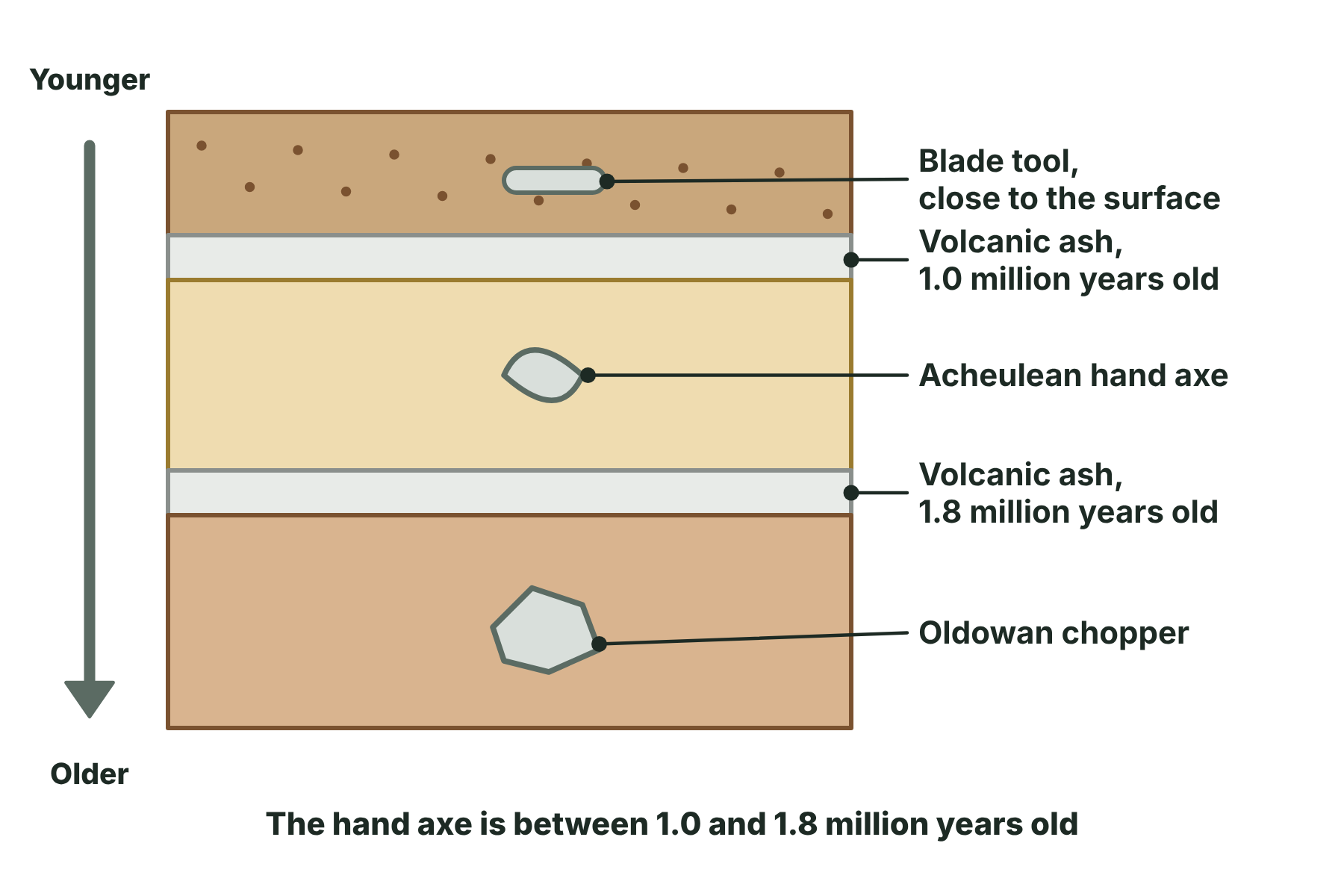
The development of stone tools
- 3.3 million years ago The oldest known tools yet found, at Lomekwi in Kenya, made before the first Homo fossils.
- 2.6 million years ago Oldowan tools, simple choppers and flakes, made by early Homo such as Homo habilis.
- 1.7 million years ago Acheulean hand axes, made by Homo erectus, shaped on both sides.
- 300 000 years ago Finely made flake tools and spear points, used by Neanderthals and early Homo sapiens.
- 40 000 years ago Thin blades, and tools of bone and antler, including needles, used by modern humans.
Fossils and stone tools as evidence
- Fossils Show what our ancestors looked like; Show brain size and body shape; Rare, and often incomplete
- Stone tools Show what our ancestors could do and how they behaved; Show skills, planning and culture; Last for a long time, and are more common
The Pentadactyl Limb (Separate only)
A human arm, a bat's wing and a whale's flipper do very different jobs, but their bones are laid out in the same way.
- Pentadactyl limb A limb with five digits, found in many vertebrates, with the same basic arrangement of bones.
- Humerus The bone of the upper limb.
- Radius One of the two bones in the lower limb.
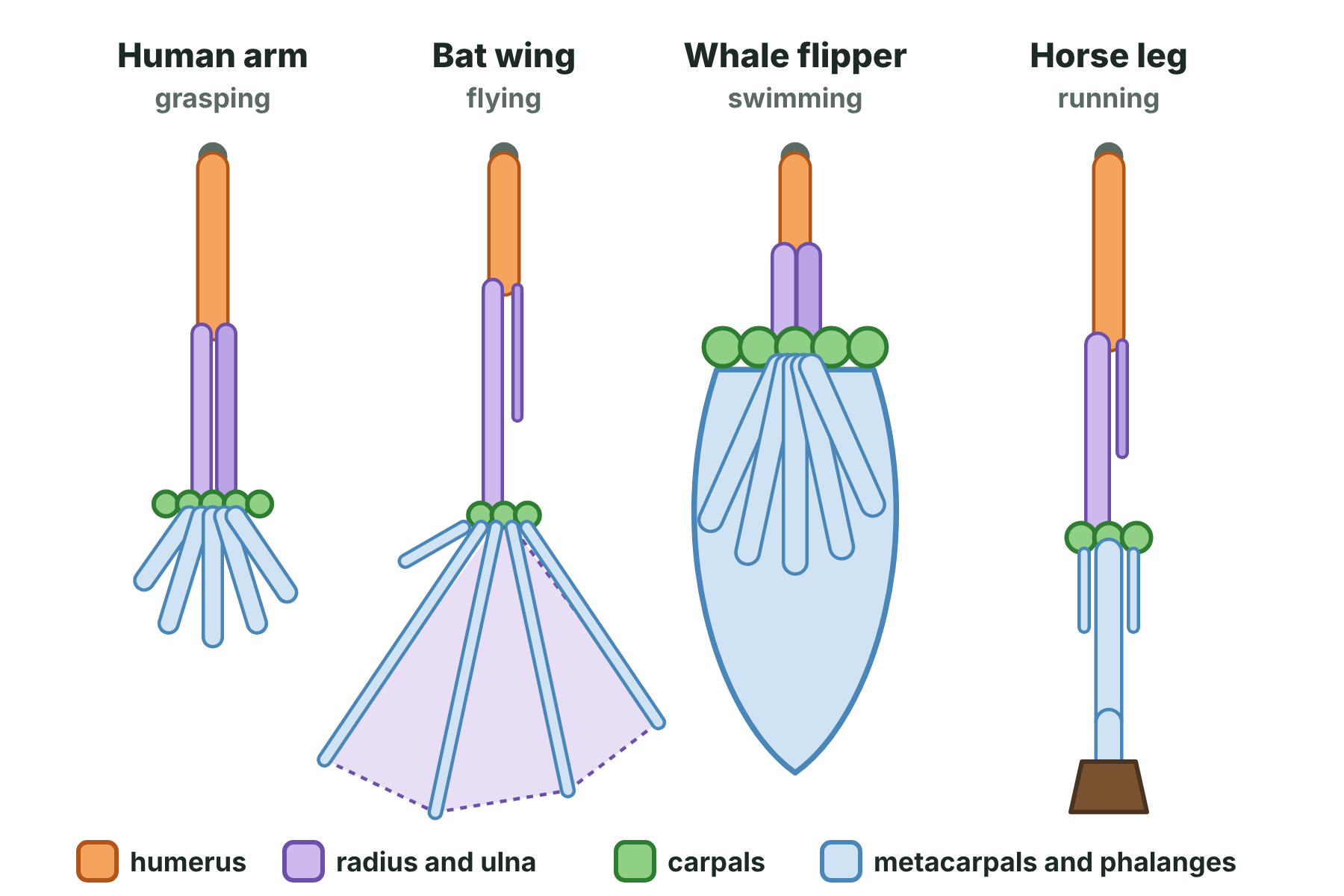
Homologous and analogous structures
- Homologous structures Have the same basic structure, such as the pentadactyl limb; May have different functions, such as grasping or flying; Are inherited from a common ancestor
- Analogous structures Have different underlying structures; Have the same function, such as the wings of a bird and an insect; Evolved separately, with no shared ancestor
Classification and the Three Domains
How do we sort the millions of species on Earth into groups? This lesson explains the five kingdom system, and how genetic analysis led to the suggestion of three domains.
- Classification Sorting living things into groups according to their features and relationships.
- Kingdom One of the large groups into which living things were sorted, such as animals or plants.
- Domain One of the three largest groups of living things: Bacteria, Archaea and Eukaryota.
- Archaea A domain of single-celled prokaryotes, often found in extreme environments.
Five kingdoms and three domains
- The five kingdoms system Based mainly on structure and the way of feeding; Places all prokaryotes in one kingdom; Has five groups at the top level
- The three domains system Based on genetic analysis, especially of ribosomal RNA; Splits the prokaryotes into Bacteria and Archaea; Has three groups at the top level