Biology · Inheritance
Alleles, Genotype and Phenotype
Why do some people have blue eyes and others brown? This lesson introduces the key words of genetics: alleles, dominant and recessive, homozygous and heterozygous, genotype and phenotype.
Learning Objectives
- 1Explain why there are differences in inherited characteristics as a result of alleles.
- 2Define the terms chromosome, gene, allele, dominant, recessive, homozygous, heterozygous, genotype, phenotype, gamete and zygote.
- 3Use letters to write genotypes, and say what the phenotype is.
- 4Explain how alleles are passed on from parents to offspring through gametes.
Retrieval practice
-
1
What is a gene?
Show answerHide answer
A section of DNA that codes for a protein.
-
2
How many chromosomes are in a human gamete?
Show answerHide answer
23.
-
3
What happens at fertilisation?
Show answerHide answer
A male gamete and a female gamete fuse, forming a zygote.
-
4
What type of cell division makes gametes?
Show answerHide answer
Meiosis.
Different versions of a gene
Every person has genes for the same characteristics, such as eye colour or blood group, in the same places on their chromosomes. But the genes come in different versions, and these versions are the reason why people differ. Each different version of a gene is called an allele. A body cell has two copies of each chromosome, so it has two alleles of each gene, one from the mother and one from the father. The combination of alleles a person has decides which characteristics they show.
Chromosomes, genes and alleles
These three words are often confused, so be clear about each one.
-
Chromosome
A long molecule of DNA that carries many genes. Body cells have 23 pairs.
-
Gene
A section of DNA that codes for a particular protein, and so for a characteristic such as flower colour.
-
Allele
A different version of the same gene. For example, a pea plant has a gene for height with an allele for tall and another for dwarf.
-
Pairs
In a pair of chromosomes, the two alleles of a gene lie at the same position, one on each chromosome.
Alleles on a pair of chromosomes
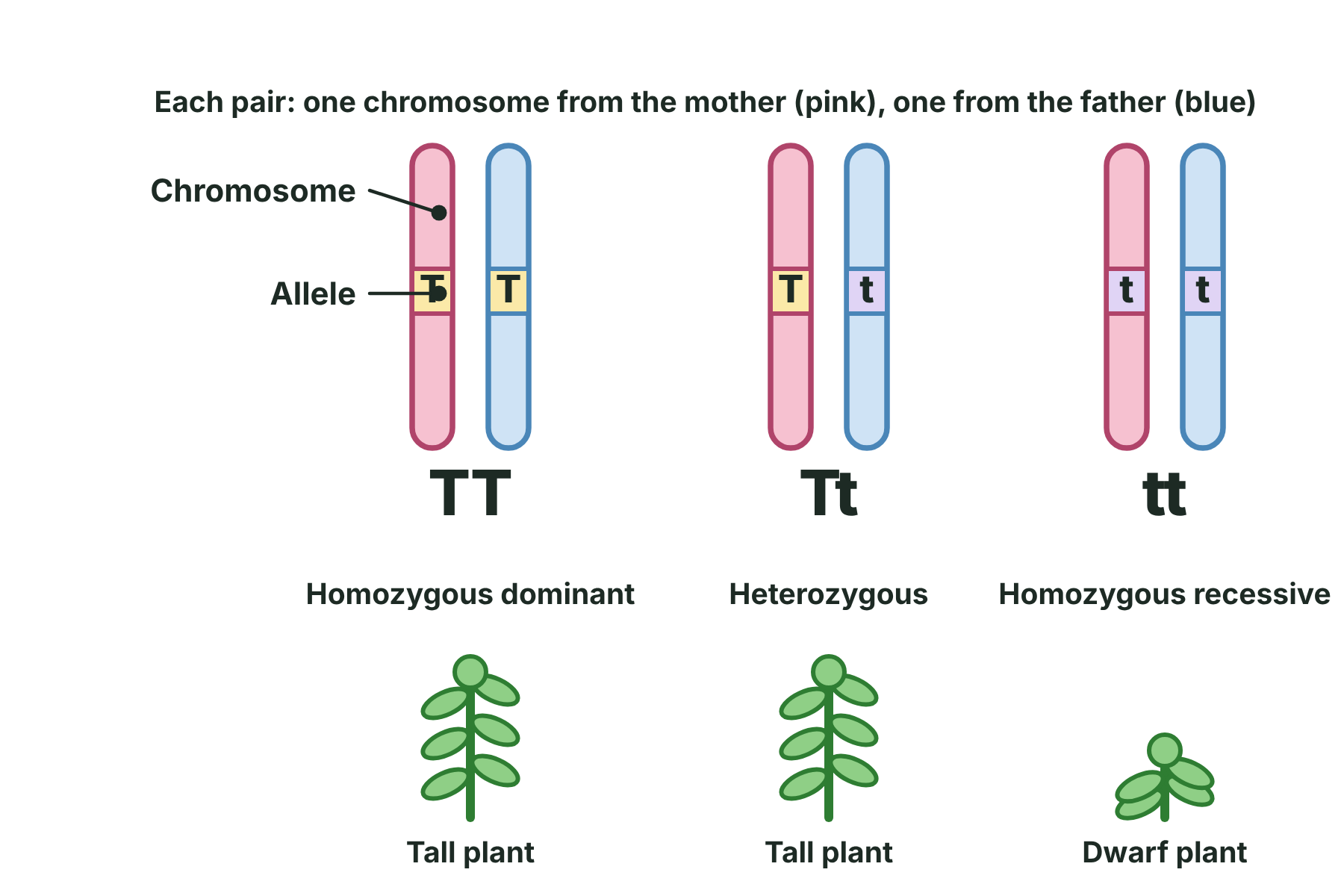
The two alleles of a gene are at the same position on a pair of chromosomes.
Dominant and recessive alleles
When the two alleles in a person are different, one may hide the effect of the other.
-
Dominant allele
An allele that has an effect even if only one copy is present. It is written with a capital letter, such as T.
-
Recessive allele
An allele that only has an effect if there are two copies, with no dominant allele present. It is written with the lower-case letter, such as t.
-
Using one letter
The same letter is used for both alleles, so that it is clear that they are versions of the same gene.
-
Not about being common
Dominant does not mean most common or stronger. Some dominant alleles, such as the one for Huntington's disease, are rare.
Homozygous and heterozygous
Homozygous
- Two identical alleles of a gene
- Written TT (homozygous dominant) or tt (homozygous recessive)
- Always makes the same type of gamete
- TT is tall and tt is dwarf
Heterozygous
- Two different alleles of a gene
- Written Tt
- Makes two types of gamete, half with T and half with t
- The dominant allele shows, so Tt is tall
Genotype and phenotype
These two words describe what a person has and what it looks like.
-
Genotype
The combination of alleles that an organism has for a gene, written as letters. For example Tt.
-
Phenotype
The characteristic that the organism shows, such as being tall. It is the result of the genotype and sometimes also the environment.
-
Same phenotype, different genotype
TT and Tt both have the phenotype tall, but different genotypes.
-
Recessive phenotype
The recessive phenotype is only seen in the homozygous recessive genotype, tt.
Naming the genotype and the phenotype
In pea plants, the allele for purple flowers (P) is dominant to the allele for white flowers (p). State the phenotype of plants with genotypes PP, Pp and pp, and say whether each is homozygous or heterozygous.
Show the solutionHide the solution
- 1 Look at the letters P is dominant, so it shows if there is at least one P.
- 2 PP Two P alleles, so the flowers are purple, and it is homozygous (same alleles).
- 3 Pp One of each, so the dominant allele shows and the flowers are purple. It is heterozygous.
- 4 pp No dominant allele, so the recessive phenotype is shown. The flowers are white and it is homozygous.
AnswerPP is purple and homozygous dominant. Pp is purple and heterozygous. pp is white and homozygous recessive.
How alleles are passed on
Alleles are passed on in gametes, one from each parent.
-
Gametes carry one allele
Meiosis separates the pair of chromosomes, so each gamete has only one allele of each gene.
-
A heterozygous parent
A parent with Tt makes two kinds of gamete, half carrying T and half carrying t.
-
Zygote
At fertilisation a gamete from the mother and one from the father fuse, so the zygote has two alleles again.
-
Chance
Which gamete fertilises which is random, so the allele passed on is a matter of chance.
Case study
Cystic fibrosis
Cystic fibrosis is an inherited disorder that causes thick, sticky mucus to build up in the lungs and gut. It is caused by a recessive allele, which we can call f. A person with two recessive alleles, ff, has the disorder. A person with Ff does not have it, but is a carrier who can pass the allele on, and a person with FF is unaffected. About 1 in 25 people in the UK are carriers, and most do not know it.
Summary and exam focus
- An allele is a different version of a gene.
- A dominant allele shows if one copy is present, and a recessive allele shows only if two copies are present.
- Homozygous means two identical alleles, and heterozygous means two different alleles.
- The genotype is the alleles that an organism has, and the phenotype is the characteristic that it shows.
- Each gamete contains one allele of each gene.
Exam focus
In cats, the allele for black fur (B) is dominant to the allele for ginger fur (b). Explain what is meant by the terms genotype and phenotype, and state the phenotype of a cat with the genotype Bb. (4 marks) (4 marks)
Define each term in one sentence, with a use of the example. Remember that a heterozygous organism shows the dominant phenotype, so Bb is black. Always say whether a letter is dominant or recessive when you define the alleles in your answer.
Key terms
The words this lesson expects you to use. Each one is linked from the first place it appears above.
- Allele
- A different version of the same gene.
- Dominant
- An allele that shows its effect even when only one copy is present.
- Recessive
- An allele that only shows its effect when two copies are present.
- Homozygous
- Having two identical alleles of a gene.
- Heterozygous
- Having two different alleles of a gene.
- Genotype
- The combination of alleles that an organism has for a gene.
- Phenotype
- The characteristics that an organism shows.
- Gamete
- A sex cell, with one allele of each gene.
- Zygote
- The cell formed when two gametes fuse.
- Carrier
- A person with one copy of a recessive allele who does not show the characteristic but can pass the allele on.
You've finished the notes
Check your understanding
Test yourself while it is fresh. Start with the flashcards, then try the exam questions.
Something here looks wrong?
Tell us what and we will go and look. It goes to whoever writes these pages, nobody else, and we do not ask who you are — so there is nothing to sign and nothing comes back to you.