Biology · Inheritance
Knowledge organiser
The whole chapter on two pages. Print it on A4 — they are already landscape — or cover a box and see how much of it you can say from memory.
Biology · Edexcel Paper 1
Inheritance
Alleles, Genotype and Phenotype
Why do some people have blue eyes and others brown? This lesson introduces the key words of genetics: alleles, dominant and recessive…
- Allele A different version of the same gene.
- Dominant An allele that shows its effect even when only one copy is present.
- Recessive An allele that only shows its effect when two copies are present.
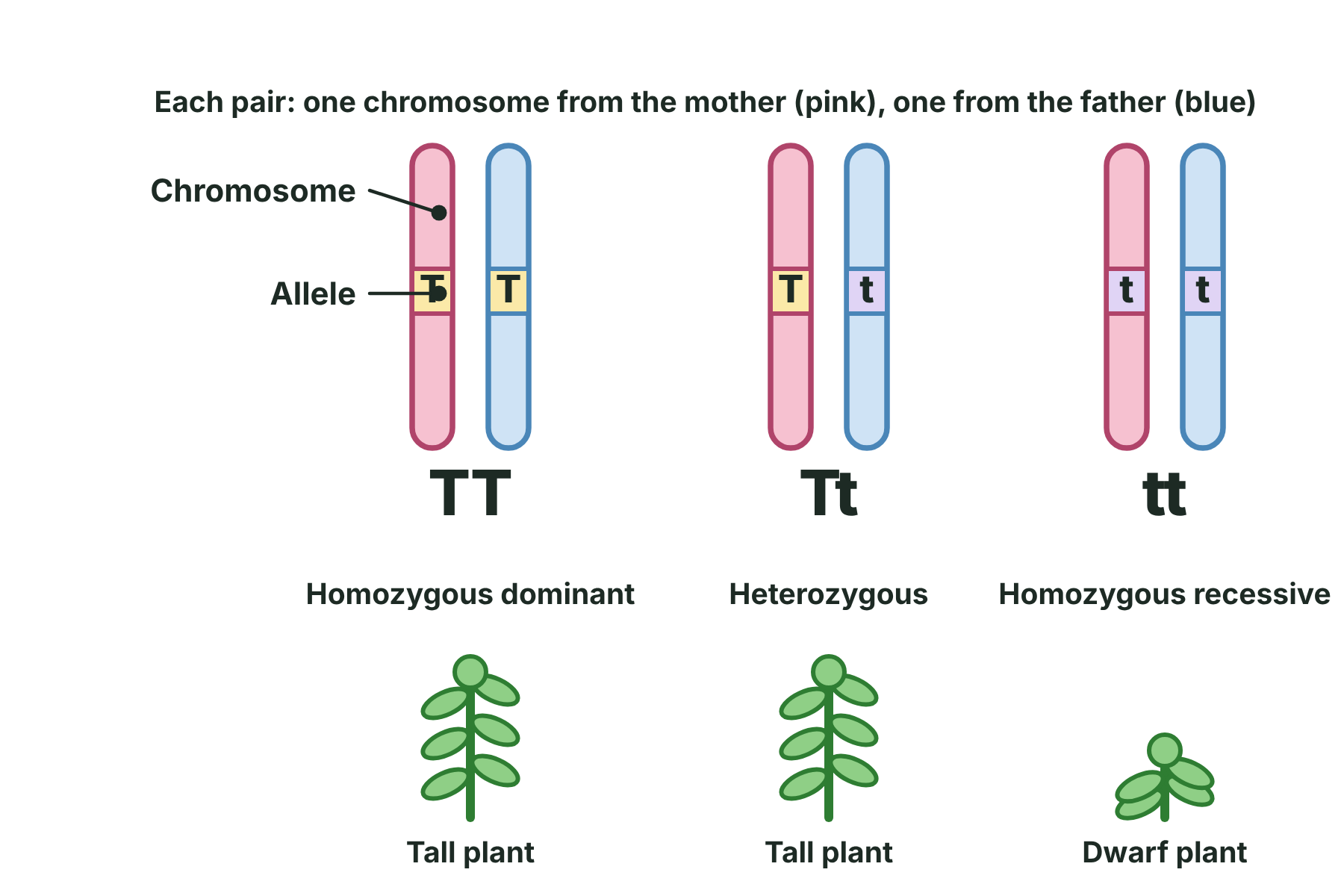
Homozygous and heterozygous
- Homozygous Two identical alleles of a gene; Written TT (homozygous dominant) or tt (homozygous recessive); Always makes the same type of gamete
- Heterozygous Two different alleles of a gene; Written Tt; Makes two types of gamete, half with T and half with t
Monohybrid Crosses and Punnett Squares
How likely is it that two parents will have a child with a particular characteristic?
- Monohybrid cross A genetic cross that looks at the inheritance of a single gene.
- Punnett square A grid used to show all the possible combinations of gametes in a cross.
- Genetic diagram A diagram that shows the genotypes of parents, their gametes and their possible offspring.
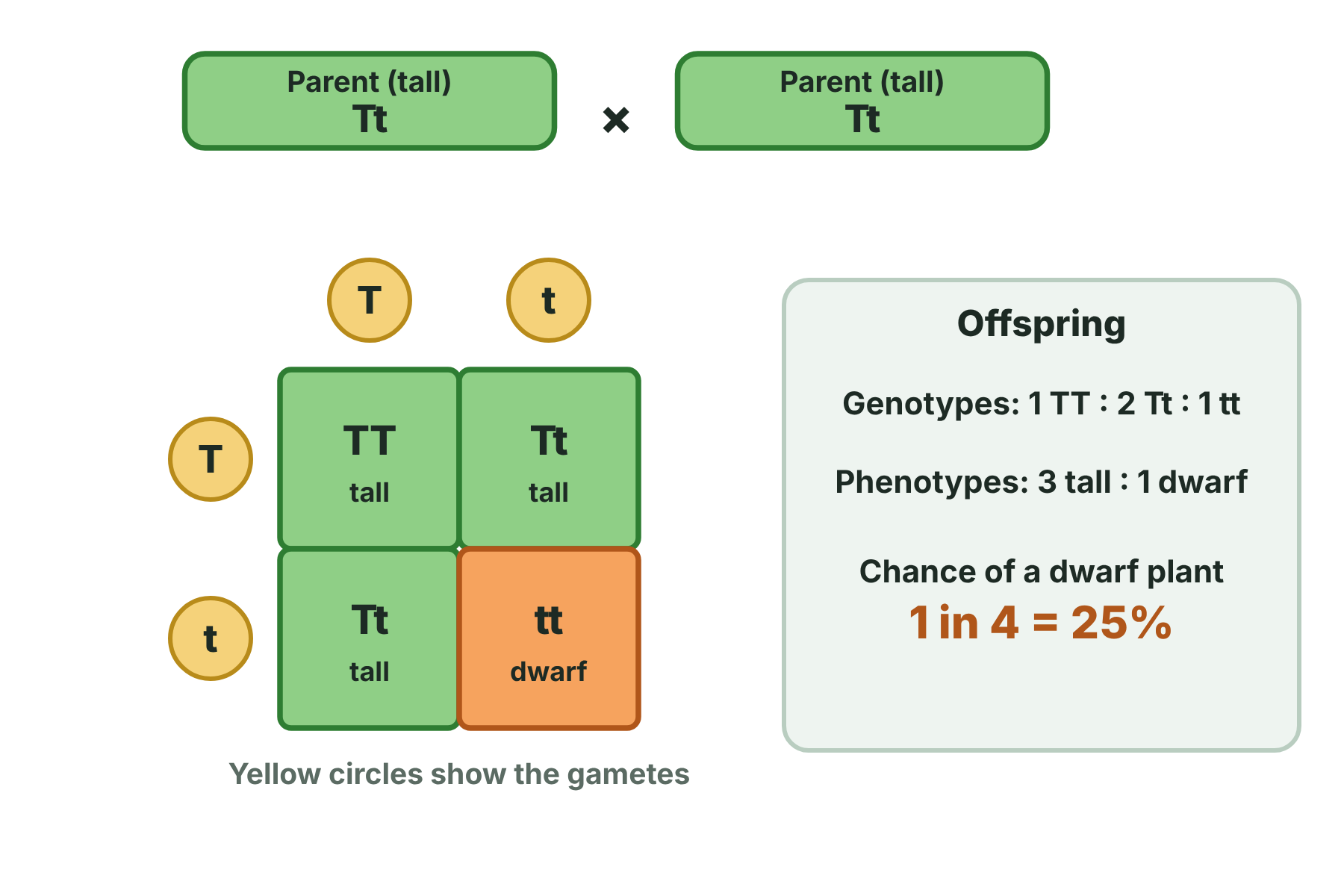
Other crosses to know
- Homozygous cross, TT x tt Gametes are all T from one parent and all t from the other; All offspring are Tt; All offspring are tall
- Test cross, Tt x tt Gametes are T and t from one parent, and all t from the other; Half the offspring are Tt, half are tt; Half are tall and half are dwarf
Drawing a genetic cross
- Define the alleles State the letters used, for example T for tall.
- Write the parents' genotypes For example Tt and Tt.
- Write the gametes Put each gamete in a circle. A Tt parent gives T and t.
- Draw the Punnett square Put one parent's gametes along the top and the other's down the side.
Family Pedigrees
A family tree can show how a characteristic or disorder is passed down.
- Pedigree A family tree that shows how a characteristic is inherited through the generations.
- Carrier A person with one copy of a recessive allele who does not have the disorder.
- Affected Showing the characteristic or the disorder.
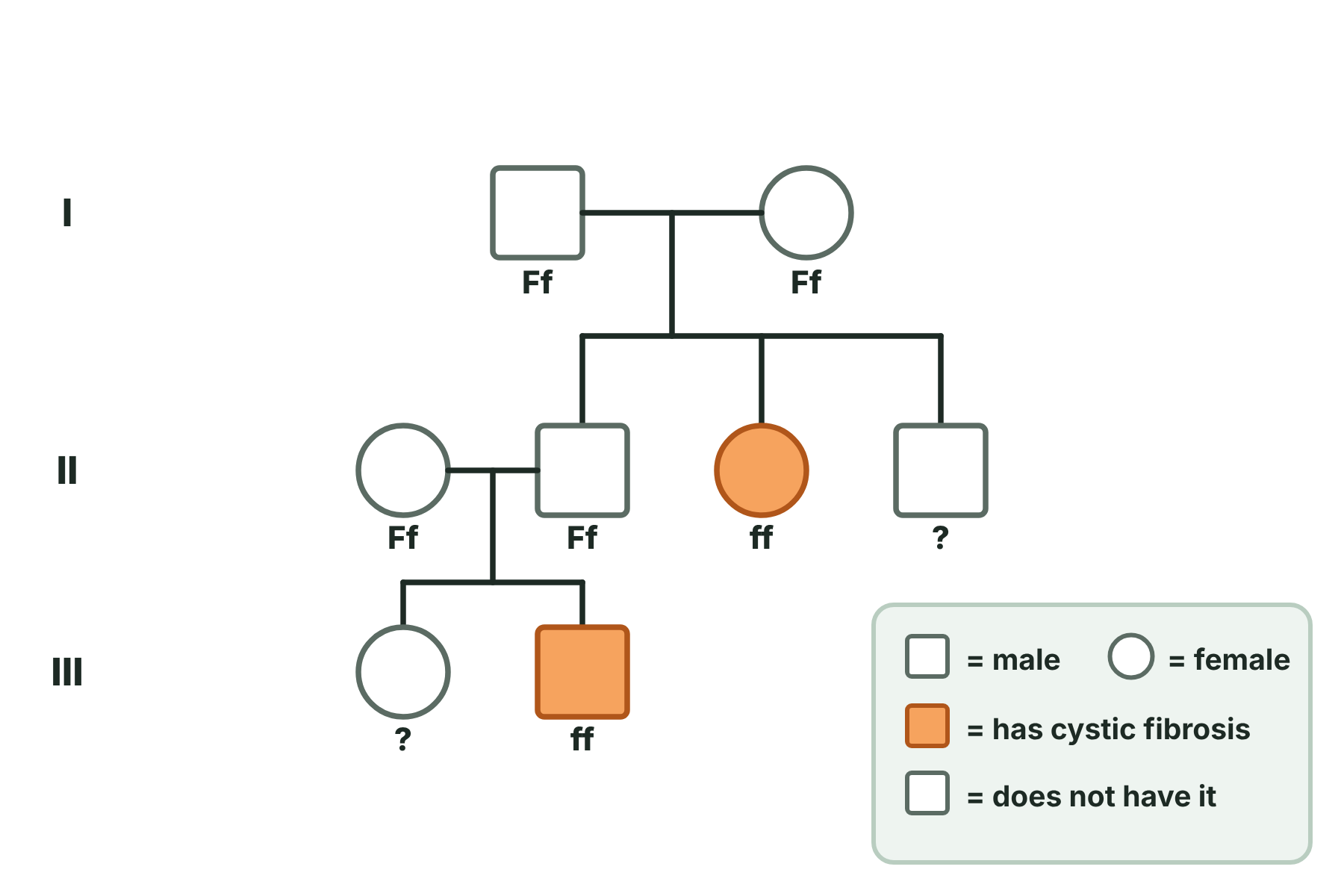
Recessive and dominant disorders
- Cystic fibrosis (recessive) Caused by a recessive allele; Affected people have two copies, ff; Unaffected parents can have an affected child
- Huntington's disease (dominant) Caused by a dominant allele; Affected people have at least one copy, Hh; Every affected person has an affected parent
Biology · Edexcel Paper 1
Inheritance continued
Inheriting Sex
Is a baby going to be a boy or a girl? This lesson explains how sex is determined at fertilisation by the sex chromosomes.
- Sex chromosomes The pair of chromosomes that decides the sex of a person: XX in females and XY in males.
- X chromosome The larger sex chromosome, found in both males and females.
- Y chromosome The smaller sex chromosome, found only in males, which carries a gene for male development.
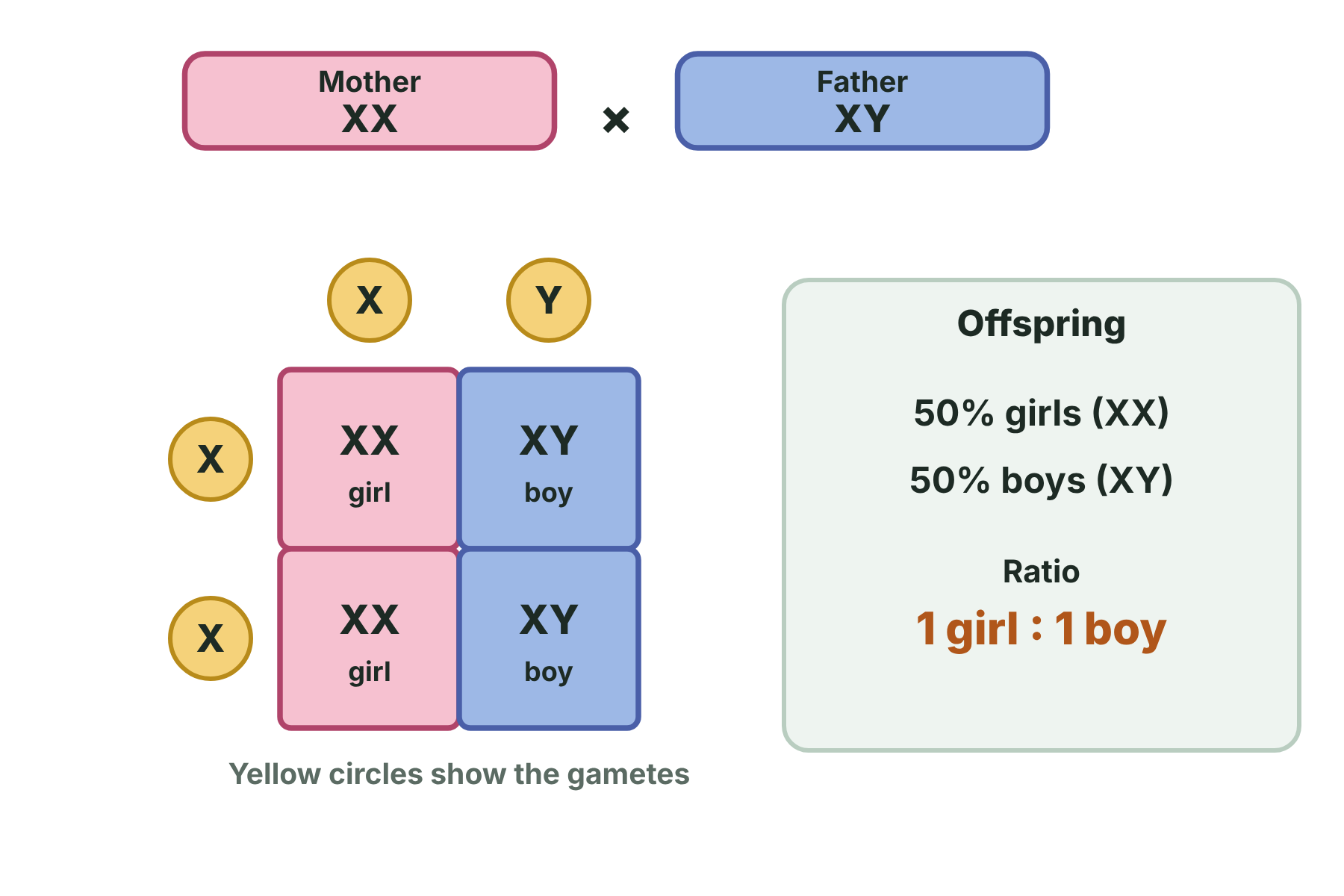
Female and male sex chromosomes
- Female (XX) Two X chromosomes; All eggs carry one X; Develop ovaries
- Male (XY) One X and one Y chromosome; Half of the sperm carry X and half carry Y; Develop testes, due to a gene on the Y chromosome
Working out the sex of a baby
- Parents' genotypes The mother is XX and the father is XY.
- Gametes Each egg carries X. A sperm carries either X or Y, with equal chance.
- Fertilisation An egg is fertilised by one sperm, at random.
- If the sperm carries X The zygote is XX, and the baby is a girl.
Mendel and the Discovery of Inheritance (Separate only)
Genetics began with a monk and some pea plants. This lesson is for separate Biology only: Combined Science students do not need it.
- Mendel The Austrian monk who discovered the basic rules of inheritance by breeding pea plants.
- Pure-breeding Always producing offspring with the same characteristic as the parents, because they are homozygous.
- Cross-pollination The transfer of pollen from one plant to the flower of another plant.
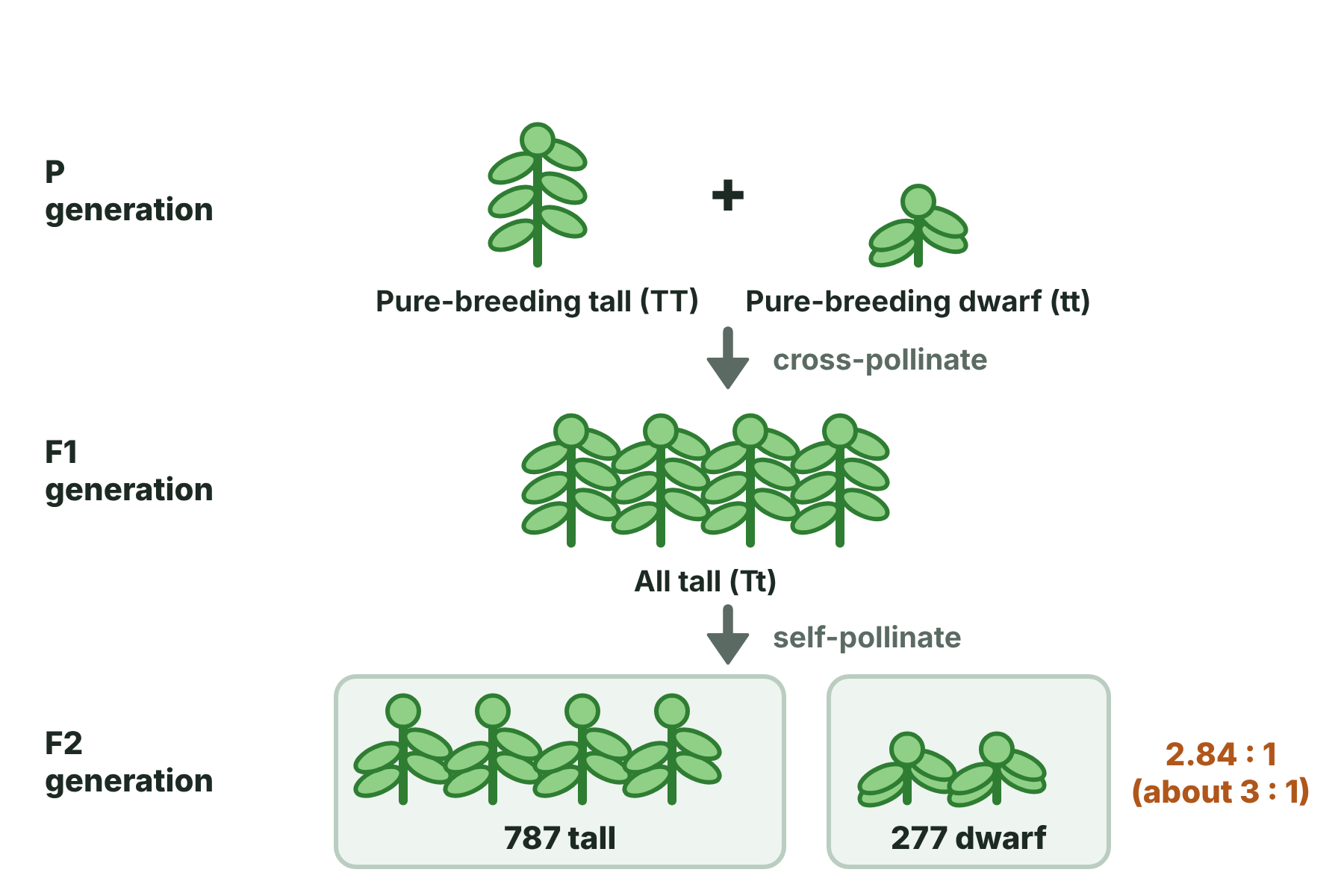
The tall and dwarf experiment
- P generation Pure-breeding tall plants were crossed with pure-breeding dwarf plants.
- F1 generation All the offspring were tall.
- Self-pollination The F1 plants were allowed to pollinate themselves.
- F2 generation Of 1064 plants, 787 were tall and 277 were dwarf, about 3 tall to 1 dwarf.
Codominance and ABO Blood Groups (Separate only)
Sometimes neither allele is dominant, and sometimes there are more than two alleles.
- Codominance When both alleles of a gene show their effect in a heterozygous person.
- Multiple alleles When a gene has more than two alleles in a population.
- Blood group The type of blood a person has, decided by antigens on the red blood cells.
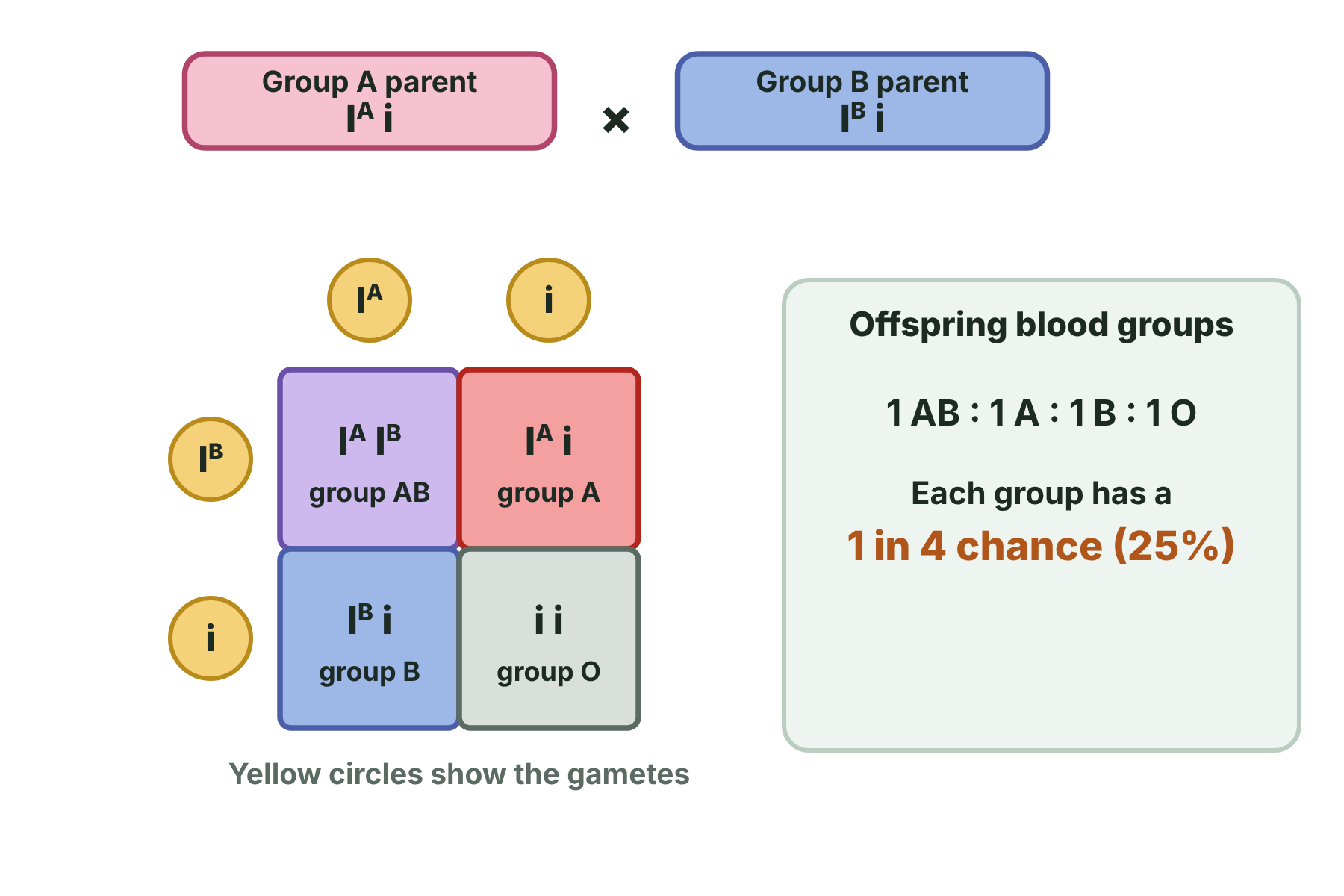
Dominance and codominance
- Complete dominance One allele hides the other in a heterozygous person; Example: Tt is tall; The heterozygous phenotype is like the homozygous dominant
- Codominance Both alleles show their effect in a heterozygous person; Example: I^A I^B has both antigens, so group AB; The heterozygous phenotype shows both
Sex-Linked Genetic Disorders (Higher tier) (Separate only)
Why are some disorders much more common in boys than girls? This lesson is for separate Biology only, and for the Higher tier only: Combined Science and Foundation students do not need it. It explains sex-linked inheritance.
- Sex-linked Describes a gene that is found on one of the sex chromosomes, usually the X.
- X-linked Describes a gene on the X chromosome.
- Haemophilia A sex-linked recessive disorder in which blood does not clot properly.
- Colour blindness A sex-linked recessive condition in which a person cannot tell some colours apart.
Autosomal and sex-linked recessive disorders
- Autosomal recessive, such as cystic fibrosis The gene is on one of the 22 pairs of chromosomes; Males and females are equally likely to be affected; Both parents are carriers or affected
- Sex-linked recessive, such as haemophilia The gene is on the X chromosome; Males are much more likely to be affected; A carrier mother can have an affected son