Biology · The Nervous System
Knowledge organiser
The whole chapter on three pages. Print it on A4 — they are already landscape — or cover a box and see how much of it you can say from memory.
Biology · Edexcel Paper 1
The Nervous System
Sensory Receptors and Neurones
Your body is always collecting information and acting on it.
- Stimulus A change in the environment that a receptor can detect.
- Receptor A cell that detects a stimulus and turns it into an electrical impulse.
- Neurone A nerve cell, specialised to carry electrical impulses around the body.
Sensory and motor neurones
- Sensory neurone Carries impulses from a receptor to the CNS; Cell body to one side of the long dendron and axon; Starts at a receptor in an organ such as the skin or eye
- Motor neurone Carries impulses from the CNS to an effector; Cell body at the start of the neurone, inside the CNS; Starts at a relay neurone in the spinal cord or brain
From stimulus to response
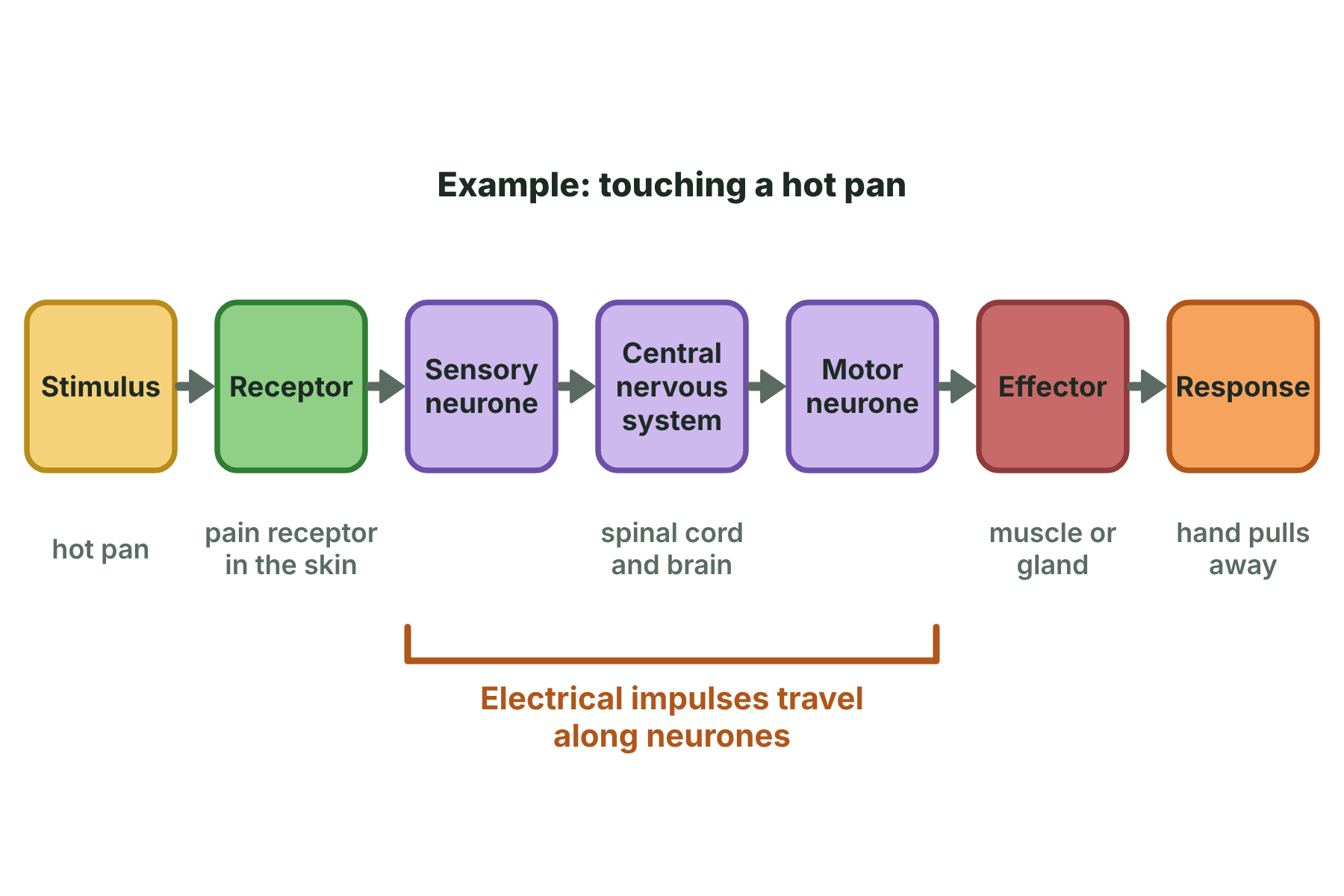
- Stimulus A change in the surroundings is detected.
- Receptor The sensory receptor converts the stimulus into an electrical impulse.
- Sensory neurone The impulse travels along a sensory neurone towards the central…
- Central nervous system The brain or spinal cord coordinates the response, using relay neurones.
Synapses and Neurotransmitters
Neurones do not touch each other. This lesson explains the tiny gap between them, called a synapse.
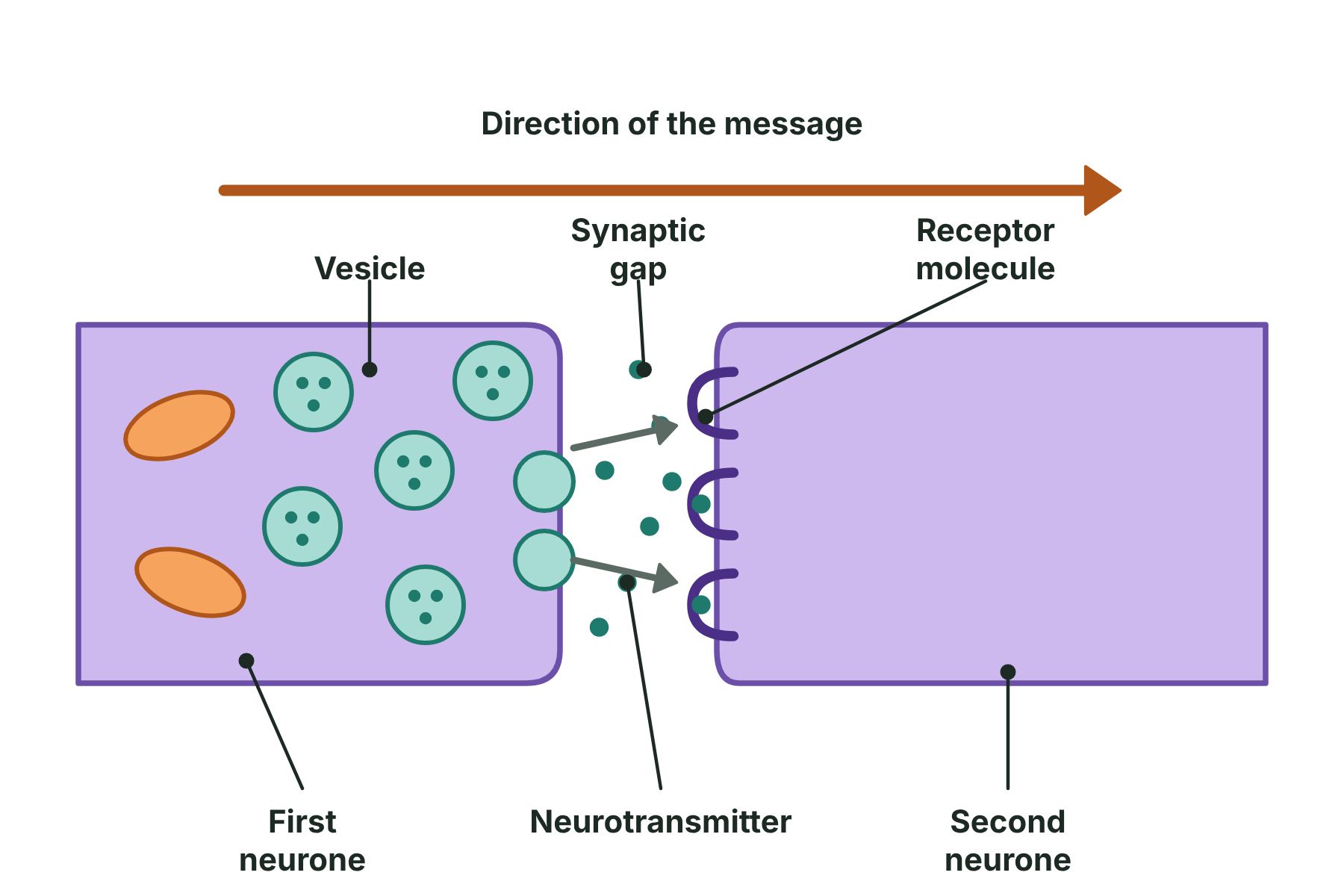
- Synapse The junction between two neurones, where a gap separates them.
- Synaptic gap The very narrow space between the end of one neurone and the start of the next.
- Neurotransmitter A chemical released by a neurone that diffuses across a synapse and triggers an impulse in the next neurone.
Two kinds of signal in the nervous system
- Inside a neurone An electrical impulse; Travels along the axon or dendron; Very fast, especially along a myelinated neurone
- At a synapse A chemical signal; Neurotransmitter diffuses across the synaptic gap; Slower, because diffusion takes time
How an impulse crosses a synapse
- Impulse arrives An electrical impulse reaches the end of the first neurone.
- Neurotransmitter released The impulse makes the neurone release a chemical called a…
- Diffusion The neurotransmitter molecules diffuse across the synaptic gap, which is very narrow.
- Binding The molecules bind to specific receptor molecules on the…
Biology · Edexcel Paper 1
The Nervous System continued
Reflex Arcs and Reaction Times
Some responses are too urgent to wait for you to think about them.
- Reflex action A fast, automatic response to a stimulus that does not involve conscious thought.
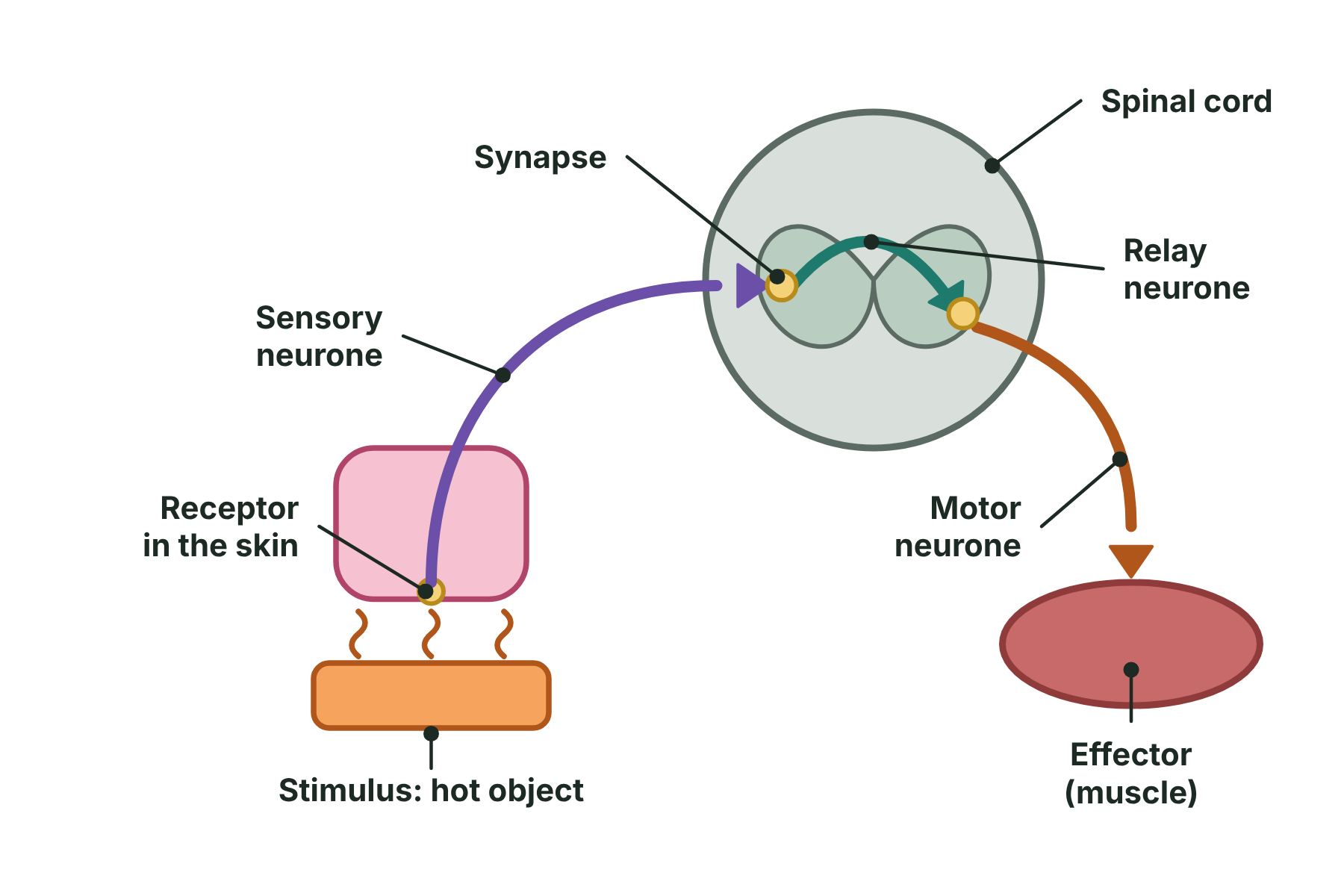
- Reflex arc The pathway taken by an impulse in a reflex action, from receptor to effector.
- Voluntary action An action that is controlled by conscious thought.
Reflex and voluntary actions
- Reflex action Automatic, no conscious thought; Very fast; Passes through the spinal cord or the unconscious brain
- Voluntary action Decided on by the person, using conscious thought; Slower; Involves the cerebral hemispheres of the brain
A reflex arc: touching a hot object
- Stimulus The heat of a hot pan acts on the skin of the hand.
- Receptor Temperature and pain receptors in the skin detect the stimulus…
- Sensory neurone The impulse travels along a sensory neurone to the spinal cord.
- Relay neurone In the spinal cord, a synapse passes the impulse to a relay neurone.
The Brain (Separate only)
The brain is the control centre of the body. This lesson is for separate Biology only: Combined Science students do not need it.
- Brain The organ in the skull that coordinates the body's responses, and is the centre of conscious thought.
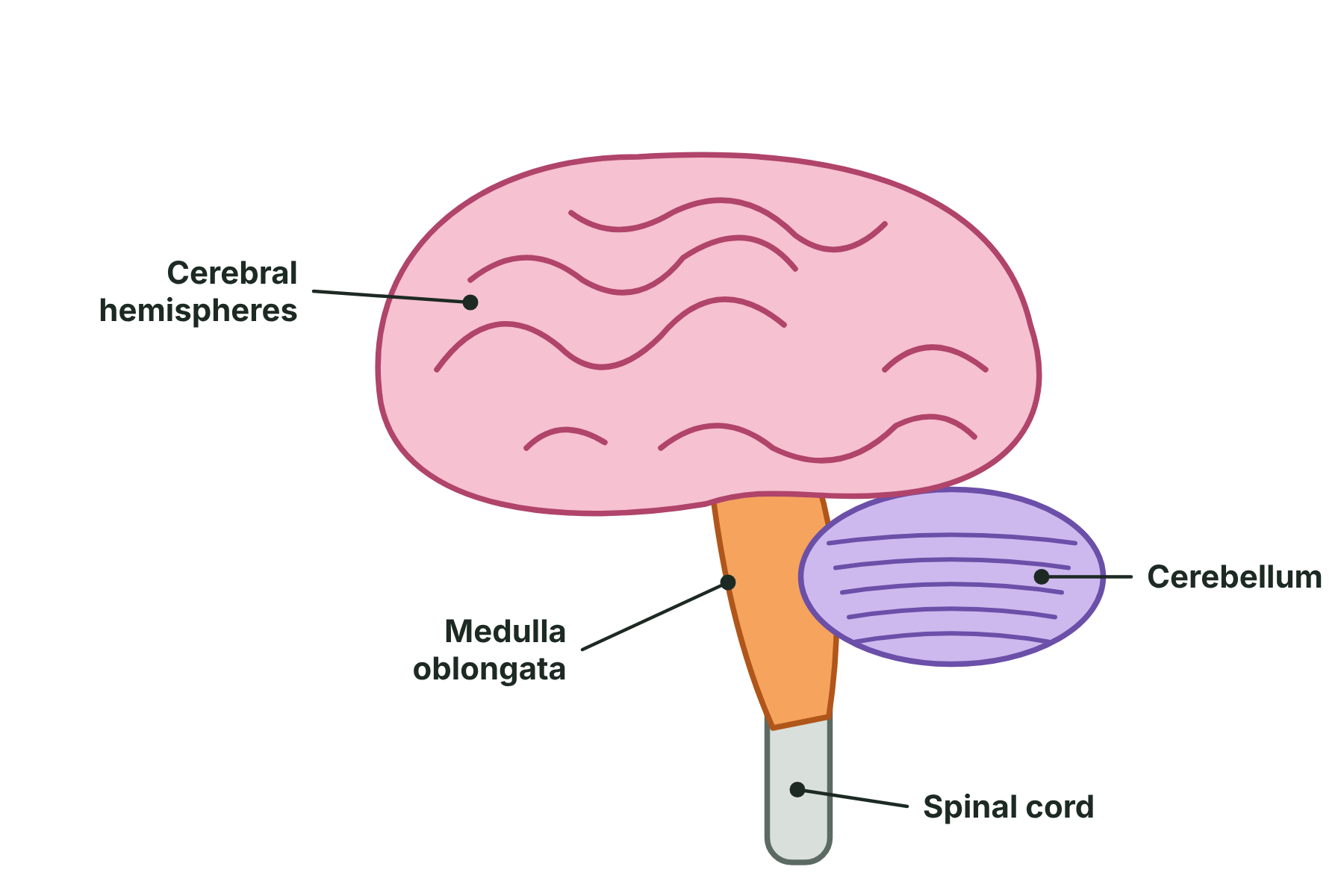
- Cerebral hemispheres The two large, folded halves of the brain, which control conscious thought, memory, language and voluntary movement.
- Cerebral cortex The thin, folded outer layer of the cerebral hemispheres.
Conscious and unconscious control
- Cerebral hemispheres Control actions that you choose to do; Used for thinking, memory, language and intelligence; Receive and interpret information from the senses
- Cerebellum and medulla oblongata Control actions that happen automatically; Cerebellum: balance and smooth movement; Medulla: heart rate and breathing rate
Catching a ball
- Eyes detect the ball Light receptors send impulses along the optic nerve to the…
- Hemispheres decide The cerebral hemispheres recognise the ball and decide to catch it.
- Impulses sent to the muscles A motor area sends impulses along motor neurones to the muscles…
- Cerebellum coordinates The cerebellum adjusts the movements and keeps the body balanced…
Biology · Edexcel Paper 1
The Nervous System continued
Scanning and Treating the Brain (Higher tier) (Separate only)
How do doctors see inside a living brain, and why is it so hard to repair?
- CT scan A scan that uses X-rays taken from many angles to make detailed images of the structure of the brain.
- PET scan A scan that uses a radioactive tracer to show which areas of the brain are active.
- Tracer A radioactive substance injected into the body so that its movement can be detected.
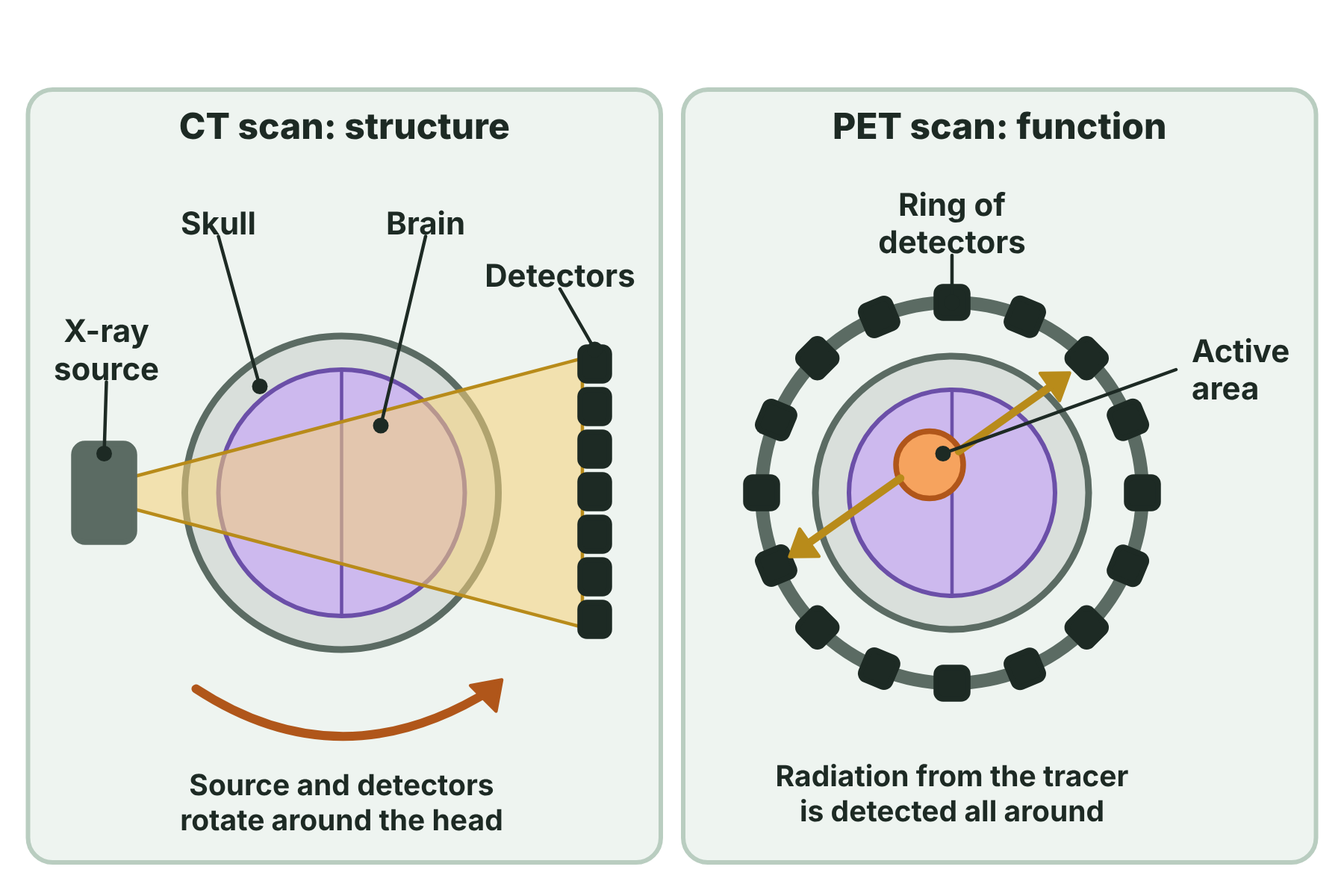
CT scans and PET scans
- CT scan Uses X-rays; Shows the structure of the brain; Finds tumours, bleeds and damaged areas
- PET scan Uses a radioactive tracer; Shows the function of the brain; Finds which areas are active, and how a disease changes the activity
The Eye (Separate only)
The eye is a sensory organ full of receptors. This lesson is for separate Biology only: Combined Science students do not need it.
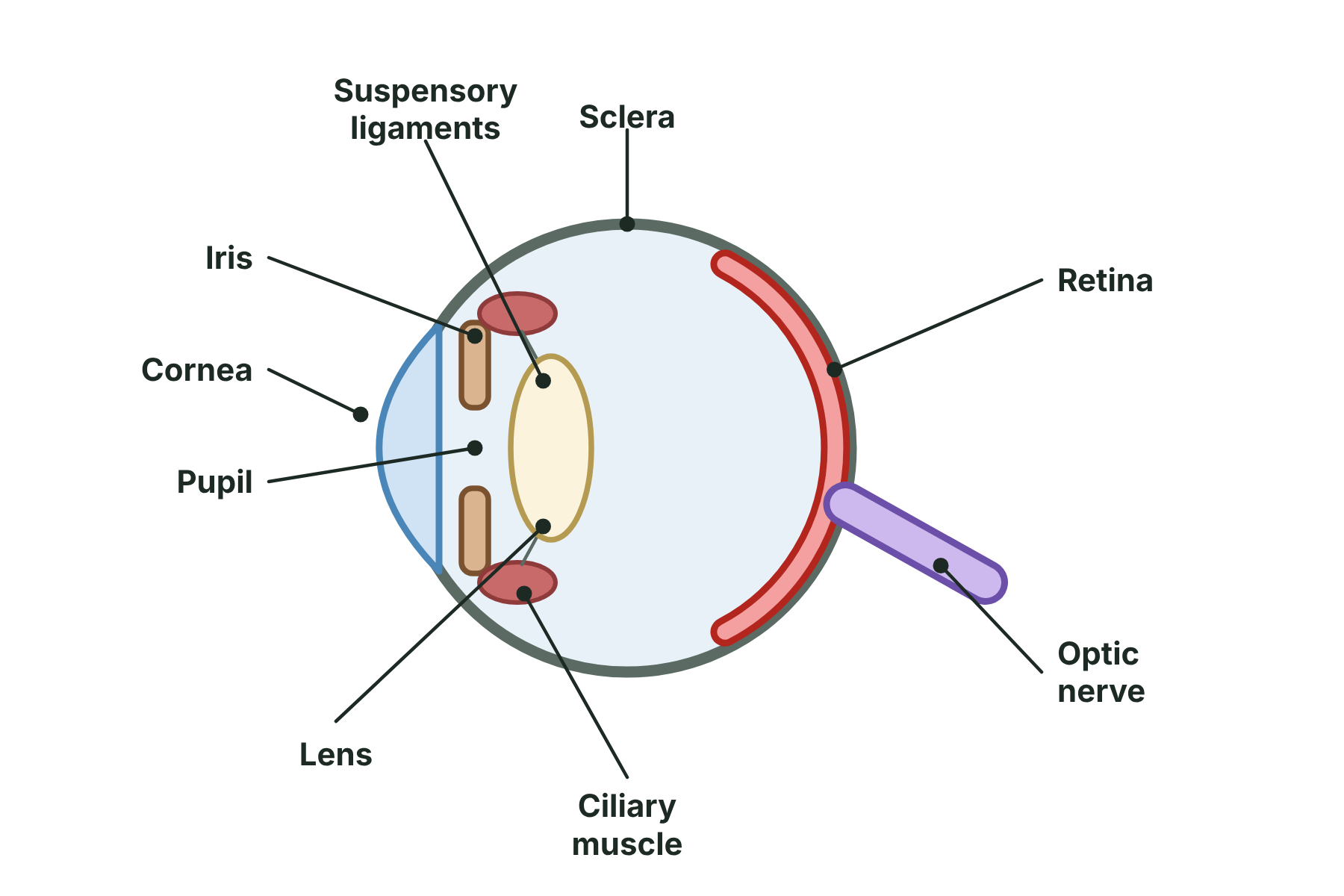
- Cornea The clear layer at the front of the eye that refracts the light entering it.
- Iris The ring of muscle that controls the size of the pupil.
- Pupil The hole in the middle of the iris through which light enters the eye.
Rods and cones
- Rod cells Work in dim light; Do not detect colour, so give a black and white image; Very many of them, mostly around the edge of the retina
- Cone cells Work in bright light; Detect colour, in three types: red, green and blue; Fewer of them, packed in the fovea at the centre
How we see an object
- Light enters Light from the object is refracted by the cornea as it enters the eye.
- Through the pupil The light passes through the pupil.
- Focused by the lens The lens refracts the light further.
- Detected by the retina The rod and cone cells detect the light and turn it into…
Eye Defects and Their Correction (Separate only)
Many people need glasses or an operation to see clearly. This lesson is for separate Biology only: Combined Science students do not need it.
- Short-sightedness A defect in which distant objects look blurred because light is focused in front of the retina.
- Long-sightedness A defect in which near objects look blurred because light would be focused behind the retina.
- Cataract A cloudy area in the lens of the eye that makes vision misty or blurred.
- Colour blindness A defect in which a person cannot tell certain colours apart because some cone cells are missing or faulty.
Short sight and long sight
- Short-sighted Near objects are clear, distant ones are blurred; Focus is in front of the retina; Eyeball too long, or lens too strong
- Long-sighted Distant objects are clear, near ones are blurred; Focus is behind the retina; Eyeball too short, or lens too weak