Biology · Exchange Surfaces and Gas Exchange
Knowledge organiser
The whole chapter on one page. Print it on A4 — it is already landscape — or cover a box and see how much of it you can say from memory.
Biology · Edexcel Paper 2
Exchange Surfaces and Gas Exchange
Why Organisms Need Exchange Surfaces and Transport Systems
As an organism gets bigger its surface area to volume ratio falls.
- Exchange surface A specialised surface, such as the alveoli, the gills or the villi, where substances pass into and out of an organism.
- Transport system The organs that carry substances around a large organism, such as the heart, blood vessels and blood in an animal.
- Surface area The total area of the outside of an object, across which substances can enter or leave.
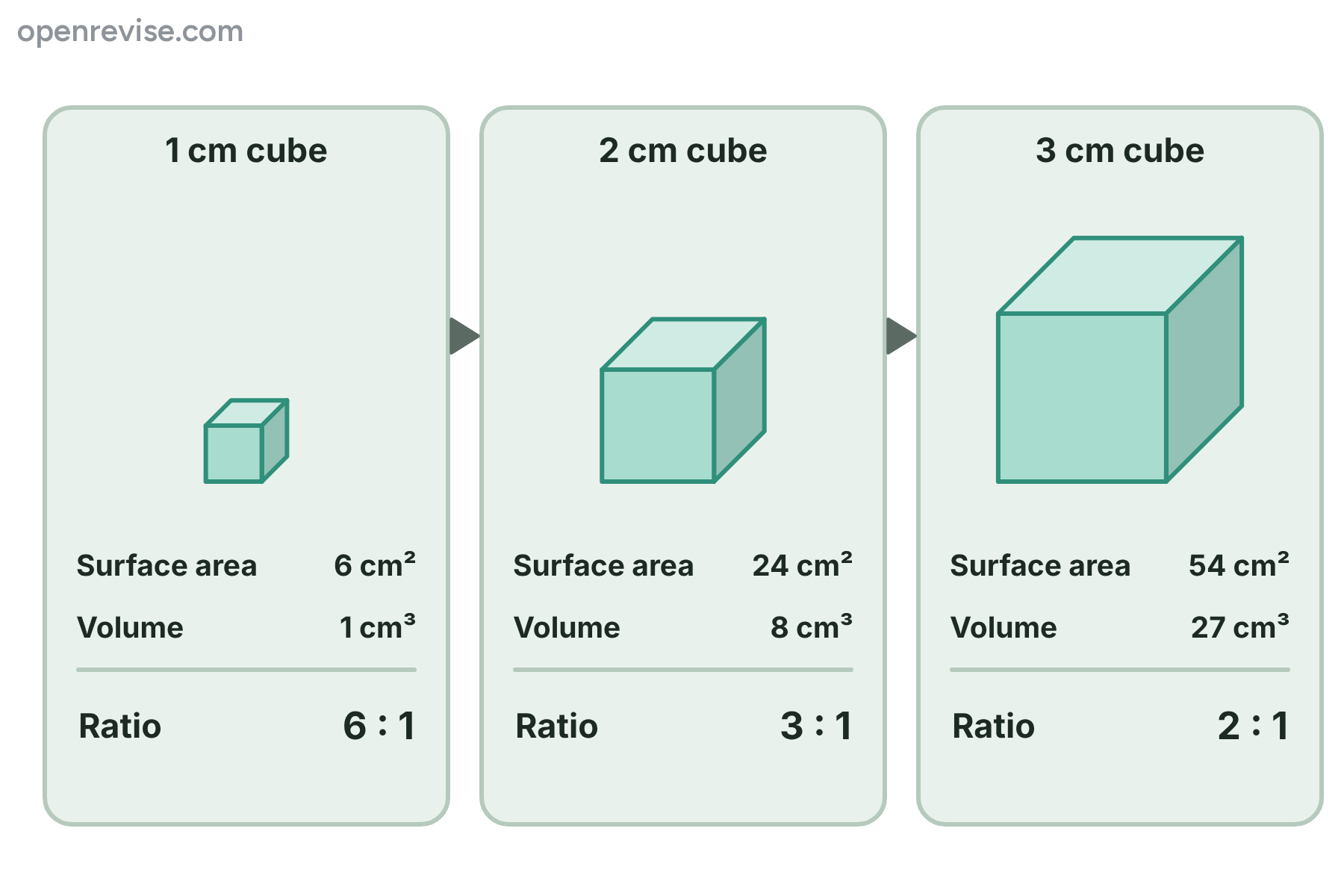
Single-celled and multicellular organisms
- Single-celled organism Large surface area to volume ratio; Every part of the cell is close to the outside; No exchange organs or transport system needed
- Large multicellular organism Small surface area to volume ratio; Most cells are deep inside, far from the outside; Diffusion through the skin alone would be far too slow
From the air to a cell deep inside the body
- Exchange at the surface Oxygen diffuses from the air across the exchange surface.
- Transport The heart pumps the blood round the body.
- Exchange at the cell Oxygen diffuses from the blood into the cells.
- Transport of the waste The blood carries carbon dioxide to the lungs and urea to the kidneys.
Alveoli and Gas Exchange
The alveoli are adapted for gas exchange because they have a large surface area, thin walls, a rich blood supply and ventilation.
- Alveolus One of millions of tiny air sacs at the ends of the bronchioles, where oxygen and carbon dioxide are exchanged (plural alveoli).
- Trachea The windpipe, a tube held open by rings of cartilage that carries air to the bronchi.
- Bronchus One of the two tubes that branch from the trachea, one into each lung (plural bronchi).
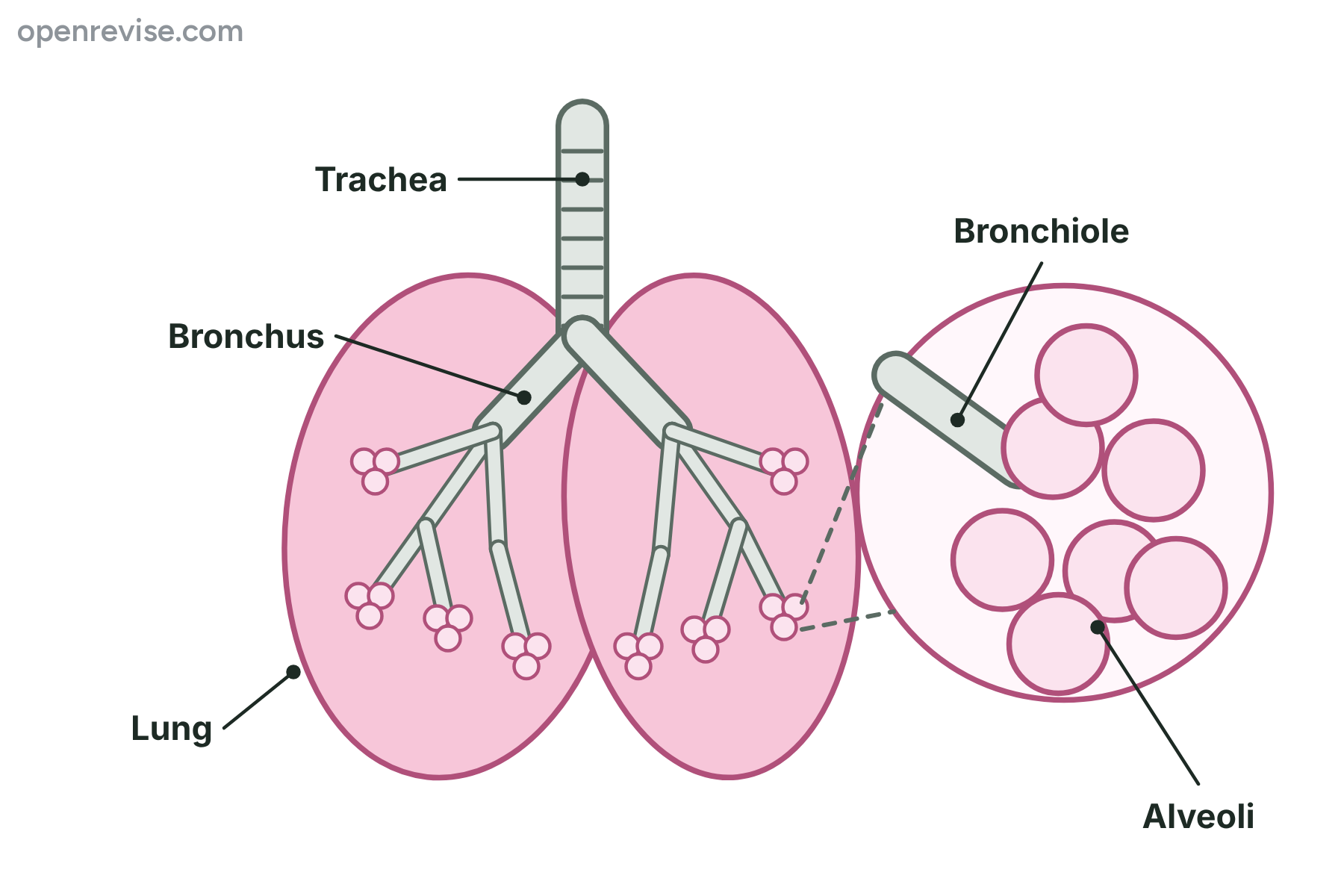
Inhaled air and exhaled air
- Inhaled air About 21 percent oxygen; About 0.04 percent carbon dioxide; Fresh air that has just entered the airways
- Exhaled air About 16 percent oxygen; About 4 percent carbon dioxide; Some oxygen has diffused into the blood
The journey of an oxygen molecule
- Breathed in The oxygen enters through the nose or mouth and passes down the trachea.
- Down the airways It passes through a bronchus and then a bronchiole into an alveolus.
- Across the walls It dissolves in the moist lining and diffuses across the wall of…
- Into the blood It diffuses into a red blood cell and combines with haemoglobin.
Factors Affecting the Rate of Diffusion and Fick's Law (Separate only)
\text{rate of diffusion} \propto \dfrac{\text{surface area} × \text{concentration difference}}{\text{thickness of membrane}}
- Rate of diffusion How quickly particles move from a region of higher concentration to a region of lower concentration.
- Fick's law The rate of diffusion is proportional to the surface area multiplied by the concentration difference, divided by the…
- Concentration difference The difference in concentration between the two sides of a membrane. It makes the concentration gradient.
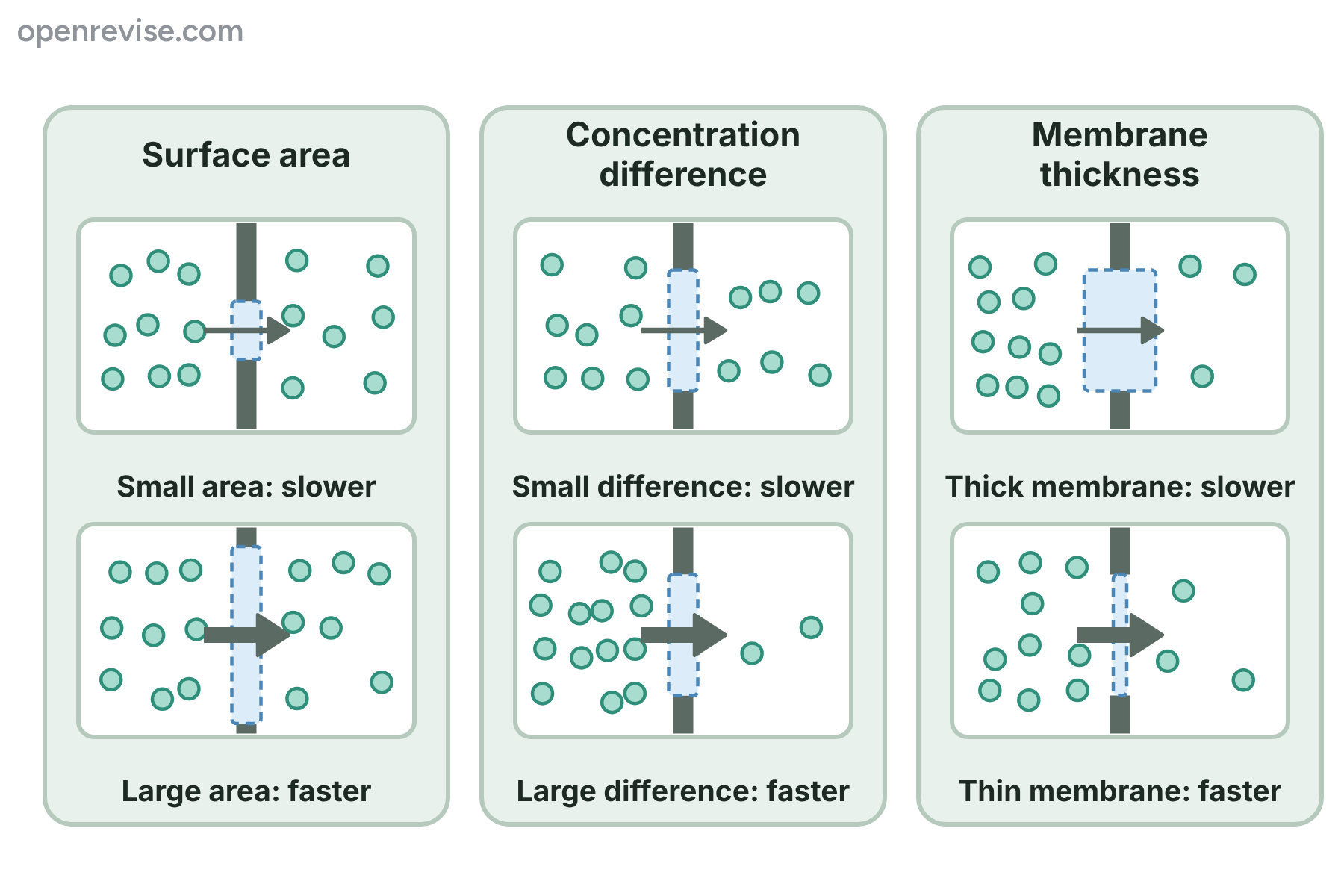
Faster or slower diffusion
- Makes diffusion faster A larger surface area; A bigger concentration difference; A thinner membrane, so a shorter diffusion distance
- Makes diffusion slower A smaller surface area; A smaller concentration difference; A thicker membrane, so a longer diffusion distance