Biology · Photosynthesis
Investigating Light Intensity and Photosynthesis
This is the core practical on photosynthesis. This lesson describes how to use pondweed to investigate the effect of light intensity on the rate of photosynthesis, how to control the variables and how to process the results, including the inverse square law for Higher tier.
Learning Objectives
- 1Describe how to investigate the effect of light intensity on the rate of photosynthesis using pondweed.
- 2Identify the independent, dependent and control variables.
- 3Calculate rates and means and interpret a graph of the results.
- 4(Higher tier) Use the inverse square law to relate light intensity to distance.
Retrieval practice
-
1
Which gas does a plant release in photosynthesis?
Show answerHide answer
Oxygen.
-
2
What is a limiting factor?
Show answerHide answer
A factor in short supply that sets the rate of a reaction.
-
3
What is an independent variable?
Show answerHide answer
The variable you change in an investigation.
-
4
What is a control variable?
Show answerHide answer
A variable that is kept the same so the test is fair.
Counting the bubbles
When pondweed photosynthesises under water, it releases oxygen as small bubbles that rise from the cut end of the stem. The faster the pondweed photosynthesises, the faster the bubbles appear. If you change the light intensity and count the bubbles, or measure the volume of gas, you can see how light intensity affects the rate. The usual way to change the light intensity is to move a lamp nearer to, or further from, the pondweed.
The apparatus
The pondweed must be in water that contains plenty of carbon dioxide, so that this is not the limiting factor.
-
Pondweed
A piece of Elodea or Cabomba, with its stem cut at an angle under water, held upside down in a beaker of water.
-
Sodium hydrogencarbonate
A small amount in the water gives a constant supply of carbon dioxide.
-
A lamp
The source of light, placed at different distances measured with a ruler.
-
A heat shield or water bath
A second beaker or a tank of water between the lamp and the pondweed stops the temperature changing.
-
A way to measure the gas
Count the bubbles from the cut stem, or collect the oxygen in a small measuring tube or gas syringe.
Pondweed apparatus
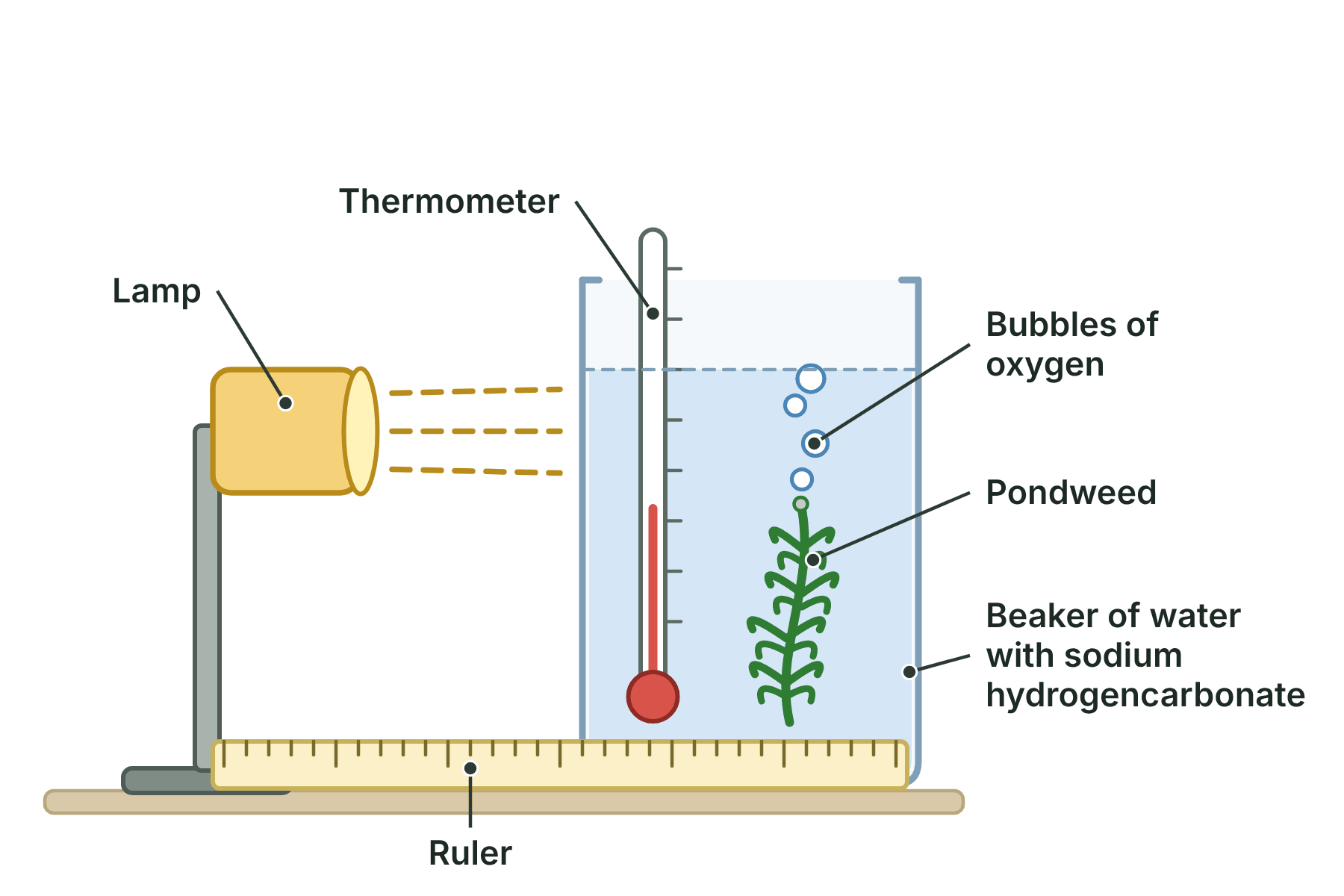
The number of bubbles in a set time shows the rate of photosynthesis.
Carrying out the investigation
Follow the same method each time you change the distance.
-
1
Set up
Place the pondweed in the beaker, add sodium hydrogencarbonate and set the lamp 10 cm from the beaker.
-
2
Wait
Leave the pondweed for a few minutes to adjust to the light.
-
3
Count
Count the number of bubbles released in one minute, or measure the volume of gas collected.
-
4
Repeat
Take three readings and calculate the mean.
-
5
Change the distance
Move the lamp further away, for example to 20, 30, 40 and 50 cm, and repeat each time.
-
6
Record
Write the distance and the mean number of bubbles per minute in a table.
The variables
A fair test changes only one variable at a time.
-
Independent variable
The distance of the lamp from the pondweed, which changes the light intensity.
-
Dependent variable
The number of bubbles produced per minute, or the volume of oxygen collected, which is a measure of the rate of photosynthesis.
-
Control variables
The same pondweed, the same temperature, the same carbon dioxide concentration, the same time and the same size of the beaker.
-
Limitations
Bubbles can differ in size, so counting them is a rough measure, and a gas syringe gives more accurate results.
Rate against distance
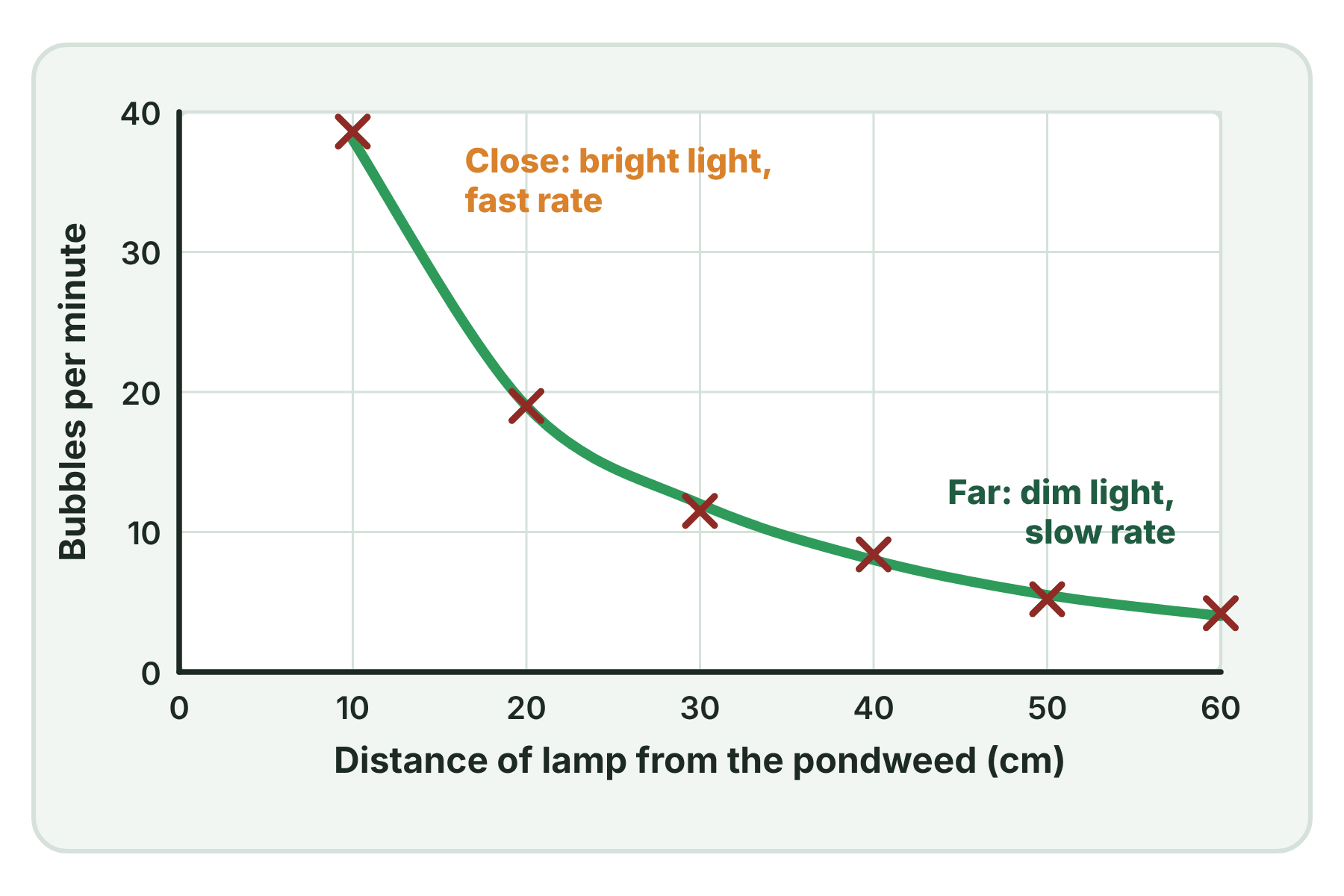
The further the lamp, the lower the light intensity and the slower the rate.
Calculating the mean rate
At 20 cm from the lamp, a student counts 18, 21 and 18 bubbles in one minute. Calculate the mean number of bubbles per minute.
Show the solutionHide the solution
- 1 Add the readings \(18 + 21 + 18 = 57\)
- 2 Divide by the number of readings \(57 \div 3\)
- 3 Give the answer with its unit \(= 19\) bubbles per minute
AnswerThe mean is 19 bubbles per minute.
The inverse square law (Higher tier)
Light intensity is not in direct proportion to distance. It falls much faster than that.
-
Inverse proportion
Light intensity is inversely proportional to the square of the distance from the lamp.
-
The relationship
\(\text{light intensity} \propto \dfrac{1}{d^{2}}\), where d is the distance from the lamp.
-
Doubling the distance
If the distance doubles, the light intensity falls to one quarter, because \(\dfrac{1}{2^{2}} = \dfrac{1}{4}\).
-
Using it
Plotting the rate against \(\dfrac{1}{d^{2}}\) should give a straight line while light is the limiting factor.
Using the inverse square law
A lamp is moved from 10 cm to 30 cm from a plant. By what factor does the light intensity change?
Show the solutionHide the solution
- 1 Find the factor for the distance The distance has been multiplied by \(30 \div 10 = 3\).
- 2 Square it \(3^{2} = 9\)
- 3 Invert it The intensity falls by a factor of 9, to \(\dfrac{1}{9}\) of its original value.
AnswerThe light intensity falls to one ninth.
Case study
Why bubbles are not perfect
Counting bubbles is quick and cheap, but it has problems. The bubbles are not all the same size, so a count of 30 small bubbles could be less oxygen than a count of 20 larger ones. Some of the oxygen dissolves in the water. Collecting the gas in a tube and measuring its volume gives a better result. Scientists also repeat the experiment many times and calculate a mean, to reduce the effect of any odd reading.
The key idea
The bubbles of oxygen released by pondweed show the rate of photosynthesis, and the lamp's distance changes the light intensity.
Light intensity practical
Light intensity practical
-
Apparatus
- pondweed
- beaker
- lamp
- ruler
- sodium hydrogencarbonate
-
Variables
- independent: distance
- dependent: bubbles per minute
-
Fair test
- same temperature
- carbon dioxide and pondweed
-
Results
- mean
- graph
- rate falls with distance
-
Higher
- inverse square law
Summary and exam focus
- Pondweed releases bubbles of oxygen when it photosynthesises.
- The distance of the lamp is the independent variable and the rate of bubbles is the dependent variable.
- Temperature and carbon dioxide are controlled with a heat shield and sodium hydrogencarbonate.
- Repeat readings and calculate a mean to improve reliability.
- Higher tier: light intensity is proportional to 1 divided by the distance squared.
Exam focus
Describe how you would investigate the effect of light intensity on the rate of photosynthesis in pondweed. (6 marks) (6 marks)
Give the apparatus, the independent variable (distance of the lamp), the dependent variable (bubbles or volume of gas per minute) and at least two control variables, then say how to make the results reliable: repeat and calculate a mean.
Key terms
The words this lesson expects you to use. Each one is linked from the first place it appears above.
- Pondweed
- A water plant, such as Elodea or Cabomba, used in photosynthesis experiments.
- Independent variable
- The variable that the investigator changes.
- Dependent variable
- The variable that is measured.
- Control variable
- A variable that is kept the same so the test is fair.
- Sodium hydrogencarbonate
- A chemical added to water to provide carbon dioxide.
- Reliable
- Giving similar results each time the investigation is repeated.
- Inverse square law
- The rule that light intensity falls in proportion to 1 divided by the square of the distance.
- Mean
- An average, found by adding the values and dividing by how many there are.
You've finished the notes
Check your understanding
Test yourself while it is fresh. Start with the flashcards, then try the exam questions.
Something here looks wrong?
Tell us what and we will go and look. It goes to whoever writes these pages, nobody else, and we do not ask who you are — so there is nothing to sign and nothing comes back to you.