Biology · Photosynthesis
The Photosynthetic Reaction
Photosynthesis is the reaction that feeds almost every food chain on Earth. This lesson covers why photosynthetic organisms are the main producers of food and biomass, the equation for photosynthesis, and why it is an endothermic reaction.
Learning Objectives
- 1Describe photosynthetic organisms as the main producers of food, and therefore biomass.
- 2State the word equation and the symbol equation for photosynthesis.
- 3Describe photosynthesis as an endothermic reaction in which energy is transferred from the environment to the chloroplasts by light.
- 4Describe where photosynthesis takes place and what the reactants and products are.
Retrieval practice
-
1
What is the green pigment in chloroplasts?
Show answerHide answer
-
2
Where is most photosynthesis carried out in a leaf?
Show answerHide answer
In the palisade mesophyll.
-
3
What carries water up a plant?
Show answerHide answer
The xylem.
-
4
What are stomata for?
Show answerHide answer
They let gases in and out of the leaf.
How plants feed
Plants, algae and some bacteria make their own food by photosynthesis. They take in simple substances from their surroundings and use light energy to turn them into glucose, a sugar. Because they make food for themselves, they are called producers. They also provide the food, and the oxygen, that nearly all other living things depend on.
Producers and biomass
Almost all life on Earth depends on organisms that photosynthesise.
-
Photosynthetic organisms
Plants and algae trap light energy and use it to make glucose from carbon dioxide and water.
-
Producers
Because they make their own food, they are the producers at the start of nearly every food chain.
-
Biomass
The glucose is used to make carbohydrates, proteins and lipids, which become the producer's biomass, the mass of living material. When an animal eats a producer, some of that biomass becomes the animal's biomass.
-
Oxygen
Photosynthesis also releases the oxygen that most living things use for aerobic respiration.
The equation for photosynthesis
Photosynthesis is a chemical reaction in which the reactants are carbon dioxide and water, and the products are glucose and oxygen.
-
Word equation
carbon dioxide + water, in the presence of light, makes glucose + oxygen.
-
Symbol equation
\(6CO_2 + 6H_2O \rightarrow C_6H_{12}O_6 + 6O_2\) with light energy absorbed by chlorophyll.
-
What you need to know
You must recognise the symbols CO₂, H₂O, O₂ and C₆H₁₂O₆.
-
Where the raw materials come from
Carbon dioxide diffuses in from the air through the stomata. Water is taken up by the roots and carried to the leaf by the xylem.
Photosynthesis in a leaf
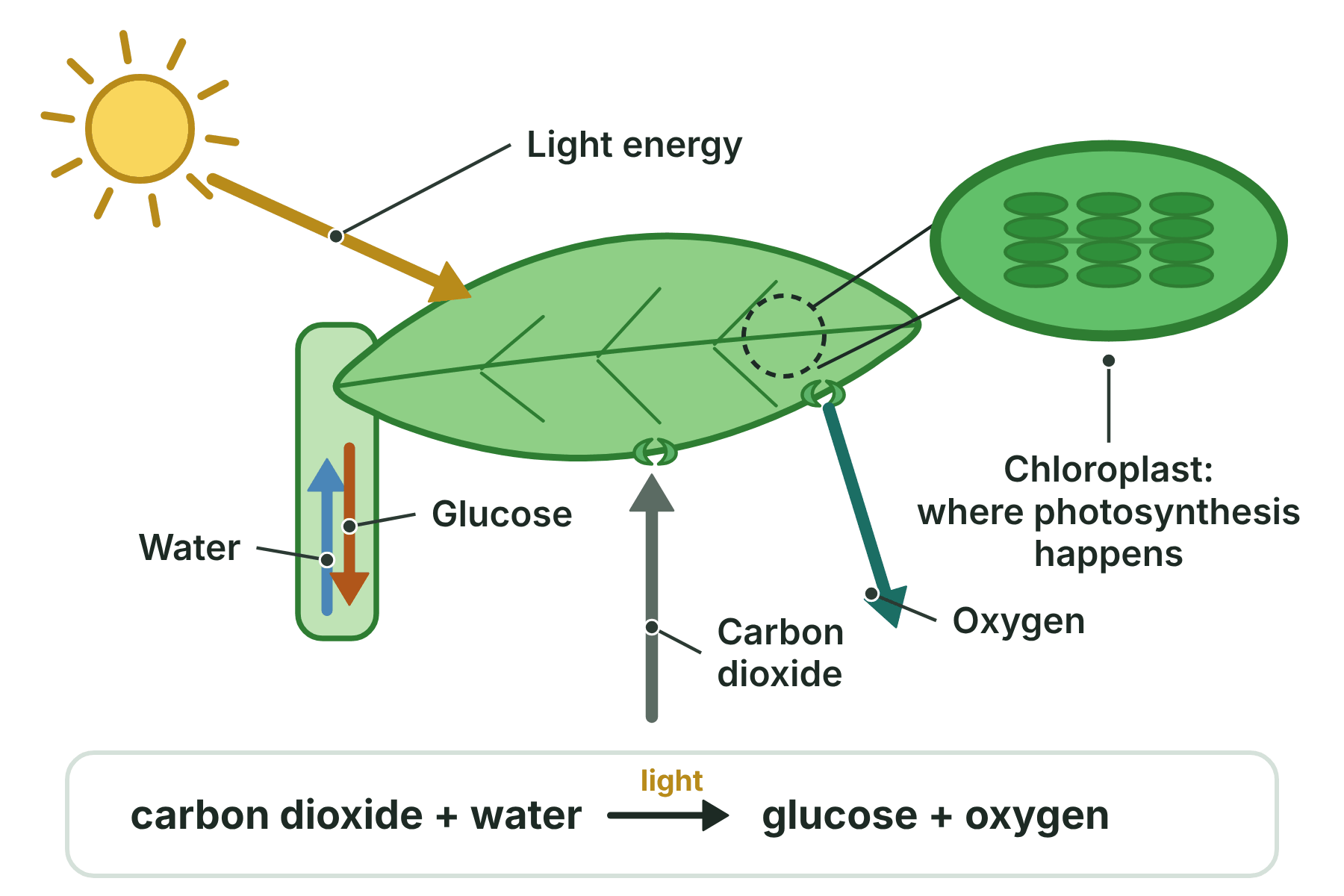
Light energy is used to make glucose and oxygen from carbon dioxide and water.
An endothermic reaction
Energy is stored in the glucose that photosynthesis makes.
-
Endothermic
An endothermic reaction takes in energy from the surroundings. Photosynthesis is endothermic.
-
Light is the source
The energy is transferred from the environment to the chloroplasts by light.
-
Chlorophyll
The green pigment chlorophyll in the chloroplasts absorbs the light energy.
-
Stored in glucose
The energy is stored in the chemical bonds of the glucose, and released later when it is used in respiration or eaten by animals.
Testing a leaf for starch
Glucose made in photosynthesis is turned into starch, so a leaf that has been photosynthesising contains starch. This test shows whether it has.
-
1
Kill the leaf
Dip it in boiling water for about a minute. This stops chemical reactions and softens the leaf.
-
2
Remove the chlorophyll
Heat the leaf in hot ethanol in a water bath, away from flames. This turns the leaf white.
-
3
Soften the leaf
Rinse it in warm water to make it soft again.
-
4
Add iodine
Spread the leaf on a tile and add iodine solution. Starch turns the iodine blue-black.
Reactants and products compared
What goes in (reactants)
- Carbon dioxide, from the air through the stomata
- Water, from the soil through the roots and xylem
- Light energy, absorbed by chlorophyll
What comes out (products)
- Glucose, which is used or stored
- Oxygen, which leaves through the stomata
- Energy stored in the glucose
Case study
The oxygen in the air
The air today is about one fifth oxygen. It was not always so. Billions of years ago there was almost no free oxygen. The oxygen built up over millions of years, as algae and then plants photosynthesised and released it. Most of the oxygen that you breathe was made by photosynthesis, and the same process feeds almost every food chain on Earth.
The big idea
Photosynthesis takes in carbon dioxide and water, and uses light energy to make glucose and oxygen.
Photosynthesis
Photosynthesis
-
Equation
- carbon dioxide + water
- in light
- makes glucose + oxygen
-
Energy
- endothermic
- light energy absorbed by chlorophyll
-
Where
- chloroplasts
- mainly in palisade cells
-
Raw materials
- carbon dioxide through stomata
- water through roots and xylem
-
Test
- starch turns iodine blue-black
Summary and exam focus
- Photosynthesis makes glucose and oxygen from carbon dioxide and water.
- The symbol equation is 6CO₂ + 6H₂O makes C₆H₁₂O₆ + 6O₂.
- It is endothermic: energy is transferred from the environment to the chloroplasts by light.
- It takes place in the chloroplasts, which contain chlorophyll.
Exam focus
Write the word equation for photosynthesis and explain why it is an endothermic reaction. (3 marks) (3 marks)
The word equation is carbon dioxide + water, in light, makes glucose + oxygen. Then explain endothermic: energy is transferred from the surroundings to the chloroplasts by light.
Key terms
The words this lesson expects you to use. Each one is linked from the first place it appears above.
- Biomass
- The mass of living material in an organism or a food chain.
- Photosynthesis
- The reaction in which plants use light energy to make glucose and oxygen from carbon dioxide and water.
- Producer
- An organism that makes its own food, such as a plant.
- Chlorophyll
- The green pigment in chloroplasts that absorbs light for photosynthesis.
- Chloroplast
- The part of a plant cell where photosynthesis happens.
- Endothermic reaction
- A reaction that takes in energy from its surroundings.
- Reactant
- A substance that is used up in a chemical reaction.
- Product
- A substance made in a chemical reaction.
- Glucose
- A sugar made in photosynthesis, which is a source of energy.
You've finished the notes
Check your understanding
Test yourself while it is fresh. Start with the flashcards, then try the exam questions.
Something here looks wrong?
Tell us what and we will go and look. It goes to whoever writes these pages, nobody else, and we do not ask who you are — so there is nothing to sign and nothing comes back to you.