Biology · Plant Structures and Transport
Knowledge organiser
The whole chapter on two pages. Print it on A4 — they are already landscape — or cover a box and see how much of it you can say from memory.
Biology · Edexcel Paper 2
Plant Structures and Transport
Transpiration and the Xylem
Transpiration is the loss of water vapour from the leaves, which pulls water up the xylem from the roots.
- Root hair cell A cell on the surface of a root with a long thin extension that takes up water and mineral ions.
- Xylem Tissue made of dead hollow cells strengthened with lignin that carries water and mineral ions from the roots to the leaves.
- Lignin A strong material that strengthens the walls of the xylem.
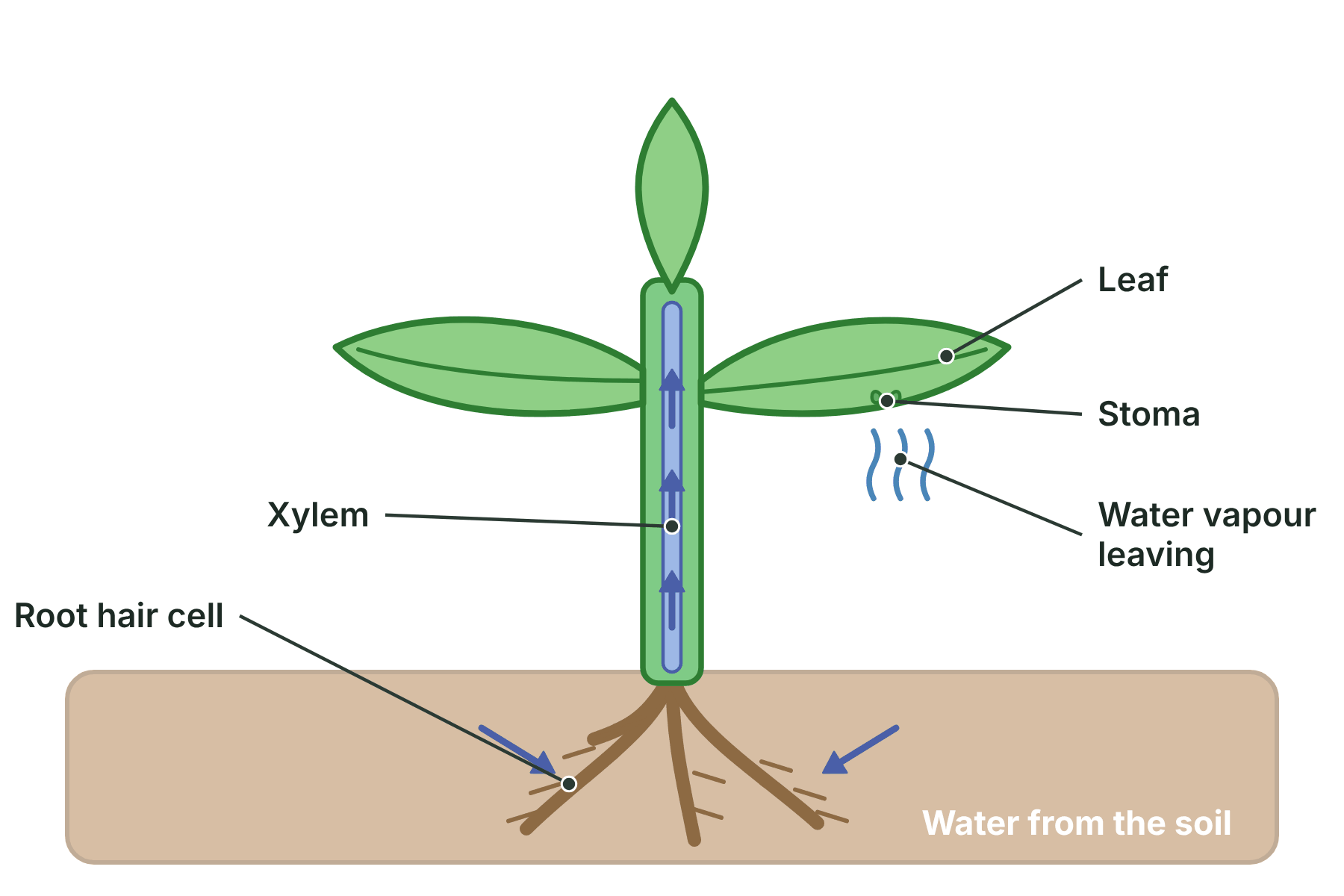
Factors that increase and decrease transpiration
- Faster transpiration A higher temperature; Lower humidity (drier air); More air movement (windy)
- Slower transpiration A lower temperature; Higher humidity (damp air); Still air
How transpiration works
- Evaporation Water evaporates from the surface of the cells inside the leaf…
- Diffusion The water vapour diffuses out of the leaf through the open…
- Water is pulled up Water leaving the leaf pulls more water up the xylem to replace it.
- Water enters the roots More water moves into the root hair cells from the soil.
Translocation and the Phloem
Xylem carries water up. Phloem carries sugars up and down.
- Phloem Living tissue made of tubes of elongated cells that carries dissolved sugars around a plant.
- Translocation The movement of dissolved sugars through the phloem from the leaves to the rest of the plant.
- Sucrose The sugar in which the glucose made in photosynthesis is transported.
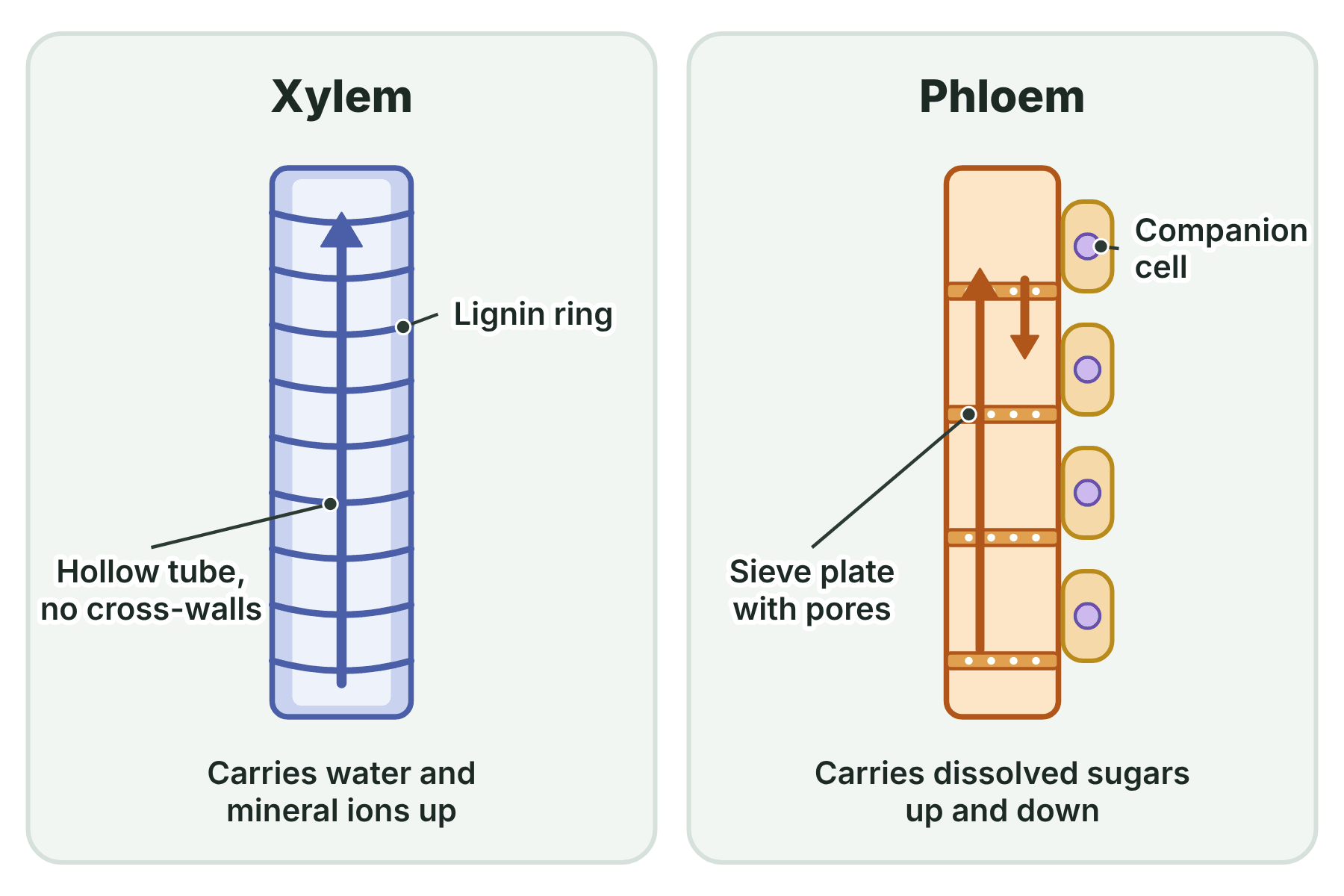
Xylem and phloem compared
- Xylem Carries water and mineral ions; From the roots to the leaves; Dead cells, hollow tubes with no end walls
- Phloem Carries dissolved sugars (food); From the leaves to where they are needed; Living cells, with pores in the end walls
The journey of the sugars
- Made in the leaf Photosynthesis in the palisade cells makes glucose.
- Loaded into the phloem The sucrose is moved into the phloem in the veins of the leaf.
- Carried round the plant Translocation carries it through the phloem to all other parts…
- Used or stored Cells use it for respiration and growth, or store it.
Biology · Edexcel Paper 2
Plant Structures and Transport continued
The Structure of a Leaf (Separate only)
Every tissue in a leaf has a structure that fits its function.
- Epidermis The thin outer layer of cells that covers a leaf.
- Waxy cuticle A waxy layer on the upper surface of a leaf that reduces water loss.
- Palisade mesophyll A layer of tall, tightly packed cells full of chloroplasts, where most photosynthesis takes place.
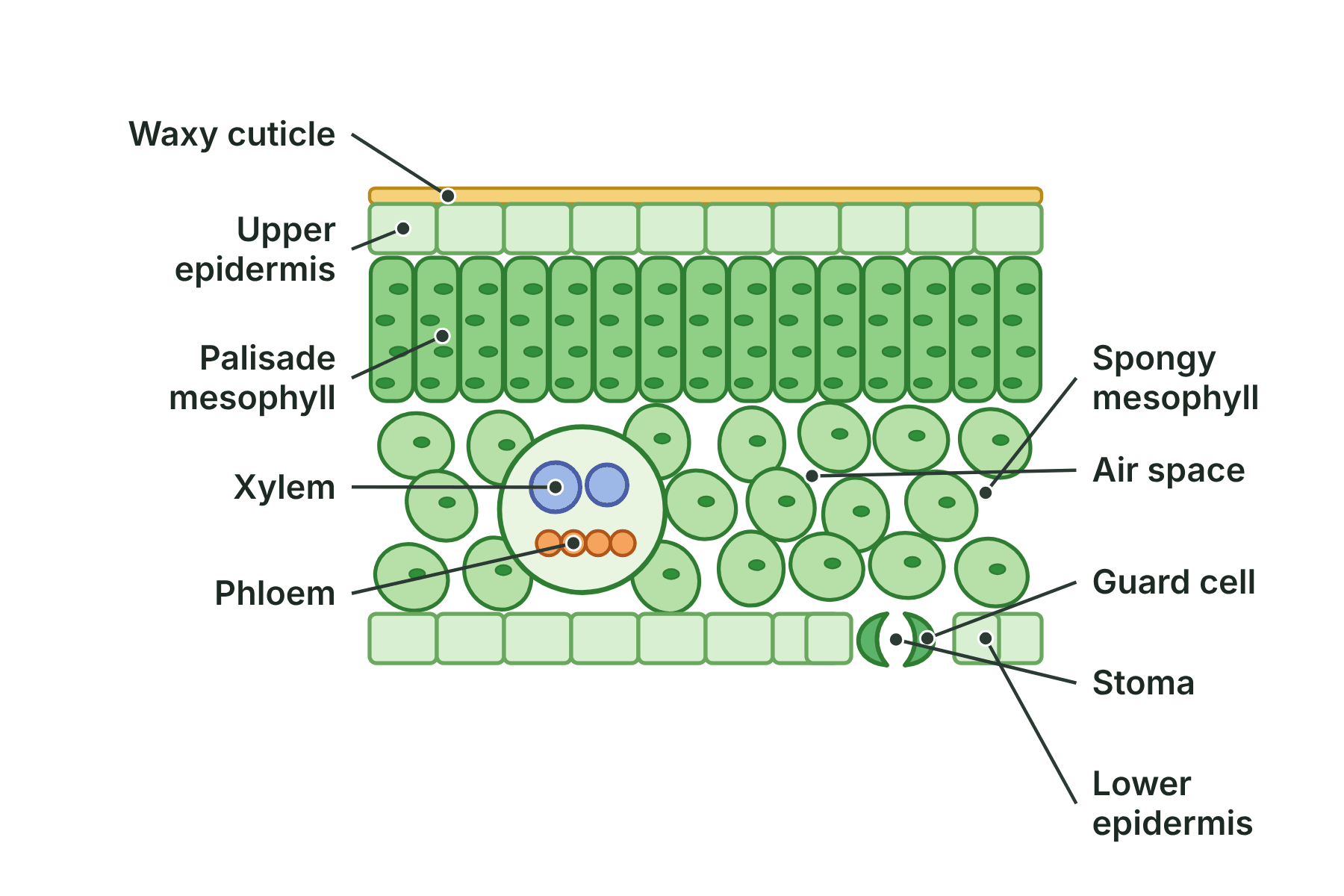
Palisade and spongy mesophyll compared
- Palisade mesophyll Tall cells packed tightly together; Many chloroplasts; Near the top of the leaf, where most light arrives
- Spongy mesophyll Rounded cells loosely packed; Fewer chloroplasts; Large air spaces between the cells
How guard cells control the stomata
- Plenty of water Water enters the guard cells by osmosis, so they swell and become turgid.
- The stoma opens The thin inner walls of the guard cells are stretched.
- Gases move Carbon dioxide diffuses in for photosynthesis and oxygen and…
- Little water If the plant loses too much water, the guard cells become flaccid and close the stoma.
Measuring Transpiration
Water uptake in a potometer is a measure of the rate of transpiration.
- Potometer Apparatus that measures the rate at which a plant shoot takes up water.
- Capillary tube A very thin tube in which the bubble moves in a potometer.
- Independent variable The variable that is changed in an investigation.
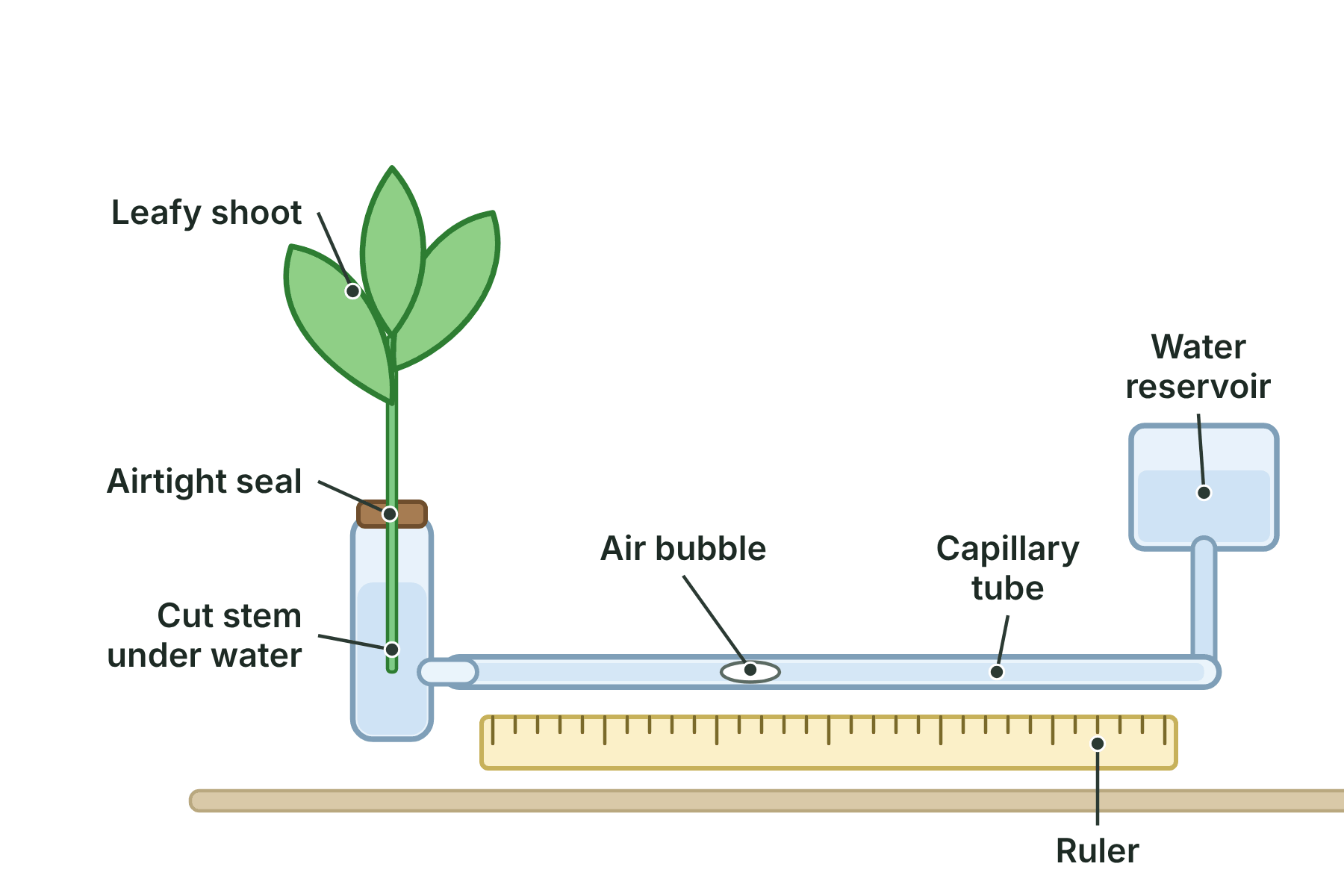
Investigating the effect of a factor
- Set up Cut a shoot under water and join it to the potometer under water.
- Dry the leaves Dry the leaf surface and let the shoot adjust to the room.
- Start Make an air bubble in the capillary tube and note its starting…
- Measure After a set time, such as 5 minutes, record how far the bubble has moved.