Biology · Exchange and Transport in Animals
Blood
Blood is a tissue made of a liquid and three kinds of cell fragment. This lesson names each part of the blood, explains what it does and shows how to recognise the cells in a photograph.
Learning Objectives
- 1Describe blood as a tissue made of plasma, red blood cells, white blood cells and platelets.
- 2State the function of each component of the blood.
- 3Explain how red blood cells, white blood cells and platelets are adapted to their functions.
- 4Recognise the different types of blood cell in a photograph or diagram.
Retrieval practice
-
1
What is a tissue?
Show answerHide answer
A group of cells with a similar structure and function.
-
2
What does a nucleus contain?
Show answerHide answer
The genetic material (DNA).
-
3
Which blood vessels carry blood to the heart?
Show answerHide answer
Veins.
-
4
What is a pathogen?
Show answerHide answer
A microorganism that causes disease.
Blood is a tissue
A litre of blood looks like a red liquid, but it is really a tissue with several parts. About half of it is a pale yellow liquid called plasma. Suspended in the plasma are billions of red blood cells, fewer white blood cells and tiny cell fragments called platelets. Each part has its own job, and together they move materials round the body, defend it against disease and seal wounds.
Plasma
Plasma is the liquid part of the blood. It is mostly water, with many substances dissolved in it.
-
Carbon dioxide
Carried in the plasma from the organs to the lungs.
-
Soluble food molecules
Glucose and amino acids are carried from the small intestine to the cells that need them.
-
Urea
A waste product made in the liver, carried to the kidneys to be removed.
-
Hormones
Chemical messengers carried from the glands that make them to the organs they affect.
-
Heat
Carried from warm organs such as the liver and muscles to the rest of the body.
Red blood cells
Red blood cells carry oxygen from the lungs to every cell in the body.
-
Haemoglobin
A red pigment that joins with oxygen in the lungs and lets go of it in the tissues. It is what makes red blood cells red.
-
Biconcave shape
The cell is a disc that is dimpled on both sides. This gives a large surface area for oxygen to diffuse in and out quickly.
-
No nucleus
Without a nucleus there is more room inside the cell for haemoglobin, so it can carry more oxygen.
-
Flexible
The cells are small and flexible, so they can squeeze through the narrowest capillaries.
The components of blood
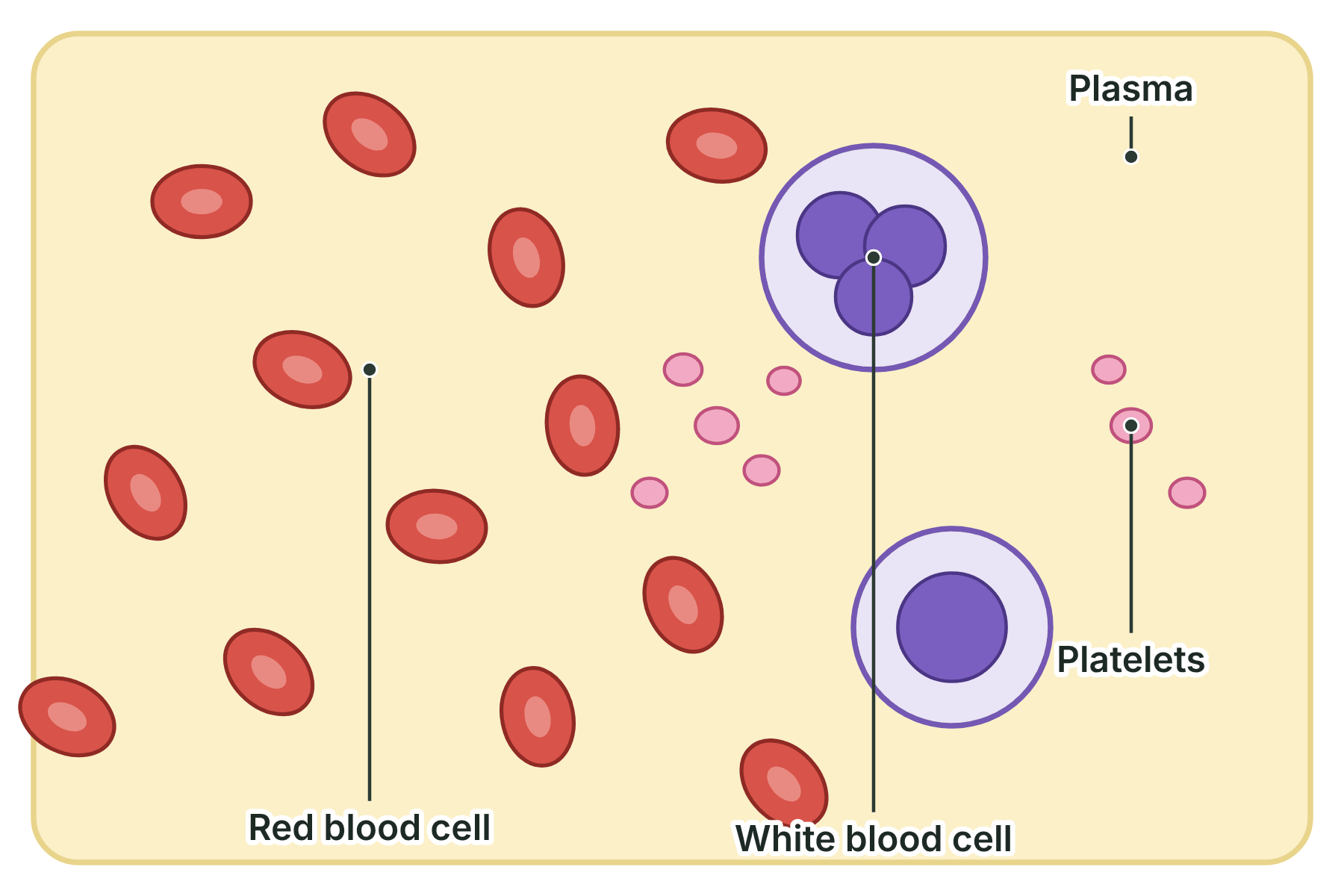
Red blood cells are the most numerous. White blood cells are larger and have a nucleus.
White blood cells and platelets
These two components protect the body.
-
White blood cells
Defend the body against pathogens. Phagocytes engulf and digest pathogens, and lymphocytes make antibodies and antitoxins. They have a nucleus.
-
Platelets
Small fragments of cells with no nucleus. They help the blood to clot at a wound, which forms a scab, stops the bleeding and keeps out microorganisms.
Red and white blood cells compared
Red blood cell
- Carries oxygen
- Contains haemoglobin
- Biconcave disc with no nucleus
- Far more numerous
White blood cell
- Defends against pathogens
- Makes antibodies, antitoxins or engulfs pathogens
- Has a nucleus
- Larger and fewer in number
Recognising blood cells in a photograph
Under a microscope the stains used make the different cells easy to tell apart.
-
Red blood cells
Lots of small, round, pink or red cells with a paler centre and no nucleus.
-
White blood cells
A few much bigger cells, each with a large nucleus stained dark purple.
-
Platelets
Tiny pieces, much smaller than the red cells, with no nucleus.
Case study
Blood transfusions and blood products
After a serious accident, a patient may be given donated red blood cells, plasma or platelets. A transfusion can save a life, but it carries risks that have to be weighed up. Blood from another person could carry an infection, so donated blood is screened. Giving the wrong blood group can cause a dangerous reaction, so the blood is matched to the patient. Some patients also have an allergic reaction.
The four jobs of blood
Red blood cells carry oxygen, white blood cells defend, platelets clot the blood and plasma transports everything else.
Blood
Blood
-
Plasma
- carries CO₂
- glucose
- amino acids
- urea
- hormones
- heat
-
Red blood cells
- haemoglobin
- biconcave
- no nucleus
-
White blood cells
- phagocytes
- lymphocytes
- nucleus
-
Platelets
- cell fragments
- clotting
- scab
-
Blood products
- benefits and risks of transfusion
Summary and exam focus
- Blood is a tissue made of plasma, red blood cells, white blood cells and platelets.
- Plasma carries carbon dioxide, soluble food, urea, hormones and heat.
- Red blood cells carry oxygen using haemoglobin and are adapted by their biconcave shape and lack of a nucleus.
- White blood cells defend against pathogens and have a nucleus.
- Platelets cause blood to clot at wounds.
Exam focus
Describe the functions of the four components of blood. (4 marks) (4 marks)
Give each component its own sentence, naming the component and its job. Do not describe red blood cells as carrying "oxygen and carbon dioxide": the plasma carries the carbon dioxide.
Key terms
The words this lesson expects you to use. Each one is linked from the first place it appears above.
- Plasma
- The pale yellow liquid part of the blood that transports dissolved substances.
- Red blood cell
- A cell with no nucleus that carries oxygen around the body.
- Haemoglobin
- The red pigment in red blood cells that joins with oxygen.
- White blood cell
- A blood cell with a nucleus that helps to defend the body against pathogens.
- Platelet
- A small fragment of a cell that helps blood to clot.
- Biconcave
- Shaped like a disc that is dimpled on both sides.
- Phagocyte
- A white blood cell that engulfs and digests pathogens.
- Blood clot
- A mass of platelets and fibres that seals a wound.
You've finished the notes
Check your understanding
Test yourself while it is fresh. Start with the flashcards, then try the exam questions.
Something here looks wrong?
Tell us what and we will go and look. It goes to whoever writes these pages, nobody else, and we do not ask who you are — so there is nothing to sign and nothing comes back to you.