Biology · Exchange and Transport in Animals
Knowledge organiser
The whole chapter on two pages. Print it on A4 — they are already landscape — or cover a box and see how much of it you can say from memory.
Biology · OCR Paper 1
Exchange and Transport in Animals
Surface Area to Volume Ratio and Exchange Surfaces
A big organism has a small surface area compared with its volume, so it needs exchange surfaces and a transport system.
- Surface area to volume ratio The surface area of an object divided by its volume. It gets smaller as the object gets bigger.
- Surface area The total area of the outside of an object.
- Volume The amount of space inside an object.
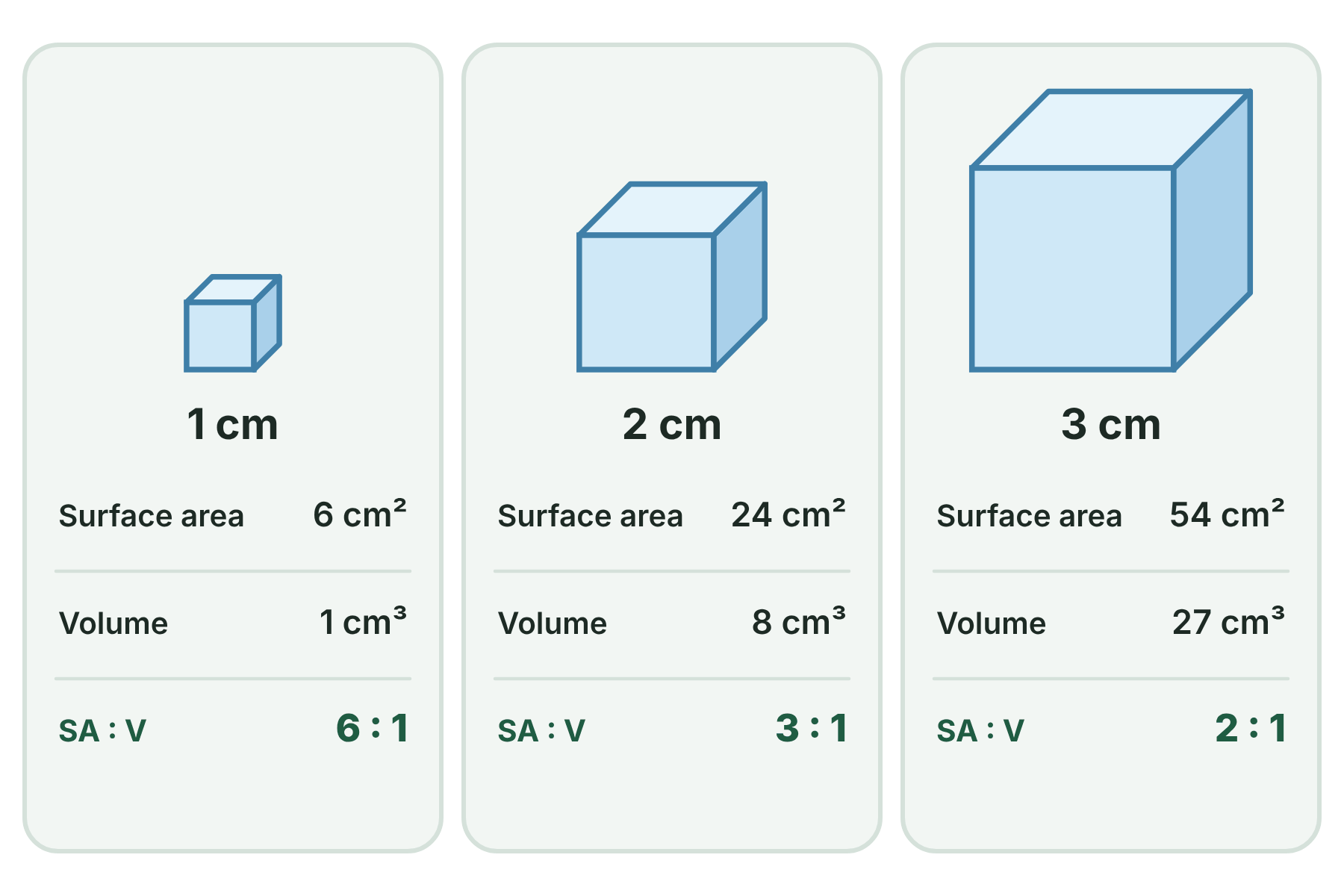
Single-celled and multicellular organisms
- Single-celled organism Large surface area to volume ratio; Every part of the cell is close to the outside; No transport system or special exchange surface needed
- Multicellular organism Small surface area to volume ratio; The body surface alone could not supply the cells deep inside; Diffusion over such long distances is far too slow
The Heart and Double Circulation
The right ventricle pumps blood to the lungs. The left ventricle pumps blood to the rest of the body.
- Double circulatory system A circulation in which blood passes through the heart twice on each trip round the body, once to the lungs and once to the body.
- Atrium An upper chamber of the heart that receives blood.
- Ventricle A lower chamber of the heart that pumps blood out.
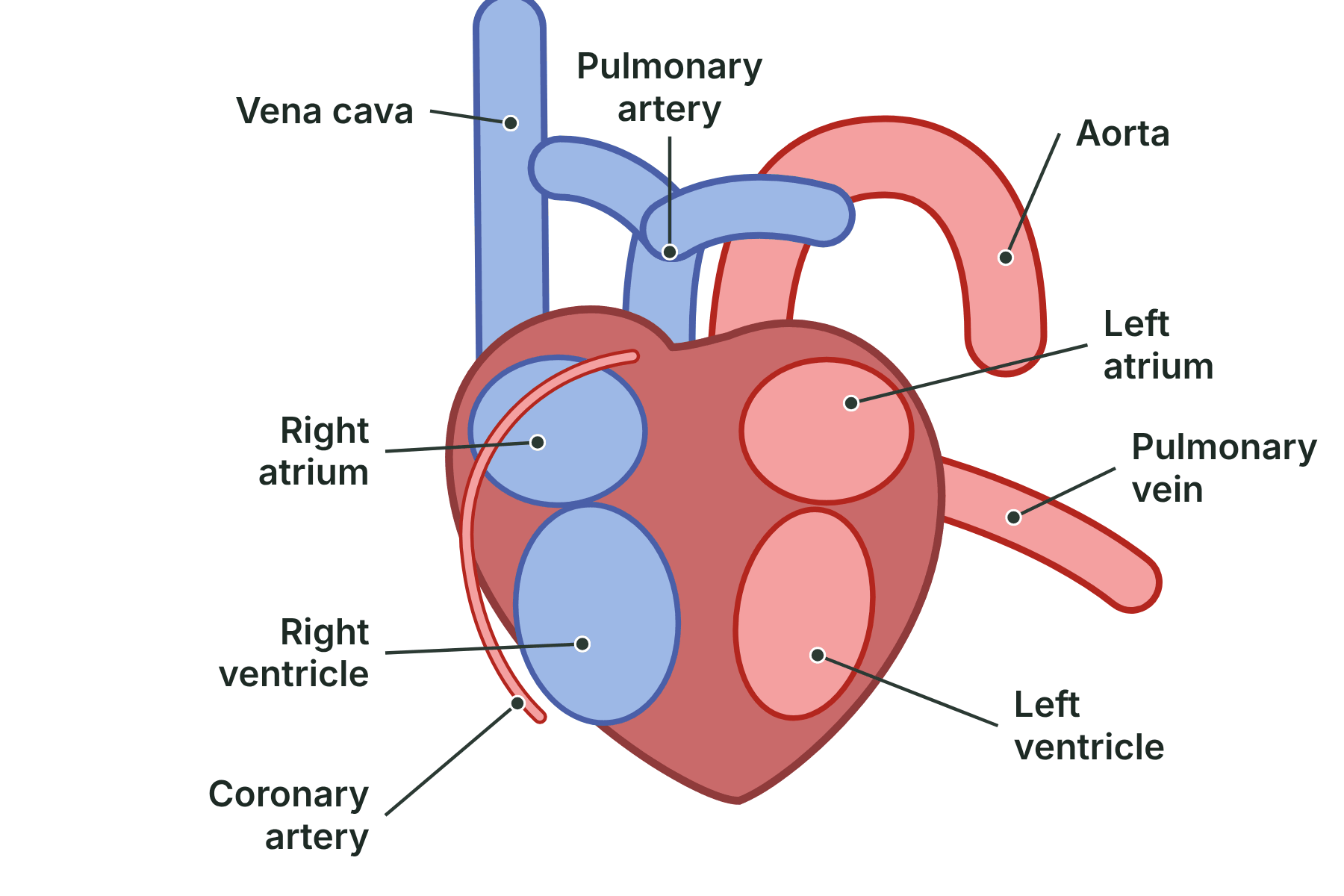
The two sides of the heart
- Right side Receives deoxygenated blood from the body; Pumps blood a short distance to the lungs; Thinner muscle wall
- Left side Receives oxygenated blood from the lungs; Pumps blood to every organ of the body; Thicker muscle wall
Following the blood round the double circulation
- Body to heart Deoxygenated blood returns from the body in the vena cava and…
- Heart to lungs The right ventricle pumps the blood along the pulmonary artery…
- Gas exchange In the lungs the blood picks up oxygen and gives up carbon dioxide.
- Lungs to heart Oxygenated blood returns along the pulmonary vein to the left atrium.
Blood Vessels
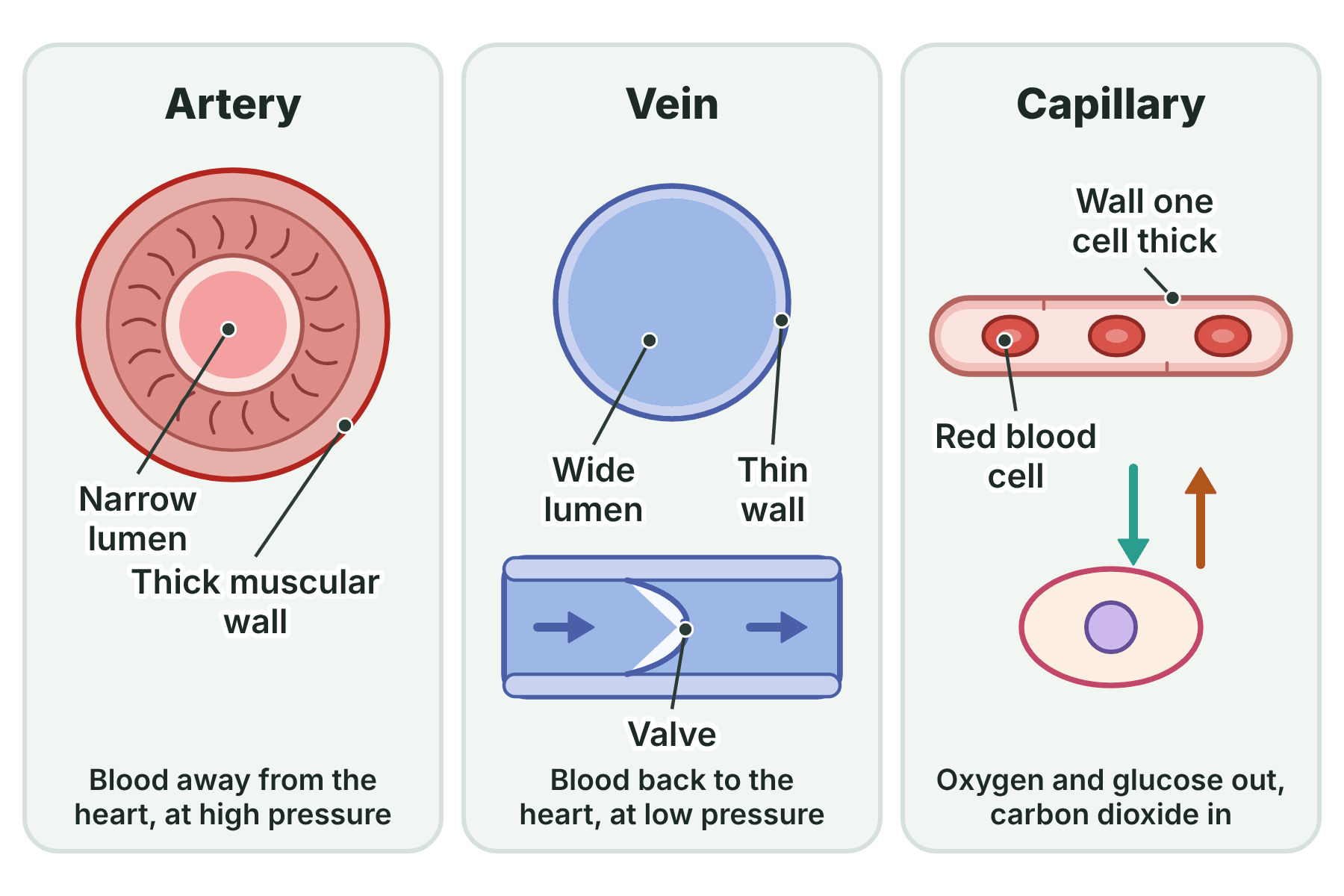
Arteries carry blood away from the heart. Veins carry blood to the heart. Capillaries link the two.
- Artery A blood vessel that carries blood away from the heart at high pressure.
- Vein A blood vessel that carries blood to the heart at low pressure.
- Capillary A tiny blood vessel with a wall one cell thick, where substances are exchanged with the cells.
Biology · OCR Paper 1
Exchange and Transport in Animals continued
Artery and vein compared
- Artery Carries blood away from the heart; High blood pressure; Thick wall with muscle and elastic fibres
- Vein Carries blood towards the heart; Low blood pressure; Thinner wall
The Lungs and Gas Exchange
The alveoli are one cell thick, packed with capillaries and ventilated by breathing, which makes them a very effective exchange surface.
- Trachea The windpipe, the tube that carries air from the mouth and nose towards the lungs.
- Bronchus One of the two tubes that branch from the trachea, one into each lung.
- Bronchiole A smaller tube that branches from a bronchus and ends in alveoli.
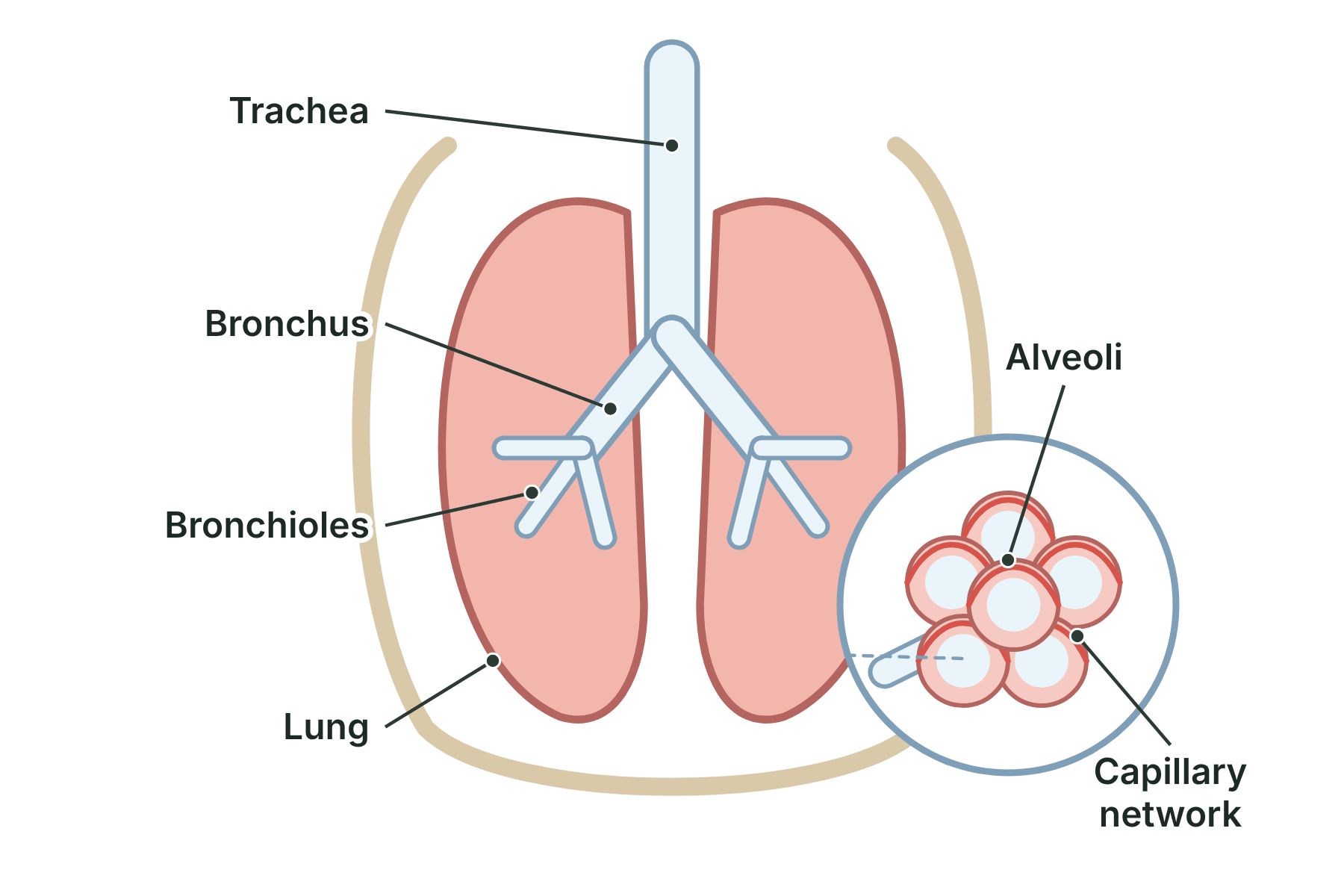
Gas exchange in the alveoli
- Breathe in Fresh air fills the alveoli.
- Oxygen diffuses in The blood arriving is low in oxygen.
- Carbon dioxide diffuses out The blood arriving is high in carbon dioxide.
- Breathe out The air that leaves has less oxygen and more carbon dioxide than…
Blood
Red blood cells carry oxygen, white blood cells defend, platelets clot the blood and plasma transports everything else.
- Plasma The pale yellow liquid part of the blood that transports dissolved substances.
- Red blood cell A cell with no nucleus that carries oxygen around the body.
- Haemoglobin The red pigment in red blood cells that joins with oxygen.
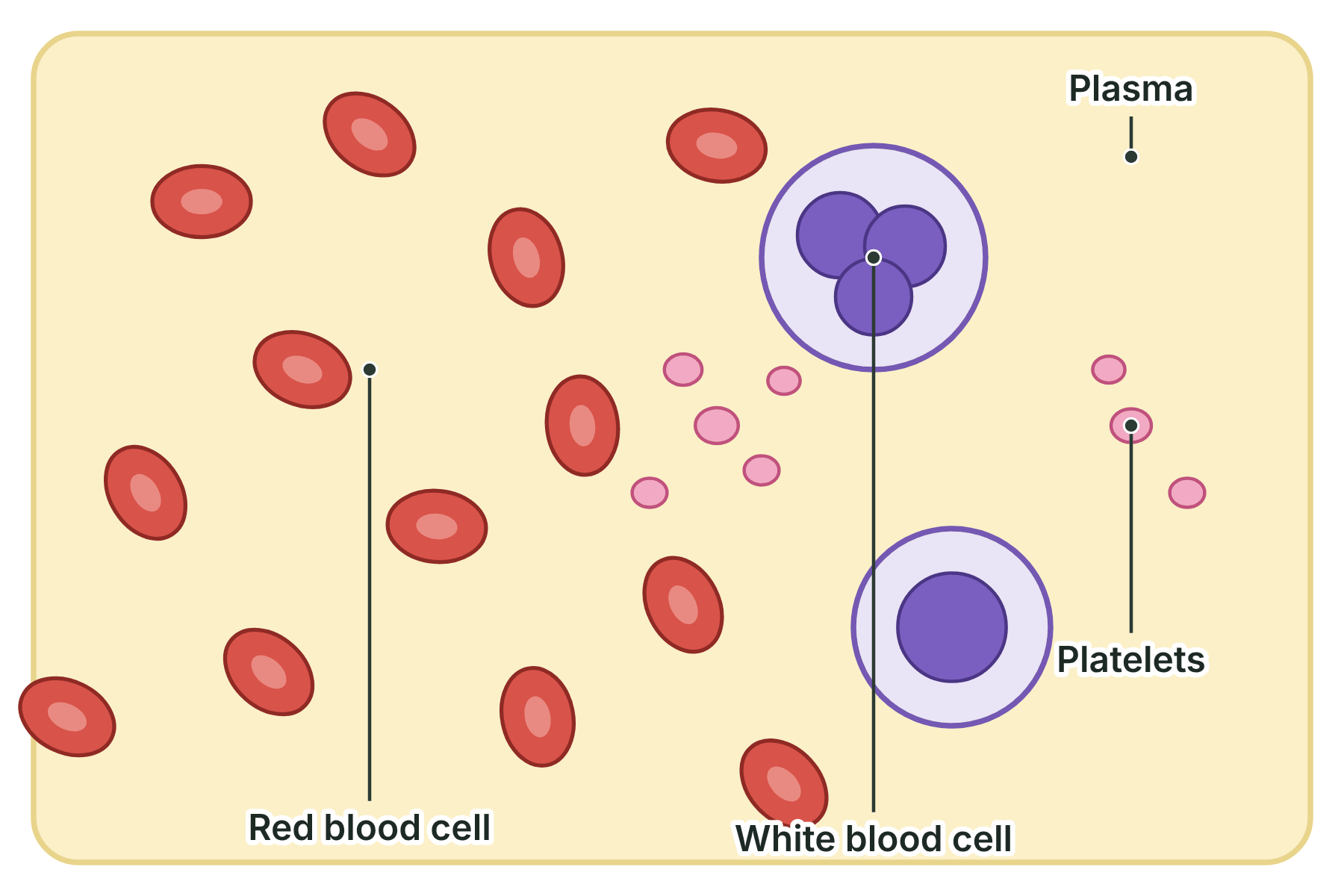
Red and white blood cells compared
- Red blood cell Carries oxygen; Contains haemoglobin; Biconcave disc with no nucleus
- White blood cell Defends against pathogens; Makes antibodies, antitoxins or engulfs pathogens; Has a nucleus