Biology · What Happens in Cells
The Structure of DNA
DNA carries the instructions that build and run every living thing. This lesson describes DNA as a polymer made of two strands that form a double helix, shows how DNA, chromosomes and genes are related, and describes how DNA can be extracted from a living organism.
Learning Objectives
- 1Describe DNA as a polymer.
- 2Describe DNA as being made up of two strands forming a double helix.
- 3Describe how DNA, genes and chromosomes are related, and where DNA is found in eukaryotic and prokaryotic cells.
- 4Describe how DNA can be extracted from the cells of a living organism.
Retrieval practice
-
1
Which part of an animal or plant cell contains the genetic material?
Show answerHide answer
The nucleus.
-
2
What is found in a bacterial cell instead of a nucleus?
Show answerHide answer
A loop of DNA, and sometimes small rings called plasmids.
-
3
What do ribosomes do?
Show answerHide answer
They are the site of protein synthesis.
-
4
What is an enzyme made of?
Show answerHide answer
Protein.
The code of life
Every cell in your body contains DNA, a long molecule that stores the instructions for making you. These instructions tell the cell which proteins to make, and proteins build the cell and control its chemistry. The structure of DNA explains how it can store so much information and how it can be copied exactly when a cell divides.
DNA is a polymer
DNA is a very long molecule built by joining many smaller units in a chain.
-
A polymer
A polymer is a large molecule made of many smaller units joined together. DNA is a polymer.
-
Very long
The DNA in one human cell would stretch about two metres if it was uncoiled, but it is packed into a nucleus a few thousandths of a millimetre across.
-
The units
The smaller units are called nucleotides. You will meet their structure in the next lesson.
Two strands forming a double helix
A DNA molecule is made of two strands wound round each other.
-
Two strands
Each strand is a long chain of units. The two strands run side by side.
-
Held together
The two strands are joined by pairs of chemicals called bases, like the rungs of a ladder.
-
Double helix
The ladder is twisted into a spiral shape called a double helix. Double means two strands, and helix means spiral.
-
Why it matters
The twisted shape is strong and compact, and each strand can act as a template for copying the other.
A DNA molecule
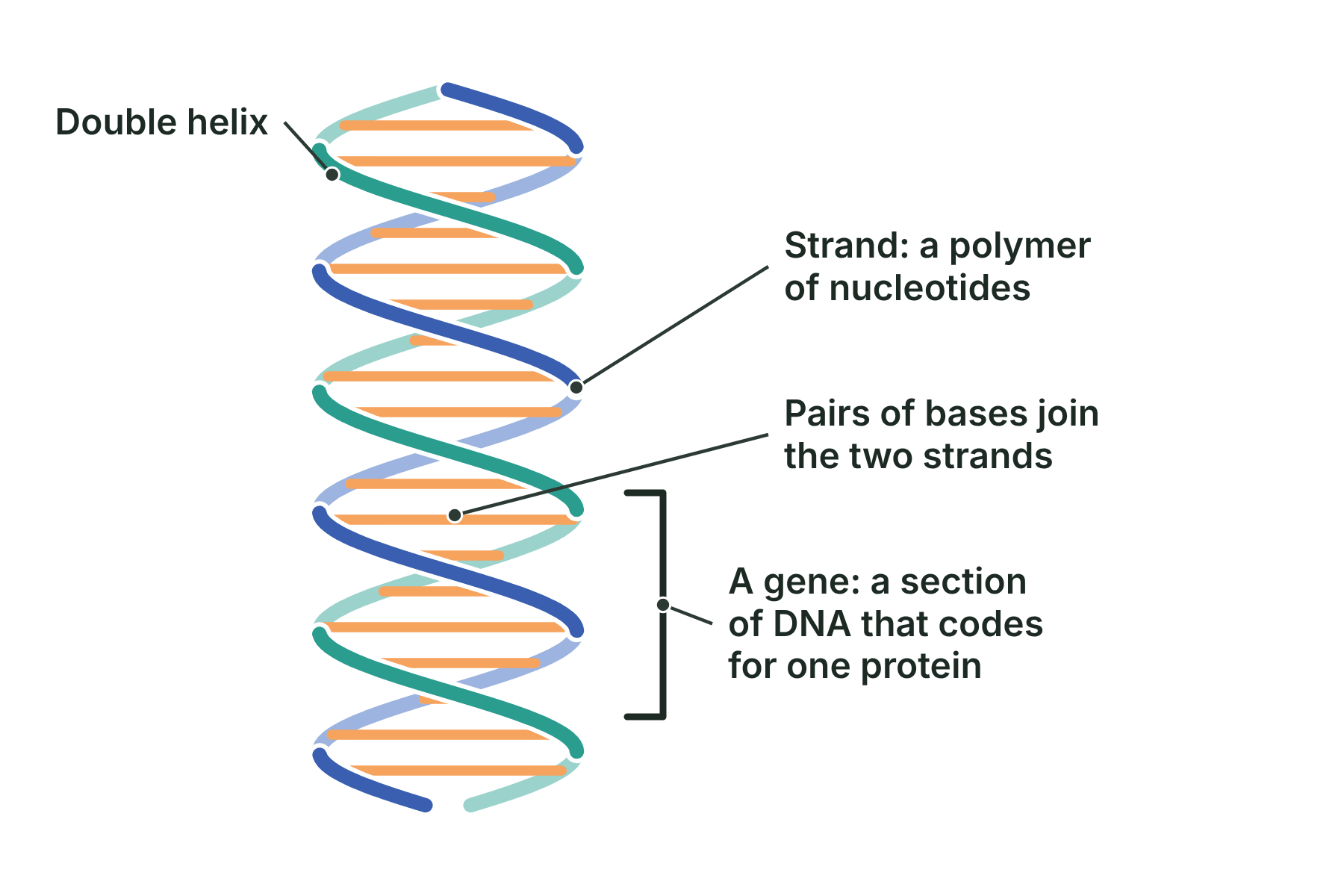
DNA is a double helix: two polymer strands joined by pairs of bases.
DNA, genes and chromosomes
DNA is organised into genes and chromosomes inside the cell.
-
Gene
A gene is a section of DNA that codes for a particular protein.
-
Chromosome
A chromosome is one very long DNA molecule, coiled up tightly, that carries many genes.
-
Genome
The genome is all of the genetic material of an organism.
-
Where
In plant and animal cells the chromosomes are in the nucleus. In a bacterial cell the DNA is a single loop in the cytoplasm, and there may also be small rings of DNA called plasmids.
DNA in two kinds of cell
Eukaryotic cell (plant or animal)
- DNA is in chromosomes
- Chromosomes are inside the nucleus
- Usually many chromosomes in pairs
- No plasmids in animal cells
Prokaryotic cell (bacterium)
- DNA is a single loop
- It floats in the cytoplasm, with no nucleus
- Often has extra rings of DNA called plasmids
- Plasmids carry extra genes
Extracting DNA from a living organism
DNA can be seen as a stringy white solid if it is extracted from fruit such as strawberries, or from onion.
-
1
Break up the tissue
Mash the fruit in a bag to separate the cells.
-
2
Break open the cells
Add a mixture of detergent and salt. The detergent breaks down the cell membranes and the nuclear membranes, and the salt helps the DNA to clump.
-
3
Filter
Filter the mixture to remove the pieces of cell, leaving a liquid that contains the DNA.
-
4
Add cold ethanol
Carefully pour ice-cold ethanol down the side of the tube so that it forms a layer on top.
-
5
Collect the DNA
The DNA is not soluble in ethanol. It appears as a stringy white layer between the two liquids, and can be lifted out with a glass rod.
Case study
Finding the shape of DNA
In 1953 James Watson and Francis Crick published a model of the double helix. They used evidence from X-ray images made by Rosalind Franklin and Maurice Wilkins. Franklin's X-ray image of DNA showed that it was a helix. The model explained how DNA could carry information and be copied, and it opened up the study of genes and heredity.
The big idea
DNA is a polymer made of two strands wound into a double helix, and a gene is a section of DNA that codes for a protein.
DNA
DNA
-
Polymer
- a long chain of nucleotides
-
Double helix
- two strands joined by pairs of bases
-
Gene
- a section of DNA that codes for a protein
-
Chromosome
- one long coiled DNA molecule
-
Where
- in the nucleus
- a loop and plasmids in bacteria
Summary and exam focus
- DNA is a polymer, a very long molecule made of many smaller units.
- It is made of two strands that form a double helix.
- The strands are joined by pairs of bases.
- A gene is a section of DNA that codes for a protein.
- A chromosome is one long DNA molecule, carrying many genes.
- DNA can be extracted by breaking open cells, filtering and adding cold ethanol.
Exam focus
Describe the structure of a DNA molecule. (3 marks) (3 marks)
Use the key words: polymer, two strands, double helix. Add that the strands are joined by pairs of bases, which is why it looks like a twisted ladder.
Key terms
The words this lesson expects you to use. Each one is linked from the first place it appears above.
- DNA
- The molecule that stores the genetic information of a cell.
- Polymer
- A large molecule made of many smaller units joined together.
- Double helix
- The twisted ladder shape of DNA: two strands wound round each other.
- Gene
- A section of DNA that codes for a particular protein.
- Chromosome
- A long, coiled molecule of DNA that carries many genes.
- Genome
- All of the genetic material of an organism.
- Plasmid
- A small ring of DNA found in bacterial cells.
- Nucleotide
- One of the units that are joined to make a strand of DNA.
You've finished the notes
Check your understanding
Test yourself while it is fresh. Start with the flashcards, then try the exam questions.
Something here looks wrong?
Tell us what and we will go and look. It goes to whoever writes these pages, nobody else, and we do not ask who you are — so there is nothing to sign and nothing comes back to you.