Biology · Monitoring and Maintaining the Environment
Knowledge organiser
The whole chapter on one page. Print it on A4 — it is already landscape — or cover a box and see how much of it you can say from memory.
Biology · OCR Paper 2
Monitoring and Maintaining the Environment
Sampling Organisms: Quadrats and Transects
Sample by chance to estimate the abundance of a species, and sample along a line to show how its distribution changes.
- Abundance The number of individuals of a species in an area or habitat.
- Distribution Where in a habitat a species is found.
- Quadrat A square frame that marks off a known area for sampling.
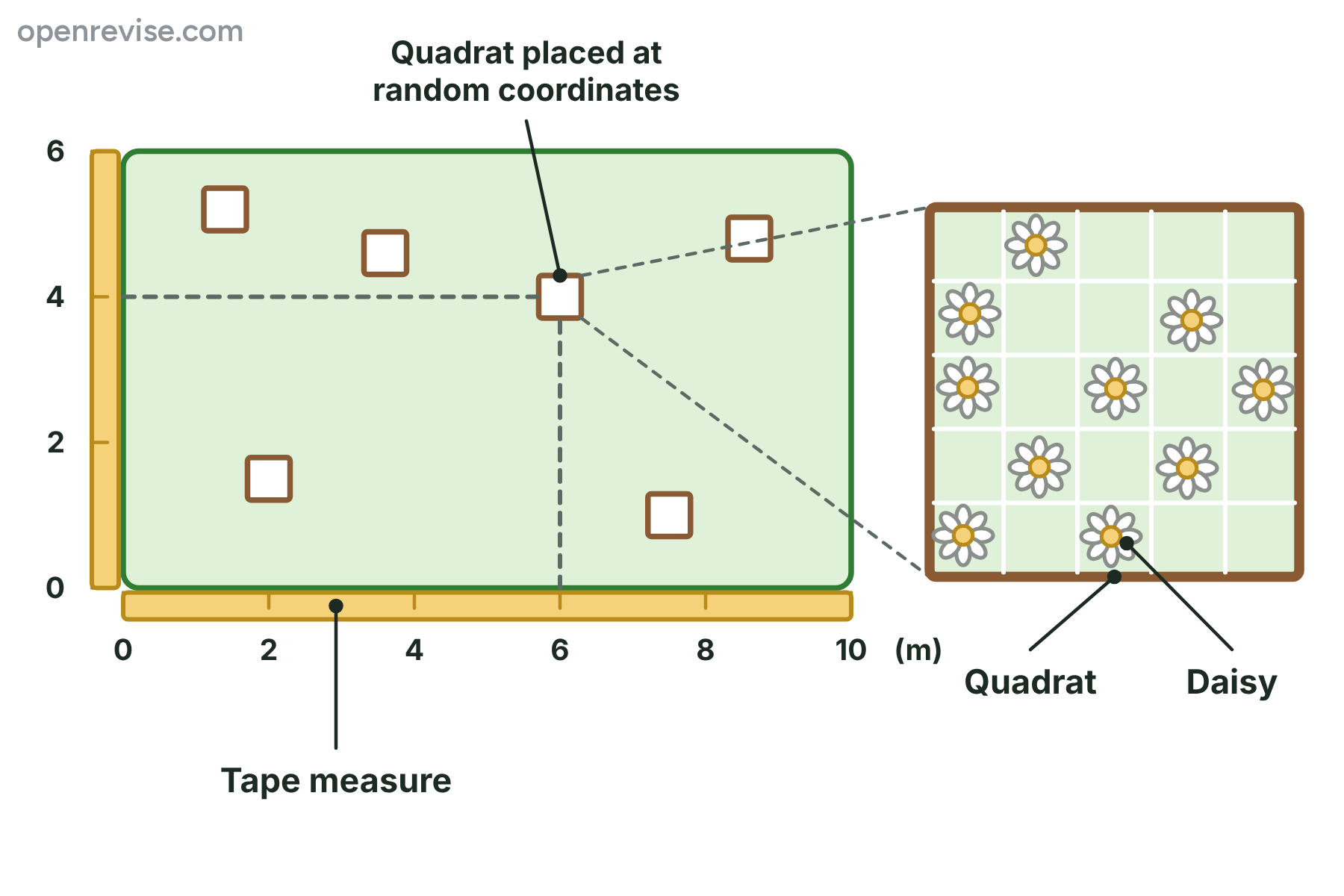
Random sampling and systematic sampling
- Random sampling with quadrats Quadrats placed at random coordinates; Shows the abundance of a species in an area; Used when the habitat looks the same all over
- Systematic sampling along a transect Samples at regular intervals along a line; Shows how the distribution of a species changes; Used when there is a gradient, such as light or moisture
Method for random sampling of an area
- Mark out the area Lay two long tape measures at right angles along two sides of the study area.
- Choose random positions Use a random number generator, or random number tables.
- Place the quadrat At each pair of coordinates place the quadrat.
- Repeat Do this for at least 10 quadrats, and record the results in a table.
Estimating Population Size
Population size = (number in first sample × number in second sample) ÷ number of marked animals in the second sample.
- Population size The number of individuals of a species living in an area.
- Estimate An approximate value, found by calculation from a sample.
- Scaling up Using the mean of a sample to calculate the total for a whole area.
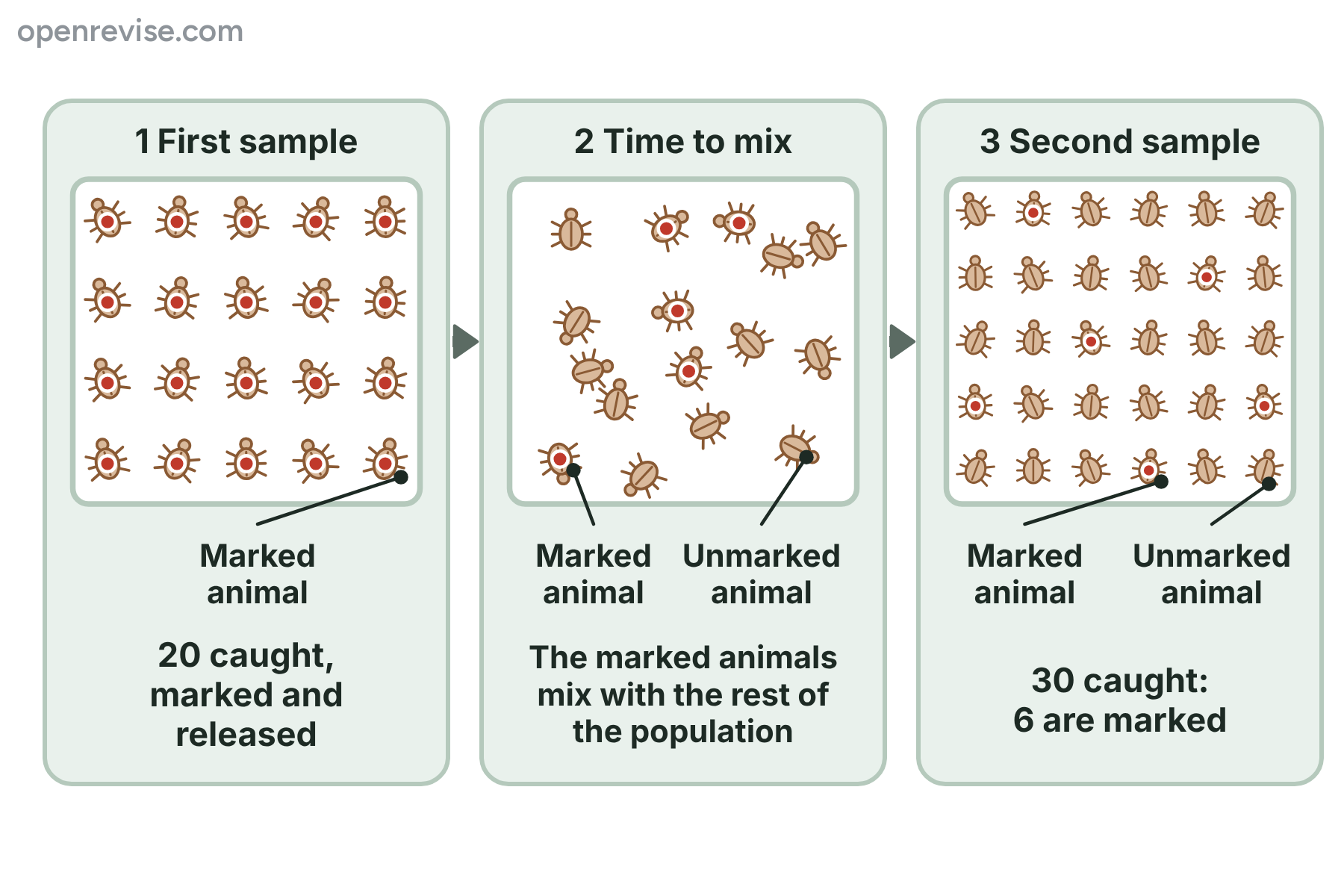
Which method to use?
- Scaling up from quadrats For plants and animals that do not move, such as snails or limpets; Quadrats are placed at random; Population = mean per quadrat × number of quadrats that fit in the area
- Capture-recapture For animals that move about; Animals are caught, marked, released and caught again; Population = first sample × second sample ÷ marked in second sample
The capture-recapture method
- First sample Catch as many animals as you can in an area, for example with pitfall traps.
- Mark and release Mark each one in a way that will not harm it or make it easier to see.
- Wait Leave enough time for the marked animals to mix with the rest of the population.
- Second sample Catch another sample in the same way and count the total, n.
Human Interactions and Biodiversity
Human actions can reduce biodiversity by destroying habitats, taking too many organisms, polluting and introducing species.
- Biodiversity The variety of living organisms in a habitat, or on Earth.
- Deforestation The clearing of large areas of forest, usually to use the wood or the land.
- Overharvesting Taking animals or plants faster than they can reproduce.
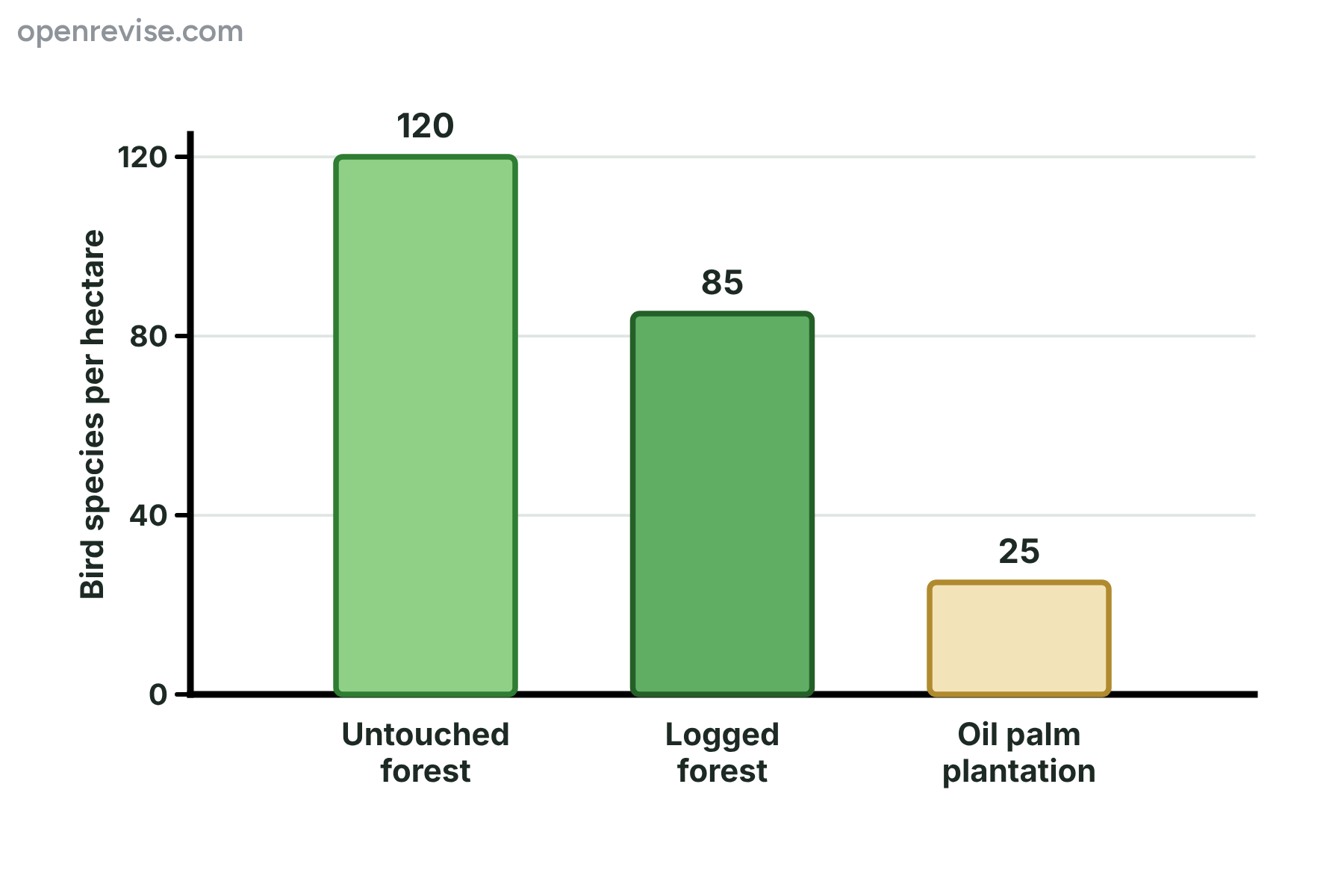
Negative and positive interactions
- Negative interactions Habitat destruction by building, farming and deforestation; Hunting and overfishing; Pollution of water, air and land
- Positive interactions Nature reserves and national parks; Captive breeding and reintroduction; Habitat restoration and wildlife corridors
How fertiliser pollutes a pond
- Fertiliser runs off Rain washes fertiliser from fields into the pond.
- Light is blocked A thick layer of algae floats on the surface and blocks the light.
- Decomposers multiply Bacteria feed on the dead plants and algae, and they multiply.
- Fish die The amount of oxygen in the water falls so low that fish and other animals suffocate.