Biology · Natural Selection and Evolution
Knowledge organiser
The whole chapter on three pages. Print it on A4 — they are already landscape — or cover a box and see how much of it you can say from memory.
Biology · OCR Paper 2
Natural Selection and Evolution
Natural Selection
Natural selection does not change individuals: it changes the population.
- Population A group of individuals of the same species living in the same place.
- Genetic variation Differences in the alleles carried by individuals of the same species.
- Mutation A random change in the base sequence of DNA that may produce a new variant.
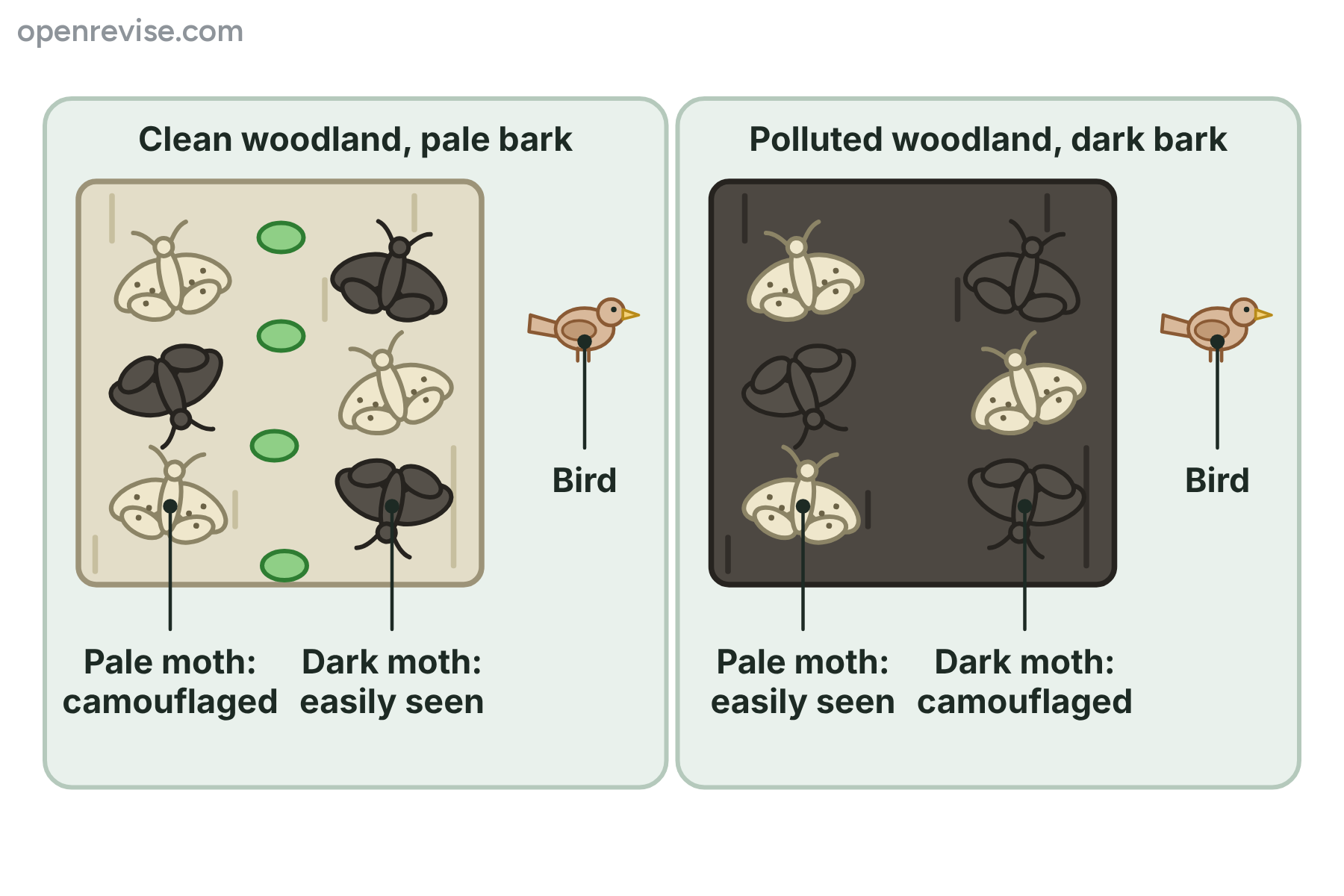
Saying it correctly
- Say this The dark moths were more likely to survive and breed; A mutation produced a new variant, by chance; The allele for dark colour became more common in the population
- Not this The moths changed colour so that they could hide; The moths needed to be dark, so they mutated; Each moth became better camouflaged during its life
Natural selection step by step
- Variation Individuals in the population have different alleles.
- Selection pressure Something in the environment, such as predators, disease…
- Survival and breeding The individuals with phenotypes best suited to the environment…
- Alleles passed on Their offspring inherit the alleles that gave the advantage.
Evolution and the Formation of New Species
A new species forms when populations that are kept apart evolve for so long, under different selection pressures, that they can no longer…
- Evolution A change in the inherited characteristics of a population over time, through natural selection.
- Species A group of organisms that can interbreed to produce fertile offspring.
- Fertile Able to reproduce and have offspring.
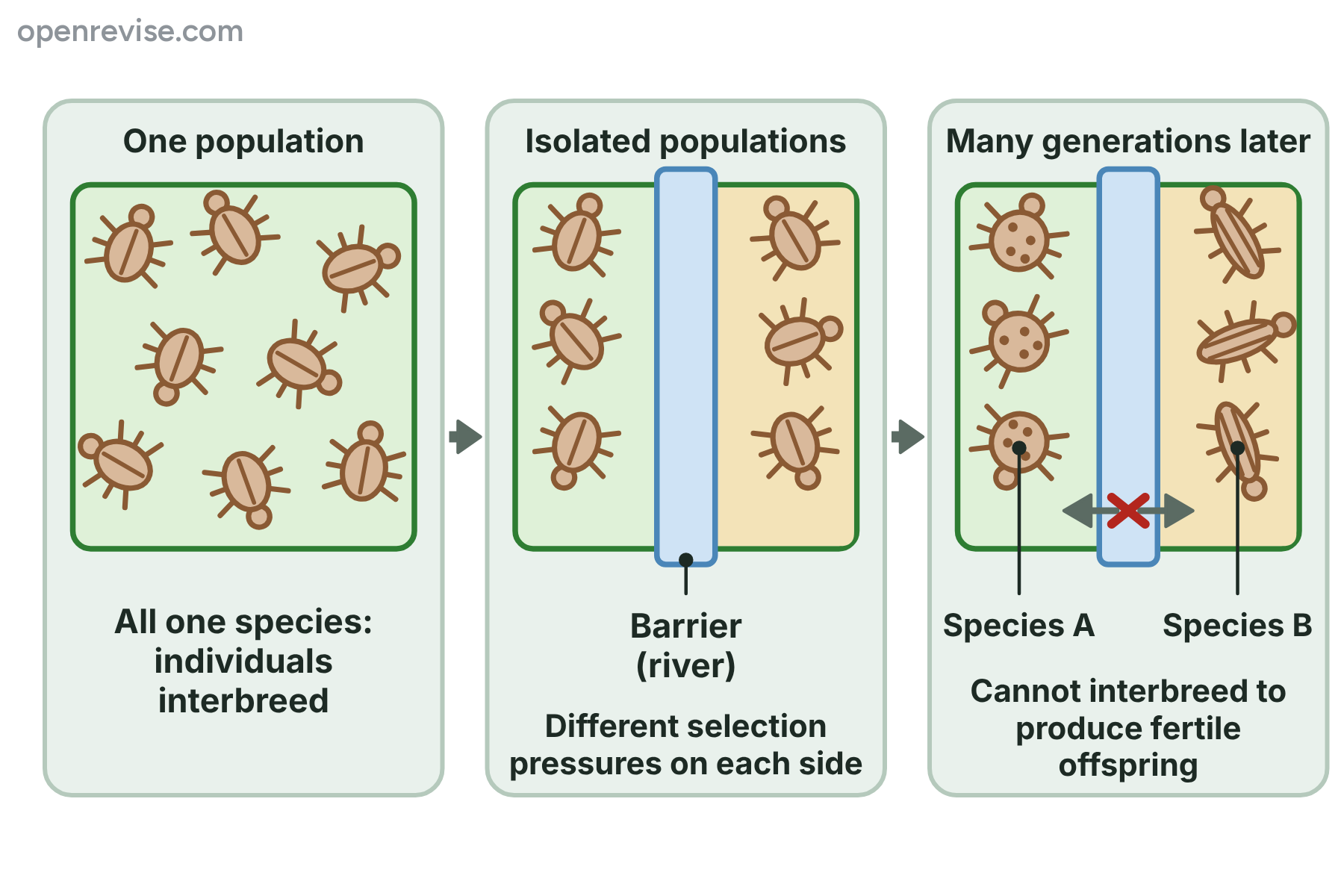
Same species or different species?
- Same species Can interbreed, for example two horses; The offspring are fertile; Alleles are shared through breeding, so the population stays alike
- Different species Cannot interbreed, or the offspring are infertile; A horse and a donkey have a sterile mule; Alleles are no longer shared between them
How isolation can form a new species
- Isolation A population is split into two groups by a barrier, such as a…
- Different environments The two groups live in different conditions.
- Different mutations Random mutations happen in each group, and they are different.
- Different selection In each group, the variants best suited to its own environment survive and breed more.
Biology · OCR Paper 2
Natural Selection and Evolution continued
Fossils and Extinction
Fossils show that life has changed over millions of years, but the fossil record is incomplete, and most species that have ever lived are now extinct.
- Fossil The remains or traces of an organism from many years ago that are found in rock.
- Sediment Mud, sand or other small particles that settle in layers, usually under water.
- Fossil record All of the fossils that have been found, which shows how life has changed over time.
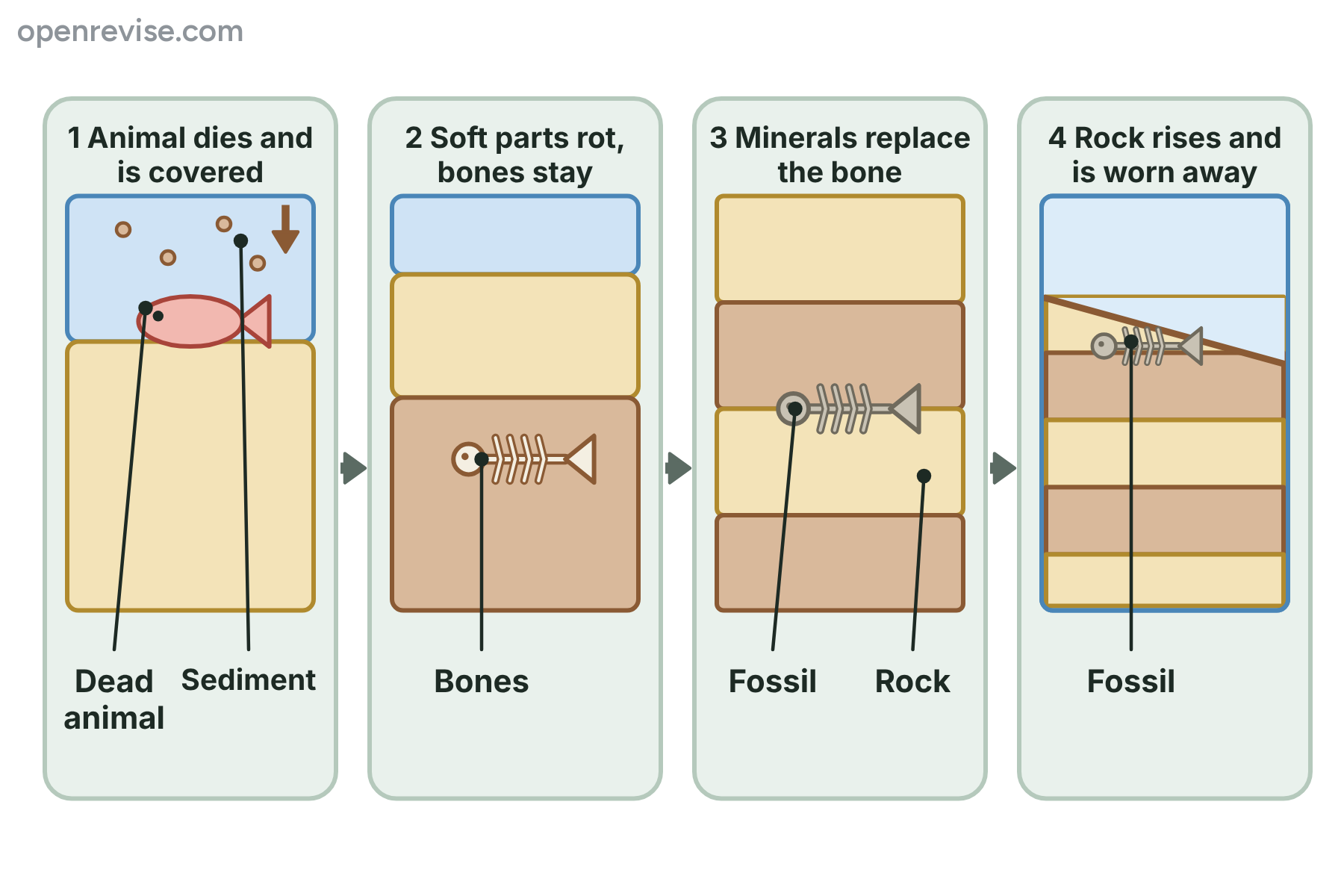
Fossil evidence: strengths and limits
- What fossils can show The age of the organism, from the layer of rock it is in; What extinct organisms looked like; Gradual change in a feature over millions of years
- Why they cannot show everything Most organisms never become fossils; Soft tissues and behaviour are rarely preserved; Many fossils have been destroyed or not found yet
How a hard part becomes a fossil
- Burial The animal dies and is quickly covered by sediment, such as mud…
- Decay of soft parts The soft parts rot away or are eaten.
- Replacement and compaction New layers of sediment build up and press down on the lower…
- Exposure Movements of the Earth lift the rock.
Antibiotic Resistance in Bacteria
Antibiotics do not make bacteria resistant: they kill the non-resistant ones and leave the resistant ones to survive, breed and pass on the allele.
- Antibiotic A medicine that kills bacteria or stops them growing, without harming human cells.
- Antibiotic resistance The ability of a bacterium not to be killed by an antibiotic, because of a variant (allele) that it carries.
- MRSA Methicillin-resistant Staphylococcus aureus, a strain of bacteria that is resistant to many antibiotics.
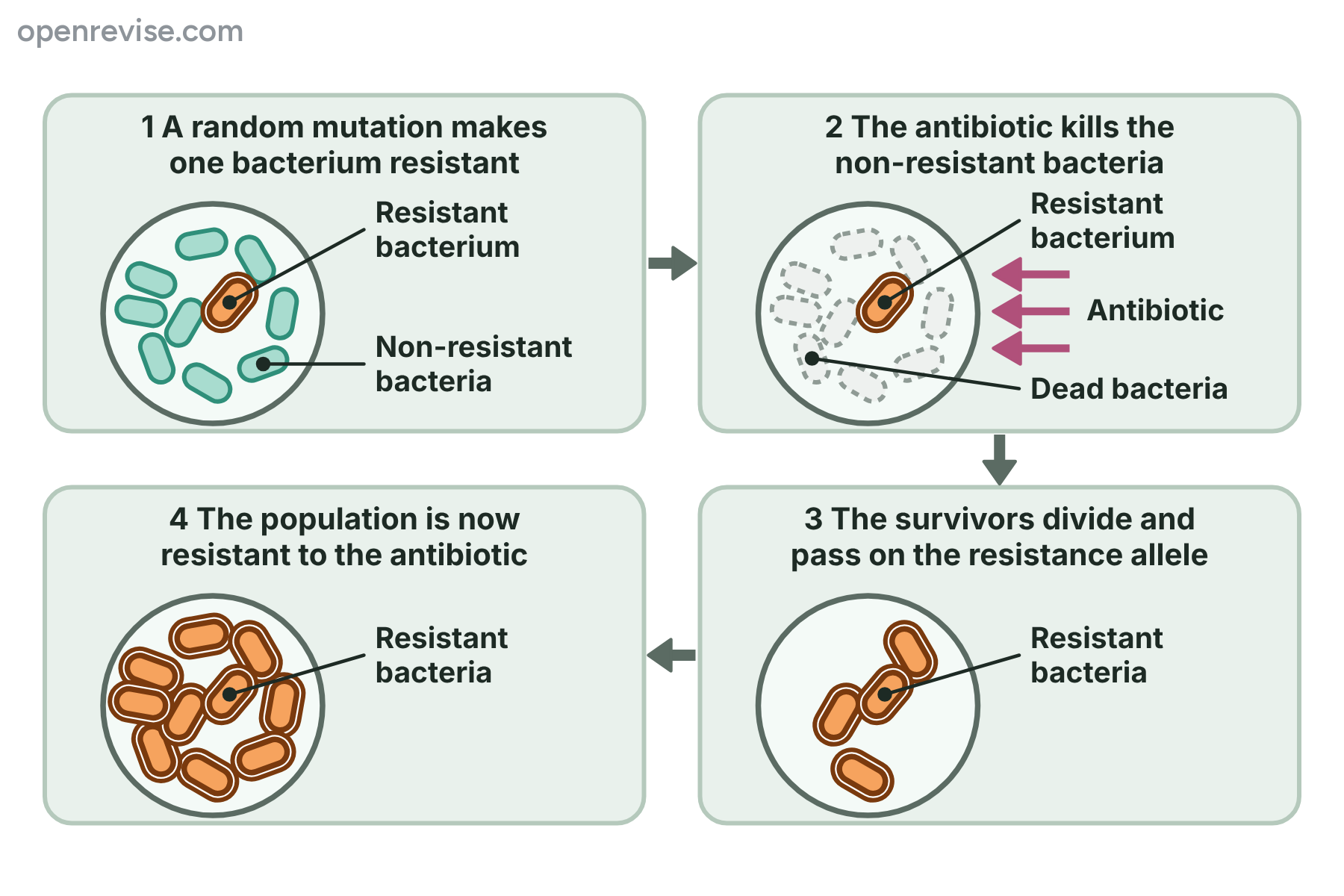
Getting the words right
- Correct The bacteria become resistant to the antibiotic; A mutation, by chance, makes a bacterium resistant; The antibiotic kills the non-resistant bacteria
- Common mistakes The person becomes resistant to the antibiotic; The bacteria mutate because of the antibiotic; The bacteria get used to the antibiotic
How resistance evolves
- Mutation By chance, a mutation in one bacterium gives it an allele that…
- Selection When the antibiotic is used, it kills the non-resistant bacteria.
- Reproduction With no competition, the survivor divides again and again.
- A resistant population After a few generations most of the bacteria are resistant.
Biology · OCR Paper 2
Natural Selection and Evolution continued
Classification and Molecular Phylogenetics
The best classification shows how organisms are related, and DNA sequencing gives the most reliable evidence of that.
- Classification The sorting of living things into groups.
- Artificial classification Grouping organisms by a few easily seen features, which may not show how they are related.
- Natural classification Grouping organisms by many shared features, so that the groups show evolutionary relationships.
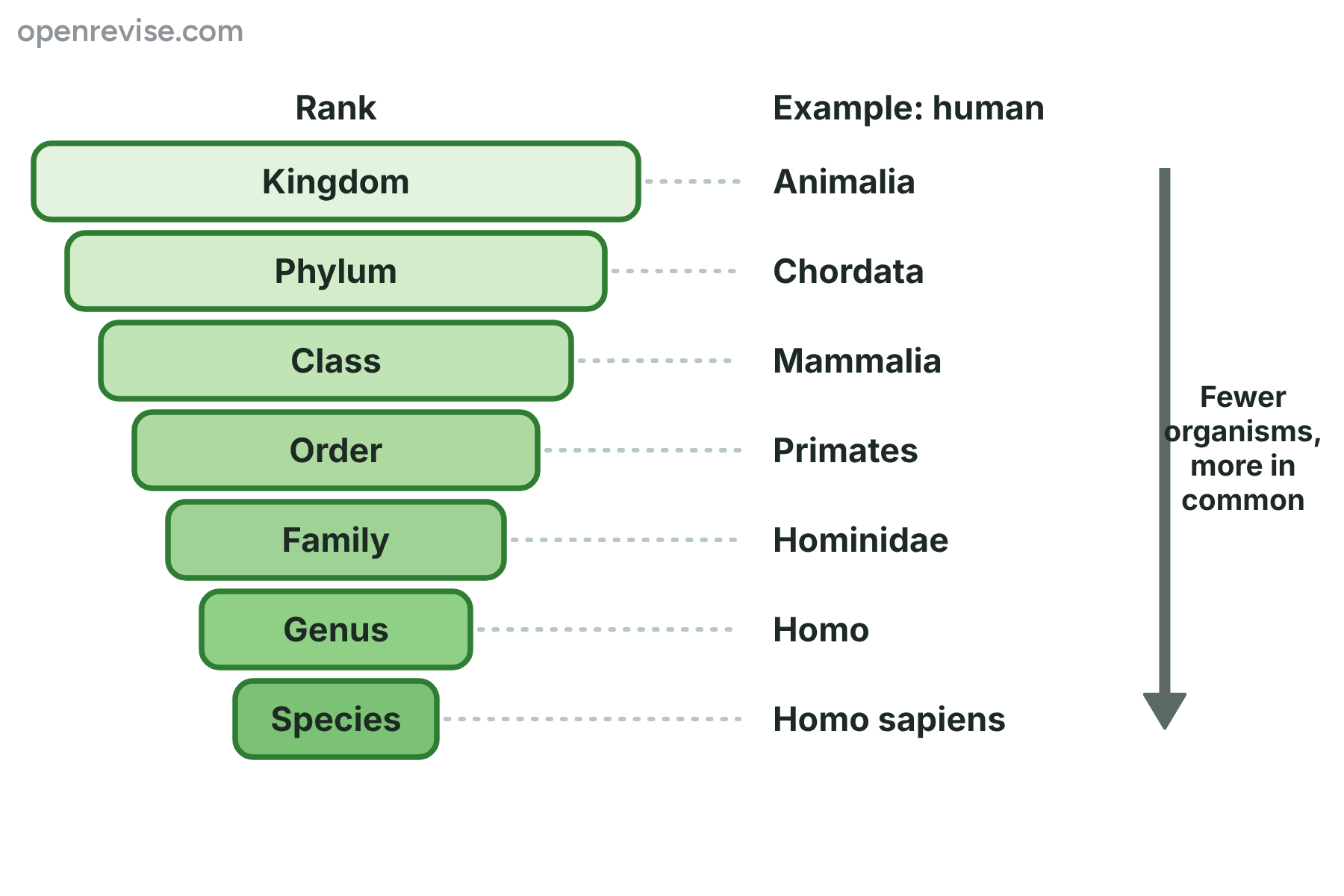
Artificial and natural systems
- Artificial classification Uses one or a few easily seen features; Groups can include unrelated organisms; Does not show evolutionary relationships
- Natural classification Uses many features, now including DNA; Groups contain organisms with a common ancestor; Shows evolutionary relationships
How DNA is used to build an evolutionary tree
- Choose a gene Select a gene that all of the species have.
- Sequence it Use DNA sequencing to read the order of the bases in this gene…
- Compare Line up the sequences and count the bases that are different.
- Link difference to time The more differences there are, the longer ago the two species…
Darwin, Wallace and the Theory of Evolution (Separate only)
Darwin and Wallace explained how species change through natural selection.
- Theory An explanation of observations that has been tested many times and is supported by a lot of evidence.
- Natural selection The process in which the individuals with the variants best suited to the environment survive and breed more.
- Origin of Species The book published by Darwin in 1859 that set out the theory of evolution by natural selection.
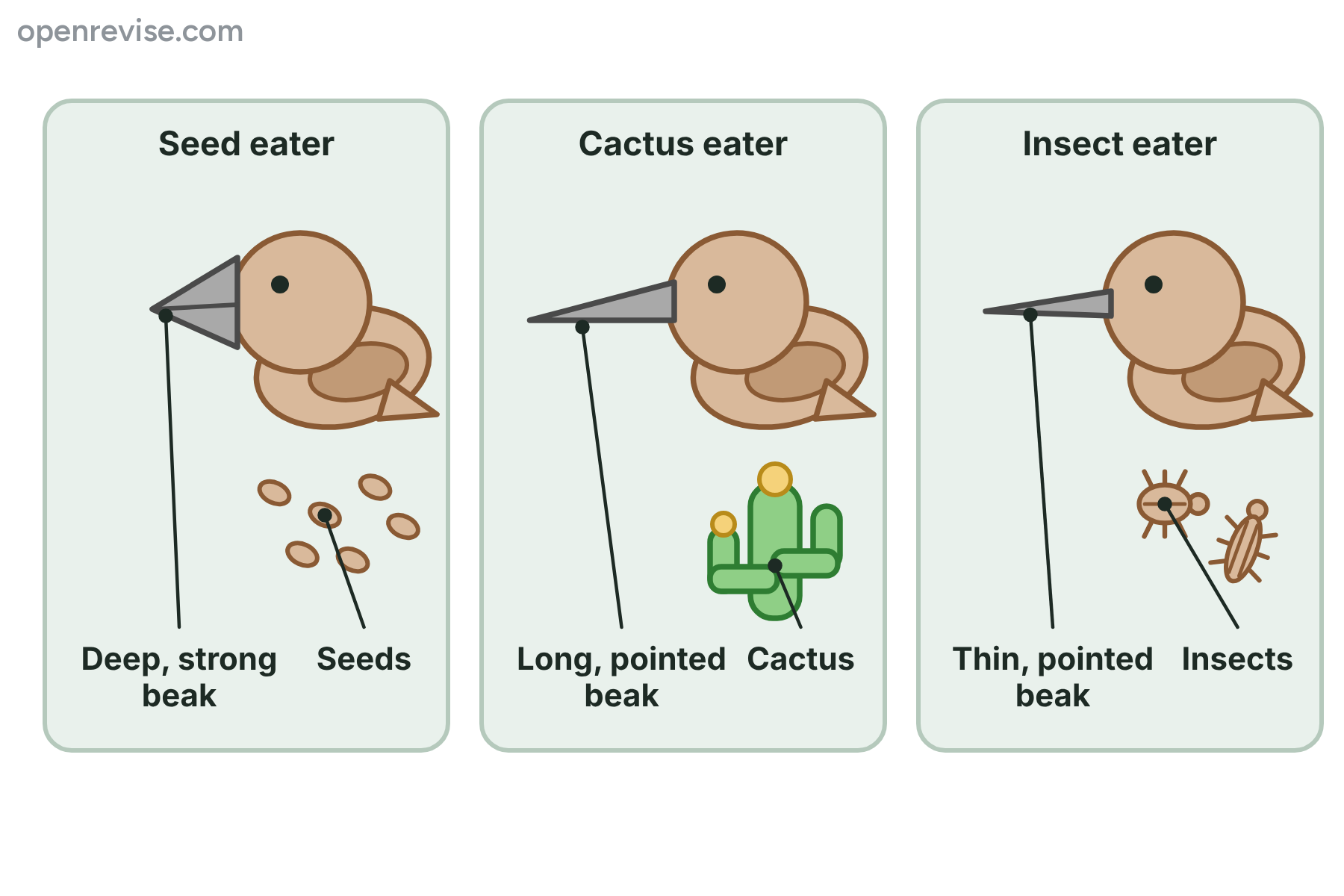
Key dates
- 1831 to 1836 Darwin sails round the world on HMS Beagle as the ship's naturalist
- 1838 Darwin reads an essay about human populations and food by Thomas Malthus.
- 1848 to 1862 Wallace collects specimens in the Amazon, and then in the islands of what is now Indonesia
- 1858 Wallace sends Darwin an essay setting out the same idea, and the two are announced together
- 1859 Darwin publishes On the Origin of Species by Means of Natural Selection
Seedbanks: benefits and limits
- Benefits Store the genetic variation of many species in a small space; Protect against extinction and loss of crop varieties; Seeds can be grown to restore wild populations
- Limits They store only plants, not animals; Stored seeds do not evolve to meet a changing environment; They need power, money and regular testing
How the theory came to be accepted
- 1860s More fossils were found, including Archaeopteryx in 1861.
- 1900 Mendel's work on inheritance, published in 1866 but ignored, was…
- 1930s and 1940s Scientists combined genetics with natural selection, showing how…
- 1953 onwards The structure of DNA was found.