Biology · Digestion and Enzymes
Viewing as
Teaching this? The teacher view opens every answer and mark scheme.
Digestive Enzymes and Bile
Starch, protein and fat each need a different enzyme. This lesson names the digestive enzymes, says where they are made and what they produce, and explains the part played by bile, which is not an enzyme but makes fat digestion faster.
Learning Objectives
- 1Name the three groups of digestive enzymes and the large molecules each one breaks down.
- 2Name the small molecules made when carbohydrates, proteins and lipids are digested.
- 3State where amylase, protease and lipase are made.
- 4Explain how bile neutralises stomach acid and emulsifies fat, and why this speeds up digestion.
- 5Explain what the products of digestion are used for.
Retrieval practice
-
1
What is an enzyme?
Show answerHide answer
A biological catalyst, made of protein, that speeds up a reaction.
-
2
Why is an enzyme specific?
Show answerHide answer
The shape of its active site fits only one substrate.
-
3
What happens to an enzyme at a very high temperature?
Show answerHide answer
It is denatured: its shape, including the active site, changes.
-
4
Which organ makes bile?
Show answerHide answer
The liver.
Three jobs, three kinds of enzyme
The food you eat contains three main kinds of large molecule: carbohydrates (mostly starch), proteins and lipids (fats and oils). Because enzymes are specific, no single enzyme can digest all three. The body makes a different enzyme for each, and all of them work outside the cells, in the gut. Digestive enzymes are made in glands and in the lining of the gut, and they are released into the food as it passes by. The result is a mixture of small, soluble molecules that can be absorbed into the blood.
The digestive enzymes and what they make
Digestive enzymes are named after the type of molecule they break down.
-
Carbohydrases
Break down carbohydrates into simple sugars. Amylase is a carbohydrase that breaks starch down into simple sugars, such as glucose.
-
Proteases
Break down proteins into amino acids.
-
Lipases
Break down lipids (fats and oils) into glycerol and fatty acids.
-
Why break them down
The products are small and soluble, so they can pass through the wall of the small intestine into the blood. The large molecules cannot.
Large molecules in, small molecules out
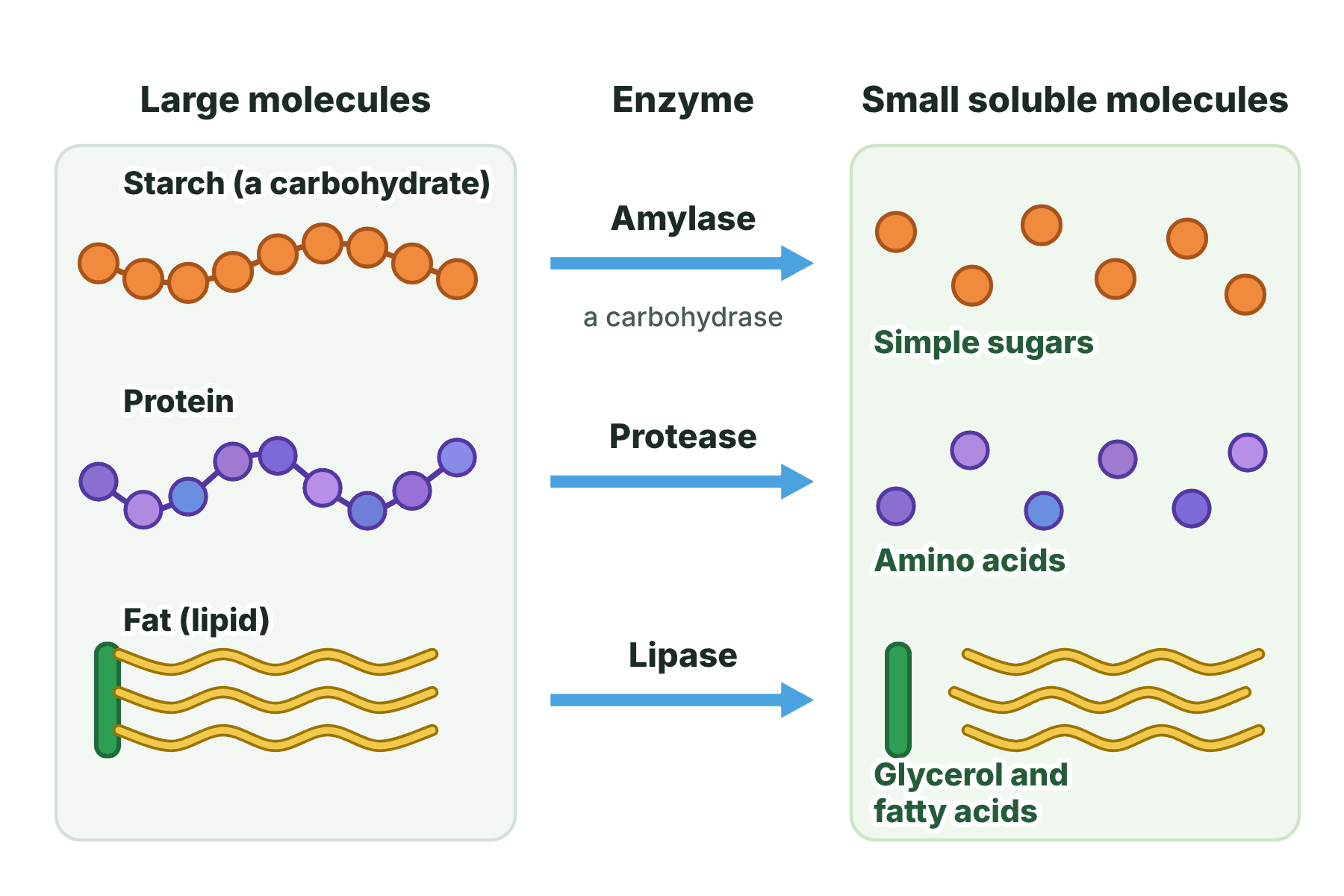
Each enzyme breaks one kind of large molecule into its small building blocks.
Where the enzymes are made
The enzymes are made in different places, and many of them are made in more than one.
-
Amylase
Made in the salivary glands, the pancreas and the small intestine.
-
Protease
Made in the stomach, the pancreas and the small intestine.
-
Lipase
Made in the pancreas and the small intestine.
-
The pancreas
Makes all three kinds of enzyme and releases them into the small intestine.
-
Where they work
Amylase begins digesting starch in the mouth. Protease begins digesting protein in the stomach. All three are active in the small intestine, where digestion is completed.
Where each enzyme is made
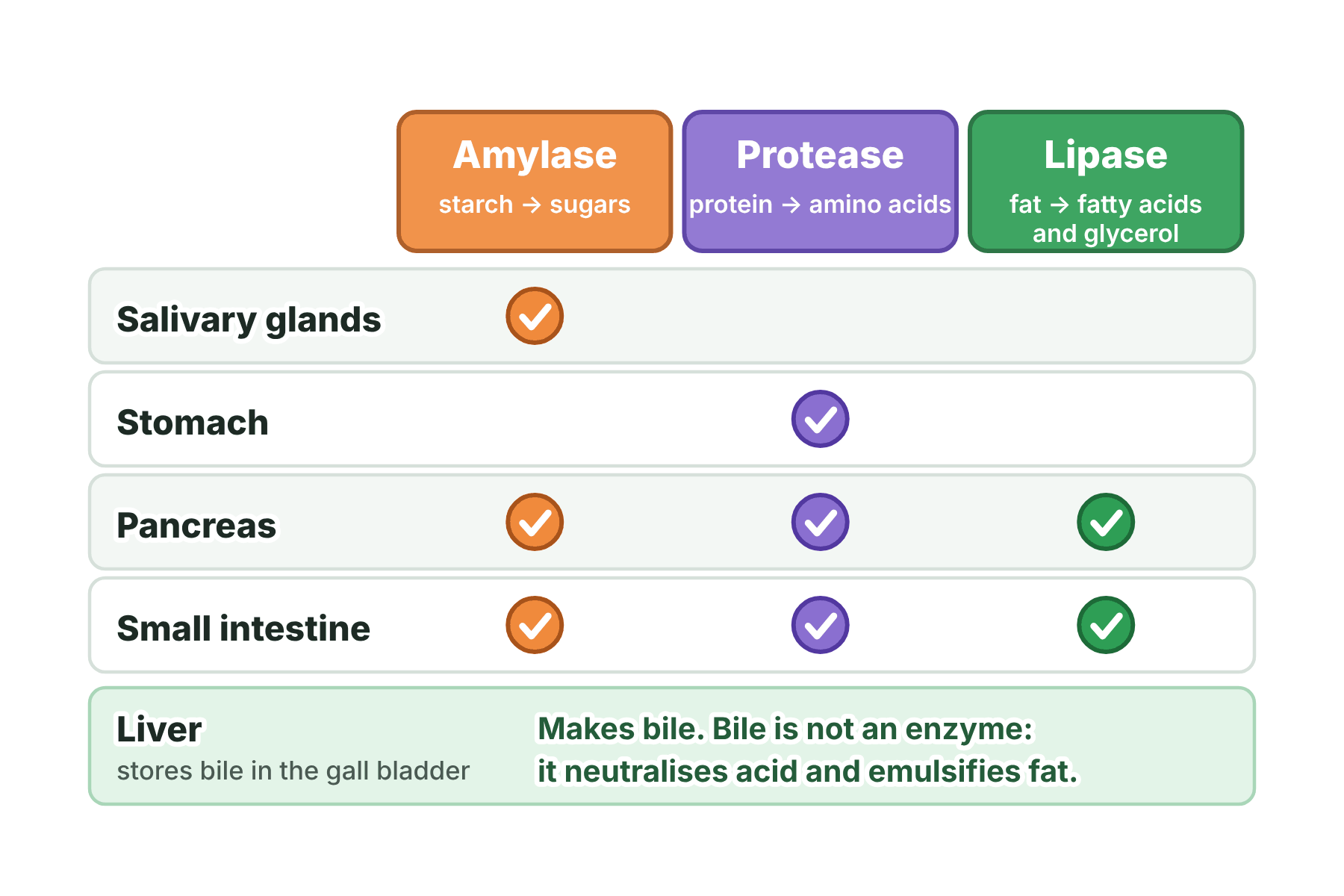
The pancreas and small intestine make all three enzymes. The liver makes bile, which is not an enzyme.
Bile and fat digestion
Bile is a fluid that helps digest fat, but it is not an enzyme and it does not break down molecules. It does two things.
-
Where it comes from
Bile is made in the liver, stored in the gall bladder and released into the small intestine.
-
It is alkaline
The food that leaves the stomach is acidic, because of the hydrochloric acid. This acid would stop the enzymes in the small intestine from working. Bile neutralises the acid and makes the conditions slightly alkaline, which suits these enzymes.
-
It emulsifies fat
Bile breaks large drops of fat into many tiny droplets. This is called emulsification.
-
A larger surface area
Many small droplets have a much bigger total surface area than one large drop. Lipase can only work on the surface of the fat, so with more surface it digests the fat faster.
How bile helps lipase
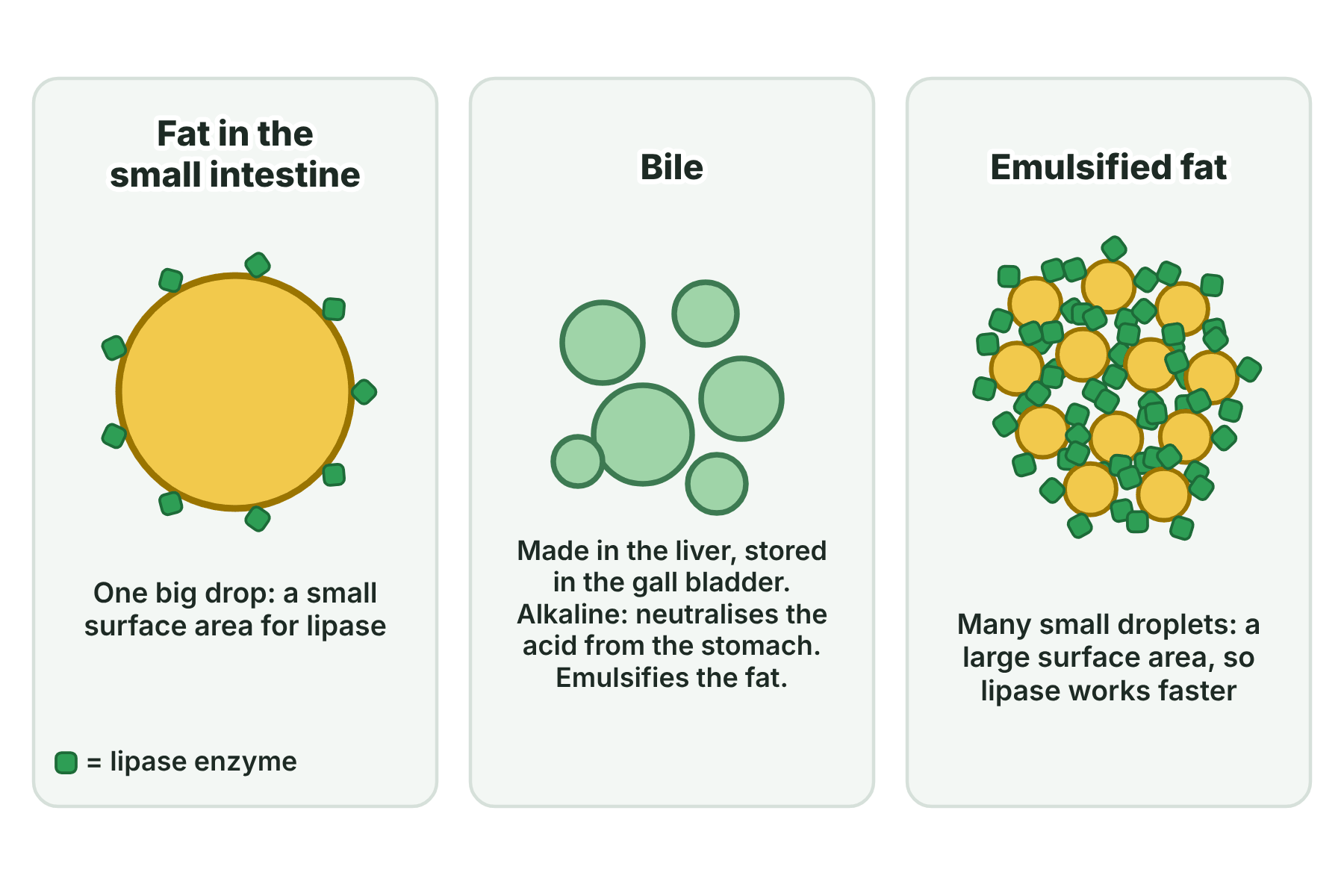
Emulsifying the fat gives lipase a larger surface to work on, so digestion is faster.
Why smaller droplets mean a bigger surface area
A cube of fat has sides of 2 cm. Bile splits it into eight cubes, each with sides of 1 cm. Compare the total surface area before and after.
Show the solutionHide the solution
- 1 One 2 cm cube Surface area = 6 faces × (2 × 2) = 24 cm².
- 2 Eight 1 cm cubes Each has an area of 6 × (1 × 1) = 6 cm², so the total is 8 × 6 = 48 cm².
- 3 Compare 48 ÷ 24 = 2. The total volume is still 8 cm³, but there is twice the surface area for lipase to work on.
AnswerThe surface area doubles, from 24 cm² to 48 cm², even though the volume is the same.
Digestive enzymes and bile
Digestive enzymes
- Made by glands and by the lining of the gut
- Are catalysts that break down large molecules chemically
- Specific: each one works on one type of molecule
- Work best at their optimum pH
Bile
- Made in the liver and stored in the gall bladder
- Is not an enzyme, and does not break down molecules
- Alkaline, so it neutralises the acid from the stomach
- Emulsifies fat, giving lipase a bigger surface area
What the products are used for
The soluble products pass into the blood. The blood takes them to cells all over the body, where they have two main uses.
-
Building new molecules
Cells use simple sugars to build new carbohydrates, fatty acids and glycerol to build new lipids, and amino acids to build new proteins.
-
Respiration
Some of the glucose is used in respiration, to release energy.
-
Why so much digesting
The molecules in your food are not the molecules that your body needs. Digestion breaks down the food so that your cells can use the parts to build what they need.
Case study
Lactose-free milk
Milk contains a sugar called lactose, which has to be digested by the enzyme lactase, a carbohydrase. Some people make too little lactase, so the lactose stays in the gut and causes pain and discomfort. In lactose-free milk, the lactase has already been added, so the lactose is broken down into simple sugars before the milk is drunk. It shows that an enzyme is specific: lactase works only on lactose, not on any other sugar.
The three digestive enzymes to learn
Carbohydrases break down carbohydrates into simple sugars, proteases break down proteins into amino acids, and lipases break down lipids into glycerol and fatty acids.
Bile is not an enzyme. It neutralises acid and emulsifies fat.
Digestive enzymes
Digestive enzymes
-
Carbohydrase
- starch to simple sugars: amylase
-
Protease
- protein to amino acids
-
Lipase
- lipid to glycerol and fatty acids
-
Bile
- made in the liver
- stored in the gall bladder
- alkaline
- emulsifies fat
-
Products
- used to build new molecules
- and glucose for respiration
Summary and exam focus
- Carbohydrases break down carbohydrates (such as starch) into simple sugars. Amylase is a carbohydrase.
- Proteases break down proteins into amino acids.
- Lipases break down lipids into glycerol and fatty acids.
- Amylase is made in the salivary glands, pancreas and small intestine. Protease is made in the stomach, pancreas and small intestine. Lipase is made in the pancreas and small intestine.
- Bile is made in the liver and stored in the gall bladder. It is alkaline, and it emulsifies fat.
- The products are used to build new carbohydrates, lipids and proteins, and some glucose is used in respiration.
Exam focus
Explain the role of bile in the digestion of fat. (4 marks) (4 marks)
Give both jobs of bile, and for each say why it matters. Bile is alkaline, so it neutralises the stomach acid and gives the right pH for the enzymes. It also emulsifies fat into small droplets, which gives lipase a larger surface area.
Key terms
The words this lesson expects you to use. Each one is linked from the first place it appears above.
- Carbohydrase
- An enzyme that breaks down carbohydrates into simple sugars.
- Amylase
- A carbohydrase that breaks down starch into simple sugars.
- Protease
- An enzyme that breaks down proteins into amino acids.
- Lipase
- An enzyme that breaks down lipids into glycerol and fatty acids.
- Simple sugars
- The small, soluble molecules that carbohydrates are broken down into, such as glucose.
- Amino acids
- The small molecules that proteins are broken down into.
- Fatty acids and glycerol
- The small molecules that lipids are broken down into.
- Bile
- An alkaline fluid, made in the liver, that neutralises acid and emulsifies fat.
- Emulsify
- To break large drops of fat into many tiny droplets.
- Neutralise
- To remove the acidity of a solution by adding an alkali.
- Surface area
- The total area of the outside of an object. A larger surface area means more space for reactions.
You've finished the notes
Check your understanding
Test yourself while it is fresh. Start with the flashcards, then try the exam questions.
Something here looks wrong?
Tell us what and we will go and look. It goes to whoever writes these pages, nobody else, and we do not ask who you are — so there is nothing to sign and nothing comes back to you.