Exam questions · Biology · Transport in Cells
Active Transport
- 10 exam questions
- 28 marks
- 10 quick checks
-
1 State [1 mark]
State what is needed for active transport.
Show answerHide answer
Model answer
Energy (from respiration).
Mark scheme
- Energy from respiration — 1 mark
-
2 Describe [2 marks]
Describe what is meant by active transport.
Show answerHide answer
Model answer
The movement of substances from a more dilute solution to a more concentrated solution (against a concentration gradient), using energy from respiration.
Mark scheme
- Movement from dilute to concentrated / against a concentration gradient — 1 mark
- Needs energy from respiration — 1 mark
-
3 Name [4 marks]
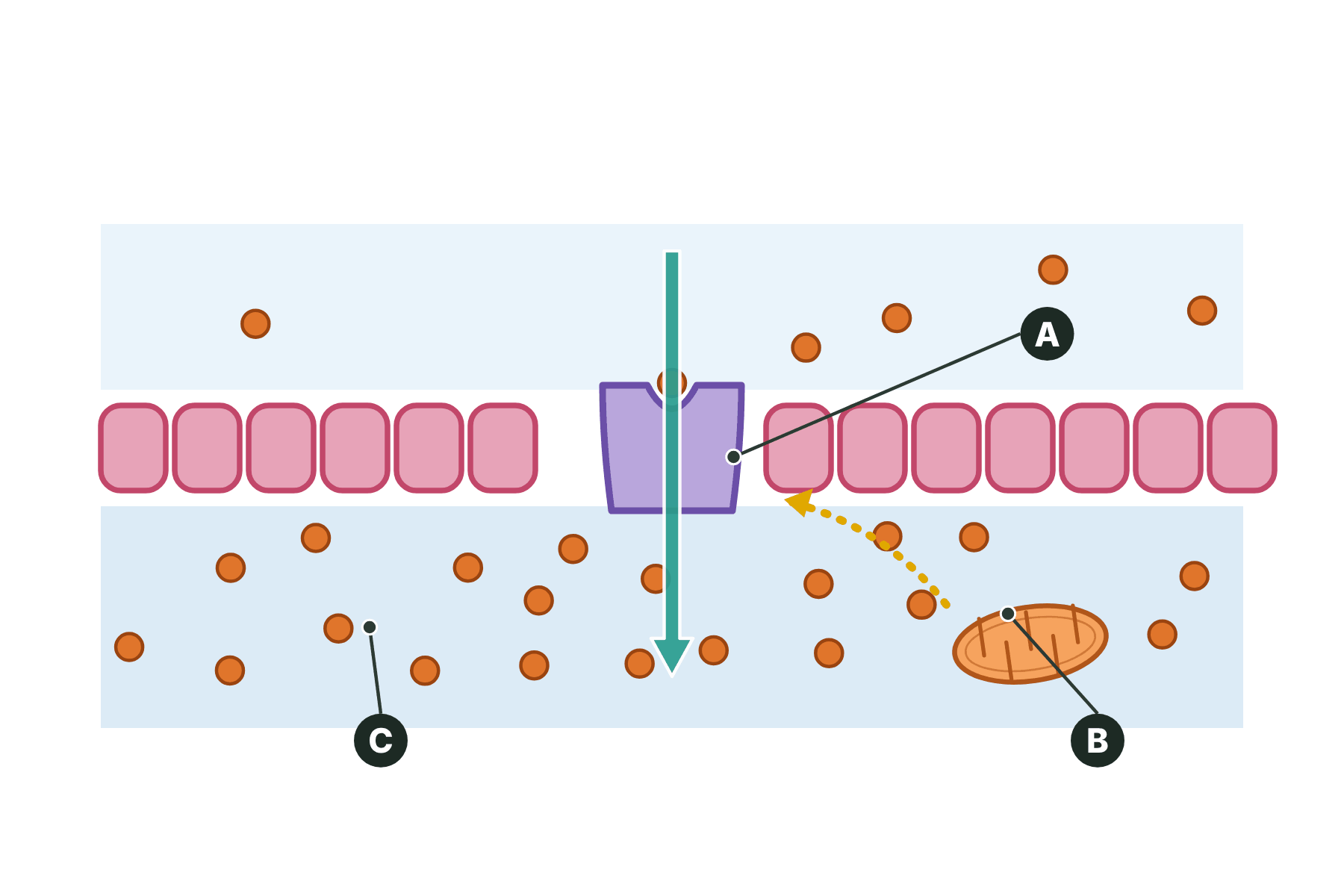
Figure 1 shows ions being taken into a cell. A is a carrier protein. Name the structure B, name the process shown, and explain how you know it is that process.
Show answerHide answer
Model answer
B is a mitochondrion. The process is active transport. The ions move from a lower to a higher concentration, which is against the concentration gradient, and the mitochondrion supplies energy from respiration, which diffusion would not need.
Mark scheme
- B: mitochondrion — 1 mark
- Active transport — 1 mark
- Ions move from lower to higher concentration / against the gradient — 1 mark
- Needs energy from respiration — 1 mark
-
4 Give [1 mark]
Give one example of active transport in a plant.
Show answerHide answer
Model answer
Mineral ions being taken into root hair cells from the soil.
Mark scheme
- Mineral ions into root hair cells — 1 mark
-
5 Explain [3 marks]
Explain why root hair cells take up mineral ions by active transport and not by diffusion.
Show answerHide answer
Model answer
The concentration of mineral ions in the soil solution is lower than in the root hair cell. Diffusion only moves substances from a higher to a lower concentration. Active transport can move ions against the concentration gradient, using energy.
Mark scheme
- Lower concentration of ions in the soil than in the cell — 1 mark
- Diffusion would not move ions into the cell / only goes down the gradient — 1 mark
- Active transport moves them against the gradient using energy — 1 mark
-
6 Explain [2 marks]
Sugar is absorbed from the gut into the blood by active transport. Explain why the sugar must be absorbed.
Show answerHide answer
Model answer
Sugar molecules are used for cell respiration, so the body needs to absorb them.
Mark scheme
- Sugar is used for respiration — 1 mark
- To release energy for the body's cells — 1 mark
-
7 Explain [3 marks]
Root hair cells contain large numbers of mitochondria. Explain why.
Show answerHide answer
Model answer
Mitochondria release energy by respiration. Root hair cells take up mineral ions by active transport, which needs energy. So they need many mitochondria to supply it.
Mark scheme
- Mitochondria release energy / respiration — 1 mark
- Active transport needs energy — 1 mark
- Root hair cells take in ions by active transport — 1 mark
-
8 Explain [3 marks]
A farmer notices that plants in waterlogged soil take up fewer mineral ions, although the soil contains plenty. Use ideas about active transport to explain why.
Show answerHide answer
Model answer
Waterlogged soil contains little oxygen, so the root cells respire less. They release less energy, and active transport of mineral ions needs energy. So fewer ions are taken up.
Mark scheme
- Little oxygen in the waterlogged soil, so less respiration — 1 mark
- Less energy released — 1 mark
- Active transport of ions needs energy, so less uptake — 1 mark
-
9 Compare [3 marks]
Give three differences between diffusion and active transport.
Show answerHide answer
Model answer
Diffusion moves substances from a higher to a lower concentration, but active transport moves them from a lower to a higher concentration. Diffusion does not need energy, but active transport needs energy from respiration. Diffusion goes down the concentration gradient, but active transport goes against it.
Mark scheme
- Direction: high to low (diffusion) compared with low to high (active transport) — 1 mark
- Diffusion needs no energy, active transport does — 1 mark
- Down the gradient compared with against the gradient — 1 mark
-
10 Compare [6 marks]
Compare diffusion, osmosis and active transport.
Show answerHide answer
Model answer
Diffusion is the net movement of particles from a higher to a lower concentration, down the concentration gradient, and needs no energy. Osmosis is the diffusion of water only, from a dilute solution to a concentrated solution through a partially permeable membrane, and needs no energy. Active transport moves substances from a more dilute to a more concentrated solution, against a concentration gradient, and needs energy from respiration.
Mark scheme
- Diffusion: particles from high to low concentration — 1 mark
- Diffusion needs no energy — 1 mark
- Osmosis: water only — 1 mark
- Osmosis: dilute to concentrated through a partially permeable membrane — 1 mark
- Active transport: dilute to concentrated (against the gradient) — 1 mark
- Active transport needs energy from respiration — 1 mark
Quick check
-
1
What does active transport need?
Show answerHide answer
C: Energy from respiration
Active transport needs energy from respiration, because it moves substances against a concentration gradient.
-
2
In which direction does active transport move substances?
Show answerHide answer
A: From low concentration to high concentration
Active transport moves substances from a more dilute to a more concentrated solution, against the concentration gradient.
-
3
Which structures supply the energy for active transport?
Show answerHide answer
D: Mitochondria
Mitochondria release energy from respiration, so cells that do a lot of active transport have many of them.
-
4
Which of these is an example of active transport?
Show answerHide answer
B: Mineral ions moving into root hair cells
Root hair cells take in mineral ions from the very dilute soil solution by active transport.
-
5
Why do plants need mineral ions?
Show answerHide answer
A: For healthy growth
Plants need ions for healthy growth, for example nitrate to make proteins and magnesium to make chlorophyll.
-
6
Sugar concentration is lower in the gut than in the blood. How does sugar move into the blood?
Show answerHide answer
C: By active transport
It has to move against the concentration gradient, so it is absorbed by active transport.
-
7
Which process needs no energy from the cell?
Show answerHide answer
D: Diffusion and osmosis
Diffusion and osmosis are passive processes, which move things down a gradient without energy from the cell.
-
8
What happens to active transport if respiration in a cell stops?
Show answerHide answer
B: It stops or slows down
Active transport needs energy from respiration, so it stops or slows down.
-
9
Which statement about osmosis is correct?
Show answerHide answer
A: It needs no energy and moves only water
Osmosis is the diffusion of water from a dilute solution to a concentrated solution through a partially permeable membrane. It needs no energy.
-
10
A cell takes in a substance from a place where it is at a lower concentration. Which is the most likely process?
Show answerHide answer
C: Active transport
Moving a substance from a lower to a higher concentration is against the gradient, so it must be active transport.