Exam questions · Biology · Transport in Cells
Investigating Osmosis in Plant Tissue
- 10 exam questions
- 26 marks
- 10 quick checks
-
1 State [2 marks]
State two variables that should be controlled in the investigation.
Show answerHide answer
Model answer
Any two from: the length (and width) of the potato cylinders; the volume of the solutions; the time the cylinders are left in the solutions; the temperature; the type of potato.
Mark scheme
- Size / length of cylinder — 1 mark
- Volume of solution — 1 mark
- Time in solution — 1 mark
- Temperature / type of potato — 1 mark
-
2 Explain [2 marks]
Explain why the potato cylinders are blotted dry before their final mass is measured.
Show answerHide answer
Model answer
To remove solution from the surface of the cylinder. Any left on the surface would add mass, so the result would not be due only to osmosis.
Mark scheme
- To remove liquid from the surface — 1 mark
- Because it would add extra mass / give an inaccurate result — 1 mark
-
3 Calculate [2 marks]
A potato cylinder has a mass of 2.50 g at the start and 2.85 g at the end. Calculate the percentage change in mass.
Show answerHide answer
Model answer
(2.85 − 2.50) ÷ 2.50 × 100 = +14%.
Mark scheme
- 0.35 ÷ 2.50 — 1 mark
- +14 (%) — 1 mark
-
4 Calculate [3 marks]
A potato cylinder has a mass of 3.20 g at the start and 2.72 g at the end. Calculate the percentage change in mass.
Show answerHide answer
Model answer
(2.72 − 3.20) ÷ 3.20 × 100 = −15%.
Mark scheme
- Change = −0.48 g — 1 mark
- −0.48 ÷ 3.20 × 100 — 1 mark
- −15 (%) — 1 mark
-
5 Explain [3 marks]
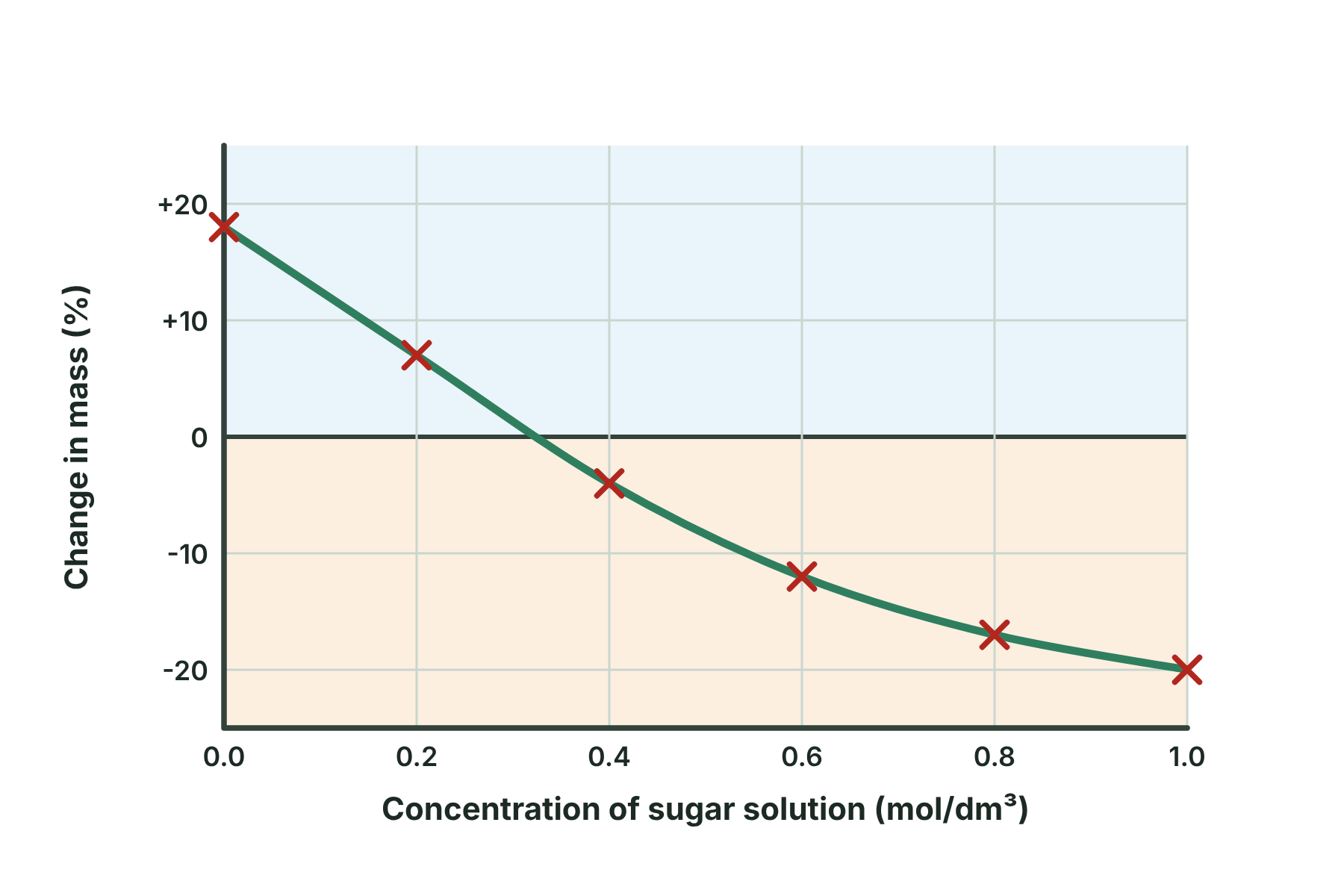
Figure 1 shows the results of an investigation into the effect of sugar concentration on potato cylinders. Estimate the concentration at which there is no change in mass, and explain what this tells you.
Show answerHide answer
Model answer
About 0.33 mol/dm³ (accept 0.30 to 0.35), where the line crosses 0% change. At this concentration the solution is the same as the concentration of the potato cells, so there is no net movement of water.
Mark scheme
- 0.30 to 0.35 mol/dm³ — 1 mark
- Same concentration as the potato cells — 1 mark
- So no net movement of water by osmosis — 1 mark
-
6 Use the graph [2 marks]
Use Figure 1 to give the percentage change in mass in the solution of concentration 0.6 mol/dm³, and say what this shows about the movement of water.
Show answerHide answer
Model answer
−12% (accept −11 to −13). A loss of mass shows that water moved out of the potato by osmosis.
Mark scheme
- −12% — 1 mark
- Water left the potato (by osmosis) — 1 mark
-
7 Explain [2 marks]
The potato cylinders in the most concentrated solutions lost mass. Explain why.
Show answerHide answer
Model answer
The solution was more concentrated than the cell sap in the potato. Water moved out of the potato cells into the solution by osmosis, so the mass fell.
Mark scheme
- Solution more concentrated than the potato cell sap — 1 mark
- Water left the cells by osmosis — 1 mark
-
8 Explain [2 marks]
A student calculates the percentage change in mass for each cylinder instead of just the change in mass. Explain why.
Show answerHide answer
Model answer
The cylinders do not all start with exactly the same mass, so a percentage of the starting mass allows a fair comparison.
Mark scheme
- Cylinders have different starting masses — 1 mark
- Percentage change allows a fair comparison — 1 mark
-
9 Suggest [2 marks]
Suggest two ways in which the student could make the results more reliable.
Show answerHide answer
Model answer
Repeat the investigation with several cylinders in each solution and calculate a mean; check for anomalous results; keep the control variables the same each time.
Mark scheme
- Repeat and calculate a mean — 1 mark
- Spot and deal with any anomalous results / control variables carefully — 1 mark
-
10 Describe [6 marks]
Describe how you would carry out an investigation into the effect of sugar concentration on the mass of potato cylinders.
Show answerHide answer
Model answer
Cut cylinders of potato of the same length with a cork borer. Measure the mass of each cylinder. Put the same volume of different concentrations of sugar solution into test tubes, including pure water. Put one cylinder in each tube and leave them for the same length of time at the same temperature. Take the cylinders out, blot them dry and measure the mass of each again. Calculate the percentage change in mass for each, and repeat the investigation to calculate a mean.
Mark scheme
- Cut identical cylinders of potato — 1 mark
- Measure the starting mass — 1 mark
- Same volume of different concentrations of solution — 1 mark
- Same time (and temperature) in the solutions — 1 mark
- Blot dry and measure the final mass — 1 mark
- Calculate the percentage change / repeat and take a mean — 1 mark
Quick check
-
1
What is the independent variable in the potato investigation?
Show answerHide answer
B: The concentration of the solution
The independent variable is the one you change: the concentration of the solution.
-
2
What is the dependent variable?
Show answerHide answer
A: The percentage change in mass
The dependent variable is what you measure: the percentage change in mass of the potato.
-
3
A potato cylinder gains mass in a solution. What does this show?
Show answerHide answer
C: The solution was more dilute than the cell sap
The potato gained water by osmosis, so the solution was more dilute than the potato cell sap.
-
4
A cylinder goes from 2.00 g to 1.80 g. What is the percentage change in mass?
Show answerHide answer
D: −10%
The change is −0.20 g. Dividing by the start mass gives −0.1, so the change is −10%.
-
5
Why is the surface of each cylinder blotted dry?
Show answerHide answer
B: To remove liquid that would add extra mass
Solution left on the surface would add mass and affect the result.
-
6
On the graph, where does the line cross zero change?
Show answerHide answer
A: At the concentration of the potato cell sap
This is the concentration at which the solution matches the potato cell sap, so there is no net movement of water.
-
7
Which would make the results more reliable?
Show answerHide answer
C: Repeating and calculating a mean
Repeating the test and calculating a mean reduces the effect of random errors and anomalies.
-
8
Which of these is a control variable?
Show answerHide answer
D: The volume of the solution
The volume of the solution has to be the same in every tube. The concentration is what is changed, and the mass is what is measured.
-
9
Why is pure water used as one of the solutions?
Show answerHide answer
A: It is the most dilute solution and gives the zero concentration
Pure water is the most dilute solution, so it shows the biggest gain in mass, and gives a zero point on the concentration scale.
-
10
A student finds the line crosses zero at 0.3 mol/dm³ and wants a more accurate value. What should they do?
Show answerHide answer
B: Use extra solutions with concentrations close to 0.3
Using more solutions close to 0.3, such as 0.25, 0.30 and 0.35 mol/dm³, narrows down where the line crosses zero.