Exam questions · Maths
Circle Theorems
- 30 exam questions
- 102 marks
- 45 quick checks
Angles at the Centre and in a Semicircle
Just this lesson-
1 Work out [2 marks]
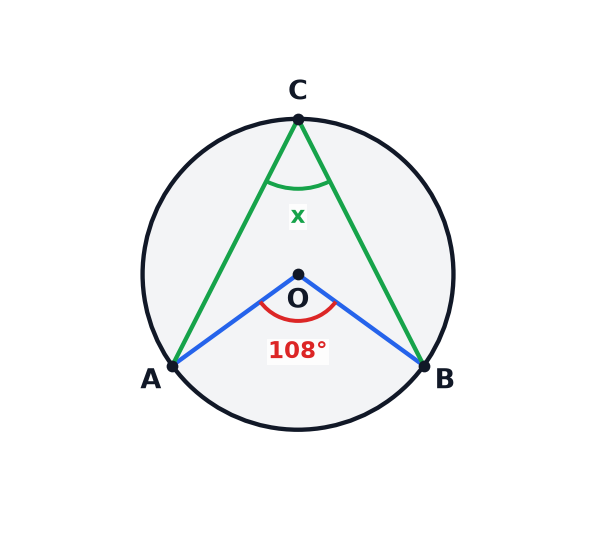
Not drawn accurately. \(A\), \(B\) and \(C\) are points on the circumference of a circle, centre \(O\). Angle \(AOB = 108^\circ\). Work out the size of angle \(ACB\). Give a reason for your answer. [2 marks]
Show answerHide answer
Model answer
Angle \(ACB = 54^\circ\), because the angle at the centre is twice the angle at the circumference.
Mark scheme
- \(54\) — B1
- The angle at the centre is twice the angle at the circumference — Q1
-
2 Work out [3 marks]
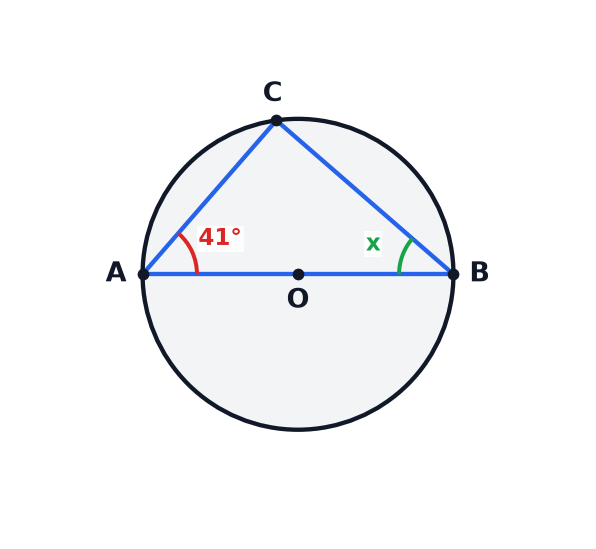
Not drawn accurately. \(AB\) is a diameter of a circle. \(C\) is a point on the circumference. Angle \(ABC = 41^\circ\). Work out the size of angle \(BAC\). Give reasons for your answer. [3 marks]
Show answerHide answer
Model answer
Angle \(ACB = 90^\circ\), because the angle in a semicircle is a right angle. Then \(BAC = 180 - 90 - 41 = 49^\circ\).
Mark scheme
- Angle \(ACB = 90^\circ\) — M1
- \(49\) — A1
- The angle in a semicircle is 90 degrees, and the angles in a triangle add up to 180 degrees — Q1
-
3 Work out [3 marks]
\(A\), \(B\) and \(C\) are points on the circumference of a circle, centre \(O\), with \(C\) on the major arc \(AB\). Angle \(ACB = 5x - 12\) and angle \(AOB = 8x + 12\). Work out the value of \(x\). [3 marks]
Show answerHide answer
Model answer
The angle at the centre is twice the angle at the circumference, so \(8x + 12 = 2(5x - 12) = 10x - 24\). Then \(36 = 2x\) and \(x = 18\).
Mark scheme
- \(8x + 12 = 2(5x - 12)\) — M1
- \(2x = 36\) or equivalent — M1
- \(18\) — A1
-
4 Work out [4 marks]
\(A\), \(B\) and \(C\) are points on the circumference of a circle, centre \(O\), with \(C\) on the major arc \(AB\). Angle \(OBA = 32^\circ\). Work out the size of angle \(ACB\). Give reasons for your answer. [4 marks]
Show answerHide answer
Model answer
\(OA = OB\) because they are radii, so angle \(OAB = 32^\circ\). Angle \(AOB = 180 - 32 - 32 = 116^\circ\). The angle at the centre is twice the angle at the circumference, so \(ACB = 116 \div 2 = 58^\circ\).
Mark scheme
- \(180 - 32 - 32\) or angle \(OAB = 32^\circ\) — M1
- \(116\) — A1
- \(58\) — A1
- Radii make an isosceles triangle, and the angle at the centre is twice the angle at the circumference — Q1
-
5 Work out [4 marks]
\(AB\) is a diameter of a circle. \(C\) is a point on the circumference. \(AC = 24\) cm and \(BC = 7\) cm. Work out the radius of the circle. Give a reason for your answer. [4 marks]
Show answerHide answer
Model answer
Angle \(ACB = 90^\circ\), because the angle in a semicircle is a right angle. \(AB^2 = 24^2 + 7^2 = 576 + 49 = 625\), so \(AB = 25\) cm and the radius is \(12.5\) cm.
Mark scheme
- The angle in a semicircle is a right angle — Q1
- \(24^2 + 7^2\) or \(576 + 49\) — M1
- \(AB = 25\) — A1
- \(12.5\) — A1
-
6 Work out [3 marks]
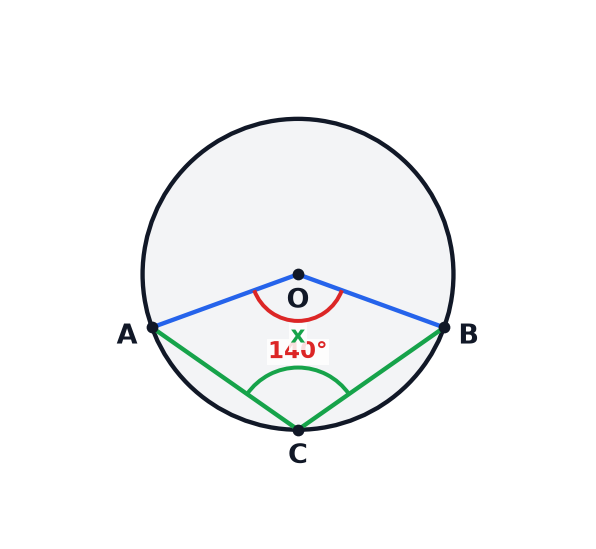
Not drawn accurately. \(A\), \(B\) and \(C\) are points on the circumference of a circle, centre \(O\). Angle \(AOB = 140^\circ\), and \(C\) is on the minor arc \(AB\). Work out the size of angle \(ACB\). Give a reason for your answer. [3 marks]
Show answerHide answer
Model answer
The reflex angle \(AOB = 360 - 140 = 220^\circ\). The angle at the circumference is half of this, so \(ACB = 110^\circ\).
Mark scheme
- \(360 - 140 = 220\) — M1
- \(110\) — A1
- The angle at the centre is twice the angle at the circumference — Q1
Quick check
-
1
The angle at the centre of a circle is \(84^\circ\). What is the angle at the circumference made by the same arc?
Show answerHide answer
B: \(42^\circ\)
The angle at the centre is twice the angle at the circumference, so the angle at the circumference is \(84 \div 2 = 42^\circ\).
-
2
What is the size of an angle in a semicircle?
Show answerHide answer
A: \(90^\circ\)
The angle at the centre on a diameter is \(180^\circ\), so the angle at the circumference is half of it, \(90^\circ\).
-
3
Which reason fits this statement? \(\angle AOB = 2 \times \angle ACB\)
Show answerHide answer
D: The angle at the centre is twice the angle at the circumference
The angle at \(O\), the centre, is double the angle at \(C\), on the circumference.
-
4
\(AB\) is a diameter and \(C\) is on the circle. Angle \(CAB = 35^\circ\). What is angle \(CBA\)?
Show answerHide answer
C: \(55^\circ\)
Angle \(ACB = 90^\circ\) in a semicircle, so \(CBA = 180 - 90 - 35 = 55^\circ\).
-
5
The angle at the circumference is \(3x\) and the angle at the centre on the same arc is \(5x + 20\). What is \(x\)?
Show answerHide answer
B: \(20\)
\(5x + 20 = 2 \times 3x = 6x\), so \(x = 20\).
-
6
In triangle \(OAB\), \(O\) is the centre and \(\angle OAB = 28^\circ\). What is angle \(AOB\)?
Show answerHide answer
A: \(124^\circ\)
\(OA = OB\) are radii, so \(\angle OBA = 28^\circ\) and \(\angle AOB = 180 - 28 - 28 = 124^\circ\).
-
7
\(AB\) is a diameter of length 10 cm and \(AC = 6\) cm. What is \(BC\)?
Show answerHide answer
D: 8 cm
Angle \(ACB = 90^\circ\) in a semicircle, so \(BC^2 = 10^2 - 6^2 = 64\) and \(BC = 8\).
-
8
Two points \(A\) and \(B\) are on a circle with centre \(O\), and \(\angle AOB = 130^\circ\). \(C\) is on the minor arc \(AB\). What is angle \(ACB\)?
Show answerHide answer
C: \(115^\circ\)
The reflex angle at the centre is \(360 - 130 = 230^\circ\), so \(ACB = 230 \div 2 = 115^\circ\).
-
9
Which statement is true for every triangle with a diameter as one side and its third corner on the circle?
Show answerHide answer
B: It is right-angled
The angle opposite the diameter is in a semicircle, so it is always \(90^\circ\).
Same Segment and Cyclic Quadrilaterals
Just this lesson-
1 Work out [2 marks]
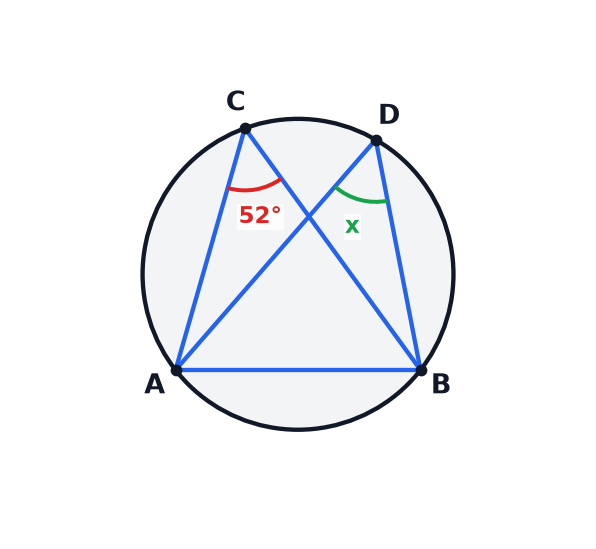
Not drawn accurately. \(A\), \(B\), \(C\) and \(D\) are points on the circumference of a circle. Angle \(ACB = 52^\circ\). Work out the size of angle \(ADB\). Give a reason for your answer. [2 marks]
Show answerHide answer
Model answer
Angle \(ADB = 52^\circ\), because angles in the same segment are equal.
Mark scheme
- \(52\) — B1
- Angles in the same segment are equal — Q1
-
2 Work out [4 marks]
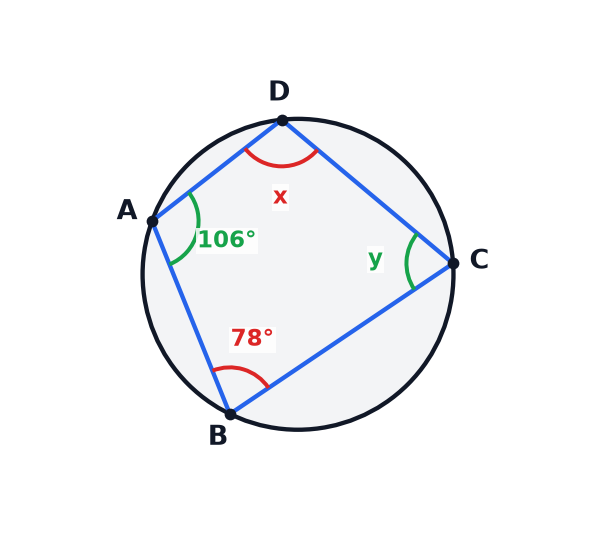
Not drawn accurately. \(ABCD\) is a cyclic quadrilateral. Angle \(BAD = 106^\circ\) and angle \(ABC = 78^\circ\). (a) Work out the size of angle \(BCD\). Give a reason for your answer. [2 marks] (b) Work out the size of angle \(ADC\). [2 marks]
Show answerHide answer
Model answer
(a) \(BCD = 180 - 106 = 74^\circ\), because opposite angles of a cyclic quadrilateral add up to \(180^\circ\). (b) \(ADC = 180 - 78 = 102^\circ\).
Mark scheme
- (a) \(74\) — B1
- (a) Opposite angles of a cyclic quadrilateral add up to 180 degrees — Q1
- (b) \(180 - 78\) — M1
- (b) \(102\) — A1
-
3 Work out [3 marks]
\(ABCD\) is a cyclic quadrilateral. Angle \(A = 4x - 5\) and angle \(C = 2x + 35\). Work out the value of \(x\). [3 marks]
Show answerHide answer
Model answer
Opposite angles add up to \(180^\circ\), so \(4x - 5 + 2x + 35 = 180\). Then \(6x = 150\) and \(x = 25\).
Mark scheme
- \((4x - 5) + (2x + 35) = 180\) — M1
- \(6x + 30 = 180\) or \(6x = 150\) — M1
- \(25\) — A1
-
4 Work out [3 marks]
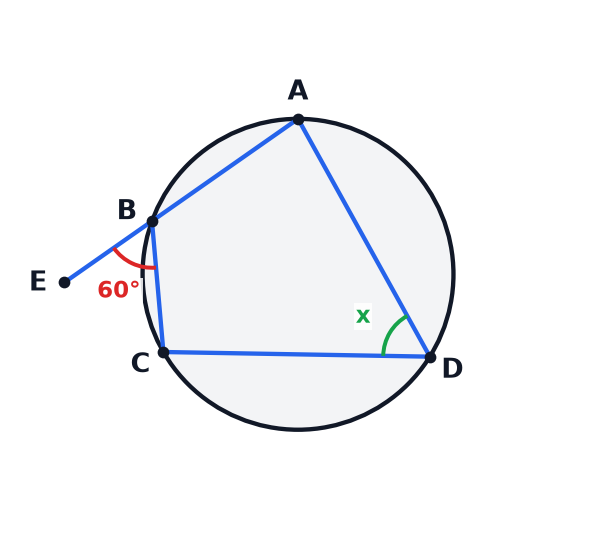
Not drawn accurately. \(ABCD\) is a cyclic quadrilateral. The side \(AB\) is extended to the point \(E\). Angle \(CBE = 60^\circ\). (a) Work out the size of angle \(ABC\). [1 mark] (b) Work out the size of angle \(ADC\). Give a reason for your answer. [2 marks]
Show answerHide answer
Model answer
(a) \(ABC = 180 - 60 = 120^\circ\), because angles on a straight line add up to \(180^\circ\). (b) \(ADC = 180 - 120 = 60^\circ\), because opposite angles of a cyclic quadrilateral add up to \(180^\circ\).
Mark scheme
- (a) \(120\) — B1
- (b) \(60\) — B1
- (b) Opposite angles of a cyclic quadrilateral add up to 180 degrees — Q1
-
5 Work out [4 marks]
\(A\), \(B\), \(C\) and \(D\) are points on the circumference of a circle. The lines \(AC\) and \(BD\) cross at \(E\). Angle \(CAD = 29^\circ\) and angle \(ABC = 97^\circ\). (a) Work out the size of angle \(CBD\). Give a reason for your answer. [2 marks] (b) Work out the size of angle \(ADC\). Give a reason for your answer. [2 marks]
Show answerHide answer
Model answer
(a) \(CBD = 29^\circ\), because angles in the same segment are equal. (b) \(ADC = 180 - 97 = 83^\circ\), because opposite angles of a cyclic quadrilateral add up to \(180^\circ\).
Mark scheme
- (a) \(29\) — B1
- (a) Angles in the same segment are equal — Q1
- (b) \(83\) — B1
- (b) Opposite angles of a cyclic quadrilateral add up to 180 degrees — Q1
-
6 Show that [3 marks]
\(ABCD\) is a parallelogram. Angle \(A = 70^\circ\). Show that \(ABCD\) cannot be a cyclic quadrilateral. [3 marks]
Show answerHide answer
Model answer
Opposite angles of a parallelogram are equal, so angle \(C = 70^\circ\). Then \(70 + 70 = 140\), which is not \(180^\circ\), so the opposite angles do not add up to \(180^\circ\) and \(ABCD\) is not cyclic.
Mark scheme
- Opposite angles of a parallelogram are equal, so \(C = 70^\circ\) — M1
- \(70 + 70 = 140\) — M1
- States that 140 is not 180, so the quadrilateral is not cyclic — Q1
Quick check
-
1
Two angles are in the same segment of a circle. One is \(47^\circ\). What is the other?
Show answerHide answer
C: \(47^\circ\)
Angles in the same segment are equal.
-
2
What do opposite angles of a cyclic quadrilateral add up to?
Show answerHide answer
B: \(180^\circ\)
This is the cyclic quadrilateral theorem.
-
3
A cyclic quadrilateral has an angle of \(112^\circ\). What is the opposite angle?
Show answerHide answer
A: \(68^\circ\)
\(180 - 112 = 68\).
-
4
What is a cyclic quadrilateral?
Show answerHide answer
D: A quadrilateral with all four corners on a circle
“Cyclic” means all the corners lie on one circle.
-
5
In a cyclic quadrilateral \(ABCD\), \(\angle A = 2x + 10\) and \(\angle C = 3x + 20\). What is \(x\)?
Show answerHide answer
C: \(30\)
\(5x + 30 = 180\), so \(5x = 150\) and \(x = 30\).
-
6
\(ABCD\) is cyclic and the side \(AB\) is extended to \(E\). Angle \(CBE = 70^\circ\). What is angle \(ADC\)?
Show answerHide answer
B: \(70^\circ\)
An exterior angle of a cyclic quadrilateral equals the interior opposite angle.
-
7
Which of these must be true for the angles \(ACB\) and \(ADB\) to be equal?
Show answerHide answer
A: \(C\) and \(D\) are on the same side of the chord \(AB\)
Angles in the same segment are made on the same side of a chord.
-
8
A quadrilateral has opposite angles of \(95^\circ\) and \(80^\circ\). Can it be cyclic?
Show answerHide answer
D: No, because \(95 + 80 \ne 180\)
Opposite angles of a cyclic quadrilateral must add up to \(180^\circ\), and \(95 + 80 = 175\).
-
9
\(A\), \(B\), \(C\) and \(D\) are on a circle, with \(AC\) and \(BD\) meeting at \(E\). Angle \(CAD = 36^\circ\). What is angle \(CBD\)?
Show answerHide answer
C: \(36^\circ\)
Angles \(CAD\) and \(CBD\) are made by the chord \(CD\) on the same side, so they are equal.
Tangents and Chords
Just this lesson-
1 Work out [3 marks]
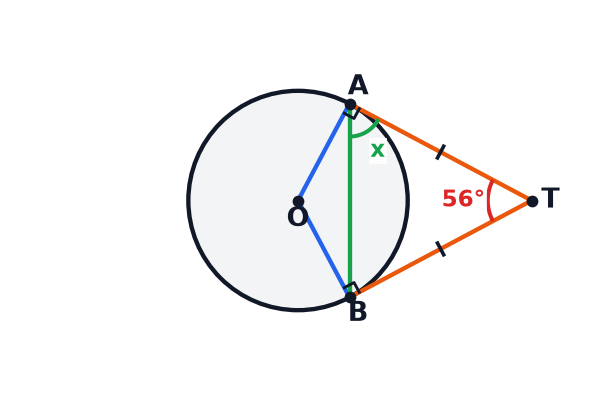
Not drawn accurately. \(TA\) and \(TB\) are tangents to a circle, centre \(O\). Angle \(ATB = 56^\circ\). Work out the size of angle \(TAB\). Give a reason for your answer. [3 marks]
Show answerHide answer
Model answer
\(TA = TB\), because tangents from a point to a circle are equal, so triangle \(TAB\) is isosceles. Angle \(TAB = (180 - 56) \div 2 = 62^\circ\).
Mark scheme
- Tangents from a point are equal, so triangle TAB is isosceles — Q1
- \((180 - 56) \div 2\) — M1
- \(62\) — A1
-
2 Work out [3 marks]
\(PT\) is a tangent to a circle, centre \(O\), touching the circle at \(T\). The radius of the circle is 9 cm and \(OP = 15\) cm. Work out the length of \(PT\). [3 marks]
Show answerHide answer
Model answer
The tangent is perpendicular to the radius, so angle \(OTP = 90^\circ\). \(PT^2 = 15^2 - 9^2 = 225 - 81 = 144\), so \(PT = 12\) cm.
Mark scheme
- Angle OTP is a right angle, as a tangent is perpendicular to the radius — Q1
- \(15^2 - 9^2\) or \(225 - 81\) — M1
- \(12\) — A1
-
3 Work out [3 marks]
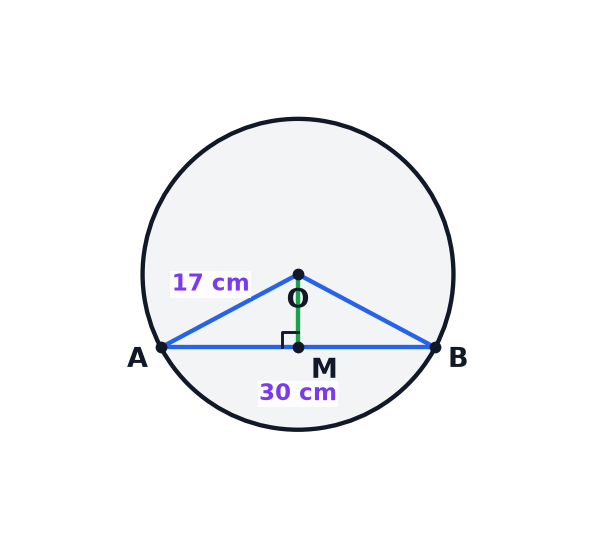
Not drawn accurately. \(AB\) is a chord of a circle, centre \(O\), with radius 17 cm. \(AB = 30\) cm. \(M\) is the point on \(AB\) where \(OM\) is perpendicular to \(AB\). Work out the length of \(OM\). [3 marks]
Show answerHide answer
Model answer
The perpendicular from the centre bisects the chord, so \(AM = 15\) cm. \(OM^2 = 17^2 - 15^2 = 289 - 225 = 64\), so \(OM = 8\) cm.
Mark scheme
- \(AM = 15\) — M1
- \(17^2 - 15^2\) — M1
- \(8\) — A1
-
4 Work out [4 marks]
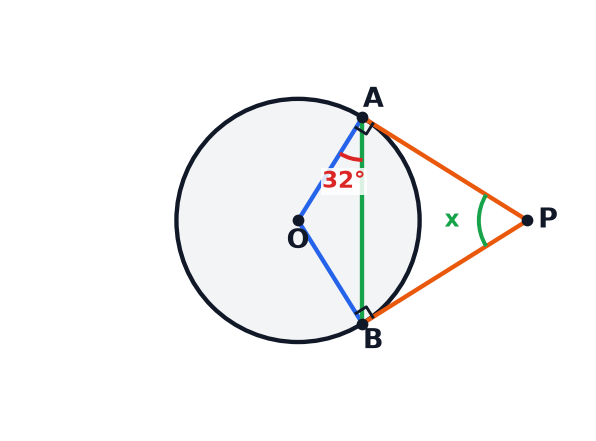
Not drawn accurately. \(PA\) and \(PB\) are tangents to a circle, centre \(O\). Angle \(OAB = 32^\circ\). Work out the size of angle \(APB\). Give reasons for your answer. [4 marks]
Show answerHide answer
Model answer
Angle \(OAP = 90^\circ\), because a tangent is perpendicular to the radius, so \(PAB = 90 - 32 = 58^\circ\). \(PA = PB\), so \(PBA = 58^\circ\) and \(APB = 180 - 58 - 58 = 64^\circ\).
Mark scheme
- Angle \(PAB = 90 - 32 = 58\) — M1
- \(180 - 58 - 58\) — M1
- \(64\) — A1
- Tangent perpendicular to the radius, and tangents from a point are equal — Q1
-
5 Work out [3 marks]
A circle has centre \(O\) and radius 5 cm. A chord is 3 cm from \(O\). Work out the length of the chord. [3 marks]
Show answerHide answer
Model answer
Half the chord is \(\sqrt{5^2 - 3^2} = \sqrt{16} = 4\) cm, so the chord is 8 cm.
Mark scheme
- \(5^2 - 3^2\) or \(25 - 9\) — M1
- \(4\) found as half the chord — M1
- \(8\) — A1
-
6 Prove [4 marks]
\(PA\) and \(PB\) are tangents to a circle, centre \(O\), touching the circle at \(A\) and \(B\). Prove that \(PA = PB\) using Pythagoras' theorem. [4 marks]
Show answerHide answer
Model answer
\(OA\) and \(OB\) are radii, and the tangents are perpendicular to them, so \(OAP\) and \(OBP\) are right-angled triangles. \(PA^2 = OP^2 - OA^2\) and \(PB^2 = OP^2 - OB^2\). Since \(OA = OB\) (radii), \(PA^2 = PB^2\), so \(PA = PB\).
Mark scheme
- Angles \(OAP\) and \(OBP\) are \(90^\circ\), because a tangent is perpendicular to the radius — B1
- \(PA^2 = OP^2 - OA^2\) — M1
- \(PB^2 = OP^2 - OB^2\) — M1
- OA = OB as radii, so PA = PB — Q1
Quick check
-
1
What is the angle between a tangent and the radius at the point of contact?
Show answerHide answer
D: \(90^\circ\)
A tangent is perpendicular to the radius.
-
2
Two tangents from the point \(P\) touch a circle at \(A\) and \(B\). \(PA = 9\) cm. What is \(PB\)?
Show answerHide answer
C: 9 cm
Tangents from the same point are equal in length.
-
3
A perpendicular from the centre of a circle meets a chord. What does it do to the chord?
Show answerHide answer
B: It bisects the chord
The perpendicular from the centre bisects the chord.
-
4
\(PT\) is a tangent, \(O\) is the centre, the radius is 3 cm and \(OP = 5\) cm. How long is \(PT\)?
Show answerHide answer
A: 4 cm
\(OTP\) is right-angled at \(T\), so \(PT^2 = 5^2 - 3^2 = 16\).
-
5
Tangents \(PA\) and \(PB\) touch a circle with centre \(O\). Angle \(AOB = 100^\circ\). What is angle \(APB\)?
Show answerHide answer
D: \(80^\circ\)
\(OAPB\) is a quadrilateral with two right angles, so \(APB = 360 - 90 - 90 - 100 = 80^\circ\).
-
6
A circle has radius 5 cm and a chord is 8 cm long. How far is the chord from the centre?
Show answerHide answer
C: 3 cm
Half the chord is 4 cm, so the distance is \(\sqrt{5^2 - 4^2} = 3\).
-
7
Tangents \(PA\) and \(PB\) touch a circle at \(A\) and \(B\). Angle \(APB = 50^\circ\). What is angle \(PAB\)?
Show answerHide answer
B: \(65^\circ\)
\(PA = PB\), so triangle \(PAB\) is isosceles and \(PAB = (180 - 50) \div 2 = 65^\circ\).
-
8
The distance from the centre of a circle of radius 13 cm to a chord is 5 cm. How long is the chord?
Show answerHide answer
A: 24 cm
Half the chord is \(\sqrt{13^2 - 5^2} = 12\), so the chord is 24 cm.
-
9
A line from the centre to a point \(P\) outside a circle of radius \(r\) has length \(d\). Which expression gives the tangent length from \(P\)?
Show answerHide answer
D: \(\sqrt{d^2 - r^2}\)
The radius and tangent make a right angle, with \(d\) as the hypotenuse.
The Alternate Segment Theorem
Just this lesson-
1 Work out [2 marks]
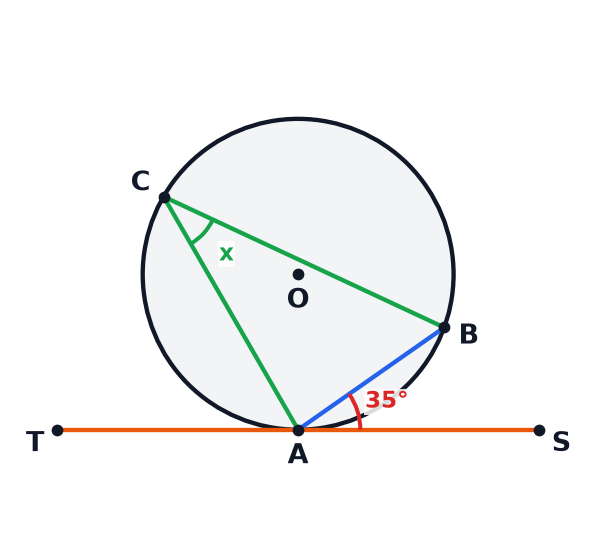
Not drawn accurately. \(TAS\) is a tangent to the circle at \(A\). \(B\) and \(C\) are points on the circumference. Angle \(SAB = 35^\circ\). Work out the size of angle \(ACB\). Give a reason for your answer. [2 marks]
Show answerHide answer
Model answer
Angle \(ACB = 35^\circ\), because the angle between a tangent and a chord equals the angle in the alternate segment.
Mark scheme
- \(35\) — B1
- The angle between a tangent and a chord equals the angle in the alternate segment — Q1
-
2 Work out [4 marks]
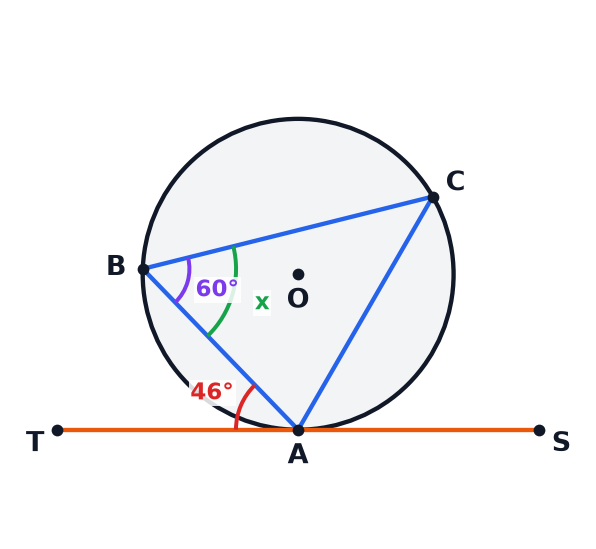
Not drawn accurately. \(TAS\) is a tangent to the circle at \(A\). \(B\) and \(C\) are points on the circumference. Angle \(TAB = 46^\circ\) and angle \(ABC = 60^\circ\). Work out the size of angle \(BAC\). Give reasons for your answer. [4 marks]
Show answerHide answer
Model answer
Angle \(ACB = 46^\circ\), because the angle between a tangent and a chord equals the angle in the alternate segment. Then \(BAC = 180 - 46 - 60 = 74^\circ\).
Mark scheme
- \(ACB = 46\) — B1
- \(180 - 46 - 60\) — M1
- \(74\) — A1
- Alternate segment theorem, and the angles in a triangle add up to 180 degrees — Q1
-
3 Work out [3 marks]
\(TA\) is a tangent to a circle at \(A\). \(B\) and \(C\) are points on the circumference, with \(C\) in the alternate segment. Angle \(TAB = 2x + 18\) and angle \(ACB = 4x - 12\). Work out the value of \(x\). [3 marks]
Show answerHide answer
Model answer
By the alternate segment theorem, \(2x + 18 = 4x - 12\). Then \(30 = 2x\), so \(x = 15\).
Mark scheme
- \(2x + 18 = 4x - 12\) — M1
- \(2x = 30\) — M1
- \(15\) — A1
-
4 Work out [4 marks]
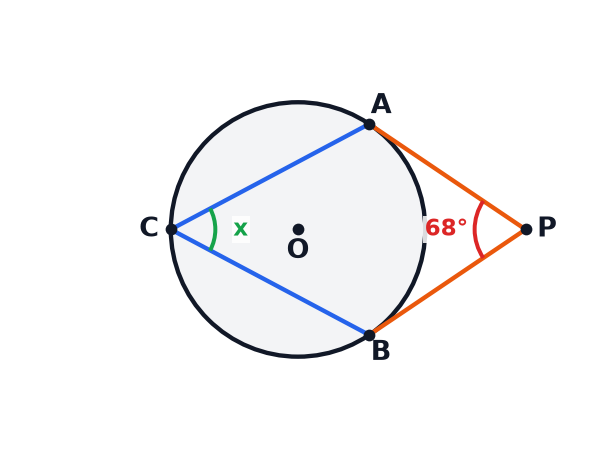
Not drawn accurately. \(PA\) and \(PB\) are tangents to a circle, centre \(O\). \(C\) is a point on the circumference. Angle \(APB = 68^\circ\). Work out the size of angle \(ACB\). Give reasons for your answer. [4 marks]
Show answerHide answer
Model answer
\(PA = PB\), so triangle \(PAB\) is isosceles and \(PAB = (180 - 68) \div 2 = 56^\circ\). By the alternate segment theorem, \(ACB = PAB = 56^\circ\).
Mark scheme
- \((180 - 68) \div 2\) — M1
- \(PAB = 56\) — A1
- \(ACB = 56\) — B1
- Alternate segment theorem stated — Q1
-
5 Work out [4 marks]
\(AD\) is a diameter of a circle. \(TA\) is a tangent at \(A\). \(B\) is a point on the circumference. Angle \(TAB = 33^\circ\). (a) Work out the size of angle \(ADB\). Give a reason for your answer. [2 marks] (b) Work out the size of angle \(DAB\). [2 marks]
Show answerHide answer
Model answer
(a) \(ADB = 33^\circ\), by the alternate segment theorem. (b) \(TAD = 90^\circ\), because a tangent is perpendicular to the radius, so \(DAB = 90 - 33 = 57^\circ\).
Mark scheme
- (a) \(33\) — B1
- (a) Alternate segment theorem stated — Q1
- (b) \(90 - 33\), using angle \(TAD = 90^\circ\) — M1
- (b) \(57\) — A1
-
6 Prove [4 marks]
\(TA\) is a tangent at \(A\) to a circle, centre \(O\). \(B\) and \(C\) are points on the circumference, with \(C\) in the alternate segment. Use the circle theorems for the centre and for tangents to prove that angle \(TAB\) equals angle \(ACB\). [4 marks]
Show answerHide answer
Model answer
\(OA\) is perpendicular to \(TA\), so \(OAB = 90^\circ - TAB\). \(OA = OB\), so \(OBA = OAB\) and \(AOB = 180 - 2(90 - TAB) = 2 \times TAB\). The angle at the centre is twice the angle at the circumference, so \(ACB = \dfrac{1}{2}AOB = TAB\).
Mark scheme
- \(OAB = 90^\circ - TAB\), because the tangent is perpendicular to the radius — B1
- Triangle \(OAB\) is isosceles, so \(OBA = OAB\) — B1
- \(AOB = 180 - 2(90 - TAB) = 2 \times TAB\) — M1
- \(ACB = \dfrac{1}{2}AOB = TAB\), as the angle at the centre is twice the angle at the circumference — Q1
Quick check
-
1
What does the alternate segment theorem say?
Show answerHide answer
A: The angle between a tangent and a chord equals the angle in the alternate segment
This is the alternate segment theorem.
-
2
Where must the chord start for the alternate segment theorem to apply?
Show answerHide answer
D: At the point of contact of the tangent
The chord starts at the point where the tangent touches the circle.
-
3
The angle between a tangent and a chord is \(58^\circ\). What is the angle in the alternate segment?
Show answerHide answer
C: \(58^\circ\)
They are equal.
-
4
What does “alternate” mean in the alternate segment theorem?
Show answerHide answer
B: On the other side of the chord
The alternate segment is the one on the opposite side of the chord from the angle.
-
5
\(TA\) is a tangent at \(A\). Angle \(TAB = 40^\circ\) and angle \(ABC = 75^\circ\), where \(C\) is in the alternate segment. What is angle \(BAC\)?
Show answerHide answer
A: \(65^\circ\)
\(ACB = 40^\circ\) by the alternate segment theorem, so \(BAC = 180 - 75 - 40 = 65^\circ\).
-
6
\(PA\) and \(PB\) are tangents and \(\angle APB = 64^\circ\). \(C\) is on the major arc. What is angle \(ACB\)?
Show answerHide answer
D: \(58^\circ\)
\(PAB = (180 - 64) \div 2 = 58^\circ\), and this equals the angle in the alternate segment.
-
7
The angle between the tangent and the chord is \(2x + 4\) and the angle in the alternate segment is \(3x - 10\). What is \(x\)?
Show answerHide answer
C: \(14\)
\(2x + 4 = 3x - 10\), so \(x = 14\).
-
8
\(AD\) is a diameter, \(TA\) is a tangent at \(A\) and \(B\) is on the circle. Angle \(TAB = 36^\circ\). What is angle \(DAB\)?
Show answerHide answer
B: \(54^\circ\)
\(TAD = 90^\circ\) because a tangent is perpendicular to the radius, so \(DAB = 90 - 36 = 54^\circ\).
-
9
A tangent at \(A\) makes an angle of \(x\) with the chord \(AB\). What is the angle \(AOB\) at the centre, on the same side as that angle?
Show answerHide answer
A: \(2x\)
The angle in the alternate segment is \(x\), and the angle at the centre is twice that.
Circle Theorem Proofs and Problems
Just this lesson-
1 Prove [4 marks]
Not drawn accurately. \(A\), \(B\) and \(C\) are points on the circumference of a circle, centre \(O\). Prove that angle \(AOB\) is twice angle \(ACB\). You may add lines to the diagram. [4 marks]
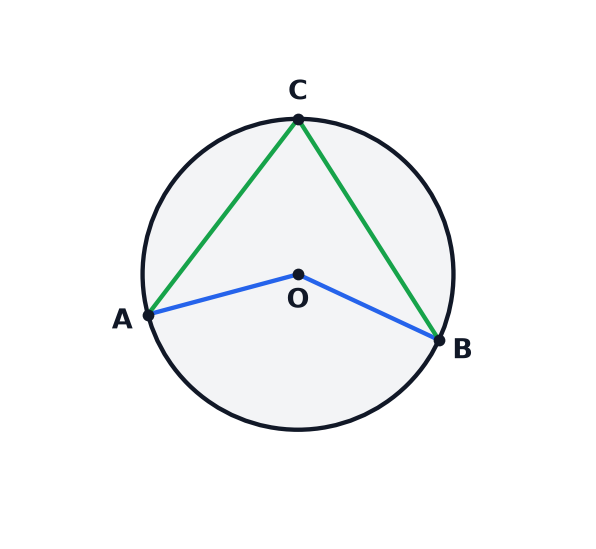
Show answerHide answer
Model answer
Draw the line \(CO\) and extend it to meet the circle at \(D\). \(OA = OC = OB\), because they are radii. Triangles \(OAC\) and \(OBC\) are isosceles, so \(OAC = OCA\) and \(OBC = OCB\). The exterior angle \(AOD = 2 \times OCA\) and \(BOD = 2 \times OCB\). So \(AOB = 2(OCA + OCB) = 2 \times ACB\).
Mark scheme
- Draws CO extended to D and states OA = OB = OC as radii — B1
- Isosceles triangles, so OCA = OAC and OCB = OBC — M1
- Exterior angles: AOD = 2 x OCA and BOD = 2 x OCB — M1
- Concludes AOB = 2 x ACB — Q1
-
2 Work out [4 marks]
Not drawn accurately. \(A\), \(B\), \(C\) and \(D\) are points on the circumference of a circle, centre \(O\). Angle \(AOC = 136^\circ\). (a) Work out the size of angle \(ABC\). Give a reason for your answer. [2 marks] (b) Work out the size of angle \(ADC\). Give a reason for your answer. [2 marks]
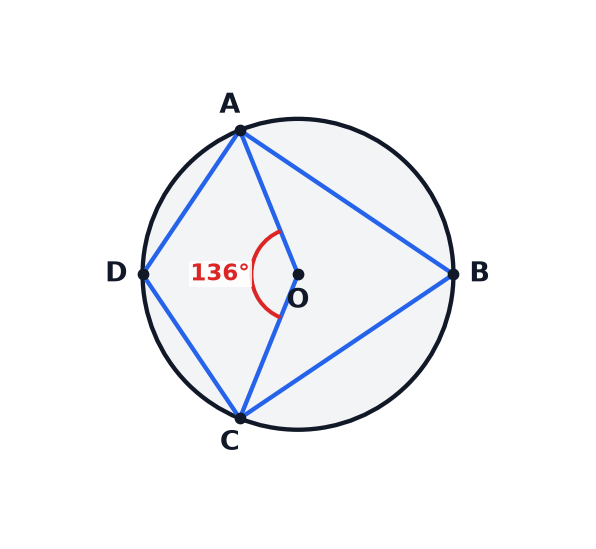
Show answerHide answer
Model answer
(a) \(ABC = 136 \div 2 = 68^\circ\), because the angle at the centre is twice the angle at the circumference. (b) \(ADC = 180 - 68 = 112^\circ\), because opposite angles of a cyclic quadrilateral add up to \(180^\circ\).
Mark scheme
- (a) \(68\) — B1
- (a) The angle at the centre is twice the angle at the circumference — Q1
- (b) \(112\) — B1
- (b) Opposite angles of a cyclic quadrilateral add up to 180 degrees — Q1
-
3 Work out [4 marks]
The point \(P(-3, 4)\) is on the circle \(x^2 + y^2 = 25\). Work out an equation of the tangent to the circle at \(P\). [4 marks]
Show answerHide answer
Model answer
The radius \(OP\) has gradient \(\dfrac{4}{-3} = -\dfrac{4}{3}\), so the tangent has gradient \(\dfrac{3}{4}\). Then \(y - 4 = \dfrac{3}{4}(x + 3)\), which gives \(y = \dfrac{3}{4}x + \dfrac{25}{4}\).
Mark scheme
- Gradient of \(OP = -\dfrac{4}{3}\) — B1
- Gradient of the tangent \(= \dfrac{3}{4}\) — B1
- \(y - 4 = \dfrac{3}{4}(x + 3)\) or equivalent — M1
- \(y = \dfrac{3}{4}x + \dfrac{25}{4}\) or \(3x - 4y = -25\) — A1
-
4 Show that [3 marks]
Show that the line \(3x + 4y = 25\) is a tangent to the circle \(x^2 + y^2 = 25\) at the point \((3, 4)\). [3 marks]
Show answerHide answer
Model answer
\(3^2 + 4^2 = 25\), and \(3 \times 3 + 4 \times 4 = 25\), so \((3, 4)\) is on both. The line is \(y = -\dfrac{3}{4}x + \dfrac{25}{4}\), with gradient \(-\dfrac{3}{4}\). The radius to \((3, 4)\) has gradient \(\dfrac{4}{3}\), and \(\dfrac{4}{3} \times -\dfrac{3}{4} = -1\), so the line is perpendicular to the radius, and is a tangent.
Mark scheme
- Checks that \((3, 4)\) is on both the circle and the line — B1
- Gradient of line \(= -\dfrac{3}{4}\) and gradient of radius \(= \dfrac{4}{3}\) — B1
- Product of the gradients is -1, so the line is perpendicular to the radius, with a conclusion — Q1
-
5 Work out [5 marks]
Not drawn accurately. \(TAS\) is a tangent to the circle at \(A\). \(A\), \(B\), \(C\) and \(D\) are points on the circumference. Angle \(TAD = 56^\circ\) and angle \(CAD = 44^\circ\). (a) Write down the size of angle \(ACD\). Give a reason for your answer. [2 marks] (b) Work out the size of angle \(ADC\). [2 marks] (c) Work out the size of angle \(ABC\). Give a reason for your answer. [1 mark]
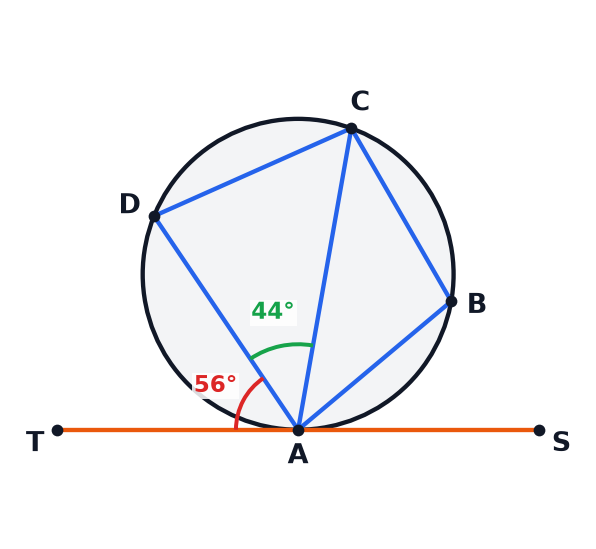
Show answerHide answer
Model answer
(a) \(ACD = 56^\circ\), by the alternate segment theorem. (b) \(ADC = 180 - 56 - 44 = 80^\circ\). (c) \(ABC = 180 - 80 = 100^\circ\), because opposite angles of a cyclic quadrilateral add up to \(180^\circ\).
Mark scheme
- (a) \(56\) — B1
- (a) Alternate segment theorem stated — Q1
- (b) \(180 - 56 - 44\) — M1
- (b) \(80\) — A1
- (c) \(100\) with the cyclic quadrilateral reason — A1
-
6 Prove [3 marks]
\(A\), \(B\), \(C\) and \(D\) are points on the circumference of a circle, centre \(O\). \(C\) and \(D\) are on the same side of the chord \(AB\). Prove that angle \(ACB\) equals angle \(ADB\). [3 marks]
Show answerHide answer
Model answer
The angle at the centre, \(AOB\), is twice the angle at the circumference. So \(ACB = \dfrac{1}{2}AOB\) and \(ADB = \dfrac{1}{2}AOB\). Therefore \(ACB = ADB\).
Mark scheme
- States that the angle at the centre AOB is twice the angle at the circumference — B1
- \(ACB = \dfrac{1}{2}AOB\) and \(ADB = \dfrac{1}{2}AOB\) — M1
- Concludes that ACB = ADB — Q1
Quick check
-
1
Why is a triangle made by two radii and a chord isosceles?
Show answerHide answer
B: Two of its sides are radii, so they are equal
Two radii are always equal.
-
2
In a proof, what should be written next to every step?
Show answerHide answer
A: A reason
Each step needs a reason.
-
3
What does the exterior angle of a triangle equal?
Show answerHide answer
D: The sum of the two opposite interior angles
This is the exterior angle theorem.
-
4
The radius to a point on a circle has gradient \(\dfrac{2}{3}\). What is the gradient of the tangent at that point?
Show answerHide answer
C: \(-\dfrac{3}{2}\)
A tangent is perpendicular to the radius, so its gradient is the negative reciprocal.
-
5
What is the gradient of the radius from the origin to \((3, 4)\)?
Show answerHide answer
B: \(\dfrac{4}{3}\)
\(\dfrac{4 - 0}{3 - 0} = \dfrac{4}{3}\).
-
6
What is the gradient of the tangent to \(x^2 + y^2 = 25\) at \((3, 4)\)?
Show answerHide answer
A: \(-\dfrac{3}{4}\)
The radius has gradient \(\dfrac{4}{3}\), so the tangent has gradient \(-\dfrac{3}{4}\).
-
7
\(AOC\) is \(150^\circ\) at the centre, and \(D\) is on the minor arc \(AC\). What is angle \(ADC\)?
Show answerHide answer
D: \(105^\circ\)
\(B\) on the major arc gives \(ABC = 75^\circ\), and \(ADC = 180 - 75 = 105^\circ\).
-
8
Which line is the tangent to \(x^2 + y^2 = 25\) at \((3, 4)\)?
Show answerHide answer
C: \(3x + 4y = 25\)
Gradient \(-\dfrac{3}{4}\) through \((3, 4)\) gives \(y - 4 = -\dfrac{3}{4}(x - 3)\), which rearranges to \(3x + 4y = 25\).
-
9
Why must a proof not rely on measuring angles in a diagram?
Show answerHide answer
B: The proof must work for every case, not just the one drawn
A proof uses letters and reasons so that it works for any angle.