Exam questions · Maths
Further Algebra
- 30 exam questions
- 90 marks
- 45 quick checks
Solving Quadratic Equations
Just this lesson-
1 Solve [3 marks]
Solve \(x^2 - 3x - 10 = 0\).
Show answerHide answer
Model answer
\((x - 5)(x + 2) = 0\), so \(x = 5\) or \(x = -2\).
Mark scheme
- \((x - 5)(x + 2)\) — M1
- \(x = 5\) — A1
- \(x = -2\) — A1
-
2 Solve [3 marks]
Solve \(x^2 = 5x + 14\).
Show answerHide answer
Model answer
Rearrange to \(x^2 - 5x - 14 = 0\), so \((x - 7)(x + 2) = 0\) and \(x = 7\) or \(x = -2\).
Mark scheme
- \(x^2 - 5x - 14 = 0\) — M1
- \((x - 7)(x + 2)\) — M1
- \(x = 7\) and \(x = -2\) — A1
-
3 Show that [4 marks]
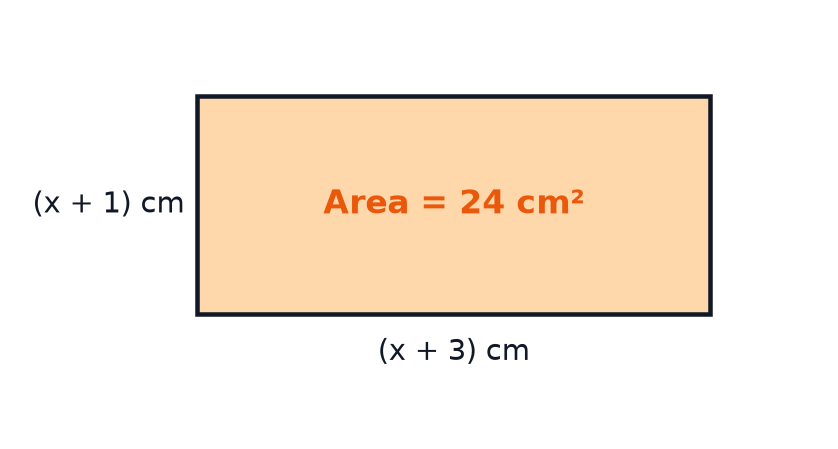
The diagram shows a rectangle with area 24 cm\(^2\). (a) Show that \(x^2 + 4x - 21 = 0\). [2 marks] (b) Work out the value of \(x\). [2 marks]
Show answerHide answer
Model answer
(a) \((x + 3)(x + 1) = 24\), so \(x^2 + 4x + 3 = 24\) and \(x^2 + 4x - 21 = 0\). (b) \((x + 7)(x - 3) = 0\), so \(x = -7\) or \(x = 3\). A length cannot be negative, so \(x = 3\).
Mark scheme
- (a) \((x + 3)(x + 1) = 24\) — M1
- (a) \(x^2 + 4x - 21 = 0\) shown — Q1
- (b) \((x + 7)(x - 3)\) — M1
- (b) \(x = 3\) with \(x = -7\) rejected — A1
-
4 Solve [3 marks]
(a) Solve \(x^2 - 100 = 0\). [1 mark] (b) Solve \(x^2 - 8x = 0\). [2 marks]
Show answerHide answer
Model answer
(a) \(x = 10\) or \(x = -10\). (b) \(x(x - 8) = 0\), so \(x = 0\) or \(x = 8\).
Mark scheme
- (a) \(x = \pm 10\) — B1
- (b) \(x(x - 8)\) — M1
- (b) \(x = 0\) and \(x = 8\) — A1
-
5 Solve [3 marks]
Solve \(3x^2 + x - 2 = 0\).
Show answerHide answer
Model answer
\(3x^2 + 3x - 2x - 2 = 3x(x + 1) - 2(x + 1) = (3x - 2)(x + 1) = 0\), so \(x = \dfrac{2}{3}\) or \(x = -1\).
Mark scheme
- \((3x - 2)(x + 1)\) — M1
- \(x = \dfrac{2}{3}\) — A1
- \(x = -1\) — A1
-
6 Solve [3 marks]
Solve \(x^2 - 6x + 2 = 0\). Give your answers in the form \(a \pm \sqrt{b}\).
Show answerHide answer
Model answer
Complete the square: \((x - 3)^2 - 9 + 2 = 0\), so \((x - 3)^2 = 7\) and \(x = 3 \pm \sqrt{7}\).
Mark scheme
- \((x - 3)^2\) seen — M1
- \((x - 3)^2 = 7\) — M1
- \(3 \pm \sqrt{7}\) — A1
Quick check
-
1
Solve \((x - 2)(x - 3) = 0\).
Show answerHide answer
B: \(x = 2\) or \(x = 3\)
Each bracket can be zero: \(x - 2 = 0\) or \(x - 3 = 0\).
-
2
Solve \(x^2 - 49 = 0\).
Show answerHide answer
A: \(x = 7\) or \(x = -7\)
\(x^2 = 49\) has two square roots.
-
3
Solve \(x^2 - 6x = 0\).
Show answerHide answer
D: \(x = 0\) or \(x = 6\)
\(x(x - 6) = 0\), so \(x = 0\) or \(x = 6\).
-
4
Factorise \(x^2 - 5x + 6\).
Show answerHide answer
C: \((x - 2)(x - 3)\)
The numbers multiply to 6 and add to \(-5\): \(-2\) and \(-3\).
-
5
What is the first step in solving \(x^2 = 3x + 10\) by factorising?
Show answerHide answer
B: Rearrange to \(x^2 - 3x - 10 = 0\)
One side must be zero before you factorise.
-
6
Solve \(x^2 + 5x + 6 = 0\).
Show answerHide answer
A: \(x = -2\) or \(x = -3\)
\((x + 2)(x + 3) = 0\).
-
7
Solve \(2x^2 + 7x + 3 = 0\).
Show answerHide answer
D: \(x = -\dfrac{1}{2}\) or \(x = -3\)
\((2x + 1)(x + 3) = 0\).
-
8
What is the value of \(b^2 - 4ac\) for \(x^2 + 2x - 8 = 0\)?
Show answerHide answer
C: \(36\)
\(4 - 4 \times 1 \times (-8) = 4 + 32 = 36\).
-
9
Use the quadratic formula to solve \(2x^2 + 5x - 3 = 0\).
Show answerHide answer
B: \(x = \dfrac{1}{2}\) or \(x = -3\)
\(x = \dfrac{-5 \pm \sqrt{49}}{4} = \dfrac{-5 \pm 7}{4}\).
Simultaneous Equations
Just this lesson-
1 Use [2 marks]
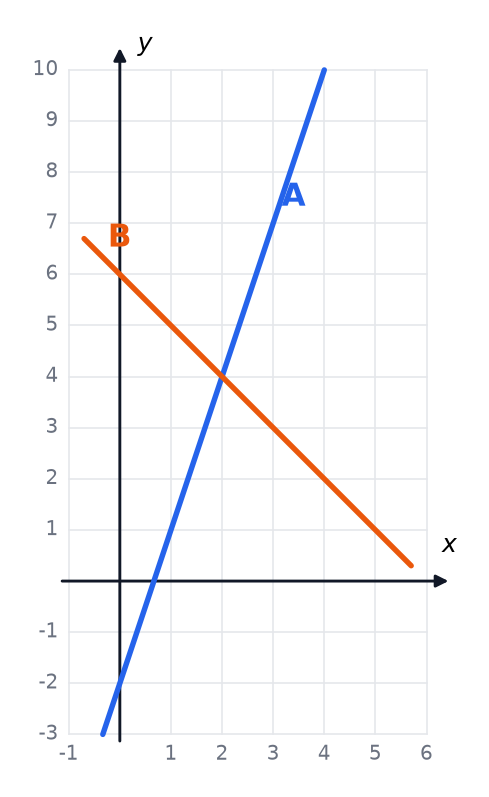
The graph shows the straight lines \(A\) and \(B\). Use the graph to solve the simultaneous equations \(y = 3x - 2\) and \(x + y = 6\).
Show answerHide answer
Model answer
The lines cross at \((2, 4)\), so \(x = 2\) and \(y = 4\).
Mark scheme
- \(x = 2\) — B1
- \(y = 4\) — B1
-
2 Solve [3 marks]
Solve the simultaneous equations \(2x + y = 13\) and \(x - y = 2\).
Show answerHide answer
Model answer
Adding gives \(3x = 15\), so \(x = 5\). Then \(y = 13 - 10 = 3\). Check: \(5 - 3 = 2\).
Mark scheme
- \(3x = 15\) or another correct elimination — M1
- \(x = 5\) — A1
- \(y = 3\) — A1
-
3 Solve [3 marks]
Solve the simultaneous equations \(5x + 2y = 16\) and \(3x + 2y = 8\).
Show answerHide answer
Model answer
Subtracting gives \(2x = 8\), so \(x = 4\). Then \(20 + 2y = 16\), so \(y = -2\). Check: \(12 - 4 = 8\).
Mark scheme
- \(2x = 8\) — M1
- \(x = 4\) — A1
- \(y = -2\) — A1
-
4 Solve [4 marks]
Solve the simultaneous equations \(3x + 2y = 18\) and \(2x - y = 5\).
Show answerHide answer
Model answer
From the second equation \(y = 2x - 5\). Substituting gives \(3x + 2(2x - 5) = 18\), so \(7x - 10 = 18\) and \(x = 4\). Then \(y = 3\).
Mark scheme
- \(y = 2x - 5\), or the equations made to match — M1
- \(3x + 2(2x - 5) = 18\) — M1
- \(x = 4\) — A1
- \(y = 3\) — A1
-
5 Work out [4 marks]
3 pens and 2 pencils cost 190p. 2 pens and 1 pencil cost 110p. Work out the cost of one pen and the cost of one pencil.
Show answerHide answer
Model answer
\(3p + 2q = 190\) and \(2p + q = 110\). Then \(q = 110 - 2p\), so \(3p + 220 - 4p = 190\) and \(p = 30\), \(q = 50\). A pen costs 30p and a pencil costs 50p.
Mark scheme
- Two correct equations — M1
- A correct method to eliminate a letter — M1
- Pen 30p — A1
- Pencil 50p — A1
-
6 Solve [4 marks]
Solve the simultaneous equations \(x^2 + y^2 = 20\) and \(y = 2x\).
Show answerHide answer
Model answer
Substituting gives \(x^2 + 4x^2 = 20\), so \(5x^2 = 20\), \(x^2 = 4\) and \(x = 2\) or \(x = -2\). Then \(y = 4\) or \(y = -4\). The solutions are \((2, 4)\) and \((-2, -4)\).
Mark scheme
- \(x^2 + (2x)^2 = 20\) — M1
- \(x = 2\) and \(x = -2\) — A1
- One correct \(y\)-value — M1
- \((2, 4)\) and \((-2, -4)\) — A1
Quick check
-
1
Solve \(x + y = 9\) and \(x - y = 1\).
Show answerHide answer
C: \(x = 5\), \(y = 4\)
Adding gives \(2x = 10\), so \(x = 5\) and \(y = 4\).
-
2
When do you add the two equations in elimination?
Show answerHide answer
B: When the terms in one letter are opposites
Opposites such as \(+3y\) and \(-3y\) cancel when added.
-
3
Solve \(3x + 2y = 16\) and \(x + 2y = 8\).
Show answerHide answer
A: \(x = 4\), \(y = 2\)
Subtract: \(2x = 8\), so \(x = 4\). Then \(4 + 2y = 8\) gives \(y = 2\).
-
4
Solve \(2x + 3y = 13\) and \(3x - y = 3\).
Show answerHide answer
D: \(x = 2\), \(y = 3\)
Multiply the second equation by 3 and add: \(11x = 22\), so \(x = 2\), \(y = 3\).
-
5
Solve \(y = 2x + 1\) and \(3x + y = 16\).
Show answerHide answer
C: \(x = 3\), \(y = 7\)
\(3x + 2x + 1 = 16\), so \(x = 3\) and \(y = 7\).
-
6
Two straight lines are parallel. How many solutions do their simultaneous equations have?
Show answerHide answer
B: None
Parallel lines never meet, so there is no point on both.
-
7
2 adult and 3 child tickets cost \(\pounds 19\). 3 adult and 1 child ticket cost \(\pounds 18\). What does an adult ticket cost?
Show answerHide answer
A: \(\pounds 5\)
\(2a + 3c = 19\) and \(3a + c = 18\) give \(a = 5\), \(c = 3\).
-
8
Solve \(y = x^2\) and \(y = x + 6\).
Show answerHide answer
D: \((3, 9)\) and \((-2, 4)\)
\(x^2 = x + 6\) gives \((x - 3)(x + 2) = 0\).
-
9
Solve \(x^2 + y^2 = 25\) and \(y = x + 1\).
Show answerHide answer
C: \((3, 4)\) and \((-4, -3)\)
\(x^2 + (x + 1)^2 = 25\) gives \(x^2 + x - 12 = 0\), so \(x = 3\) or \(x = -4\).
Inequalities and Regions
Just this lesson-
1 Write down [2 marks]
Write down all the integers that satisfy \(2 < x \leq 6\).
Show answerHide answer
Model answer
The integers are 3, 4, 5, 6.
Mark scheme
- At least three correct and no more than one wrong — M1
- 3, 4, 5, 6 — A1
-
2 Write down [5 marks]
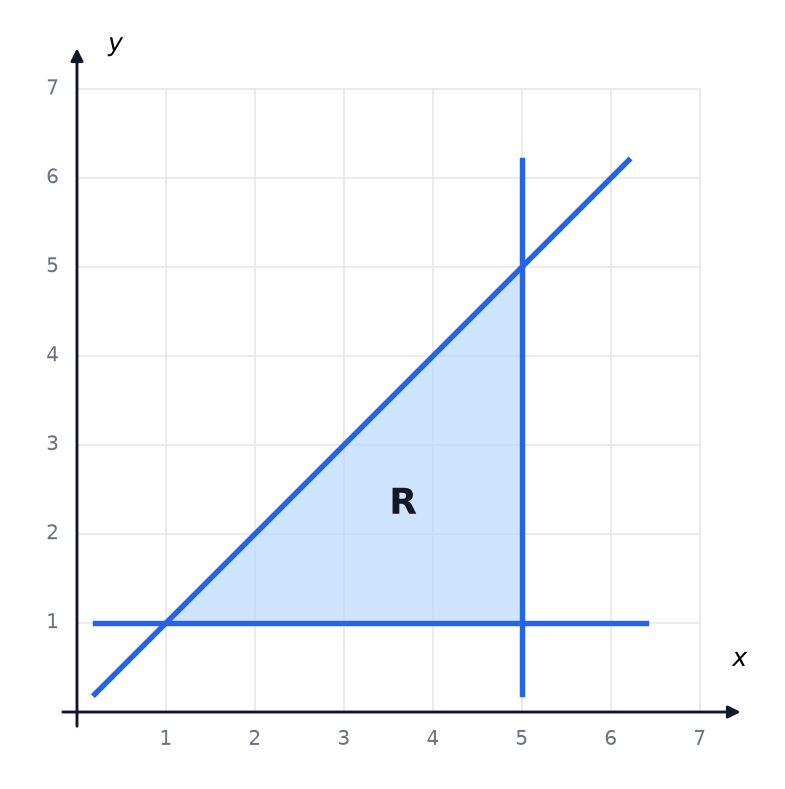
The diagram shows a shaded region \(R\). (a) Write down the three inequalities that define \(R\). [3 marks] (b) How many points with integer coordinates are inside \(R\) or on its boundary? [2 marks]
Show answerHide answer
Model answer
(a) \(y \geq 1\), \(y \leq x\) and \(x \leq 5\). (b) For \(x = 1, 2, 3, 4, 5\) there are \(1, 2, 3, 4, 5\) points, so the total is 15.
Mark scheme
- (a) \(y \geq 1\) — B1
- (a) \(y \leq x\) — B1
- (a) \(x \leq 5\) — B1
- (b) Counts by columns, such as 1, 2, 3, 4, 5 — M1
- (b) 15 — A1
-
3 Solve [2 marks]
Solve \(5x - 3 \leq 17\).
Show answerHide answer
Model answer
\(5x \leq 20\), so \(x \leq 4\).
Mark scheme
- \(5x \leq 20\) — M1
- \(x \leq 4\) — A1
-
4 Decide [2 marks]
Here are two points: \((1, 3)\) and \((2, 6)\). For each point, say whether it satisfies the inequality \(y \leq 2x + 1\). You must show your working.
Show answerHide answer
Model answer
For \((1, 3)\): \(2 \times 1 + 1 = 3\) and \(3 \leq 3\), so it does. For \((2, 6)\): \(2 \times 2 + 1 = 5\) and \(6 \leq 5\) is false, so it does not.
Mark scheme
- \((1, 3)\) satisfies it, with \(2 \times 1 + 1 = 3\) — B1
- \((2, 6)\) does not satisfy it, with \(2 \times 2 + 1 = 5\) — B1
-
5 Solve [3 marks]
Solve \(x^2 + x - 12 > 0\).
Show answerHide answer
Model answer
\(x^2 + x - 12 = (x + 4)(x - 3)\), with roots \(-4\) and 3. The curve is above the \(x\)-axis outside the roots, so \(x < -4\) or \(x > 3\).
Mark scheme
- \((x + 4)(x - 3)\) or the roots \(-4\) and 3 — M1
- A sketch or a clear statement of which regions are above the axis — M1
- \(x < -4\) or \(x > 3\) — A1
-
6 Solve [3 marks]
(a) Solve \(x^2 < 25\). [1 mark] (b) Solve \(x^2 - 3x - 10 \leq 0\). [2 marks]
Show answerHide answer
Model answer
(a) \(-5 < x < 5\). (b) \((x - 5)(x + 2) \leq 0\), so \(-2 \leq x \leq 5\).
Mark scheme
- (a) \(-5 < x < 5\) — B1
- (b) Roots \(-2\) and 5 — M1
- (b) \(-2 \leq x \leq 5\) — A1
Quick check
-
1
What does a dashed boundary line mean on a graph of an inequality?
Show answerHide answer
D: The line itself is not included
A dashed line goes with \(<\) or \(>\).
-
2
Which inequality describes the region to the right of the line \(x = 1\), including the line?
Show answerHide answer
C: \(x \geq 1\)
To the right means larger \(x\), and the line is included.
-
3
Which inequality describes the region on or below the line \(y = 2x\)?
Show answerHide answer
B: \(y \leq 2x\)
Below the line means smaller \(y\), and the line is included.
-
4
Which integers satisfy \(-2 < x \leq 3\)?
Show answerHide answer
A: \(-1, 0, 1, 2, 3\)
\(-2\) is not included but 3 is.
-
5
The origin is tested in \(x + y \leq 6\). What does this show?
Show answerHide answer
D: The origin is in the region, so shade that side
\(0 + 0 \leq 6\) is true.
-
6
How many points with whole-number coordinates satisfy \(x \geq 1\), \(y \geq 1\) and \(x + y \leq 6\)?
Show answerHide answer
C: \(15\)
The columns \(x = 1, 2, 3, 4, 5\) have \(5, 4, 3, 2, 1\) points.
-
7
Which kind of boundary line goes with the inequality \(y > 3\)?
Show answerHide answer
B: A dashed line
Strict inequalities do not include the boundary.
-
8
Solve \(x^2 - x - 6 < 0\).
Show answerHide answer
A: \(-2 < x < 3\)
The roots are \(-2\) and 3, and the curve is below the axis between them.
-
9
Solve \(x^2 > 9\).
Show answerHide answer
D: \(x < -3\) or \(x > 3\)
The curve is above the axis outside the roots \(-3\) and 3.
Surds
Just this lesson-
1 Simplify [2 marks]
Write \(\sqrt{45}\) in the form \(a\sqrt{5}\), where \(a\) is an integer.
Show answerHide answer
Model answer
\(\sqrt{45} = \sqrt{9 \times 5} = 3\sqrt{5}\).
Mark scheme
- \(\sqrt{9 \times 5}\) — M1
- \(3\sqrt{5}\) — A1
-
2 Expand [3 marks]
(a) Expand and simplify \((\sqrt{5} + 2)^2\). [2 marks] (b) Show that \((\sqrt{5} + 2)(\sqrt{5} - 2) = 1\). [1 mark]
Show answerHide answer
Model answer
(a) \(5 + 2\sqrt{5} + 2\sqrt{5} + 4 = 9 + 4\sqrt{5}\). (b) \(5 - 2\sqrt{5} + 2\sqrt{5} - 4 = 1\).
Mark scheme
- (a) Three of the four terms correct — M1
- (a) \(9 + 4\sqrt{5}\) — A1
- (b) \(5 - 4 = 1\) shown — Q1
-
3 Simplify [3 marks]
Write \(\sqrt{200} - \sqrt{50}\) in the form \(a\sqrt{2}\).
Show answerHide answer
Model answer
\(\sqrt{200} = 10\sqrt{2}\) and \(\sqrt{50} = 5\sqrt{2}\), so the difference is \(5\sqrt{2}\).
Mark scheme
- \(10\sqrt{2}\) or \(5\sqrt{2}\) seen — M1
- Both correct — M1
- \(5\sqrt{2}\) — A1
-
4 Rationalise [2 marks]
Rationalise the denominator of \(\dfrac{10}{\sqrt{5}}\).
Show answerHide answer
Model answer
\(\dfrac{10\sqrt{5}}{5} = 2\sqrt{5}\).
Mark scheme
- Multiplies the top and bottom by \(\sqrt{5}\) — M1
- \(2\sqrt{5}\) — A1
-
5 Show that [3 marks]
Show that \(\dfrac{4}{\sqrt{7} - \sqrt{3}} = \sqrt{7} + \sqrt{3}\).
Show answerHide answer
Model answer
Multiply the top and bottom by \(\sqrt{7} + \sqrt{3}\): the bottom becomes \(7 - 3 = 4\), and the fraction is \(\dfrac{4(\sqrt{7} + \sqrt{3})}{4} = \sqrt{7} + \sqrt{3}\).
Mark scheme
- Multiplies by \(\sqrt{7} + \sqrt{3}\) — M1
- Denominator \(7 - 3 = 4\) — M1
- Completes with a conclusion — Q1
-
6 Work out [4 marks]
A rectangle has length \((3 + \sqrt{2})\) cm and width \((3 - \sqrt{2})\) cm. (a) Show that the area of the rectangle is 7 cm\(^2\). [2 marks] (b) Work out the perimeter of the rectangle. [2 marks]
Show answerHide answer
Model answer
(a) \((3 + \sqrt{2})(3 - \sqrt{2}) = 9 - 2 = 7\). (b) The perimeter is \(2 \times ((3 + \sqrt{2}) + (3 - \sqrt{2})) = 2 \times 6 = 12\) cm.
Mark scheme
- (a) \((3 + \sqrt{2})(3 - \sqrt{2})\) expanded — M1
- (a) \(9 - 2 = 7\) — Q1
- (b) \(2(3 + \sqrt{2} + 3 - \sqrt{2})\) — M1
- (b) 12 cm — A1
Quick check
-
1
What is \(\sqrt{5} \times \sqrt{5}\)?
Show answerHide answer
A: \(5\)
A root times itself gives the number: \(\sqrt{a} \times \sqrt{a} = a\).
-
2
Simplify \(\sqrt{12}\).
Show answerHide answer
D: \(2\sqrt{3}\)
\(\sqrt{12} = \sqrt{4 \times 3} = 2\sqrt{3}\).
-
3
Work out \(\sqrt{2} \times \sqrt{8}\).
Show answerHide answer
C: \(4\)
\(\sqrt{2 \times 8} = \sqrt{16} = 4\).
-
4
Work out \(3\sqrt{2} + 5\sqrt{2}\).
Show answerHide answer
B: \(8\sqrt{2}\)
Like surds add, as in \(3x + 5x = 8x\).
-
5
Simplify \(\sqrt{50}\).
Show answerHide answer
A: \(5\sqrt{2}\)
\(\sqrt{50} = \sqrt{25 \times 2} = 5\sqrt{2}\).
-
6
Rationalise the denominator of \(\dfrac{6}{\sqrt{3}}\).
Show answerHide answer
D: \(2\sqrt{3}\)
\(\dfrac{6\sqrt{3}}{3} = 2\sqrt{3}\).
-
7
Expand and simplify \((3 + \sqrt{2})(3 - \sqrt{2})\).
Show answerHide answer
C: \(7\)
This is a difference of two squares: \(9 - 2 = 7\).
-
8
Write \(\sqrt{48} + \sqrt{3}\) in the form \(a\sqrt{3}\).
Show answerHide answer
B: \(5\sqrt{3}\)
\(\sqrt{48} = 4\sqrt{3}\), and \(4\sqrt{3} + \sqrt{3} = 5\sqrt{3}\).
-
9
Rationalise the denominator of \(\dfrac{1}{2 + \sqrt{3}}\).
Show answerHide answer
A: \(2 - \sqrt{3}\)
Multiply top and bottom by \(2 - \sqrt{3}\); the bottom becomes \(4 - 3 = 1\).
Algebraic Fractions and Proof
Just this lesson-
1 Show that [3 marks]
Show that the sum of three consecutive even numbers is a multiple of 6.
Show answerHide answer
Model answer
Let the numbers be \(2n\), \(2n + 2\) and \(2n + 4\). Their sum is \(6n + 6 = 6(n + 1)\), which is a multiple of 6.
Mark scheme
- \(2n\), \(2n + 2\), \(2n + 4\) — M1
- \(6n + 6\) — M1
- \(6(n + 1)\) with a conclusion — Q1
-
2 Simplify [3 marks]
Simplify \(\dfrac{x^2 + 5x}{x^2 - 25}\).
Show answerHide answer
Model answer
\(\dfrac{x(x + 5)}{(x - 5)(x + 5)} = \dfrac{x}{x - 5}\).
Mark scheme
- \(x(x + 5)\) — M1
- \((x - 5)(x + 5)\) — M1
- \(\dfrac{x}{x - 5}\) — A1
-
3 Solve [3 marks]
Solve \(\dfrac{x - 2}{3} + \dfrac{x + 1}{2} = 4\).
Show answerHide answer
Model answer
Multiply every term by 6: \(2(x - 2) + 3(x + 1) = 24\). Then \(5x - 1 = 24\), so \(x = 5\).
Mark scheme
- \(2(x - 2) + 3(x + 1) = 24\) — M1
- \(5x - 1 = 24\) — M1
- \(x = 5\) — A1
-
4 Show that [2 marks]
Edith says, “\(n^2 > n\) for every number \(n\).” Show that Edith is wrong.
Show answerHide answer
Model answer
When \(n = 1\), \(n^2 = 1\) and \(n = 1\), so \(n^2\) is not greater than \(n\). This counter-example shows she is wrong. (\(n = 0.5\) also works.)
Mark scheme
- A valid counter-example, such as \(n = 1\) or \(n = 0.5\) — M1
- Substitutes and shows the statement is false — Q1
-
5 Prove [3 marks]
Prove that \((2n + 1)^2 - (2n - 1)^2\) is a multiple of 8 for every positive integer \(n\).
Show answerHide answer
Model answer
\((2n + 1)^2 = 4n^2 + 4n + 1\) and \((2n - 1)^2 = 4n^2 - 4n + 1\). The difference is \(8n\), which is a multiple of 8.
Mark scheme
- \(4n^2 + 4n + 1\) or \(4n^2 - 4n + 1\) — M1
- \(8n\) — M1
- States that \(8n\) is a multiple of 8 — Q1
-
6 Write [3 marks]
Write \(\dfrac{2}{x + 1} - \dfrac{1}{x - 2}\) as a single fraction, in its simplest form.
Show answerHide answer
Model answer
The common denominator is \((x + 1)(x - 2)\), so the fraction is \(\dfrac{2(x - 2) - (x + 1)}{(x + 1)(x - 2)} = \dfrac{x - 5}{(x + 1)(x - 2)}\).
Mark scheme
- Common denominator \((x + 1)(x - 2)\) — M1
- \(2(x - 2) - (x + 1)\) — M1
- \(\dfrac{x - 5}{(x + 1)(x - 2)}\) — A1
Quick check
-
1
What may be cancelled in an algebraic fraction?
Show answerHide answer
B: Factors that multiply the whole top and the whole bottom
Terms that are added or subtracted cannot be cancelled.
-
2
Simplify \(\dfrac{x^2 - 9}{x + 3}\).
Show answerHide answer
A: \(x - 3\)
\(\dfrac{(x - 3)(x + 3)}{x + 3} = x - 3\).
-
3
Which statement about \(\dfrac{x + 3}{3}\) is correct?
Show answerHide answer
D: The 3s cannot be cancelled because the 3 on top is added
Only factors can be cancelled, not terms.
-
4
Solve \(\dfrac{x - 1}{3} + \dfrac{x + 2}{6} = 2\).
Show answerHide answer
C: \(x = 4\)
Multiply by 6: \(2(x - 1) + (x + 2) = 12\), so \(3x = 12\).
-
5
Which expression is an odd number for any whole number \(n\)?
Show answerHide answer
B: \(2n + 1\)
\(2n\) is even, so adding 1 makes it odd.
-
6
What is the sum of three consecutive whole numbers \(n\), \(n + 1\) and \(n + 2\)?
Show answerHide answer
A: \(3n + 3\)
\(n + n + 1 + n + 2 = 3n + 3 = 3(n + 1)\).
-
7
Which value of \(n\) is a counter-example to “\(n^2 + n + 1\) is always prime”?
Show answerHide answer
D: \(n = 4\)
\(16 + 4 + 1 = 21 = 3 \times 7\), which is not prime.
-
8
Simplify \(\dfrac{x^2 + 5x + 6}{x^2 + 3x + 2}\).
Show answerHide answer
C: \(\dfrac{x + 3}{x + 1}\)
\(\dfrac{(x + 2)(x + 3)}{(x + 1)(x + 2)} = \dfrac{x + 3}{x + 1}\).
-
9
Expand and simplify \((n + 1)^2 - (n - 1)^2\).
Show answerHide answer
B: \(4n\)
\(n^2 + 2n + 1 - n^2 + 2n - 1 = 4n\).