Exam questions · Maths · Further Trigonometry
Trigonometric Graphs and Exact Values
- 6 exam questions
- 16 marks
- 9 quick checks
-
1 Solve [2 marks]
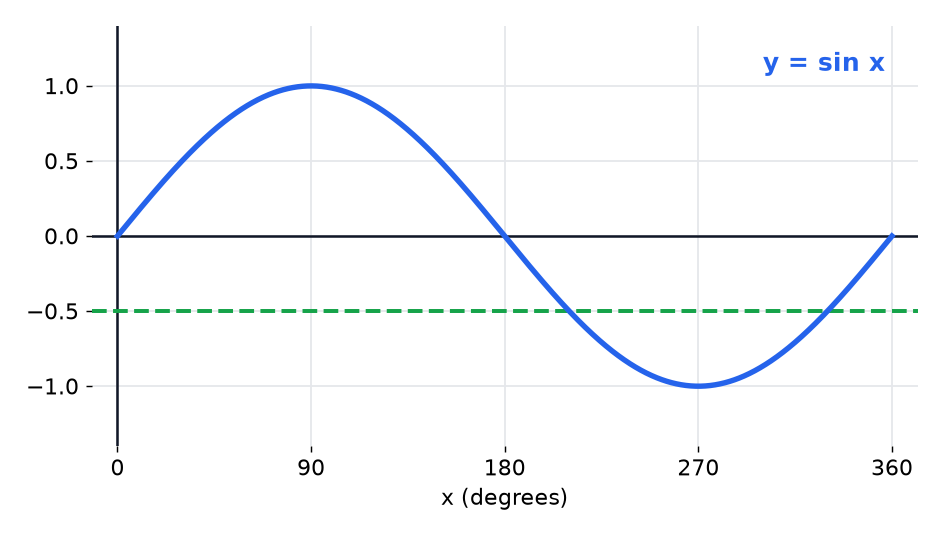
The diagram shows the graph of \(y = \sin x\) for \(0^\circ \le x \le 360^\circ\), and the line \(y = -0.5\). Solve \(\sin x = -0.5\) for \(0^\circ \le x \le 360^\circ\). [2 marks]
Show answerHide answer
Model answer
\(\sin 30^\circ = 0.5\). Sine is negative between \(180^\circ\) and \(360^\circ\), so \(x = 180 + 30 = 210^\circ\) or \(x = 360 - 30 = 330^\circ\).
Mark scheme
- \(210\) — M1
- \(330\) — A1
-
2 Write down [3 marks]
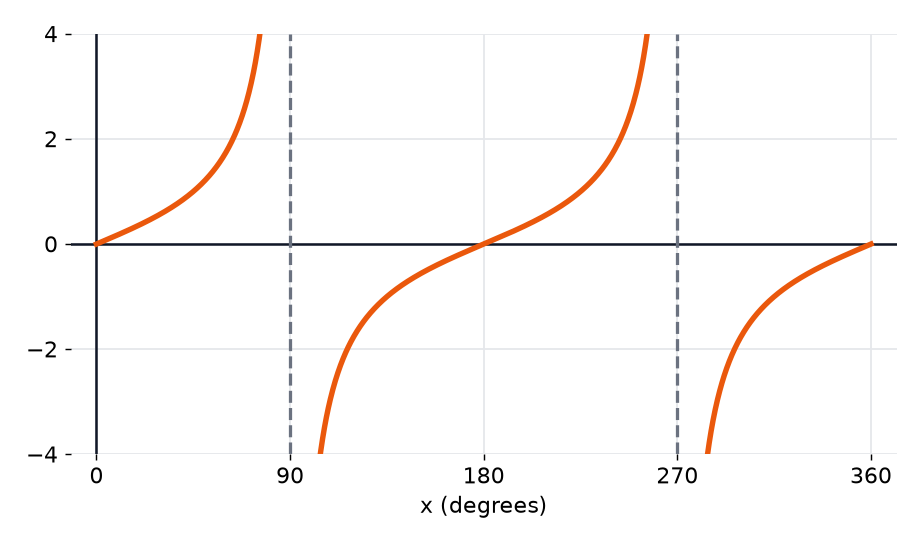
The diagram shows a graph for \(0^\circ \le x \le 360^\circ\). The dashed lines are asymptotes. (a) Write down the equation of the graph. [1 mark] (b) Write down the equations of the asymptotes. [1 mark] (c) Write down the values of \(x\) where the graph crosses the \(x\)-axis. [1 mark]
Show answerHide answer
Model answer
(a) \(y = \tan x\). (b) \(x = 90\) and \(x = 270\). (c) \(x = 0\), \(180\) and \(360\).
Mark scheme
- (a) \(y = \tan x\) — B1
- (b) \(x = 90\) and \(x = 270\) — B1
- (c) \(0, 180, 360\) — B1
-
3 Write down [3 marks]
Write down the exact value of (a) \(\cos 150^\circ\) [1 mark] (b) \(\sin 210^\circ\) [1 mark] (c) \(\tan 120^\circ\) [1 mark]
Show answerHide answer
Model answer
(a) \(-\dfrac{\sqrt{3}}{2}\). (b) \(-\dfrac{1}{2}\). (c) \(-\sqrt{3}\).
Mark scheme
- (a) \(-\dfrac{\sqrt{3}}{2}\) — B1
- (b) \(-\dfrac{1}{2}\) — B1
- (c) \(-\sqrt{3}\) — B1
-
4 Solve [3 marks]
Solve \(2\sin x = \sqrt{2}\) for \(0^\circ \le x \le 360^\circ\). [3 marks]
Show answerHide answer
Model answer
\(\sin x = \dfrac{\sqrt{2}}{2}\), so \(x = 45^\circ\) or \(x = 180 - 45 = 135^\circ\).
Mark scheme
- \(\sin x = \dfrac{\sqrt{2}}{2}\) — M1
- \(45\) — A1
- \(135\) — A1
-
5 Solve [3 marks]
Solve \(\tan x = \sqrt{3}\) for \(0^\circ \le x \le 360^\circ\). [3 marks]
Show answerHide answer
Model answer
\(\tan 60^\circ = \sqrt{3}\), and the tangent graph repeats every \(180^\circ\), so \(x = 60^\circ\) or \(x = 60 + 180 = 240^\circ\).
Mark scheme
- \(60\) as the first solution — M1
- \(240\) — A1
- No other solutions in the range — A1
-
6 Write down [2 marks]
(a) How many solutions does \(\sin x = 1\) have for \(0^\circ \le x \le 360^\circ\)? [1 mark] (b) How many solutions does \(\sin x = -1\) have for \(0^\circ \le x \le 360^\circ\)? [1 mark]
Show answerHide answer
Model answer
(a) One solution, \(x = 90^\circ\). (b) One solution, \(x = 270^\circ\).
Mark scheme
- (a) 1, which is \(x = 90^\circ\) — B1
- (b) 1, which is \(x = 270^\circ\) — B1
Quick check
-
1
What is the maximum value of \(y = \sin x\)?
Show answerHide answer
B: 1
The sine graph is a wave between \(-1\) and \(1\).
-
2
What is \(\cos 0^\circ\)?
Show answerHide answer
A: 1
The cosine graph starts at its maximum, 1.
-
3
Where are the asymptotes of \(y = \tan x\) between \(0^\circ\) and \(360^\circ\)?
Show answerHide answer
D: \(x = 90^\circ\) and \(x = 270^\circ\)
The tangent is undefined at \(90^\circ\) and \(270^\circ\).
-
4
How many solutions does \(\sin x = \dfrac{1}{2}\) have for \(0^\circ \le x \le 360^\circ\)?
Show answerHide answer
C: 2
The line \(y = \dfrac{1}{2}\) crosses the sine curve twice, at \(30^\circ\) and \(150^\circ\).
-
5
If \(\sin 30^\circ = \dfrac{1}{2}\), what is the other solution of \(\sin x = \dfrac{1}{2}\) between \(0^\circ\) and \(360^\circ\)?
Show answerHide answer
B: \(150^\circ\)
The second solution is \(180^\circ - 30^\circ = 150^\circ\).
-
6
What is the period of \(y = \tan x\)?
Show answerHide answer
A: \(180^\circ\)
The tangent graph repeats every \(180^\circ\).
-
7
Solve \(\cos x = \dfrac{1}{2}\) for \(0^\circ \le x \le 360^\circ\).
Show answerHide answer
D: \(60^\circ\) and \(300^\circ\)
\(\cos 60^\circ = \dfrac{1}{2}\), and the second solution is \(360^\circ - 60^\circ = 300^\circ\).
-
8
Solve \(\sin x = -\dfrac{1}{2}\) for \(0^\circ \le x \le 360^\circ\).
Show answerHide answer
C: \(210^\circ\) and \(330^\circ\)
Sine is negative between \(180^\circ\) and \(360^\circ\), so the solutions are \(180 + 30 = 210\) and \(360 - 30 = 330\).
-
9
Which equation has no solutions?
Show answerHide answer
B: \(\sin x = 1.5\)
Sine and cosine are never greater than 1, so \(\sin x = 1.5\) has no solution.