Exam questions · Maths · Further Trigonometry
Trigonometry in 3D and Mixed Problems
- 6 exam questions
- 24 marks
- 9 quick checks
-
1 Work out [3 marks]
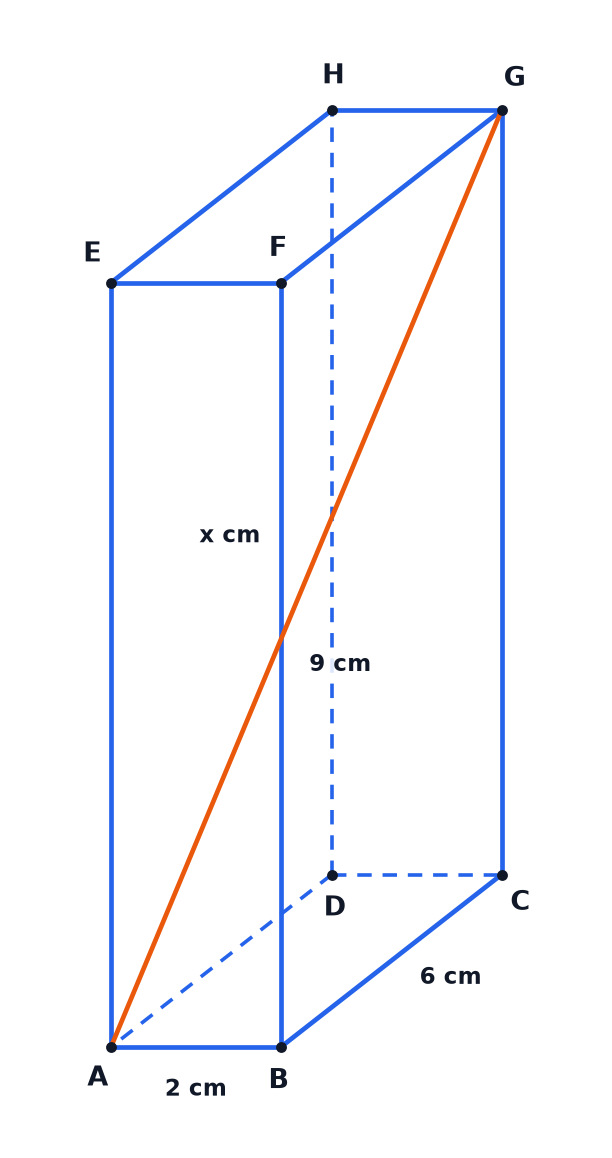
Not drawn accurately. The diagram shows a cuboid. Work out the length of the diagonal \(AG\). [3 marks]
Show answerHide answer
Model answer
\(AG^2 = 2^2 + 6^2 + 9^2 = 4 + 36 + 81 = 121\), so \(AG = 11\) cm.
Mark scheme
- \(2^2 + 6^2 + 9^2\), or a base diagonal \(AC^2 = 2^2 + 6^2\) then \(AG^2 = AC^2 + 9^2\) — M1
- \(121\) — M1
- \(11\) — A1
-
2 Work out [4 marks]
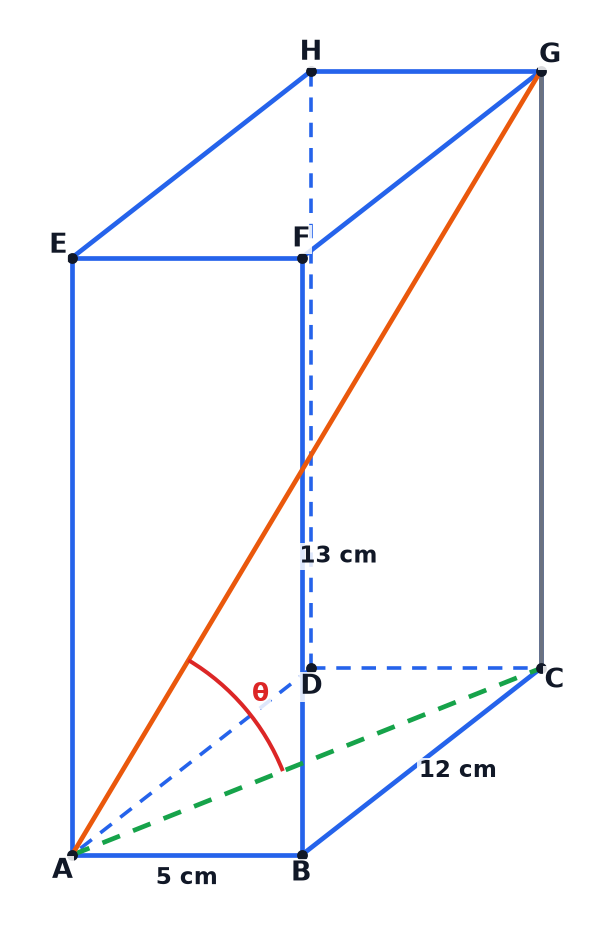
Not drawn accurately. The diagram shows a cuboid. Work out the size of angle \(\theta\), the angle between \(AG\) and the base \(ABCD\). [4 marks]
Show answerHide answer
Model answer
\(AC^2 = 5^2 + 12^2 = 169\), so \(AC = 13\) cm. In the right-angled triangle \(ACG\), \(\tan\theta = \dfrac{CG}{AC} = \dfrac{13}{13} = 1\), so \(\theta = 45^\circ\).
Mark scheme
- \(AC = 13\) — B1
- \(\tan\theta = \dfrac{13}{13}\) — M1
- \(\tan\theta = 1\) — A1
- \(45\) — A1
-
3 Work out [5 marks]
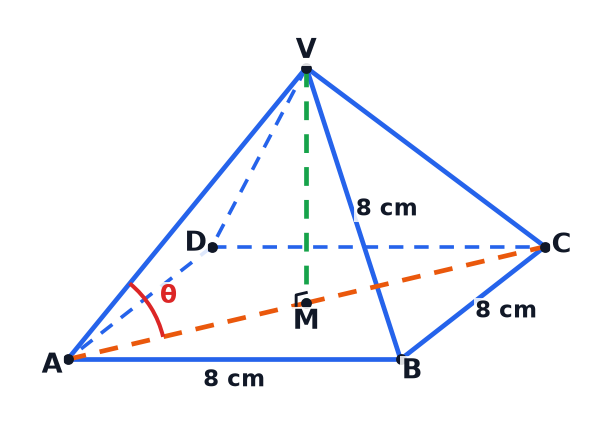
Not drawn accurately. The diagram shows a pyramid with a square base \(ABCD\). The apex \(V\) is directly above the centre \(M\) of the base. All the edges are 8 cm long. (a) Work out the exact height \(VM\) of the pyramid. [3 marks] (b) Work out the size of angle \(\theta\), the angle between \(VA\) and the base. [2 marks]
Show answerHide answer
Model answer
(a) \(AC^2 = 8^2 + 8^2 = 128\), so \(AM = \dfrac{1}{2}AC = 4\sqrt{2}\). \(VM^2 = 8^2 - (4\sqrt{2})^2 = 64 - 32 = 32\), so \(VM = 4\sqrt{2}\) cm. (b) \(\cos\theta = \dfrac{AM}{VA} = \dfrac{4\sqrt{2}}{8} = \dfrac{\sqrt{2}}{2}\), so \(\theta = 45^\circ\).
Mark scheme
- (a) \(AM = 4\sqrt{2}\) — M1
- (a) \(VM^2 = 8^2 - 32\) — M1
- (a) \(4\sqrt{2}\) — A1
- (b) \(\cos\theta = \dfrac{4\sqrt{2}}{8}\) or \(\tan\theta = 1\) — M1
- (b) \(45\) — A1
-
4 Work out [4 marks]
A boat sails 30 km from \(P\) to \(Q\) on a bearing of \(090^\circ\). It then sails 50 km from \(Q\) to \(R\) on a bearing of \(150^\circ\). Work out the distance \(PR\). [4 marks]
Show answerHide answer
Model answer
The bearing of \(P\) from \(Q\) is \(270^\circ\), so angle \(PQR = 270 - 150 = 120^\circ\). \(PR^2 = 30^2 + 50^2 - 2 \times 30 \times 50 \times \cos 120^\circ = 900 + 2500 + 1500 = 4900\), so \(PR = 70\) km.
Mark scheme
- Angle \(PQR = 120^\circ\) — M1
- \(PR^2 = 30^2 + 50^2 - 2 \times 30 \times 50 \times \cos 120^\circ\) — M1
- \(4900\) — A1
- \(70\) — A1
-
5 Work out [5 marks]
\(BT\) is a vertical tower on horizontal ground. The angle of elevation of \(T\) from a point \(A\) is \(30^\circ\), and from a point \(C\) is \(45^\circ\). Angle \(ABC = 90^\circ\) and \(AC = 60\) m. Work out the height of the tower. [5 marks]
Show answerHide answer
Model answer
Let \(BT = h\). \(BA = \dfrac{h}{\tan 30^\circ} = h\sqrt{3}\) and \(BC = \dfrac{h}{\tan 45^\circ} = h\). In the right-angled triangle \(ABC\), \(AC^2 = 3h^2 + h^2 = 4h^2 = 3600\), so \(h^2 = 900\) and \(h = 30\) m.
Mark scheme
- \(BA = h\sqrt{3}\), or \(\tan 30^\circ = \dfrac{h}{BA}\) — B1
- \(BC = h\) — B1
- \(AC^2 = BA^2 + BC^2 = 4h^2\) — M1
- \(4h^2 = 3600\) — M1
- \(30\) — A1
-
6 Show that [3 marks]
\(ABCDEFGH\) is a cube with edges of length 6 cm. Show that triangle \(ACF\) is equilateral, and write down the size of angle \(CAF\). [3 marks]
Show answerHide answer
Model answer
\(AC\), \(AF\) and \(CF\) are diagonals of faces of the cube. \(AC^2 = 6^2 + 6^2 = 72\), so \(AC = 6\sqrt{2}\). The other two face diagonals are the same length, so the triangle is equilateral and angle \(CAF = 60^\circ\).
Mark scheme
- \(AC^2 = 6^2 + 6^2 = 72\), so \(AC = 6\sqrt{2}\) — M1
- \(AF\) and \(CF\) are also face diagonals, so all three sides are \(6\sqrt{2}\) — B1
- Equilateral, so angle \(CAF = 60^\circ\) — Q1
Quick check
-
1
What is the formula for the space diagonal of a cuboid?
Show answerHide answer
B: \(\sqrt{l^2 + w^2 + h^2}\)
Use Pythagoras' theorem twice.
-
2
A rectangle is 4 cm by 3 cm. What is the length of its diagonal?
Show answerHide answer
A: 5 cm
\(\sqrt{16 + 9} = 5\).
-
3
Where is the apex of a square-based pyramid?
Show answerHide answer
D: Directly above the centre of the base
For a right pyramid the apex is above the centre.
-
4
A cuboid has edges 2 cm, 3 cm and 6 cm. What is the length of the space diagonal?
Show answerHide answer
C: 7 cm
\(\sqrt{4 + 9 + 36} = \sqrt{49} = 7\).
-
5
What is the angle between a line and a plane?
Show answerHide answer
B: The angle between the line and its shadow on the plane
The shadow of the line on the plane is used.
-
6
A cuboid has a base 4 cm by 3 cm and a height of 5 cm. What is \(\tan\theta\), where \(\theta\) is the angle between the diagonal \(AG\) and the base?
Show answerHide answer
A: 1
The base diagonal is 5 cm and the height is 5 cm, so \(\tan\theta = \dfrac{5}{5} = 1\).
-
7
A cube has edges of length 2 cm. What is the length of its space diagonal?
Show answerHide answer
D: \(2\sqrt{3}\) cm
\(\sqrt{4 + 4 + 4} = \sqrt{12} = 2\sqrt{3}\).
-
8
A square-based pyramid has a base with side 6 cm and a height of \(3\sqrt{2}\) cm. What is the angle between a sloping edge and the base?
Show answerHide answer
C: \(45^\circ\)
Half the base diagonal is \(3\sqrt{2}\), the same as the height, so \(\tan\theta = 1\).
-
9
In a 3D problem, which triangle contains the angle between the space diagonal of a cuboid and the base?
Show answerHide answer
B: A right-angled triangle with the base diagonal, the vertical edge and the space diagonal
The vertical edge is perpendicular to the base, so the triangle is right-angled.