Exam questions · Maths
Ratio and Proportion
- 30 exam questions
- 85 marks
- 45 quick checks
Ratio: Simplifying and Sharing
Just this lesson-
1 Write [2 marks]
Write the ratio \(18 : 30\) in its simplest form.
Show answerHide answer
Model answer
The highest common factor is 6, so \(18 : 30 = 3 : 5\).
Mark scheme
- Divides both by a common factor, such as \(9 : 15\) or \(6 : 10\) — M1
- \(3 : 5\) — A1
-
2 Work out [3 marks]
Peter and Quinn share \(\pounds 84\) in the ratio \(3 : 4\). Work out Quinn's share.
Show answerHide answer
Model answer
There are \(3 + 4 = 7\) parts, and one part is \(84 \div 7 = 12\). Quinn's share is \(4 \times 12 = \pounds 48\).
Mark scheme
- \(3 + 4 = 7\) or \(84 \div 7\) — M1
- \(4 \times 12\) or \(84 \div 7 \times 4\) — M1
- \(\pounds 48\) — A1
-
3 Work out [3 marks]
Paint is mixed from blue and yellow in the ratio \(2 : 5\). Lena uses 600 ml of yellow paint. Work out how much blue paint she needs.
Show answerHide answer
Model answer
The yellow is 5 parts, so one part is \(600 \div 5 = 120\) ml. The blue is \(2 \times 120 = 240\) ml.
Mark scheme
- \(600 \div 5 = 120\) — M1
- \(2 \times 120\) — M1
- 240 ml — A1
-
4 Work out [3 marks]
The ratio of cats to dogs at a rescue centre is \(5 : 3\). There are 16 more cats than dogs. Work out the total number of cats and dogs.
Show answerHide answer
Model answer
The difference is \(5 - 3 = 2\) parts, and \(2\) parts \(= 16\), so one part is 8. The total is \(8\) parts, which is \(8 \times 8 = 64\).
Mark scheme
- \(16 \div 2 = 8\) — M1
- \(8 \times 8\) or \(40 + 24\) — M1
- 64 — A1
-
5 Work out [3 marks]
Concrete is made from cement, sand and gravel in the ratio \(1 : 3 : 5\). A builder makes 90 kg of concrete. Work out the mass of sand in the concrete.
Show answerHide answer
Model answer
There are \(1 + 3 + 5 = 9\) parts, so one part is \(90 \div 9 = 10\) kg. The sand is \(3 \times 10 = 30\) kg.
Mark scheme
- \(1 + 3 + 5 = 9\) or \(90 \div 9\) — M1
- \(3 \times 10\) — M1
- 30 kg — A1
-
6 Work out [4 marks]
\(x : y = 3 : 4\) and \(y : z = 6 : 5\). (a) Work out \(x : y : z\). (2 marks) (b) \(x + y + z = 124\). Work out the value of \(z\). (2 marks)
Show answerHide answer
Model answer
(a) Make \(y\) the same in both: the lowest common multiple of 4 and 6 is 12. So \(x : y = 9 : 12\) and \(y : z = 12 : 10\), giving \(x : y : z = 9 : 12 : 10\). (b) There are \(9 + 12 + 10 = 31\) parts, so one part is \(124 \div 31 = 4\) and \(z = 10 \times 4 = 40\).
Mark scheme
- (a) \(9 : 12\) or \(12 : 10\) seen — M1
- (a) \(9 : 12 : 10\) — A1
- (b) \(124 \div 31 = 4\) — M1
- (b) 40 — A1
Quick check
-
1
Simplify the ratio \(24 : 36\).
Show answerHide answer
B: \(2 : 3\)
The highest common factor of 24 and 36 is 12. Dividing both parts by 12 gives \(2 : 3\).
-
2
Which ratio is equivalent to \(3 : 5\)?
Show answerHide answer
A: \(9 : 15\)
Multiplying both parts of \(3 : 5\) by 3 gives \(9 : 15\). The others do not keep the same relationship.
-
3
Write \(40\) cm to \(1.2\) m as a ratio in its simplest form.
Show answerHide answer
D: \(1 : 3\)
Change to the same unit: \(1.2\) m \(= 120\) cm. Then \(40 : 120 = 1 : 3\).
-
4
\(\pounds 60\) is shared in the ratio \(2 : 3\). How much is the larger share?
Show answerHide answer
C: \(\pounds 36\)
There are \(2 + 3 = 5\) parts, and one part is \(60 \div 5 = 12\). The larger share is \(3 \times 12 = 36\).
-
5
The ratio of boys to girls in a class is \(3 : 5\). There are 12 boys. How many girls are there?
Show answerHide answer
B: 20
One part is \(12 \div 3 = 4\), so the number of girls is \(5 \times 4 = 20\).
-
6
Red and blue beads are in the ratio \(2 : 5\). What fraction of the beads are red?
Show answerHide answer
A: \(\dfrac{2}{7}\)
The whole is \(2 + 5 = 7\) parts, so red is \(\dfrac{2}{7}\).
-
7
Orange juice and water are mixed in the ratio \(1 : 4\). There is 250 ml of orange juice. How much water is there?
Show answerHide answer
D: 1000 ml
The water is 4 times the juice, so \(4 \times 250 = 1000\) ml.
-
8
Amy and Ben share money in the ratio \(3 : 7\). Ben gets \(\pounds 20\) more than Amy. How much money is shared?
Show answerHide answer
C: \(\pounds 50\)
The difference is \(7 - 3 = 4\) parts, so 4 parts \(= 20\) and one part is 5. The total is \(10 \times 5 = 50\).
-
9
\(A : B = 2 : 3\) and \(B : C = 4 : 5\). Write \(A : B : C\) in its simplest form.
Show answerHide answer
B: \(8 : 12 : 15\)
Make the \(B\) values match. The lowest common multiple of 3 and 4 is 12. Then \(A : B = 8 : 12\) and \(B : C = 12 : 15\), so \(A : B : C = 8 : 12 : 15\).
Direct and Inverse Proportion
Just this lesson-
1 Work out [3 marks]
Here are the ingredients for 4 people: 300 g of rice, 120 g of peas and 2 onions. Work out the amounts needed for 10 people.
Show answerHide answer
Model answer
The scale factor is \(10 \div 4 = 2.5\). Rice: \(300 \times 2.5 = 750\) g. Peas: \(120 \times 2.5 = 300\) g. Onions: \(2 \times 2.5 = 5\).
Mark scheme
- Scale factor 2.5, or the amounts for 2 people found — M1
- Two of the three amounts correct — A1
- 750 g, 300 g and 5 onions — A1
-
2 Work out [2 marks]
7 notebooks cost \(\pounds 10.50\). Work out the cost of 12 of these notebooks.
Show answerHide answer
Model answer
One notebook costs \(10.50 \div 7 = \pounds 1.50\), so 12 cost \(12 \times 1.50 = \pounds 18\).
Mark scheme
- \(10.50 \div 7 = 1.50\) — M1
- \(\pounds 18\) — A1
-
3 Work out [3 marks]
Here are two offers for tea bags. Offer A (80 tea bags) costs \(\pounds 2.40\) Offer B (240 tea bags) costs \(\pounds 6.60\) Which offer is better value for money? You must show your working.
Show answerHide answer
Model answer
Offer A: \(240 \div 80 = 3\) pence per tea bag. Offer B: \(660 \div 240 = 2.75\) pence per tea bag. Offer B is cheaper per tea bag, so it is better value.
Mark scheme
- A method to compare, such as the cost of one tea bag or the cost of 240 tea bags for offer A — M1
- 3p and 2.75p, or \(\pounds 7.20\) and \(\pounds 6.60\) — A1
- Offer B, with a correct comparison — Q1
-
4 Work out [2 marks]
\(\pounds 1 = \euro 1.25\). Work out how many pounds you get for \(\euro 200\).
Show answerHide answer
Model answer
\(200 \div 1.25 = 160\), so you get \(\pounds 160\).
Mark scheme
- \(200 \div 1.25\) — M1
- \(\pounds 160\) — A1
-
5 Work out [2 marks]
5 machines take 12 hours to make a batch of parts. All the machines work at the same rate. How long would 4 machines take to make the same batch?
Show answerHide answer
Model answer
The batch needs \(5 \times 12 = 60\) machine-hours, and \(60 \div 4 = 15\) hours.
Mark scheme
- \(5 \times 12 = 60\) — M1
- 15 hours — A1
-
6 Work out [4 marks]
\(y\) is directly proportional to the square of \(x\). When \(x = 3\), \(y = 18\). (a) Work out the value of \(y\) when \(x = 5\). (3 marks) (b) Work out the positive value of \(x\) when \(y = 32\). (1 mark)
Show answerHide answer
Model answer
(a) \(y = kx^2\), so \(18 = k \times 9\) and \(k = 2\). When \(x = 5\), \(y = 2 \times 25 = 50\). (b) \(32 = 2x^2\), so \(x^2 = 16\) and \(x = 4\).
Mark scheme
- (a) \(y = kx^2\) with \(k = 2\) found — M1
- (a) \(2 \times 5^2\) — M1
- (a) 50 — A1
- (b) 4 — B1
Quick check
-
1
5 pens cost \(\pounds 3.50\). How much do 8 pens cost?
Show answerHide answer
C: \(\pounds 5.60\)
One pen costs \(3.50 \div 5 = 0.70\). Then 8 pens cost \(8 \times 0.70 = 5.60\).
-
2
A recipe for 4 people uses 300 g of flour. How much flour is needed for 10 people?
Show answerHide answer
B: 750 g
For one person, \(300 \div 4 = 75\) g. For 10 people, \(75 \times 10 = 750\) g.
-
3
Which of these shows that \(y\) is directly proportional to \(x\)?
Show answerHide answer
A: \(y = 3x\)
In direct proportion \(y\) is a constant multiple of \(x\), so \(y = 3x\), which makes a straight line through the origin.
-
4
6 workers take 10 days to build a wall. How long would 15 workers take, working at the same rate?
Show answerHide answer
D: 4 days
The job takes \(6 \times 10 = 60\) worker-days. With 15 workers it takes \(60 \div 15 = 4\) days.
-
5
Which pack of cereal is the best value?
Show answerHide answer
C: 750 g for \(\pounds 2.85\)
The cost per 100 g is 40p, 38p, 39.5p and 39p. The 750 g pack is the cheapest per 100 g.
-
6
\(\pounds 1 = \euro 1.20\). How many euros do you get for \(\pounds 50\)?
Show answerHide answer
B: \(\euro 60\)
Multiply by the exchange rate: \(50 \times 1.2 = 60\).
-
7
Two taps fill a tank in 30 minutes. How long would 5 identical taps take?
Show answerHide answer
A: 12 minutes
This is inverse proportion. The total is \(2 \times 30 = 60\) tap-minutes, so 5 taps need \(60 \div 5 = 12\) minutes.
-
8
\(y\) is directly proportional to \(x\). \(y = 12\) when \(x = 3\). Work out \(y\) when \(x = 7\).
Show answerHide answer
D: 28
\(y = kx\) and \(12 = 3k\), so \(k = 4\). Then \(y = 4 \times 7 = 28\).
-
9
\(y\) is inversely proportional to \(x\). \(y = 6\) when \(x = 4\). Work out \(y\) when \(x = 3\).
Show answerHide answer
C: 8
\(y = \dfrac{k}{x}\) and \(6 = \dfrac{k}{4}\), so \(k = 24\). Then \(y = \dfrac{24}{3} = 8\).
Speed, Distance, Time and Density
Just this lesson-
1 Work out [2 marks]
A train travels 210 km in 3 hours 30 minutes. Work out the average speed of the train.
Show answerHide answer
Model answer
3 hours 30 minutes is 3.5 hours, so the speed is \(210 \div 3.5 = 60\) km/h.
Mark scheme
- \(210 \div 3.5\) or 3.5 hours seen — M1
- 60 km/h — A1
-
2 Work out [2 marks]
A runner runs at 12 km/h for 1 hour 45 minutes. How far does the runner run?
Show answerHide answer
Model answer
1 hour 45 minutes is 1.75 hours, so the distance is \(12 \times 1.75 = 21\) km.
Mark scheme
- \(12 \times 1.75\) or 1.75 hours seen — M1
- 21 km — A1
-
3 Work out [5 marks]
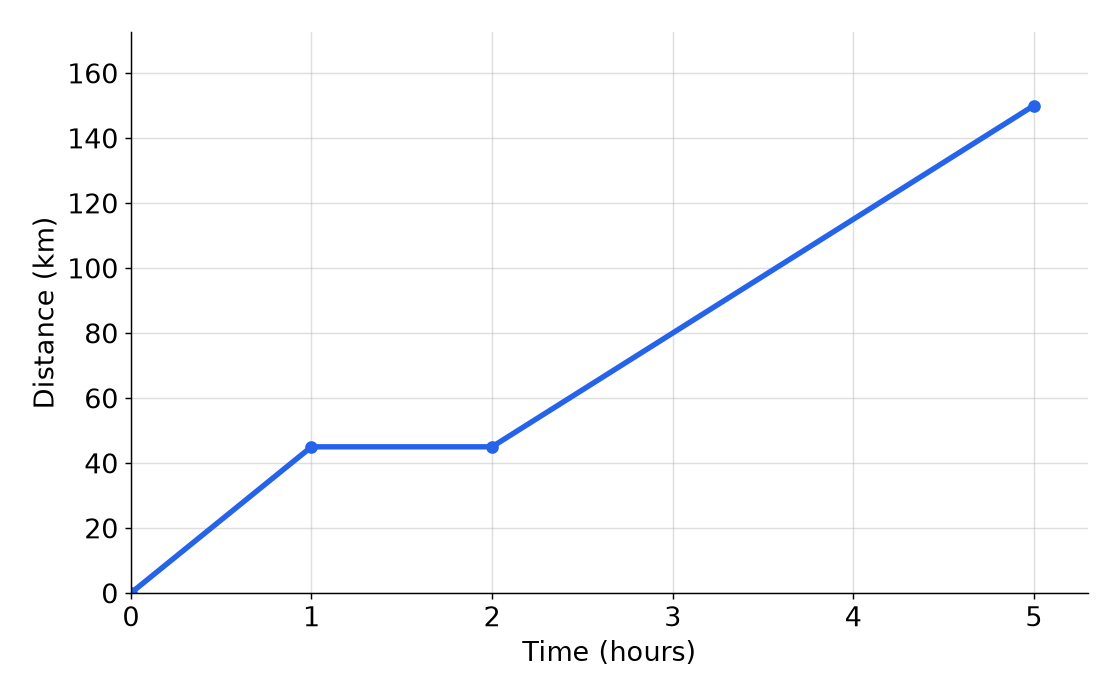
The graph shows Sofia's journey from her home to a campsite. (a) How far had Sofia travelled when she stopped? [1 mark] (b) Work out Sofia's speed during the last part of her journey. [2 marks] (c) Work out Sofia's average speed for the first 2 hours of her journey. [2 marks]
Show answerHide answer
Model answer
(a) The flat part of the graph is at 45 km. (b) In the last part she travelled \(150 - 45 = 105\) km in \(5 - 2 = 3\) hours, so her speed was \(105 \div 3 = 35\) km/h. (c) In the first 2 hours she travelled 45 km, so her average speed was \(45 \div 2 = 22.5\) km/h.
Mark scheme
- (a) 45 km — B1
- (b) \(105 \div 3\) — M1
- (b) 35 km/h — A1
- (c) \(45 \div 2\) — M1
- (c) 22.5 km/h — A1
-
4 Work out [2 marks]
Jess walks 6 km in 90 minutes. Work out her average speed in kilometres per hour.
Show answerHide answer
Model answer
90 minutes is 1.5 hours, so the speed is \(6 \div 1.5 = 4\) km/h.
Mark scheme
- \(6 \div 1.5\) or 1.5 hours seen — M1
- 4 km/h — A1
-
5 Work out [2 marks]
A solid has a mass of 450 g and a volume of 60 cm\(^3\). Work out the density of the solid.
Show answerHide answer
Model answer
Density \(=\) mass \(\div\) volume \(= 450 \div 60 = 7.5\) g/cm\(^3\).
Mark scheme
- \(450 \div 60\) — M1
- 7.5 g/cm\(^3\) — A1
-
6 Work out [4 marks]
(a) A car travels at 90 km/h. Work out this speed in metres per second. [2 marks] (b) A force of 240 N acts on an area of 0.4 m\(^2\). Work out the pressure in N/m\(^2\). [2 marks]
Show answerHide answer
Model answer
(a) \(90 \times 1000 \div 3600 = 25\) m/s. (b) Pressure \(= 240 \div 0.4 = 600\) N/m\(^2\).
Mark scheme
- (a) \(90 \times 1000 \div 3600\) or \(90 \div 3.6\) — M1
- (a) 25 — A1
- (b) \(240 \div 0.4\) — M1
- (b) 600 — A1
Quick check
-
1
A car travels 150 km in 2 hours 30 minutes. What is its average speed?
Show answerHide answer
D: 60 km/h
Write 2 hours 30 minutes as 2.5 hours. Then \(150 \div 2.5 = 60\) km/h.
-
2
What is 45 minutes as a decimal of an hour?
Show answerHide answer
C: 0.75 hours
\(45 \div 60 = 0.75\).
-
3
A train travels at 80 km/h for 3 hours 15 minutes. How far does it go?
Show answerHide answer
B: 260 km
3 hours 15 minutes is 3.25 hours, so the distance is \(80 \times 3.25 = 260\) km. Writing the time as 3.15 hours is a common error.
-
4
A cyclist rides 60 km at 30 km/h and then 60 km at 60 km/h. What is the average speed for the whole journey?
Show answerHide answer
A: 40 km/h
The times are 2 hours and 1 hour. The total distance is 120 km and the total time is 3 hours, so \(120 \div 3 = 40\) km/h.
-
5
What does a horizontal line on a distance-time graph show?
Show answerHide answer
D: The object is stationary
A flat line means the distance is not changing with time, so the speed is zero.
-
6
A metal block has mass 240 g and volume 30 cm\(^3\). What is its density?
Show answerHide answer
C: 8 g/cm\(^3\)
Density \(=\) mass \(\div\) volume \(= 240 \div 30 = 8\) g/cm\(^3\).
-
7
The density of a metal is 8 g/cm\(^3\). What is the mass of 25 cm\(^3\) of it?
Show answerHide answer
B: 200 g
Mass \(=\) density \(\times\) volume \(= 8 \times 25 = 200\) g.
-
8
Change 72 km/h into metres per second.
Show answerHide answer
A: 20 m/s
\(72 \times 1000 = 72\,000\) m per hour, and \(72\,000 \div 3600 = 20\) m/s.
-
9
A force of 600 N acts on an area of 0.5 m\(^2\). What is the pressure?
Show answerHide answer
D: 1200 N/m\(^2\)
Pressure \(=\) force \(\div\) area \(= 600 \div 0.5 = 1200\) N/m\(^2\).
Units, Conversions and Scale
Just this lesson-
1 Change [2 marks]
(a) Change 6.5 m to centimetres. [1 mark] (b) Change 3200 g to kilograms. [1 mark]
Show answerHide answer
Model answer
(a) \(6.5 \times 100 = 650\) cm. (b) \(3200 \div 1000 = 3.2\) kg.
Mark scheme
- (a) 650 cm — B1
- (b) 3.2 kg — B1
-
2 Work out [2 marks]
A bottle holds 1.5 litres of juice. How many 250 ml glasses can be completely filled from the bottle?
Show answerHide answer
Model answer
\(1.5\text{ litres} = 1500\) ml, and \(1500 \div 250 = 6\) glasses.
Mark scheme
- 1500 ml seen, or \(1500 \div 250\) — M1
- 6 — A1
-
3 Work out [5 marks]
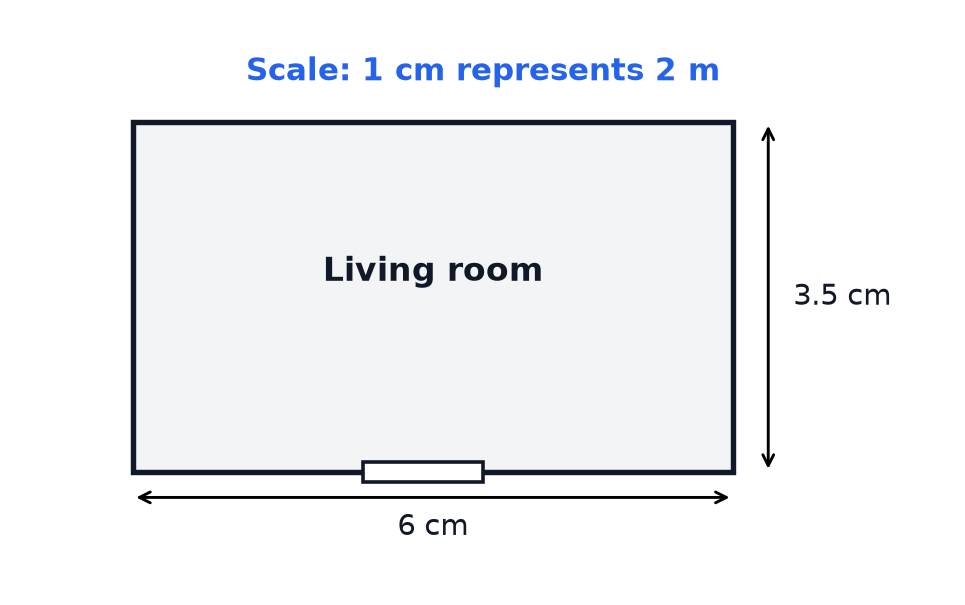
The diagram shows a scale drawing of a living room. The scale is 1 cm to 2 m. (a) Work out the real length of the room. [1 mark] (b) Work out the real perimeter of the room. [2 marks] (c) Work out the real area of the room. [2 marks]
Show answerHide answer
Model answer
(a) \(6 \times 2 = 12\) m. (b) The real width is \(3.5 \times 2 = 7\) m, so the perimeter is \(2 \times (12 + 7) = 38\) m. (c) The area is \(12 \times 7 = 84\) m\(^2\).
Mark scheme
- (a) 12 m — B1
- (b) Real width 7 m, or \(12 + 7 + 12 + 7\) — M1
- (b) 38 m — A1
- (c) \(12 \times 7\) — M1
- (c) 84 m\(^2\) — A1
-
4 Work out [3 marks]
A map has a scale of \(1 : 20\,000\). A path is 9 cm long on the map. Work out the real length of the path in kilometres.
Show answerHide answer
Model answer
\(9 \times 20\,000 = 180\,000\) cm. This is 1800 m, which is 1.8 km.
Mark scheme
- \(9 \times 20\,000\) — M1
- \(180\,000\) cm or \(1800\) m — M1
- 1.8 km — A1
-
5 Work out [2 marks]
1 gallon is approximately 4.5 litres. A tank holds 36 litres of water. Approximately how many gallons does it hold?
Show answerHide answer
Model answer
\(36 \div 4.5 = 8\) gallons.
Mark scheme
- \(36 \div 4.5\) — M1
- 8 gallons — A1
-
6 Change [3 marks]
(a) Change 0.2 m\(^2\) to cm\(^2\). [2 marks] (b) Change \(3\,000\,000\) cm\(^3\) to m\(^3\). [1 mark]
Show answerHide answer
Model answer
(a) \(1\text{ m}^2 = 10\,000\) cm\(^2\), so \(0.2 \times 10\,000 = 2000\) cm\(^2\). (b) \(3\,000\,000 \div 1\,000\,000 = 3\) m\(^3\).
Mark scheme
- (a) \(0.2 \times 10\,000\) or \(20 \times 100\) — M1
- (a) 2000 — A1
- (b) 3 — B1
Quick check
-
1
Change 3.6 km to metres.
Show answerHide answer
A: 3600 m
Multiply by 1000: \(3.6 \times 1000 = 3600\).
-
2
Change 2450 g to kilograms.
Show answerHide answer
D: 2.45 kg
Divide by 1000: \(2450 \div 1000 = 2.45\).
-
3
Change 0.75 litres to millilitres.
Show answerHide answer
C: 750 ml
Multiply by 1000: \(0.75 \times 1000 = 750\).
-
4
Change 250 cm to metres.
Show answerHide answer
B: 2.5 m
Divide by 100: \(250 \div 100 = 2.5\).
-
5
A map has a scale of \(1 : 50\,000\). Two towns are 4 cm apart on the map. What is the real distance?
Show answerHide answer
A: 2 km
\(4 \times 50\,000 = 200\,000\) cm. Divide by 100 to get 2000 m, then by 1000 to get 2 km.
-
6
A scale drawing uses 1 cm to represent 2 m. A line on the drawing is 7 cm. How long is it in real life?
Show answerHide answer
D: 14 m
Multiply by the scale: \(7 \times 2 = 14\) m.
-
7
A cake uses 250 g of flour. How many cakes can be made from a 2 kg bag?
Show answerHide answer
C: 8
\(2\text{ kg} = 2000\) g, and \(2000 \div 250 = 8\).
-
8
How many cm\(^2\) are in 1 m\(^2\)?
Show answerHide answer
B: 10 000
A square metre is a square of side 100 cm, so its area is \(100 \times 100 = 10\,000\) cm\(^2\).
-
9
Change 5 m\(^3\) to cm\(^3\).
Show answerHide answer
A: 5 000 000 cm\(^3\)
\(1\text{ m}^3 = 100^3 = 1\,000\,000\) cm\(^3\), so \(5\text{ m}^3 = 5\,000\,000\) cm\(^3\).
Repeated Percentage Change and Compound Interest
Just this lesson-
1 Work out [2 marks]
Increase \(\pounds 60\) by 15%.
Show answerHide answer
Model answer
10% of 60 is 6 and 5% is 3, so 15% is 9. The new amount is \(60 + 9 = \pounds 69\).
Mark scheme
- 15% of 60 \(= 9\), or \(60 \times 1.15\) — M1
- \(\pounds 69\) — A1
-
2 Work out [3 marks]
\(\pounds 4000\) is invested at 3% per year compound interest. Work out the value of the investment after 2 years.
Show answerHide answer
Model answer
After year 1: \(4000 \times 1.03 = 4120\). After year 2: \(4120 \times 1.03 = 4243.60\). The value is \(\pounds 4243.60\).
Mark scheme
- \(4000 \times 1.03\) or \(4000 \times 1.03^2\) — M1
- \(4120 \times 1.03\) — M1
- \(\pounds 4243.60\) — A1
-
3 Work out [3 marks]
A tractor is worth \(\pounds 30\,000\). Each year its value falls by 20% of its value at the start of that year. Work out the value of the tractor after 2 years.
Show answerHide answer
Model answer
After year 1: \(30\,000 \times 0.8 = 24\,000\). After year 2: \(24\,000 \times 0.8 = 19\,200\). The value is \(\pounds 19\,200\).
Mark scheme
- \(30\,000 \times 0.8\) — M1
- \(24\,000 \times 0.8\) — M1
- \(\pounds 19\,200\) — A1
-
4 Work out [4 marks]
Zoe invests \(\pounds 500\) for 2 years at 10% per year simple interest. Yan invests \(\pounds 500\) for 2 years at 10% per year compound interest. How much more money does Yan have than Zoe at the end of the 2 years?
Show answerHide answer
Model answer
Zoe: \(10\%\) of 500 is 50, so after 2 years she has \(500 + 2 \times 50 = \pounds 600\). Yan: \(500 \times 1.1 = 550\) and \(550 \times 1.1 = 605\). The difference is \(605 - 600 = \pounds 5\).
Mark scheme
- \(\pounds 600\) for simple interest — M1
- \(500 \times 1.1\) or \(\pounds 550\) — M1
- \(\pounds 605\) — A1
- \(\pounds 5\) — A1
-
5 Work out [2 marks]
After a 10% increase, the price of a meal is \(\pounds 44\). Work out the price before the increase.
Show answerHide answer
Model answer
The multiplier is 1.1, so the original price is \(44 \div 1.1 = \pounds 40\).
Mark scheme
- \(44 \div 1.1\) — M1
- \(\pounds 40\) — A1
-
6 Work out [3 marks]
The number of rabbits on an island increases by 20% each year. There are 500 rabbits at the start of the first year. Work out the number of rabbits after 2 years.
Show answerHide answer
Model answer
After year 1: \(500 \times 1.2 = 600\). After year 2: \(600 \times 1.2 = 720\). There are 720 rabbits.
Mark scheme
- \(500 \times 1.2\) — M1
- \(600 \times 1.2\) or \(500 \times 1.44\) — M1
- 720 — A1
Quick check
-
1
What is the multiplier for an increase of 15%?
Show answerHide answer
B: 1.15
An increase of 15% gives \(100\% + 15\% = 115\%\), which is 1.15.
-
2
What is the multiplier for a decrease of 12%?
Show answerHide answer
A: 0.88
\(100\% - 12\% = 88\%\), which is 0.88.
-
3
A phone costs \(\pounds 400\). The price is reduced by 15%. What is the new price?
Show answerHide answer
D: \(\pounds 340\)
\(400 \times 0.85 = 340\).
-
4
\(\pounds 1000\) increases by 10% each year for 2 years. What is it worth after 2 years?
Show answerHide answer
C: \(\pounds 1210\)
\(1000 \times 1.1 = 1100\) and \(1100 \times 1.1 = 1210\). The second increase is 10% of the new amount.
-
5
\(\pounds 2000\) is invested at 5% compound interest per year. What is it worth after 2 years?
Show answerHide answer
B: \(\pounds 2205\)
\(2000 \times 1.05^2 = 2000 \times 1.1025 = 2205\). The simple interest answer would be \(\pounds 2200\).
-
6
A car worth \(\pounds 12\,000\) loses 20% of its value each year. What is it worth after 2 years?
Show answerHide answer
A: \(\pounds 7680\)
\(12\,000 \times 0.8 = 9600\) and \(9600 \times 0.8 = 7680\). Taking 40% off in one go would give \(\pounds 7200\).
-
7
Which statement about interest is correct?
Show answerHide answer
D: After the first year, compound interest is greater than simple interest
Compound interest is paid on interest already earned, so it grows faster than simple interest, which is always paid on the original amount.
-
8
After a 25% increase, a house is worth \(\pounds 150\,000\). What was it worth before the increase?
Show answerHide answer
C: \(\pounds 120\,000\)
The multiplier is 1.25, so the original is \(150\,000 \div 1.25 = 120\,000\).
-
9
A population of 8000 falls by 10% each year. What is the population after 2 years?
Show answerHide answer
B: 6480
\(8000 \times 0.9^2 = 8000 \times 0.81 = 6480\).