Exam questions · Maths
Transformations and Similarity
- 30 exam questions
- 86 marks
- 45 quick checks
Reflections and Translations
Just this lesson-
1 Write down [2 marks]
The point \((4, -1)\) is translated by the vector \(\begin{pmatrix} -2 \\ 3 \end{pmatrix}\). Write down the coordinates of the image. [2 marks]
Show answerHide answer
Model answer
\((4 - 2, -1 + 3) = (2, 2)\).
Mark scheme
- \(4 - 2\) or \(-1 + 3\) — M1
- \((2, 2)\) — A1
-
2 Reflect [3 marks]
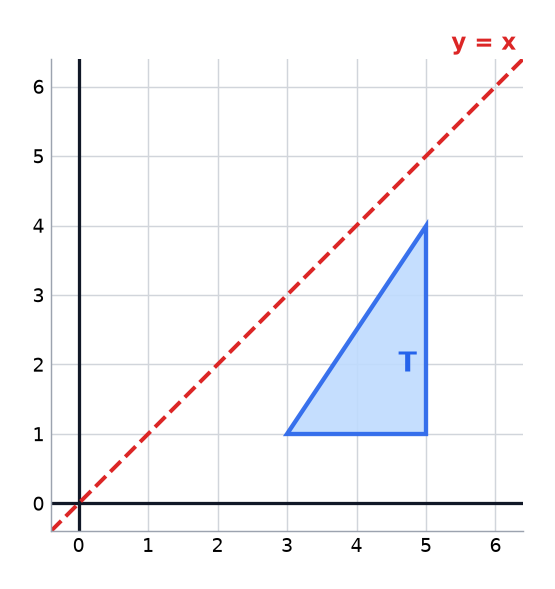
Triangle \(T\) is drawn on the grid. (a) Reflect triangle \(T\) in the line \(y = x\). [2 marks] (b) Write down the coordinates of the image of the point \((6, 2)\) in the line \(y = x\). [1 mark]
Show answerHide answer
Model answer
(a) The coordinates swap, so \((3, 1)\), \((5, 1)\) and \((5, 4)\) go to \((1, 3)\), \((1, 5)\) and \((4, 5)\). (b) \((2, 6)\).
Mark scheme
- (a) Reflects at least two vertices correctly — M1
- (a) Triangle with vertices \((1, 3)\), \((1, 5)\) and \((4, 5)\) — A1
- (b) \((2, 6)\) — B1
-
3 Describe [3 marks]
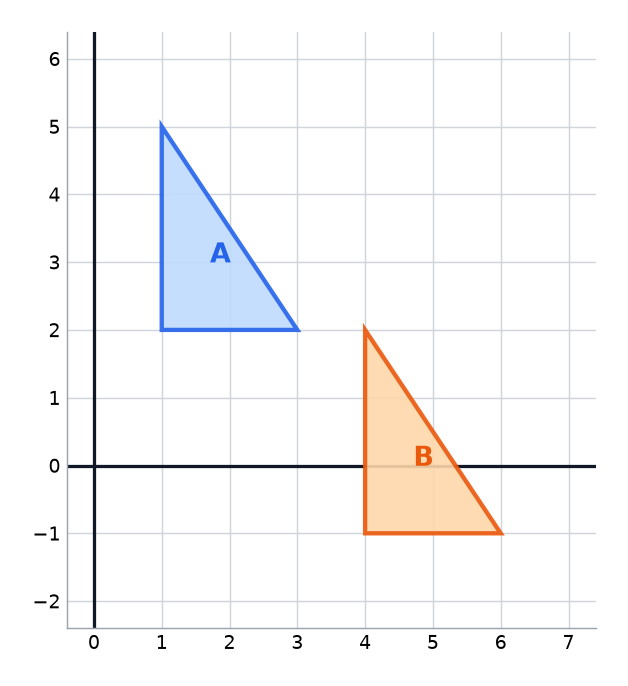
Triangle \(B\) is the image of triangle \(A\) after a single transformation. (a) Describe fully the single transformation. [2 marks] (b) Triangle \(A\) has an area of 3 square units. Write down the area of triangle \(B\). [1 mark]
Show answerHide answer
Model answer
(a) The point \((1, 2)\) goes to \((4, -1)\), which is 3 right and 3 down. It is a translation by \(\begin{pmatrix} 3 \\ -3 \end{pmatrix}\). (b) A translation does not change the size, so the area is 3 square units.
Mark scheme
- (a) Translation — B1
- (a) \(\begin{pmatrix} 3 \\ -3 \end{pmatrix}\) — B1
- (b) 3 — B1
-
4 Find [2 marks]
A reflection maps the point \((5, 1)\) onto the point \((5, 7)\). Find the equation of the mirror line. [2 marks]
Show answerHide answer
Model answer
The mirror line is halfway between the two points, and the points differ only in \(y\). The midpoint of the \(y\)-values is \(\dfrac{1 + 7}{2} = 4\), so the mirror line is \(y = 4\).
Mark scheme
- \(\dfrac{1 + 7}{2}\) or 4 seen — M1
- \(y = 4\) — A1
-
5 Work out [3 marks]
Triangle \(T\) has vertices \((1, 1)\), \((4, 1)\) and \((1, 3)\). \(T\) is reflected in the line \(x = -1\). Write down the coordinates of the image of (a) the vertex \((4, 1)\), (b) the vertex \((1, 3)\). [3 marks]
Show answerHide answer
Model answer
(a) \((4, 1)\) is 5 to the right of \(x = -1\), so the image is 5 to the left, at \((-6, 1)\). (b) \((1, 3)\) is 2 to the right, so the image is at \((-3, 3)\).
Mark scheme
- (a) Distance 5 from the line, or 5 seen — M1
- (a) \((-6, 1)\) — A1
- (b) \((-3, 3)\) — B1
-
6 Work out [3 marks]
The point \(P\) is \((2, 5)\). \(P\) is reflected in the line \(y = x\) to give \(Q\). \(Q\) is translated by the vector \(\begin{pmatrix} -3 \\ -2 \end{pmatrix}\) to give \(R\). Write down the coordinates of \(R\). [3 marks]
Show answerHide answer
Model answer
Reflecting in \(y = x\) gives \(Q = (5, 2)\). Translating gives \(R = (5 - 3, 2 - 2) = (2, 0)\).
Mark scheme
- \(Q = (5, 2)\) — B1
- Adds the vector to their \(Q\) — M1
- \((2, 0)\) — A1
Quick check
-
1
What is the image of the point \((3, 5)\) in the \(x\)-axis?
Show answerHide answer
B: \((3, -5)\)
A reflection in the \(x\)-axis changes the sign of the \(y\)-coordinate.
-
2
What is the image of the point \((2, 3)\) in the \(y\)-axis?
Show answerHide answer
A: \((-2, 3)\)
A reflection in the \(y\)-axis changes the sign of the \(x\)-coordinate.
-
3
What is the image of \((4, 1)\) in the line \(y = x\)?
Show answerHide answer
D: \((1, 4)\)
In the line \(y = x\) the coordinates swap.
-
4
The point \((5, 2)\) is reflected in the line \(x = 3\). What is the image?
Show answerHide answer
C: \((1, 2)\)
\((5, 2)\) is 2 right of the line, so the image is 2 left of it, at \((1, 2)\).
-
5
What does the column vector \(\begin{pmatrix} -2 \\ 5 \end{pmatrix}\) mean?
Show answerHide answer
B: 2 left and 5 up
The top number is left or right, and the bottom number is up or down.
-
6
The point \((4, 1)\) is translated by \(\begin{pmatrix} -3 \\ 2 \end{pmatrix}\). What is the image?
Show answerHide answer
A: \((1, 3)\)
\((4 - 3, 1 + 2) = (1, 3)\).
-
7
A translation takes \((2, 5)\) to \((7, 3)\). What is the column vector?
Show answerHide answer
D: \(\begin{pmatrix} 5 \\ -2 \end{pmatrix}\)
The change in \(x\) is \(7 - 2 = 5\) and the change in \(y\) is \(3 - 5 = -2\).
-
8
What must you give to describe a reflection fully?
Show answerHide answer
C: The equation of the mirror line
A reflection is described by its mirror line, such as \(x = 1\).
-
9
What is the image of \((4, 1)\) in the line \(y = -x\)?
Show answerHide answer
B: \((-1, -4)\)
In the line \(y = -x\) the coordinates swap and both change sign.
Rotations
Just this lesson-
1 Write down [2 marks]
Write down the coordinates of the image of the point \((-4, 1)\) after a rotation of \(90^\circ\) anticlockwise about the origin. [2 marks]
Show answerHide answer
Model answer
A \(90^\circ\) anticlockwise turn sends \((x, y)\) to \((-y, x)\), so \((-4, 1)\) goes to \((-1, -4)\).
Mark scheme
- Uses \((x, y) \to (-y, x)\) — M1
- \((-1, -4)\) — A1
-
2 Rotate [3 marks]
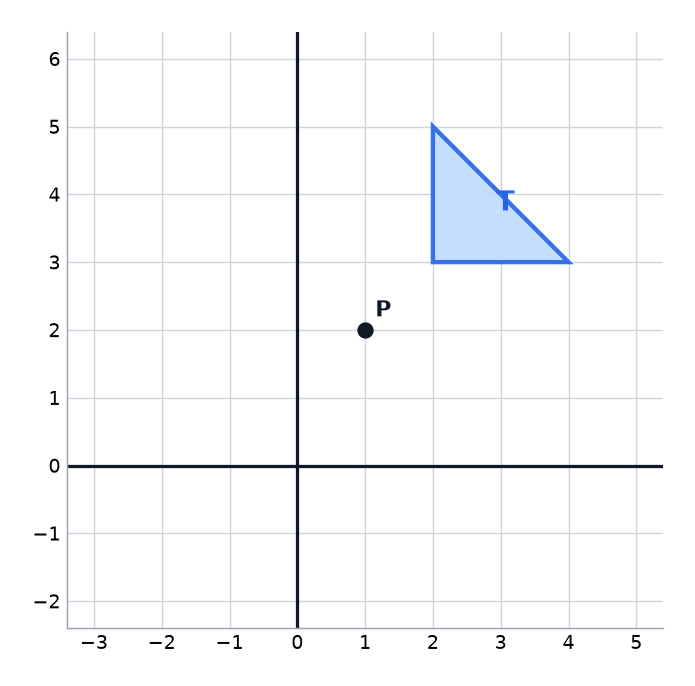
Rotate triangle \(T\) through \(180^\circ\) about the point \(P\). [3 marks]
Show answerHide answer
Model answer
The vertices are 1 right and 1 up, 3 right and 1 up, and 1 right and 3 up from \(P\). Turning through \(180^\circ\) puts them 1 left and 1 down, 3 left and 1 down, and 1 left and 3 down. The image has vertices \((0, 1)\), \((-2, 1)\) and \((0, -1)\).
Mark scheme
- Rotates at least two vertices about \(P\) — M1
- At least two vertices correct — A1
- Triangle with vertices \((0, 1)\), \((-2, 1)\) and \((0, -1)\) — A1
-
3 Describe [3 marks]
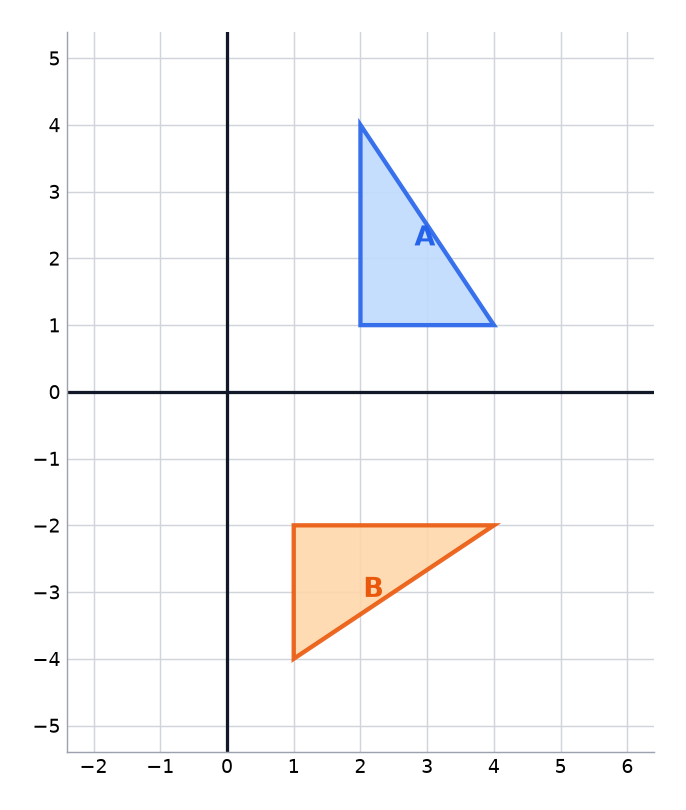
Describe fully the single transformation that maps triangle \(A\) onto triangle \(B\). [3 marks]
Show answerHide answer
Model answer
The point \((2, 1)\) goes to \((1, -2)\), and \((4, 1)\) goes to \((1, -4)\). This is \((x, y) \to (y, -x)\), a rotation of \(90^\circ\) clockwise about the origin.
Mark scheme
- Rotation — B1
- \(90^\circ\) clockwise — B1
- About the origin — B1
-
4 Find [2 marks]
A rotation of \(180^\circ\) maps the point \((2, 6)\) onto the point \((-4, 0)\). Find the coordinates of the centre of the rotation. [2 marks]
Show answerHide answer
Model answer
The centre is the midpoint: \(\left(\dfrac{2 + (-4)}{2}, \dfrac{6 + 0}{2}\right) = (-1, 3)\).
Mark scheme
- \(\dfrac{2 + (-4)}{2}\) or \(\dfrac{6 + 0}{2}\) — M1
- \((-1, 3)\) — A1
-
5 Work out [3 marks]
Triangle \(ABC\) has vertices \(A(1, 2)\), \(B(4, 2)\) and \(C(1, 5)\). It is rotated through \(90^\circ\) clockwise about the origin. Write down the coordinates of the images of \(B\) and \(C\). [3 marks]
Show answerHide answer
Model answer
A \(90^\circ\) clockwise turn sends \((x, y)\) to \((y, -x)\). \(B(4, 2)\) goes to \((2, -4)\) and \(C(1, 5)\) goes to \((5, -1)\).
Mark scheme
- Uses \((x, y) \to (y, -x)\) — M1
- \((2, -4)\) — A1
- \((5, -1)\) — A1
-
6 Find [3 marks]
A rotation of \(90^\circ\) clockwise about the origin maps the point \(P\) onto the point \(Q(5, -2)\). Work out the coordinates of \(P\). [3 marks]
Show answerHide answer
Model answer
The rotation sends \((x, y)\) to \((y, -x)\). So \(y = 5\) and \(-x = -2\), which gives \(x = 2\). \(P\) is \((2, 5)\). Check: \((2, 5)\) goes to \((5, -2)\).
Mark scheme
- \(y = 5\) or \(-x = -2\) — M1
- \(x = 2\) — A1
- \((2, 5)\) — A1
Quick check
-
1
What three details describe a rotation?
Show answerHide answer
C: The centre, the angle and the direction
A rotation is described by its centre, its angle and its direction.
-
2
What is the image of \((3, -2)\) in a \(180^\circ\) rotation about the origin?
Show answerHide answer
B: \((-3, 2)\)
A \(180^\circ\) turn about the origin changes the sign of both coordinates.
-
3
What is the image of \((2, 5)\) in a \(90^\circ\) anticlockwise rotation about the origin?
Show answerHide answer
A: \((-5, 2)\)
A \(90^\circ\) anticlockwise turn sends \((x, y)\) to \((-y, x)\).
-
4
What is the image of \((3, 1)\) in a \(90^\circ\) clockwise rotation about the origin?
Show answerHide answer
D: \((1, -3)\)
A \(90^\circ\) clockwise turn sends \((x, y)\) to \((y, -x)\).
-
5
Why is no direction needed to describe a \(180^\circ\) rotation?
Show answerHide answer
C: A half turn is the same in both directions
A half turn clockwise ends in the same place as a half turn anticlockwise.
-
6
Is the image of a rotation congruent to the object?
Show answerHide answer
B: Yes, it has the same size and shape
A rotation does not change lengths or angles.
-
7
What is the image of \((-2, 4)\) in a \(90^\circ\) clockwise rotation about the origin?
Show answerHide answer
A: \((4, 2)\)
\((x, y)\) goes to \((y, -x)\), so \((-2, 4)\) goes to \((4, 2)\).
-
8
The point \((4, 3)\) is rotated through \(180^\circ\) about the point \((1, 1)\). What is the image?
Show answerHide answer
D: \((-2, -1)\)
The point is 3 right and 2 up from the centre, so the image is 3 left and 2 down: \((1 - 3, 1 - 2) = (-2, -1)\).
-
9
A \(180^\circ\) rotation takes \((1, 5)\) to \((5, 1)\). What is the centre of rotation?
Show answerHide answer
C: \((3, 3)\)
The centre is the midpoint of a point and its image: \(\left(\dfrac{1 + 5}{2}, \dfrac{5 + 1}{2}\right) = (3, 3)\).
Enlargements
Just this lesson-
1 Write down [2 marks]
The point \((4, 6)\) is enlarged by a scale factor of \(\dfrac{1}{2}\) with the centre \((0, 0)\). Write down the coordinates of the image. [2 marks]
Show answerHide answer
Model answer
Multiply each coordinate by \(\dfrac{1}{2}\): \((2, 3)\).
Mark scheme
- \(4 \times \dfrac{1}{2}\) or \(6 \times \dfrac{1}{2}\) — M1
- \((2, 3)\) — A1
-
2 Enlarge [3 marks]
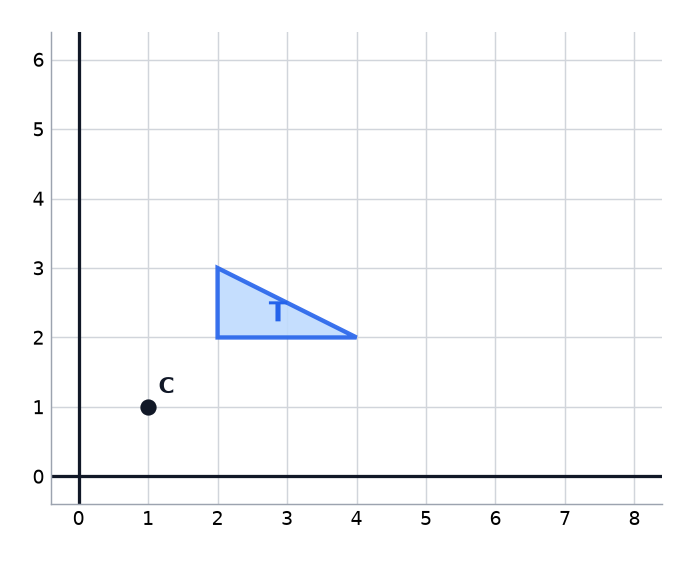
Enlarge triangle \(T\) by a scale factor of 2 with the centre \(C\). [3 marks]
Show answerHide answer
Model answer
The centre is \((1, 1)\). \((2, 2)\) is 1 right and 1 up, so the image is 2 right and 2 up, at \((3, 3)\). \((4, 2)\) goes to \((1 + 6, 1 + 2) = (7, 3)\) and \((2, 3)\) goes to \((1 + 2, 1 + 4) = (3, 5)\).
Mark scheme
- Enlarges at least two vertices from the centre \((1, 1)\) with a scale factor of 2 — M1
- At least two vertices correct — A1
- Triangle with vertices \((3, 3)\), \((7, 3)\) and \((3, 5)\) — A1
-
3 Describe [3 marks]
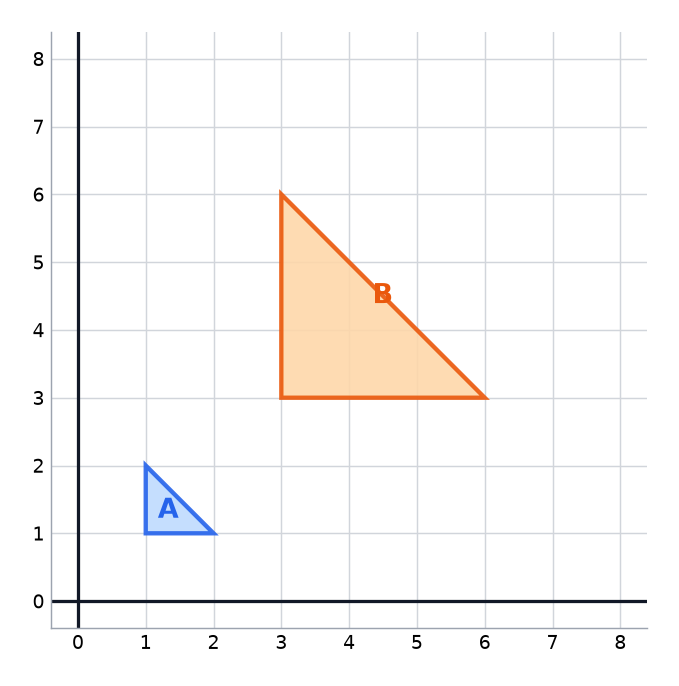
Describe fully the single transformation that maps triangle \(A\) onto triangle \(B\). [3 marks]
Show answerHide answer
Model answer
The bottom of \(A\) is 1 long and the bottom of \(B\) is 3 long, so the scale factor is 3. Matching corners \((1, 1)\) and \((3, 3)\), and \((2, 1)\) and \((6, 3)\), lie on lines through the origin. So it is an enlargement, scale factor 3, centre \((0, 0)\).
Mark scheme
- Enlargement — B1
- Scale factor 3 — B1
- Centre \((0, 0)\) — B1
-
4 Work out [3 marks]
Triangle \(ABC\) is enlarged by a scale factor of 2.5 to give triangle \(DEF\). \(AB = 6\) cm and the angle at \(A\) is \(40^\circ\). (a) Work out the length of \(DE\). [2 marks] (b) Write down the size of the angle at \(D\). [1 mark]
Show answerHide answer
Model answer
(a) \(DE = 6 \times 2.5 = 15\) cm. (b) Angles do not change in an enlargement, so the angle at \(D\) is \(40^\circ\).
Mark scheme
- (a) \(6 \times 2.5\) — M1
- (a) 15 cm — A1
- (b) \(40^\circ\) — B1
-
5 Work out [3 marks]
The point \(A\) is \((3, 2)\). \(A\) is enlarged by a scale factor of 3 with the centre \((2, 1)\). Work out the coordinates of the image of \(A\). [3 marks]
Show answerHide answer
Model answer
\(A\) is 1 right and 1 up from the centre. The image is 3 right and 3 up from the centre, at \((2 + 3, 1 + 3) = (5, 4)\).
Mark scheme
- Position relative to the centre, \((1, 1)\) — M1
- \((3, 3)\) relative to the centre — M1
- \((5, 4)\) — A1
-
6 Work out [3 marks]
The point \(P\) is \((2, -1)\). \(P\) is enlarged by a scale factor of \(-3\) with the centre \((0, 0)\). Write down the coordinates of the image of \(P\). [3 marks]
Show answerHide answer
Model answer
Multiply each coordinate by \(-3\): \((2 \times (-3), -1 \times (-3)) = (-6, 3)\).
Mark scheme
- \(2 \times (-3)\) or \(-1 \times (-3)\) — M1
- \((-6, \ldots)\) or \((\ldots, 3)\) — A1
- \((-6, 3)\) — A1
Quick check
-
1
A side of 3 cm is enlarged to 12 cm. What is the scale factor?
Show answerHide answer
D: \(4\)
\(\dfrac{12}{3} = 4\).
-
2
The point \((2, 3)\) is enlarged by scale factor 3 with centre \((0, 0)\). What is the image?
Show answerHide answer
C: \((6, 9)\)
Multiply both coordinates by 3.
-
3
What happens to the angles in an enlargement?
Show answerHide answer
B: They stay the same
An enlargement keeps the angles, so the shapes are similar.
-
4
What does an enlargement with scale factor \(\dfrac{1}{2}\) do to a shape?
Show answerHide answer
A: It halves every length
A fractional scale factor less than 1 makes the shape smaller.
-
5
The centre of enlargement is \((1, 2)\) and the scale factor is 3. What is the image of \((3, 3)\)?
Show answerHide answer
D: \((7, 5)\)
\((3, 3)\) is 2 right and 1 up from the centre, so the image is 6 right and 3 up: \((7, 5)\).
-
6
What must you give to describe an enlargement fully?
Show answerHide answer
C: The scale factor and the centre
An enlargement is described by its scale factor and its centre.
-
7
A triangle with sides 4, 6 and 8 is enlarged to give a triangle with sides 10, 15 and 20. What is the scale factor?
Show answerHide answer
B: \(2.5\)
\(\dfrac{10}{4} = 2.5\).
-
8
Which transformation is the same as an enlargement with scale factor \(-1\)?
Show answerHide answer
A: A rotation of \(180^\circ\) about the centre
Every point goes to the opposite side of the centre at the same distance.
-
9
The point \((1, 3)\) is enlarged by scale factor \(-2\) with centre \((0, 0)\). What is the image?
Show answerHide answer
D: \((-2, -6)\)
Multiply both coordinates by \(-2\).
Combined Transformations
Just this lesson-
1 Describe [4 marks]
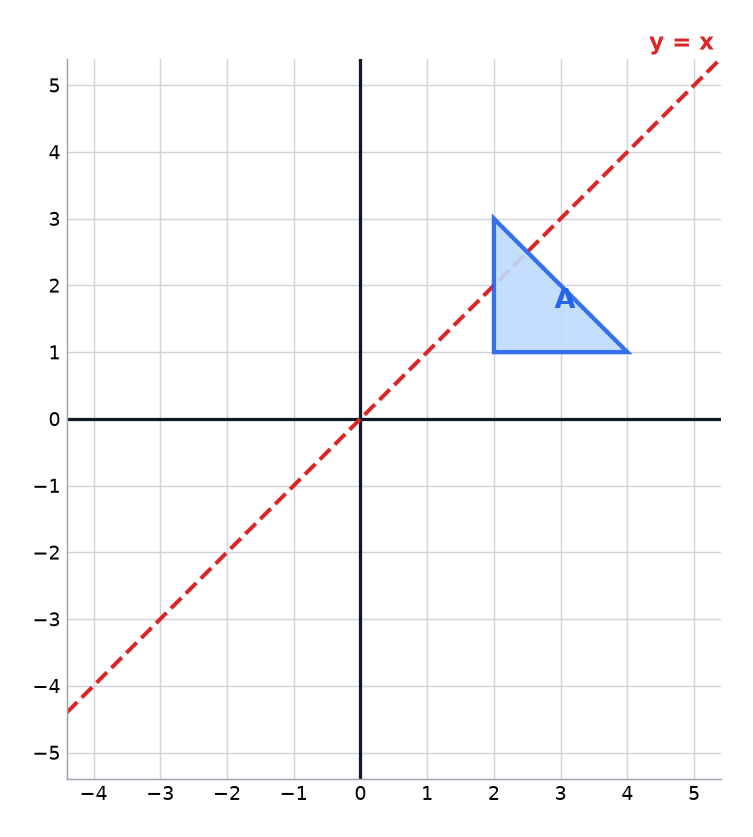
Triangle \(A\) is reflected in the line \(y = x\) to give triangle \(B\). Triangle \(B\) is reflected in the \(x\)-axis to give triangle \(C\). (a) Draw triangles \(B\) and \(C\). [2 marks] (b) Describe fully the single transformation that maps \(A\) onto \(C\). [2 marks]
Show answerHide answer
Model answer
(a) \(B\) has vertices \((1, 2)\), \((1, 4)\) and \((3, 2)\), and \(C\) has vertices \((1, -2)\), \((1, -4)\) and \((3, -2)\). (b) \((x, y)\) goes to \((y, x)\) and then to \((y, -x)\), which is a rotation of \(90^\circ\) clockwise about the origin.
Mark scheme
- (a) \(B\) correct — B1
- (a) \(C\) correct — B1
- (b) Rotation, \(90^\circ\) clockwise — B1
- (b) About the origin — B1
-
2 Describe [3 marks]
The point \((1, 4)\) is reflected in the line \(y = 2\), and the image is then reflected in the line \(y = 6\). Describe the single transformation that has the same effect. [3 marks]
Show answerHide answer
Model answer
The first reflection gives \((1, 0)\) and the second gives \((1, 12)\). The point has moved 8 up, which is twice the distance between the lines. It is a translation by \(\begin{pmatrix} 0 \\ 8 \end{pmatrix}\).
Mark scheme
- \((1, 0)\) seen — M1
- \((1, 12)\) seen — M1
- Translation by \(\begin{pmatrix} 0 \\ 8 \end{pmatrix}\) — A1
-
3 Write down [2 marks]
(a) A shape is rotated through \(180^\circ\) about the origin. Write down the coordinates of the point that does not move. [1 mark] (b) A shape is translated. How many points stay in the same place? [1 mark]
Show answerHide answer
Model answer
(a) The centre of rotation, \((0, 0)\). (b) None, because every point moves by the same vector.
Mark scheme
- (a) \((0, 0)\) — B1
- (b) None — B1
-
4 Work out [3 marks]
The point \((2, 1)\) is translated by the vector \(\begin{pmatrix} 1 \\ 2 \end{pmatrix}\) and the image is then rotated through \(180^\circ\) about the origin. Write down the coordinates of the final image. [3 marks]
Show answerHide answer
Model answer
The translation gives \((3, 3)\), and the rotation changes the sign of both coordinates, giving \((-3, -3)\).
Mark scheme
- \((3, 3)\) — B1
- Changes the sign of both coordinates of their image — M1
- \((-3, -3)\) — A1
-
5 Describe [4 marks]
The point \((3, 1)\) is reflected in the \(x\)-axis, and the image is then reflected in the line \(y = x\). (a) Write down the coordinates of the final image. [2 marks] (b) Describe the single transformation that maps \((3, 1)\) onto the final image, and explain how you know it is a rotation. [2 marks]
Show answerHide answer
Model answer
(a) The first reflection gives \((3, -1)\), and the second swaps the coordinates, giving \((-1, 3)\). (b) \((x, y)\) goes to \((-y, x)\), which is a rotation of \(90^\circ\) anticlockwise about the origin.
Mark scheme
- (a) \((3, -1)\) — B1
- (a) \((-1, 3)\) — B1
- (b) Rotation, \(90^\circ\) anticlockwise — B1
- (b) About the origin — B1
-
6 Work out [3 marks]
A shape is rotated through \(90^\circ\) clockwise about the origin and then through \(90^\circ\) clockwise about the origin again. Describe the single transformation that has the same effect, and use the point \((2, 3)\) to check. [3 marks]
Show answerHide answer
Model answer
The first rotation sends \((2, 3)\) to \((3, -2)\) and the second sends it to \((-2, -3)\). This is the same as a rotation of \(180^\circ\) about the origin.
Mark scheme
- \((3, -2)\) seen — M1
- \((-2, -3)\) seen — M1
- Rotation of \(180^\circ\) about the origin — A1
Quick check
-
1
What single transformation is a reflection in the \(x\)-axis followed by a reflection in the \(y\)-axis?
Show answerHide answer
A: A rotation of \(180^\circ\) about the origin
\((x, y)\) goes to \((x, -y)\) and then to \((-x, -y)\), which is a half turn.
-
2
What do two reflections in parallel lines give?
Show answerHide answer
D: A translation
The shape is moved in a straight line, at right angles to the mirror lines.
-
3
The point \((1, 1)\) is reflected in \(x = 2\) and then in \(x = 5\). Which translation has the same effect?
Show answerHide answer
C: \(\begin{pmatrix} 6 \\ 0 \end{pmatrix}\)
The lines are 3 apart, and the translation is twice that distance, 6, at right angles to them.
-
4
Which points are invariant in a reflection?
Show answerHide answer
B: The points on the mirror line
Points on the mirror line do not move.
-
5
Which point is invariant in a rotation?
Show answerHide answer
A: The centre of rotation
The centre stays fixed while everything else turns around it.
-
6
The point \((2, 1)\) is reflected in the line \(y = x\) and then in the \(x\)-axis. What is the final image?
Show answerHide answer
D: \((1, -2)\)
Swapping gives \((1, 2)\), and changing the sign of \(y\) gives \((1, -2)\).
-
7
Two mirror lines cross at a point, with an angle of \(30^\circ\) between them. What single transformation is a reflection in one followed by the other?
Show answerHide answer
C: A rotation of \(60^\circ\) about the crossing point
The rotation is through twice the angle between the lines.
-
8
Does a translation have an invariant point?
Show answerHide answer
B: No, every point moves
A translation moves every point by the same vector.
-
9
Two rotations of \(90^\circ\) clockwise about the same centre are carried out one after the other. What single transformation is this?
Show answerHide answer
A: A rotation of \(180^\circ\) about that centre
\(90^\circ + 90^\circ = 180^\circ\).
Congruence and Similarity
Just this lesson-
1 Give a reason [2 marks]
Triangle \(ABC\) has \(AB = 6\) cm, \(BC = 8\) cm and angle \(B = 50^\circ\). Triangle \(PQR\) has \(PQ = 6\) cm, \(QR = 8\) cm and angle \(Q = 50^\circ\). Show that the triangles are congruent. [2 marks]
Show answerHide answer
Model answer
Two sides and the angle between them are equal: \(AB = PQ\), \(BC = QR\) and angle \(B\) equals angle \(Q\). The triangles are congruent by SAS.
Mark scheme
- Two pairs of equal sides and the equal angle between them — M1
- SAS — C1
-
2 Prove [4 marks]
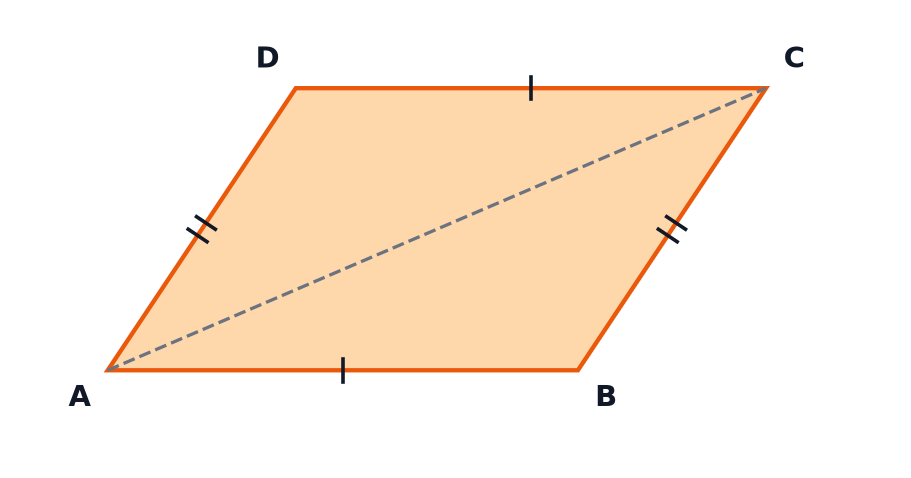
\(ABCD\) is a parallelogram. The diagonal \(AC\) is drawn. (a) Prove that triangles \(ABC\) and \(CDA\) are congruent. [3 marks] (b) Hence write down the size of angle \(ABC\) compared with angle \(CDA\). [1 mark]
Show answerHide answer
Model answer
(a) \(AB = CD\) and \(BC = DA\), because opposite sides of a parallelogram are equal. \(AC\) is a side of both triangles. All three sides are equal, so the triangles are congruent by SSS. (b) Angle \(ABC\) equals angle \(CDA\).
Mark scheme
- Opposite sides equal, with the reason — M1
- \(AC\) is a common side — M1
- SSS, so the triangles are congruent — Q1
- (b) Angle \(ABC\) = angle \(CDA\) — B1
-
3 Work out [3 marks]
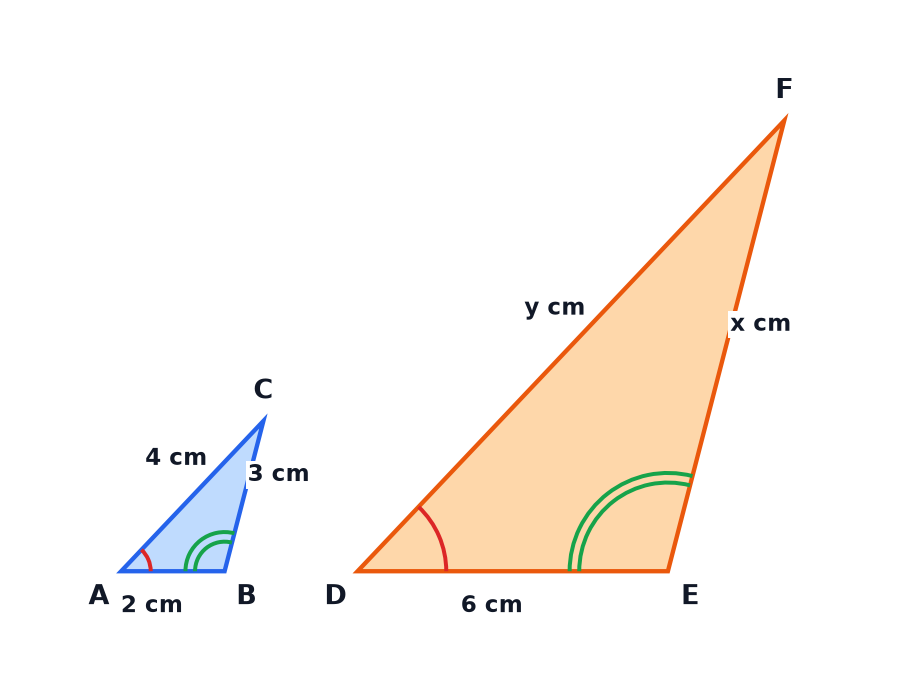
Triangles \(ABC\) and \(DEF\) are similar. (a) Work out the scale factor from \(ABC\) to \(DEF\). [1 mark] (b) Work out the length of \(EF\). [1 mark] (c) Work out the length of \(FD\). [1 mark]
Show answerHide answer
Model answer
(a) \(DE\) matches \(AB\), so the scale factor is \(\dfrac{6}{2} = 3\). (b) \(EF = 3 \times 3 = 9\) cm. (c) \(FD = 4 \times 3 = 12\) cm.
Mark scheme
- (a) 3 — B1
- (b) 9 — B1
- (c) 12 — B1
-
4 Work out [3 marks]
Rectangles \(A\) and \(B\) are similar. Rectangle \(A\) is 4 cm long and 6 cm wide. The length of rectangle \(B\) is 10 cm. (a) Work out the width of rectangle \(B\). [2 marks] (b) Work out the perimeter of rectangle \(B\). [1 mark]
Show answerHide answer
Model answer
(a) The scale factor is \(\dfrac{10}{4} = 2.5\), so the width is \(6 \times 2.5 = 15\) cm. (b) \(2 \times (10 + 15) = 50\) cm.
Mark scheme
- (a) \(\dfrac{10}{4}\) or 2.5 — M1
- (a) 15 cm — A1
- (b) 50 cm — B1 (follow through from (a))
-
5 Work out [3 marks]
Two similar prisms have lengths in the ratio \(3 : 5\). The surface area of the smaller prism is 36 cm\(^2\). Work out the surface area of the larger prism. [3 marks]
Show answerHide answer
Model answer
The area scale factor is \(\left(\dfrac{5}{3}\right)^2 = \dfrac{25}{9}\). The larger surface area is \(36 \times \dfrac{25}{9} = 100\) cm\(^2\).
Mark scheme
- \(\left(\dfrac{5}{3}\right)^2\) or \(\dfrac{25}{9}\) — M1
- \(36 \times \dfrac{25}{9}\) — M1
- 100 cm\(^2\) — A1
-
6 Work out [3 marks]
Two similar cones have volumes of 40 cm\(^3\) and 135 cm\(^3\). The radius of the smaller cone is 6 cm. Work out the radius of the larger cone. [3 marks]
Show answerHide answer
Model answer
The volume ratio is \(40 : 135 = 8 : 27\), so the length ratio is \(2 : 3\). The radius of the larger cone is \(6 \times \dfrac{3}{2} = 9\) cm.
Mark scheme
- \(40 : 135 = 8 : 27\) — M1
- Length scale factor \(\dfrac{3}{2}\) — M1
- 9 cm — A1
Quick check
-
1
Which of these is not enough to show that two triangles are congruent?
Show answerHide answer
B: Three equal angles
Three equal angles give similar triangles, which may be different sizes.
-
2
Two triangles have two equal sides and the equal angle between them. Which condition is this?
Show answerHide answer
A: SAS
Side, angle, side with the angle between the sides is SAS.
-
3
Two similar triangles have matching sides of 6 cm and 15 cm. What is the scale factor from the smaller to the larger?
Show answerHide answer
D: \(2.5\)
\(\dfrac{15}{6} = 2.5\).
-
4
A triangle with sides 3, 4 and 5 cm is similar to a triangle with sides 9 cm, \(x\) cm and 15 cm. What is \(x\)?
Show answerHide answer
C: \(12\)
The scale factor is \(\dfrac{9}{3} = 3\), so \(x = 4 \times 3 = 12\).
-
5
Triangles \(ABC\) and \(DEF\) are similar, with \(AB = 4\), \(DE = 10\) and \(BC = 6\). What is \(EF\)?
Show answerHide answer
B: 15 cm
The scale factor is \(\dfrac{10}{4} = 2.5\), so \(EF = 6 \times 2.5 = 15\) cm.
-
6
Two triangles have all three angles equal. What can you say?
Show answerHide answer
A: They are similar
Equal angles make the shapes similar, but not necessarily the same size.
-
7
The lengths of a shape are doubled. By what factor is the area multiplied?
Show answerHide answer
D: 4
The area scale factor is \(2^2 = 4\).
-
8
The lengths of a solid are multiplied by 3. By what factor is the volume multiplied?
Show answerHide answer
C: 27
The volume scale factor is \(3^3 = 27\).
-
9
Two similar shapes have areas in the ratio \(9 : 25\). What is the ratio of their lengths?
Show answerHide answer
B: \(3 : 5\)
Take square roots: \(\sqrt{9} : \sqrt{25} = 3 : 5\).