Exam questions · Maths · Circle Theorems
Angles at the Centre and in a Semicircle
- 6 exam questions
- 19 marks
- 9 quick checks
-
1 Work out [2 marks]
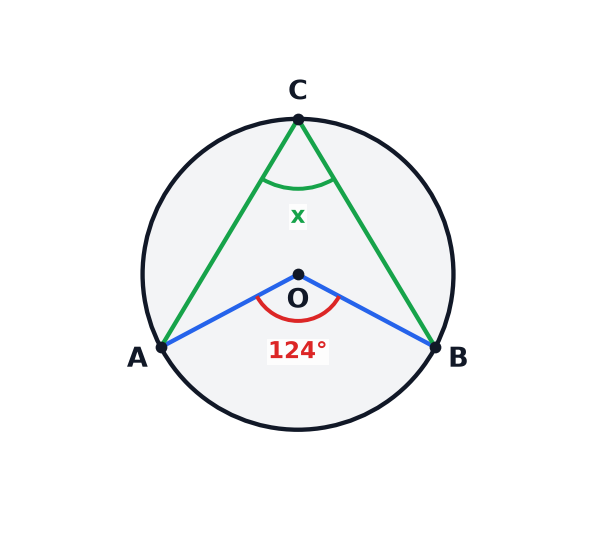
Diagram NOT accurately drawn. \(A\), \(B\) and \(C\) are points on a circle, centre \(O\). Angle \(AOB = 124^\circ\). Work out the size of angle \(ACB\). Give a reason for your answer. (2 marks)
Show answerHide answer
Model answer
Angle \(ACB = 62^\circ\), because the angle at the centre is twice the angle at the circumference.
Mark scheme
- \(62\) — B1
- The angle at the centre is twice the angle at the circumference — C1
-
2 Work out [3 marks]
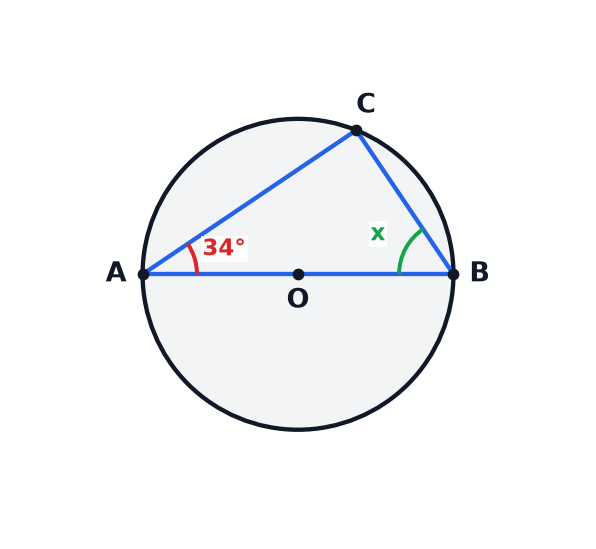
Diagram NOT accurately drawn. \(AB\) is a diameter of a circle and \(C\) is a point on the circle. Angle \(BAC = 34^\circ\). Work out the size of angle \(ABC\). Give a reason for each step of your working. (3 marks)
Show answerHide answer
Model answer
Angle \(ACB = 90^\circ\), because the angle in a semicircle is a right angle. Then \(ABC = 180 - 90 - 34 = 56^\circ\).
Mark scheme
- Angle \(ACB = 90^\circ\) — B1
- The angle in a semicircle is a right angle — C1
- \(56\) — B1
-
3 Work out [3 marks]
\(A\), \(B\) and \(C\) are points on a circle, centre \(O\), with \(C\) on the major arc \(AB\). Angle \(AOB = 6x + 20\) and angle \(ACB = 2x + 14\). Work out the value of \(x\). (3 marks)
Show answerHide answer
Model answer
The angle at the centre is twice the angle at the circumference, so \(6x + 20 = 2(2x + 14) = 4x + 28\). Then \(2x = 8\) and \(x = 4\).
Mark scheme
- \(6x + 20 = 2(2x + 14)\) — M1
- Expands and collects terms, for example \(2x = 8\) — M1
- \(4\) — A1
-
4 Work out [4 marks]
\(A\), \(B\) and \(C\) are points on a circle, centre \(O\), with \(C\) on the major arc \(AB\). Angle \(OAB = 35^\circ\). Work out the size of angle \(ACB\). Give reasons for your answer. (4 marks)
Show answerHide answer
Model answer
\(OA = OB\) because they are radii, so triangle \(OAB\) is isosceles and angle \(OBA = 35^\circ\). Then \(AOB = 180 - 35 - 35 = 110^\circ\). The angle at the centre is twice the angle at the circumference, so \(ACB = 110 \div 2 = 55^\circ\).
Mark scheme
- \(180 - 35 - 35\) or angle \(OBA = 35^\circ\) — M1
- Angle \(AOB = 110^\circ\) — A1
- \(55\) — A1
- Reasons: radii make an isosceles triangle, and the angle at the centre is twice the angle at the circumference — C1
-
5 Work out [4 marks]
\(AB\) is a diameter of a circle and \(C\) is a point on the circle. \(AC = 8\) cm and \(BC = 15\) cm. Work out the radius of the circle. Give a reason for your answer. (4 marks)
Show answerHide answer
Model answer
Angle \(ACB = 90^\circ\), because the angle in a semicircle is a right angle. \(AB^2 = 8^2 + 15^2 = 64 + 225 = 289\), so \(AB = 17\) cm and the radius is \(8.5\) cm.
Mark scheme
- Angle in a semicircle is a right angle — C1
- \(8^2 + 15^2\) or \(64 + 225\) — M1
- \(AB = 17\) — A1
- \(8.5\) — B1
-
6 Work out [3 marks]
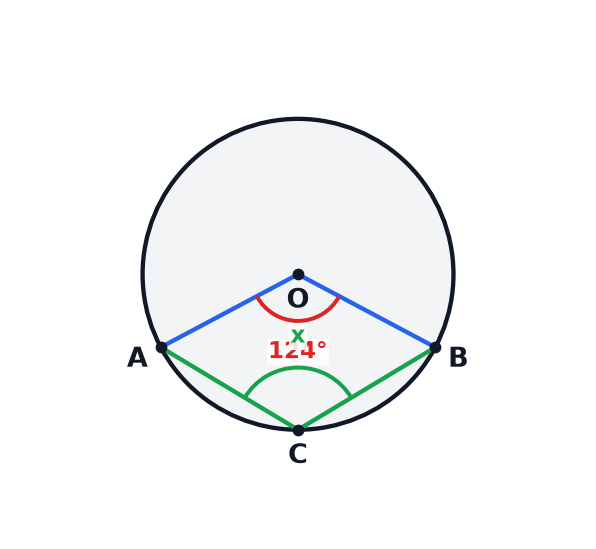
Diagram NOT accurately drawn. \(A\), \(B\) and \(C\) are points on a circle, centre \(O\). Angle \(AOB = 124^\circ\), and \(C\) is on the minor arc \(AB\). Work out the size of angle \(ACB\). Give a reason for your answer. (3 marks)
Show answerHide answer
Model answer
The reflex angle \(AOB\) is \(360 - 124 = 236^\circ\). The angle at the circumference is half the angle at the centre, so \(ACB = 236 \div 2 = 118^\circ\).
Mark scheme
- \(360 - 124 = 236\) — M1
- \(118\) — A1
- The angle at the centre is twice the angle at the circumference — C1
Quick check
-
1
The angle at the centre of a circle is \(84^\circ\). What is the angle at the circumference made by the same arc?
Show answerHide answer
B: \(42^\circ\)
The angle at the centre is twice the angle at the circumference, so the angle at the circumference is \(84 \div 2 = 42^\circ\).
-
2
What is the size of an angle in a semicircle?
Show answerHide answer
A: \(90^\circ\)
The angle at the centre on a diameter is \(180^\circ\), so the angle at the circumference is half of it, \(90^\circ\).
-
3
Which reason fits this statement? \(\angle AOB = 2 \times \angle ACB\)
Show answerHide answer
D: The angle at the centre is twice the angle at the circumference
The angle at \(O\), the centre, is double the angle at \(C\), on the circumference.
-
4
\(AB\) is a diameter and \(C\) is on the circle. Angle \(CAB = 35^\circ\). What is angle \(CBA\)?
Show answerHide answer
C: \(55^\circ\)
Angle \(ACB = 90^\circ\) in a semicircle, so \(CBA = 180 - 90 - 35 = 55^\circ\).
-
5
The angle at the circumference is \(3x\) and the angle at the centre on the same arc is \(5x + 20\). What is \(x\)?
Show answerHide answer
B: \(20\)
\(5x + 20 = 2 \times 3x = 6x\), so \(x = 20\).
-
6
In triangle \(OAB\), \(O\) is the centre and \(\angle OAB = 28^\circ\). What is angle \(AOB\)?
Show answerHide answer
A: \(124^\circ\)
\(OA = OB\) are radii, so \(\angle OBA = 28^\circ\) and \(\angle AOB = 180 - 28 - 28 = 124^\circ\).
-
7
\(AB\) is a diameter of length 10 cm and \(AC = 6\) cm. What is \(BC\)?
Show answerHide answer
D: 8 cm
Angle \(ACB = 90^\circ\) in a semicircle, so \(BC^2 = 10^2 - 6^2 = 64\) and \(BC = 8\).
-
8
Two points \(A\) and \(B\) are on a circle with centre \(O\), and \(\angle AOB = 130^\circ\). \(C\) is on the minor arc \(AB\). What is angle \(ACB\)?
Show answerHide answer
C: \(115^\circ\)
The reflex angle at the centre is \(360 - 130 = 230^\circ\), so \(ACB = 230 \div 2 = 115^\circ\).
-
9
Which statement is true for every triangle with a diameter as one side and its third corner on the circle?
Show answerHide answer
B: It is right-angled
The angle opposite the diameter is in a semicircle, so it is always \(90^\circ\).