Exam questions · Maths · Circle Theorems
Circle Theorem Proofs and Problems
- 6 exam questions
- 24 marks
- 9 quick checks
-
1 Prove [4 marks]
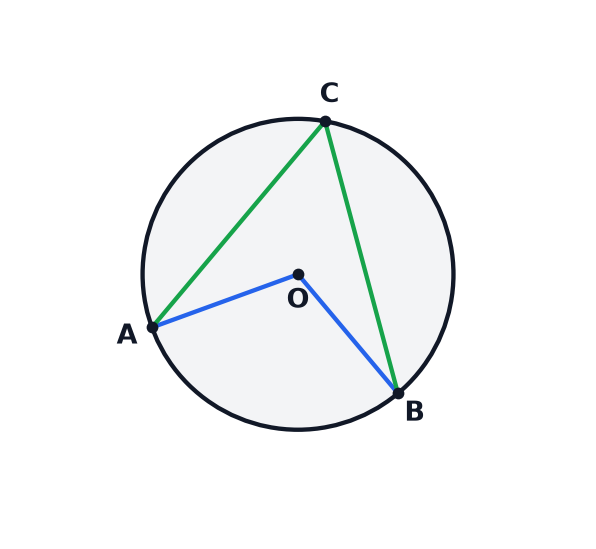
Diagram NOT accurately drawn. \(A\), \(B\) and \(C\) are points on a circle, centre \(O\). Prove that angle \(AOB\) is twice angle \(ACB\). You may add lines to the diagram. (4 marks)
Show answerHide answer
Model answer
Draw the line \(CO\) and extend it to meet the circle at \(D\). \(OA = OC = OB\), because they are radii. Triangles \(OAC\) and \(OBC\) are isosceles, so \(OAC = OCA\) and \(OBC = OCB\). The exterior angle \(AOD = 2 \times OCA\) and \(BOD = 2 \times OCB\). So \(AOB = 2(OCA + OCB) = 2 \times ACB\).
Mark scheme
- Draws CO extended to D and states OA = OB = OC as radii — B1
- Isosceles triangles, so OCA = OAC and OCB = OBC — M1
- Exterior angles: AOD = 2 x OCA and BOD = 2 x OCB — M1
- Concludes AOB = 2 x ACB — C1
-
2 Work out [4 marks]
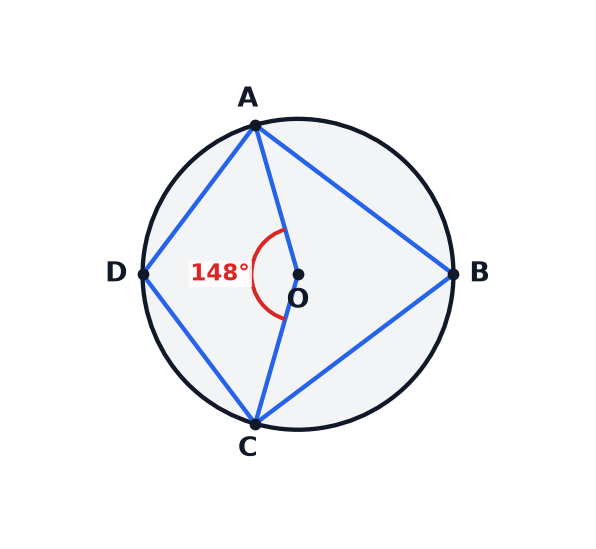
Diagram NOT accurately drawn. \(A\), \(B\), \(C\) and \(D\) are points on a circle, centre \(O\). Angle \(AOC = 148^\circ\). (a) Work out the size of angle \(ABC\). Give a reason for your answer. (2 marks) (b) Work out the size of angle \(ADC\). Give a reason for your answer. (2 marks)
Show answerHide answer
Model answer
(a) \(ABC = 148 \div 2 = 74^\circ\), because the angle at the centre is twice the angle at the circumference. (b) \(ADC = 180 - 74 = 106^\circ\), because opposite angles of a cyclic quadrilateral add up to \(180^\circ\).
Mark scheme
- (a) \(74\) — B1
- (a) The angle at the centre is twice the angle at the circumference — C1
- (b) \(106\) — B1
- (b) Opposite angles of a cyclic quadrilateral add up to 180 degrees — C1
-
3 Find [4 marks]
The point \(P(4, 3)\) is on the circle \(x^2 + y^2 = 25\). Find an equation of the tangent to the circle at \(P\). (4 marks)
Show answerHide answer
Model answer
The radius \(OP\) has gradient \(\dfrac{3}{4}\), so the tangent has gradient \(-\dfrac{4}{3}\). Then \(y - 3 = -\dfrac{4}{3}(x - 4)\), which gives \(y = -\dfrac{4}{3}x + \dfrac{25}{3}\).
Mark scheme
- Gradient of \(OP = \dfrac{3}{4}\) — B1
- Gradient of the tangent \(= -\dfrac{4}{3}\) — B1
- \(y - 3 = -\dfrac{4}{3}(x - 4)\) or equivalent — M1
- \(y = -\dfrac{4}{3}x + \dfrac{25}{3}\) or \(4x + 3y = 25\) — A1
-
4 Show that [3 marks]
Show that the line \(y = -\dfrac{3}{4}x + \dfrac{25}{2}\) is a tangent to the circle \(x^2 + y^2 = 100\) at the point \((6, 8)\). (3 marks)
Show answerHide answer
Model answer
\(6^2 + 8^2 = 100\), so \((6, 8)\) is on the circle. On the line, \(-\dfrac{3}{4} \times 6 + \dfrac{25}{2} = -4.5 + 12.5 = 8\), so the point is on the line. The radius has gradient \(\dfrac{8}{6} = \dfrac{4}{3}\) and \(\dfrac{4}{3} \times -\dfrac{3}{4} = -1\), so the line is perpendicular to the radius, and so is a tangent.
Mark scheme
- Checks that \((6, 8)\) is on both the circle and the line — B1
- Gradient of radius \(= \dfrac{4}{3}\) — B1
- Product of the gradients is \(-1\), so the line is perpendicular to the radius, with a conclusion — C1
-
5 Work out [5 marks]
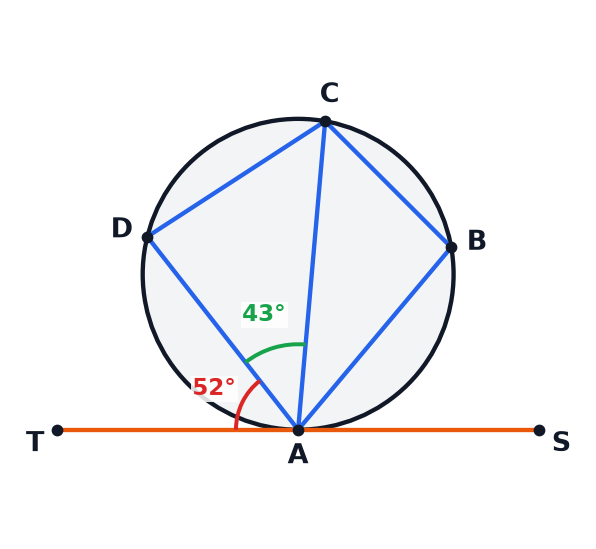
Diagram NOT accurately drawn. \(TAS\) is a tangent to the circle at \(A\). \(A\), \(B\), \(C\) and \(D\) are points on the circle. Angle \(TAD = 52^\circ\) and angle \(CAD = 43^\circ\). (a) Write down the size of angle \(ACD\). Give a reason for your answer. (2 marks) (b) Work out the size of angle \(ADC\). (2 marks) (c) Work out the size of angle \(ABC\). Give a reason for your answer. (1 mark)
Show answerHide answer
Model answer
(a) \(ACD = 52^\circ\), by the alternate segment theorem. (b) \(ADC = 180 - 52 - 43 = 85^\circ\). (c) \(ABC = 180 - 85 = 95^\circ\), because opposite angles of a cyclic quadrilateral add up to \(180^\circ\).
Mark scheme
- (a) \(52\) — B1
- (a) Alternate segment theorem stated — C1
- (b) \(180 - 52 - 43\) — M1
- (b) \(85\) — A1
- (c) \(95\) with the cyclic quadrilateral reason — A1
-
6 Prove [4 marks]
\(A\), \(B\), \(C\) and \(D\) are points on a circle, centre \(O\), in that order around the circle. Prove that angle \(ABC\) and angle \(ADC\) add up to \(180^\circ\). (4 marks)
Show answerHide answer
Model answer
Let angle \(ABC = x\). The angle at the centre on the arc \(ADC\) is \(2x\), because the angle at the centre is twice the angle at the circumference. Let angle \(ADC = y\). The angle at the centre on the arc \(ABC\) is \(2y\). The angles round the point \(O\) add up to \(360^\circ\), so \(2x + 2y = 360\), which gives \(x + y = 180\).
Mark scheme
- Angle ABC = x, so the angle at the centre on arc ADC is 2x — B1
- Angle ADC = y, so the angle at the centre on arc ABC is 2y — M1
- Angles round a point: 2x + 2y = 360 — M1
- Concludes x + y = 180 — C1
Quick check
-
1
Why is a triangle made by two radii and a chord isosceles?
Show answerHide answer
B: Two of its sides are radii, so they are equal
Two radii are always equal.
-
2
In a proof, what should be written next to every step?
Show answerHide answer
A: A reason
Each step needs a reason.
-
3
What does the exterior angle of a triangle equal?
Show answerHide answer
D: The sum of the two opposite interior angles
This is the exterior angle theorem.
-
4
The radius to a point on a circle has gradient \(\dfrac{2}{3}\). What is the gradient of the tangent at that point?
Show answerHide answer
C: \(-\dfrac{3}{2}\)
A tangent is perpendicular to the radius, so its gradient is the negative reciprocal.
-
5
What is the gradient of the radius from the origin to \((3, 4)\)?
Show answerHide answer
B: \(\dfrac{4}{3}\)
\(\dfrac{4 - 0}{3 - 0} = \dfrac{4}{3}\).
-
6
What is the gradient of the tangent to \(x^2 + y^2 = 25\) at \((3, 4)\)?
Show answerHide answer
A: \(-\dfrac{3}{4}\)
The radius has gradient \(\dfrac{4}{3}\), so the tangent has gradient \(-\dfrac{3}{4}\).
-
7
\(AOC\) is \(150^\circ\) at the centre, and \(D\) is on the minor arc \(AC\). What is angle \(ADC\)?
Show answerHide answer
D: \(105^\circ\)
\(B\) on the major arc gives \(ABC = 75^\circ\), and \(ADC = 180 - 75 = 105^\circ\).
-
8
Which line is the tangent to \(x^2 + y^2 = 25\) at \((3, 4)\)?
Show answerHide answer
C: \(3x + 4y = 25\)
Gradient \(-\dfrac{3}{4}\) through \((3, 4)\) gives \(y - 4 = -\dfrac{3}{4}(x - 3)\), which rearranges to \(3x + 4y = 25\).
-
9
Why must a proof not rely on measuring angles in a diagram?
Show answerHide answer
B: The proof must work for every case, not just the one drawn
A proof uses letters and reasons so that it works for any angle.