Exam questions · Maths
Further Algebra
- 30 exam questions
- 94 marks
- 45 quick checks
Solving Quadratic Equations
Just this lesson-
1 Solve [3 marks]
Solve \(x^2 + 7x + 12 = 0\).
Show answerHide answer
Model answer
\(x^2 + 7x + 12 = (x + 3)(x + 4) = 0\), so \(x = -3\) or \(x = -4\).
Mark scheme
- \((x + 3)(x + 4)\) — M1
- \(x = -3\) — A1
- \(x = -4\) — A1
-
2 Solve [3 marks]
Solve \(x^2 = 6x - 8\).
Show answerHide answer
Model answer
Rearrange to \(x^2 - 6x + 8 = 0\). Factorising gives \((x - 2)(x - 4) = 0\), so \(x = 2\) or \(x = 4\).
Mark scheme
- \(x^2 - 6x + 8 = 0\) — M1
- \((x - 2)(x - 4)\) — M1
- \(x = 2\) and \(x = 4\) — A1
-
3 Show that [4 marks]
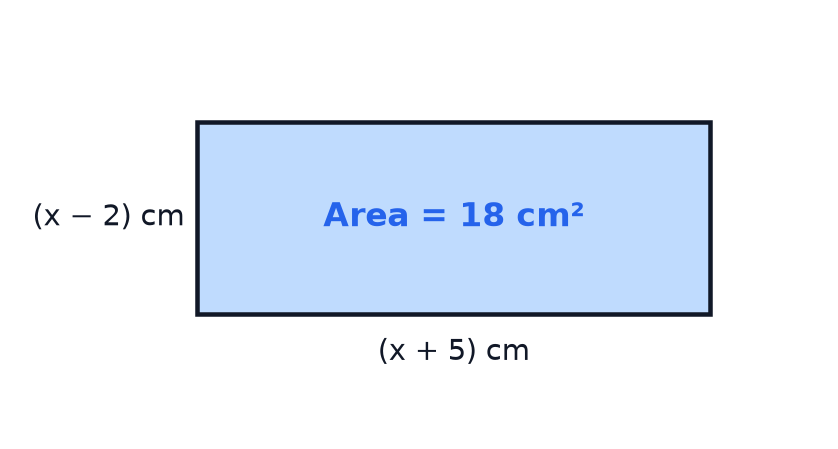
The diagram shows a rectangle. The area of the rectangle is 18 cm\(^2\). (a) Show that \(x^2 + 3x - 28 = 0\). (2 marks) (b) Hence work out the value of \(x\). (2 marks)
Show answerHide answer
Model answer
(a) \((x + 5)(x - 2) = 18\), so \(x^2 + 3x - 10 = 18\) and \(x^2 + 3x - 28 = 0\). (b) \((x + 7)(x - 4) = 0\), so \(x = -7\) or \(x = 4\). A length cannot be negative, so \(x = 4\).
Mark scheme
- (a) \((x + 5)(x - 2) = 18\) or \(x^2 + 3x - 10 = 18\) — M1
- (a) \(x^2 + 3x - 28 = 0\) shown — C1
- (b) \((x + 7)(x - 4)\) — M1
- (b) \(x = 4\) with \(x = -7\) rejected — A1
-
4 Solve [4 marks]
(a) Solve \(x^2 - 36 = 0\). (2 marks) (b) Solve \(x^2 - 5x = 0\). (2 marks)
Show answerHide answer
Model answer
(a) \(x^2 = 36\), so \(x = 6\) or \(x = -6\). (b) \(x(x - 5) = 0\), so \(x = 0\) or \(x = 5\).
Mark scheme
- (a) \(x^2 = 36\) or \((x - 6)(x + 6)\) — M1
- (a) \(x = 6\) and \(x = -6\) — A1
- (b) \(x(x - 5)\) — M1
- (b) \(x = 0\) and \(x = 5\) — A1
-
5 Solve [3 marks]
Solve \(2x^2 - 5x - 3 = 0\).
Show answerHide answer
Model answer
\(2x^2 - 6x + x - 3 = 2x(x - 3) + (x - 3) = (2x + 1)(x - 3) = 0\), so \(x = -\dfrac{1}{2}\) or \(x = 3\).
Mark scheme
- \(2x^2 - 6x + x - 3\) or \((2x + 1)(x - 3)\) — M1
- \(x = -\dfrac{1}{2}\) — A1
- \(x = 3\) — A1
-
6 Solve [3 marks]
Solve \(x^2 + 4x - 3 = 0\). Give your solutions in the form \(p \pm \sqrt{q}\), where \(p\) and \(q\) are integers.
Show answerHide answer
Model answer
Using the formula, \(x = \dfrac{-4 \pm \sqrt{16 + 12}}{2} = \dfrac{-4 \pm \sqrt{28}}{2} = \dfrac{-4 \pm 2\sqrt{7}}{2} = -2 \pm \sqrt{7}\).
Mark scheme
- \(\dfrac{-4 \pm \sqrt{4^2 - 4 \times 1 \times (-3)}}{2}\) or \((x + 2)^2 - 7\) — M1
- \(\sqrt{28} = 2\sqrt{7}\) seen — M1
- \(-2 \pm \sqrt{7}\) — A1
Quick check
-
1
Solve \((x - 2)(x - 3) = 0\).
Show answerHide answer
B: \(x = 2\) or \(x = 3\)
Each bracket can be zero: \(x - 2 = 0\) or \(x - 3 = 0\).
-
2
Solve \(x^2 - 49 = 0\).
Show answerHide answer
A: \(x = 7\) or \(x = -7\)
\(x^2 = 49\) has two square roots.
-
3
Solve \(x^2 - 6x = 0\).
Show answerHide answer
D: \(x = 0\) or \(x = 6\)
\(x(x - 6) = 0\), so \(x = 0\) or \(x = 6\).
-
4
Factorise \(x^2 - 5x + 6\).
Show answerHide answer
C: \((x - 2)(x - 3)\)
The numbers multiply to 6 and add to \(-5\): \(-2\) and \(-3\).
-
5
What is the first step in solving \(x^2 = 3x + 10\) by factorising?
Show answerHide answer
B: Rearrange to \(x^2 - 3x - 10 = 0\)
One side must be zero before you factorise.
-
6
Solve \(x^2 + 5x + 6 = 0\).
Show answerHide answer
A: \(x = -2\) or \(x = -3\)
\((x + 2)(x + 3) = 0\).
-
7
Solve \(2x^2 + 7x + 3 = 0\).
Show answerHide answer
D: \(x = -\dfrac{1}{2}\) or \(x = -3\)
\((2x + 1)(x + 3) = 0\).
-
8
What is the value of \(b^2 - 4ac\) for \(x^2 + 2x - 8 = 0\)?
Show answerHide answer
C: \(36\)
\(4 - 4 \times 1 \times (-8) = 4 + 32 = 36\).
-
9
Use the quadratic formula to solve \(2x^2 + 5x - 3 = 0\).
Show answerHide answer
B: \(x = \dfrac{1}{2}\) or \(x = -3\)
\(x = \dfrac{-5 \pm \sqrt{49}}{4} = \dfrac{-5 \pm 7}{4}\).
Simultaneous Equations
Just this lesson-
1 Use [2 marks]
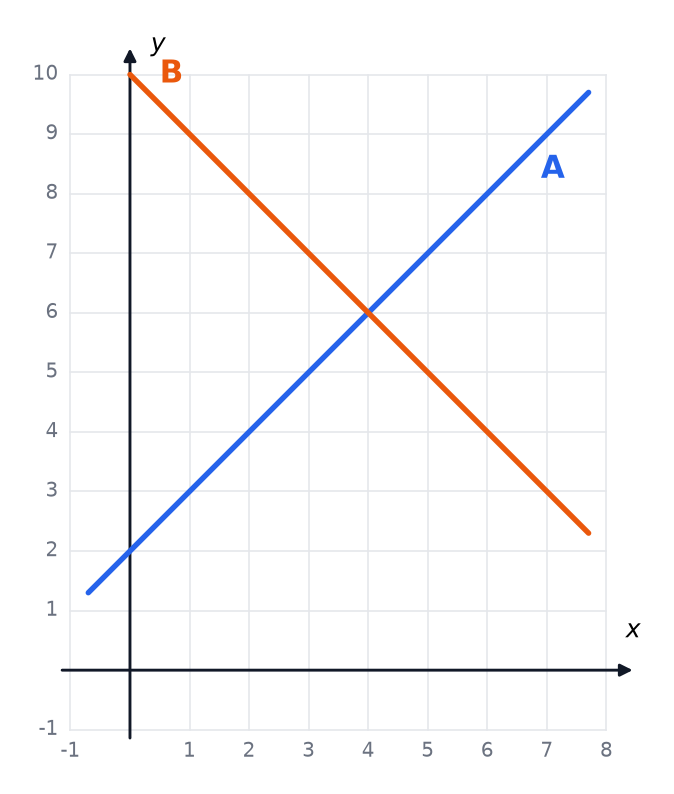
Here are the graphs of the straight lines \(A\) and \(B\). Use the graphs to solve the simultaneous equations \(y = x + 2\) and \(x + y = 10\).
Show answerHide answer
Model answer
The lines cross at \((4, 6)\), so \(x = 4\) and \(y = 6\).
Mark scheme
- \(x = 4\) — B1
- \(y = 6\) — B1
-
2 Solve [3 marks]
Solve the simultaneous equations \(x + y = 11\) and \(x - y = 3\).
Show answerHide answer
Model answer
Adding gives \(2x = 14\), so \(x = 7\). Then \(y = 11 - 7 = 4\). Check: \(7 - 4 = 3\).
Mark scheme
- Adds or eliminates \(y\) correctly — M1
- \(x = 7\) — A1
- \(y = 4\) — A1
-
3 Solve [3 marks]
Solve the simultaneous equations \(3x + y = 14\) and \(2x - y = 6\).
Show answerHide answer
Model answer
Adding gives \(5x = 20\), so \(x = 4\). Then \(12 + y = 14\), so \(y = 2\). Check: \(8 - 2 = 6\).
Mark scheme
- \(5x = 20\) — M1
- \(x = 4\) — A1
- \(y = 2\) — A1
-
4 Solve [4 marks]
Solve the simultaneous equations \(2x + 3y = 12\) and \(4x - y = 10\).
Show answerHide answer
Model answer
Multiply the second equation by 3: \(12x - 3y = 30\). Adding to the first gives \(14x = 42\), so \(x = 3\). Then \(6 + 3y = 12\), so \(y = 2\). Check: \(12 - 2 = 10\).
Mark scheme
- Multiplies to match the coefficients, such as \(12x - 3y = 30\) — M1
- Adds or subtracts correctly, \(14x = 42\) — M1
- \(x = 3\) — A1
- \(y = 2\) — A1
-
5 Work out [4 marks]
3 adults and 2 children go to the cinema. The total cost is \(\pounds 29\). 2 adults and 4 children go to the cinema. The total cost is \(\pounds 30\). Work out the cost of an adult ticket and the cost of a child ticket.
Show answerHide answer
Model answer
\(3a + 2c = 29\) and \(2a + 4c = 30\), so \(a + 2c = 15\). Subtracting this from the first equation gives \(2a = 14\), so \(a = 7\). Then \(2c = 8\) and \(c = 4\). An adult ticket costs \(\pounds 7\) and a child ticket \(\pounds 4\).
Mark scheme
- Two correct equations — M1
- A correct elimination step — M1
- Adult ticket \(\pounds 7\) — A1
- Child ticket \(\pounds 4\) — A1
-
6 Solve [5 marks]
Solve the simultaneous equations \(y = x^2 - 4\) and \(y = 2x - 1\).
Show answerHide answer
Model answer
Setting them equal gives \(x^2 - 4 = 2x - 1\), so \(x^2 - 2x - 3 = 0\) and \((x - 3)(x + 1) = 0\). So \(x = 3\) or \(x = -1\). Then \(y = 5\) when \(x = 3\), and \(y = -3\) when \(x = -1\).
Mark scheme
- \(x^2 - 4 = 2x - 1\) — M1
- \(x^2 - 2x - 3 = 0\) — M1
- \(x = 3\) and \(x = -1\) — A1
- One correct \(y\)-value — M1
- \((3, 5)\) and \((-1, -3)\) — A1
Quick check
-
1
Solve \(x + y = 9\) and \(x - y = 1\).
Show answerHide answer
C: \(x = 5\), \(y = 4\)
Adding gives \(2x = 10\), so \(x = 5\) and \(y = 4\).
-
2
When do you add the two equations in elimination?
Show answerHide answer
B: When the terms in one letter are opposites
Opposites such as \(+3y\) and \(-3y\) cancel when added.
-
3
Solve \(3x + 2y = 16\) and \(x + 2y = 8\).
Show answerHide answer
A: \(x = 4\), \(y = 2\)
Subtract: \(2x = 8\), so \(x = 4\). Then \(4 + 2y = 8\) gives \(y = 2\).
-
4
Solve \(2x + 3y = 13\) and \(3x - y = 3\).
Show answerHide answer
D: \(x = 2\), \(y = 3\)
Multiply the second equation by 3 and add: \(11x = 22\), so \(x = 2\), \(y = 3\).
-
5
Solve \(y = 2x + 1\) and \(3x + y = 16\).
Show answerHide answer
C: \(x = 3\), \(y = 7\)
\(3x + 2x + 1 = 16\), so \(x = 3\) and \(y = 7\).
-
6
Two straight lines are parallel. How many solutions do their simultaneous equations have?
Show answerHide answer
B: None
Parallel lines never meet, so there is no point on both.
-
7
2 adult and 3 child tickets cost \(\pounds 19\). 3 adult and 1 child ticket cost \(\pounds 18\). What does an adult ticket cost?
Show answerHide answer
A: \(\pounds 5\)
\(2a + 3c = 19\) and \(3a + c = 18\) give \(a = 5\), \(c = 3\).
-
8
Solve \(y = x^2\) and \(y = x + 6\).
Show answerHide answer
D: \((3, 9)\) and \((-2, 4)\)
\(x^2 = x + 6\) gives \((x - 3)(x + 2) = 0\).
-
9
Solve \(x^2 + y^2 = 25\) and \(y = x + 1\).
Show answerHide answer
C: \((3, 4)\) and \((-4, -3)\)
\(x^2 + (x + 1)^2 = 25\) gives \(x^2 + x - 12 = 0\), so \(x = 3\) or \(x = -4\).
Inequalities and Regions
Just this lesson-
1 Write down [2 marks]
Write down all the integer values of \(n\) that satisfy \(-3 \leq n < 2\).
Show answerHide answer
Model answer
The integers are \(-3, -2, -1, 0, 1\).
Mark scheme
- At least four correct and no more than one wrong — M1
- \(-3, -2, -1, 0, 1\) — A1
-
2 Write down [5 marks]
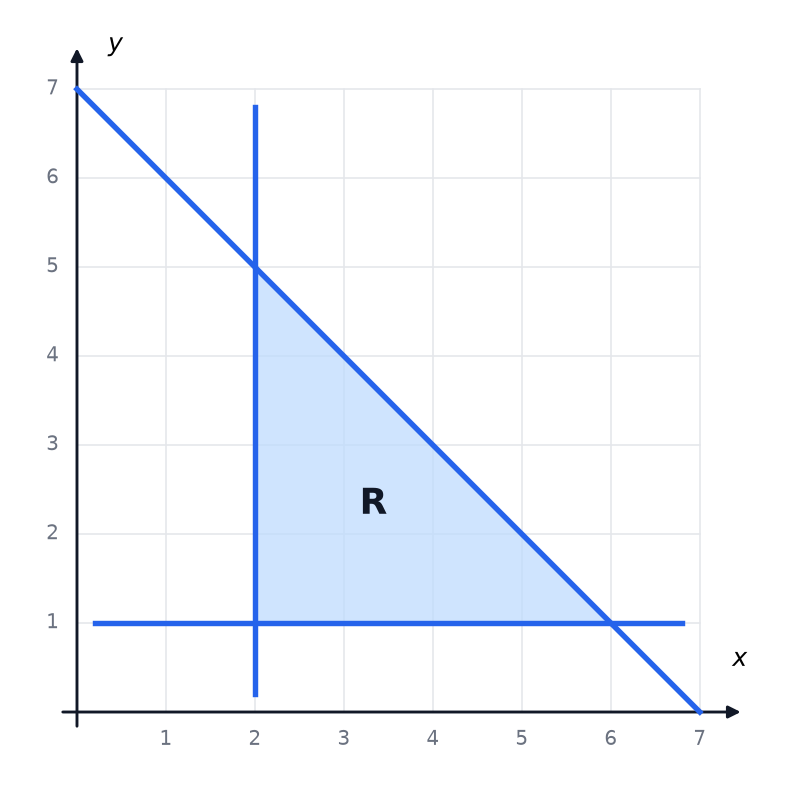
The diagram shows a shaded region \(R\). (a) Write down the three inequalities that define the region \(R\). (3 marks) (b) Write down the number of points with integer coordinates inside or on the boundary of \(R\). (2 marks)
Show answerHide answer
Model answer
(a) \(x \geq 2\), \(y \geq 1\) and \(x + y \leq 7\). (b) For \(x = 2, 3, 4, 5, 6\) there are \(5, 4, 3, 2, 1\) points, so the total is \(5 + 4 + 3 + 2 + 1 = 15\).
Mark scheme
- (a) \(x \geq 2\) — B1
- (a) \(y \geq 1\) — B1
- (a) \(x + y \leq 7\) — B1
- (b) Counts by columns, such as 5, 4, 3, 2, 1 — M1
- (b) 15 — A1
-
3 Solve [2 marks]
Solve the inequality \(3x - 2 > 10\).
Show answerHide answer
Model answer
Add 2: \(3x > 12\). Divide by 3: \(x > 4\).
Mark scheme
- \(3x > 12\) — M1
- \(x > 4\) — A1
-
4 Solve [3 marks]
Solve the inequality \(x^2 - 2x - 8 < 0\).
Show answerHide answer
Model answer
\(x^2 - 2x - 8 = (x - 4)(x + 2)\), with roots \(-2\) and 4. The curve is below the \(x\)-axis between the roots, so \(-2 < x < 4\).
Mark scheme
- \((x - 4)(x + 2)\) or the roots \(-2\) and 4 — M1
- A sketch or a statement that the quadratic is negative between the roots — M1
- \(-2 < x < 4\) — A1
-
5 Solve [4 marks]
(a) Solve \(x^2 \geq 16\). (2 marks) (b) Solve \(x^2 - 5x + 6 > 0\). (2 marks)
Show answerHide answer
Model answer
(a) \(x^2 = 16\) gives \(x = \pm 4\), and the curve is above the axis outside the roots, so \(x \leq -4\) or \(x \geq 4\). (b) \((x - 2)(x - 3) > 0\), so \(x < 2\) or \(x > 3\).
Mark scheme
- (a) Roots \(\pm 4\) — M1
- (a) \(x \leq -4\) or \(x \geq 4\) — A1
- (b) Roots 2 and 3 — M1
- (b) \(x < 2\) or \(x > 3\) — A1
-
6 Work out [3 marks]
\(n\) is an integer. \(-2 < 2n + 1 \leq 9\). Write down all the possible values of \(n\).
Show answerHide answer
Model answer
Subtract 1: \(-3 < 2n \leq 8\). Divide by 2: \(-1.5 < n \leq 4\). The integers are \(-1, 0, 1, 2, 3, 4\).
Mark scheme
- \(-3 < 2n \leq 8\) or \(-1.5 < n \leq 4\) — M1
- At least four correct integers — M1
- \(-1, 0, 1, 2, 3, 4\) — A1
Quick check
-
1
What does a dashed boundary line mean on a graph of an inequality?
Show answerHide answer
D: The line itself is not included
A dashed line goes with \(<\) or \(>\).
-
2
Which inequality describes the region to the right of the line \(x = 1\), including the line?
Show answerHide answer
C: \(x \geq 1\)
To the right means larger \(x\), and the line is included.
-
3
Which inequality describes the region on or below the line \(y = 2x\)?
Show answerHide answer
B: \(y \leq 2x\)
Below the line means smaller \(y\), and the line is included.
-
4
Which integers satisfy \(-2 < x \leq 3\)?
Show answerHide answer
A: \(-1, 0, 1, 2, 3\)
\(-2\) is not included but 3 is.
-
5
The origin is tested in \(x + y \leq 6\). What does this show?
Show answerHide answer
D: The origin is in the region, so shade that side
\(0 + 0 \leq 6\) is true.
-
6
How many points with whole-number coordinates satisfy \(x \geq 1\), \(y \geq 1\) and \(x + y \leq 6\)?
Show answerHide answer
C: \(15\)
The columns \(x = 1, 2, 3, 4, 5\) have \(5, 4, 3, 2, 1\) points.
-
7
Which kind of boundary line goes with the inequality \(y > 3\)?
Show answerHide answer
B: A dashed line
Strict inequalities do not include the boundary.
-
8
Solve \(x^2 - x - 6 < 0\).
Show answerHide answer
A: \(-2 < x < 3\)
The roots are \(-2\) and 3, and the curve is below the axis between them.
-
9
Solve \(x^2 > 9\).
Show answerHide answer
D: \(x < -3\) or \(x > 3\)
The curve is above the axis outside the roots \(-3\) and 3.
Surds
Just this lesson-
1 Simplify [2 marks]
Simplify \(\sqrt{75}\).
Show answerHide answer
Model answer
\(\sqrt{75} = \sqrt{25 \times 3} = 5\sqrt{3}\).
Mark scheme
- \(\sqrt{25 \times 3}\) — M1
- \(5\sqrt{3}\) — A1
-
2 Show that [3 marks]
Show that \(\sqrt{18} + \sqrt{8} = 5\sqrt{2}\).
Show answerHide answer
Model answer
\(\sqrt{18} = 3\sqrt{2}\) and \(\sqrt{8} = 2\sqrt{2}\), so the sum is \(3\sqrt{2} + 2\sqrt{2} = 5\sqrt{2}\).
Mark scheme
- \(\sqrt{18} = 3\sqrt{2}\) or \(\sqrt{8} = 2\sqrt{2}\) — M1
- Both simplified correctly — M1
- \(3\sqrt{2} + 2\sqrt{2} = 5\sqrt{2}\) with a conclusion — C1
-
3 Expand [3 marks]
Expand and simplify \((2 + \sqrt{3})(4 - \sqrt{3})\).
Show answerHide answer
Model answer
\(8 - 2\sqrt{3} + 4\sqrt{3} - 3 = 5 + 2\sqrt{3}\).
Mark scheme
- At least three of the four terms correct — M1
- \(8 - 2\sqrt{3} + 4\sqrt{3} - 3\) — M1
- \(5 + 2\sqrt{3}\) — A1
-
4 Rationalise [2 marks]
Rationalise the denominator of \(\dfrac{14}{\sqrt{7}}\). Give your answer in its simplest form.
Show answerHide answer
Model answer
\(\dfrac{14}{\sqrt{7}} \times \dfrac{\sqrt{7}}{\sqrt{7}} = \dfrac{14\sqrt{7}}{7} = 2\sqrt{7}\).
Mark scheme
- Multiplies the top and bottom by \(\sqrt{7}\) — M1
- \(2\sqrt{7}\) — A1
-
5 Rationalise [3 marks]
Write \(\dfrac{6}{3 + \sqrt{3}}\) in the form \(a - \sqrt{b}\), where \(a\) and \(b\) are integers.
Show answerHide answer
Model answer
Multiply the top and bottom by \(3 - \sqrt{3}\): \(\dfrac{6(3 - \sqrt{3})}{9 - 3} = \dfrac{6(3 - \sqrt{3})}{6} = 3 - \sqrt{3}\).
Mark scheme
- Multiplies by \(3 - \sqrt{3}\) — M1
- Denominator \(9 - 3 = 6\) — M1
- \(3 - \sqrt{3}\) — A1
-
6 Work out [4 marks]
A right-angled triangle has shorter sides of length \(\sqrt{2}\) cm and \(\sqrt{18}\) cm. (a) Work out the area of the triangle. (2 marks) (b) Work out the length of the hypotenuse. Give your answer in the form \(a\sqrt{b}\). (2 marks)
Show answerHide answer
Model answer
(a) \(\dfrac{1}{2} \times \sqrt{2} \times \sqrt{18} = \dfrac{1}{2} \times \sqrt{36} = 3\) cm\(^2\). (b) \(\sqrt{2 + 18} = \sqrt{20} = 2\sqrt{5}\) cm.
Mark scheme
- (a) \(\dfrac{1}{2} \times \sqrt{2} \times \sqrt{18}\) — M1
- (a) 3 cm\(^2\) — A1
- (b) \(\sqrt{20}\) — M1
- (b) \(2\sqrt{5}\) — A1
Quick check
-
1
What is \(\sqrt{5} \times \sqrt{5}\)?
Show answerHide answer
A: \(5\)
A root times itself gives the number: \(\sqrt{a} \times \sqrt{a} = a\).
-
2
Simplify \(\sqrt{12}\).
Show answerHide answer
D: \(2\sqrt{3}\)
\(\sqrt{12} = \sqrt{4 \times 3} = 2\sqrt{3}\).
-
3
Work out \(\sqrt{2} \times \sqrt{8}\).
Show answerHide answer
C: \(4\)
\(\sqrt{2 \times 8} = \sqrt{16} = 4\).
-
4
Work out \(3\sqrt{2} + 5\sqrt{2}\).
Show answerHide answer
B: \(8\sqrt{2}\)
Like surds add, as in \(3x + 5x = 8x\).
-
5
Simplify \(\sqrt{50}\).
Show answerHide answer
A: \(5\sqrt{2}\)
\(\sqrt{50} = \sqrt{25 \times 2} = 5\sqrt{2}\).
-
6
Rationalise the denominator of \(\dfrac{6}{\sqrt{3}}\).
Show answerHide answer
D: \(2\sqrt{3}\)
\(\dfrac{6\sqrt{3}}{3} = 2\sqrt{3}\).
-
7
Expand and simplify \((3 + \sqrt{2})(3 - \sqrt{2})\).
Show answerHide answer
C: \(7\)
This is a difference of two squares: \(9 - 2 = 7\).
-
8
Write \(\sqrt{48} + \sqrt{3}\) in the form \(a\sqrt{3}\).
Show answerHide answer
B: \(5\sqrt{3}\)
\(\sqrt{48} = 4\sqrt{3}\), and \(4\sqrt{3} + \sqrt{3} = 5\sqrt{3}\).
-
9
Rationalise the denominator of \(\dfrac{1}{2 + \sqrt{3}}\).
Show answerHide answer
A: \(2 - \sqrt{3}\)
Multiply top and bottom by \(2 - \sqrt{3}\); the bottom becomes \(4 - 3 = 1\).
Algebraic Fractions and Proof
Just this lesson-
1 Prove [3 marks]
Prove that the sum of two consecutive odd numbers is a multiple of 4.
Show answerHide answer
Model answer
Let the odd numbers be \(2n + 1\) and \(2n + 3\). Their sum is \(4n + 4 = 4(n + 1)\), which is a multiple of 4.
Mark scheme
- \(2n + 1\) and \(2n + 3\) — M1
- \(4n + 4\) — M1
- \(4(n + 1)\) with a conclusion — C1
-
2 Simplify [2 marks]
Simplify \(\dfrac{x^2 - 16}{x - 4}\).
Show answerHide answer
Model answer
\(\dfrac{(x - 4)(x + 4)}{x - 4} = x + 4\).
Mark scheme
- \((x - 4)(x + 4)\) — M1
- \(x + 4\) — A1
-
3 Solve [3 marks]
Solve \(\dfrac{x + 3}{2} + \dfrac{x - 1}{4} = 5\).
Show answerHide answer
Model answer
Multiply every term by 4: \(2(x + 3) + (x - 1) = 20\). Then \(3x + 5 = 20\), so \(x = 5\).
Mark scheme
- \(2(x + 3) + (x - 1) = 20\) — M1
- \(3x + 5 = 20\) — M1
- \(x = 5\) — A1
-
4 Simplify [3 marks]
Simplify \(\dfrac{x^2 + x - 6}{x^2 - 9}\).
Show answerHide answer
Model answer
\(\dfrac{(x + 3)(x - 2)}{(x - 3)(x + 3)} = \dfrac{x - 2}{x - 3}\).
Mark scheme
- \((x + 3)(x - 2)\) or \((x - 3)(x + 3)\) — M1
- Both factorised — M1
- \(\dfrac{x - 2}{x - 3}\) — A1
-
5 Show that [3 marks]
Show that \((n + 3)^2 - (n - 3)^2\) is a multiple of 12 for every integer \(n\).
Show answerHide answer
Model answer
\((n + 3)^2 = n^2 + 6n + 9\) and \((n - 3)^2 = n^2 - 6n + 9\). The difference is \(12n\), which is a multiple of 12.
Mark scheme
- \(n^2 + 6n + 9\) or \(n^2 - 6n + 9\) — M1
- \(12n\) — M1
- States that \(12n\) is a multiple of 12 — C1
-
6 Write [3 marks]
Write \(\dfrac{1}{x + 2} + \dfrac{1}{x - 1}\) as a single fraction, in its simplest form.
Show answerHide answer
Model answer
Use the common denominator \((x + 2)(x - 1)\): \(\dfrac{(x - 1) + (x + 2)}{(x + 2)(x - 1)} = \dfrac{2x + 1}{(x + 2)(x - 1)}\).
Mark scheme
- Common denominator \((x + 2)(x - 1)\) — M1
- Numerator \((x - 1) + (x + 2)\) — M1
- \(\dfrac{2x + 1}{(x + 2)(x - 1)}\) — A1
Quick check
-
1
What may be cancelled in an algebraic fraction?
Show answerHide answer
B: Factors that multiply the whole top and the whole bottom
Terms that are added or subtracted cannot be cancelled.
-
2
Simplify \(\dfrac{x^2 - 9}{x + 3}\).
Show answerHide answer
A: \(x - 3\)
\(\dfrac{(x - 3)(x + 3)}{x + 3} = x - 3\).
-
3
Which statement about \(\dfrac{x + 3}{3}\) is correct?
Show answerHide answer
D: The 3s cannot be cancelled because the 3 on top is added
Only factors can be cancelled, not terms.
-
4
Solve \(\dfrac{x - 1}{3} + \dfrac{x + 2}{6} = 2\).
Show answerHide answer
C: \(x = 4\)
Multiply by 6: \(2(x - 1) + (x + 2) = 12\), so \(3x = 12\).
-
5
Which expression is an odd number for any whole number \(n\)?
Show answerHide answer
B: \(2n + 1\)
\(2n\) is even, so adding 1 makes it odd.
-
6
What is the sum of three consecutive whole numbers \(n\), \(n + 1\) and \(n + 2\)?
Show answerHide answer
A: \(3n + 3\)
\(n + n + 1 + n + 2 = 3n + 3 = 3(n + 1)\).
-
7
Which value of \(n\) is a counter-example to “\(n^2 + n + 1\) is always prime”?
Show answerHide answer
D: \(n = 4\)
\(16 + 4 + 1 = 21 = 3 \times 7\), which is not prime.
-
8
Simplify \(\dfrac{x^2 + 5x + 6}{x^2 + 3x + 2}\).
Show answerHide answer
C: \(\dfrac{x + 3}{x + 1}\)
\(\dfrac{(x + 2)(x + 3)}{(x + 1)(x + 2)} = \dfrac{x + 3}{x + 1}\).
-
9
Expand and simplify \((n + 1)^2 - (n - 1)^2\).
Show answerHide answer
B: \(4n\)
\(n^2 + 2n + 1 - n^2 + 2n - 1 = 4n\).