Exam questions · Maths · Further Trigonometry
Trigonometric Graphs and Exact Values
- 6 exam questions
- 16 marks
- 9 quick checks
-
1 Solve [2 marks]
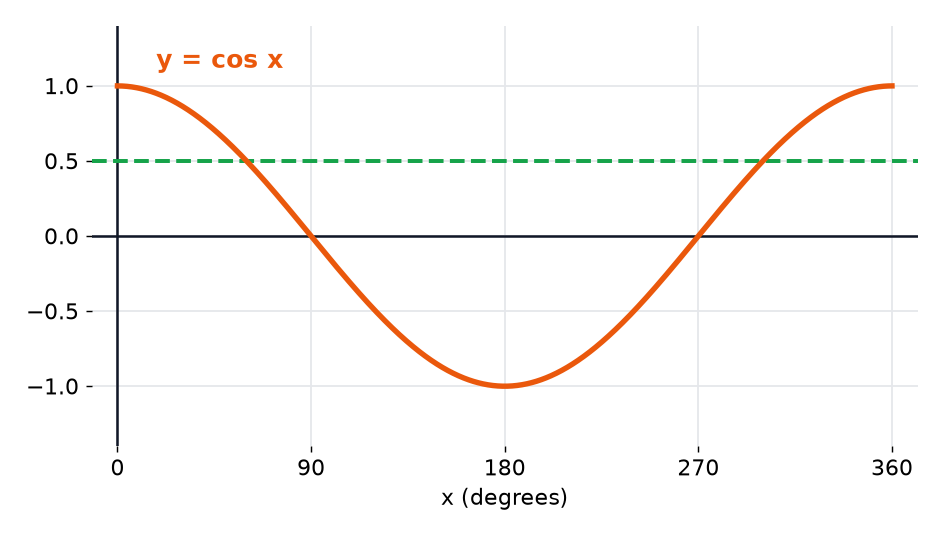
The diagram shows the graph of \(y = \cos x\) for \(0^\circ \le x \le 360^\circ\), and the line \(y = 0.5\). Solve \(\cos x = 0.5\) for \(0^\circ \le x \le 360^\circ\). (2 marks)
Show answerHide answer
Model answer
\(\cos 60^\circ = 0.5\), so \(x = 60^\circ\). The cosine graph is symmetrical about \(180^\circ\), so the other solution is \(360 - 60 = 300^\circ\).
Mark scheme
- \(60\) — M1
- \(300\) — A1
-
2 Write down [3 marks]
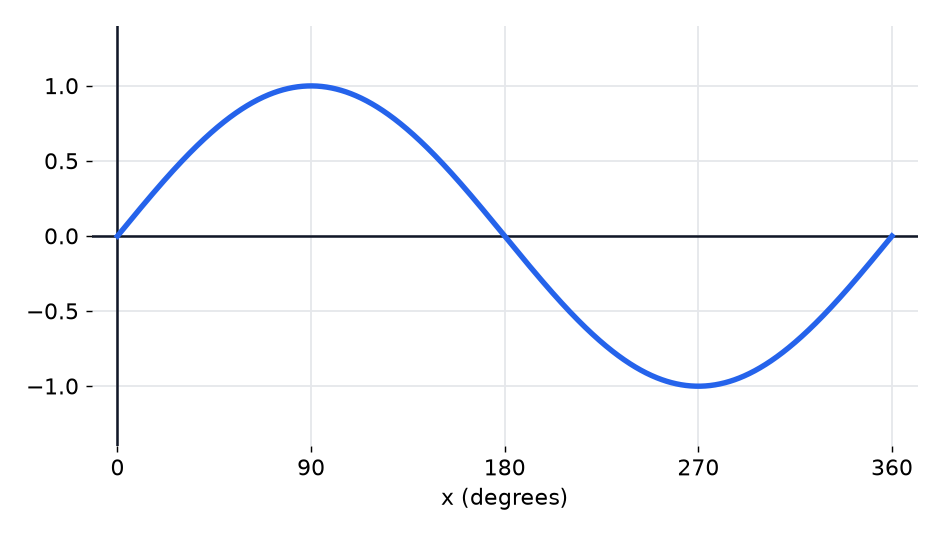
The diagram shows a graph for \(0^\circ \le x \le 360^\circ\). (a) Write down the equation of the graph. (1 mark) (b) Write down the coordinates of the maximum point. (1 mark) (c) Write down the values of \(x\) where the graph crosses the \(x\)-axis. (1 mark)
Show answerHide answer
Model answer
(a) \(y = \sin x\). (b) \((90, 1)\). (c) \(x = 0^\circ\), \(180^\circ\) and \(360^\circ\).
Mark scheme
- (a) \(y = \sin x\) — B1
- (b) \((90, 1)\) — B1
- (c) \(0, 180, 360\) — B1
-
3 Write down [3 marks]
Write down the exact value of (a) \(\sin 150^\circ\) (1 mark) (b) \(\cos 120^\circ\) (1 mark) (c) \(\tan 135^\circ\) (1 mark)
Show answerHide answer
Model answer
(a) \(\dfrac{1}{2}\). (b) \(-\dfrac{1}{2}\). (c) \(-1\).
Mark scheme
- (a) \(\dfrac{1}{2}\) — B1
- (b) \(-\dfrac{1}{2}\) — B1
- (c) \(-1\) — B1
-
4 Solve [3 marks]
Solve \(2\sin x + \sqrt{3} = 0\) for \(0^\circ \le x \le 360^\circ\). (3 marks)
Show answerHide answer
Model answer
\(\sin x = -\dfrac{\sqrt{3}}{2}\). Sine is negative between \(180^\circ\) and \(360^\circ\), and \(\sin 60^\circ = \dfrac{\sqrt{3}}{2}\), so \(x = 180 + 60 = 240^\circ\) or \(x = 360 - 60 = 300^\circ\).
Mark scheme
- \(\sin x = -\dfrac{\sqrt{3}}{2}\) — M1
- \(240\) — A1
- \(300\) — A1
-
5 Solve [3 marks]
Solve \(\tan x = -1\) for \(0^\circ \le x \le 360^\circ\). (3 marks)
Show answerHide answer
Model answer
\(\tan 45^\circ = 1\), and tangent is negative between \(90^\circ\) and \(180^\circ\), and between \(270^\circ\) and \(360^\circ\). So \(x = 180 - 45 = 135^\circ\) or \(x = 360 - 45 = 315^\circ\).
Mark scheme
- Uses \(45^\circ\) as the related angle — M1
- \(135\) — A1
- \(315\) — A1
-
6 Explain [2 marks]
(a) Explain why the equation \(\sin x = \dfrac{3}{2}\) has no solutions. (1 mark) (b) How many solutions does \(\cos x = -1\) have for \(0^\circ \le x \le 360^\circ\)? (1 mark)
Show answerHide answer
Model answer
(a) The sine of an angle is never greater than 1. (b) One solution, \(x = 180^\circ\).
Mark scheme
- (a) The sine of an angle is never more than 1, or the graph does not go above 1 — C1
- (b) 1, which is \(x = 180^\circ\) — B1
Quick check
-
1
What is the maximum value of \(y = \sin x\)?
Show answerHide answer
B: 1
The sine graph is a wave between \(-1\) and \(1\).
-
2
What is \(\cos 0^\circ\)?
Show answerHide answer
A: 1
The cosine graph starts at its maximum, 1.
-
3
Where are the asymptotes of \(y = \tan x\) between \(0^\circ\) and \(360^\circ\)?
Show answerHide answer
D: \(x = 90^\circ\) and \(x = 270^\circ\)
The tangent is undefined at \(90^\circ\) and \(270^\circ\).
-
4
How many solutions does \(\sin x = \dfrac{1}{2}\) have for \(0^\circ \le x \le 360^\circ\)?
Show answerHide answer
C: 2
The line \(y = \dfrac{1}{2}\) crosses the sine curve twice, at \(30^\circ\) and \(150^\circ\).
-
5
If \(\sin 30^\circ = \dfrac{1}{2}\), what is the other solution of \(\sin x = \dfrac{1}{2}\) between \(0^\circ\) and \(360^\circ\)?
Show answerHide answer
B: \(150^\circ\)
The second solution is \(180^\circ - 30^\circ = 150^\circ\).
-
6
What is the period of \(y = \tan x\)?
Show answerHide answer
A: \(180^\circ\)
The tangent graph repeats every \(180^\circ\).
-
7
Solve \(\cos x = \dfrac{1}{2}\) for \(0^\circ \le x \le 360^\circ\).
Show answerHide answer
D: \(60^\circ\) and \(300^\circ\)
\(\cos 60^\circ = \dfrac{1}{2}\), and the second solution is \(360^\circ - 60^\circ = 300^\circ\).
-
8
Solve \(\sin x = -\dfrac{1}{2}\) for \(0^\circ \le x \le 360^\circ\).
Show answerHide answer
C: \(210^\circ\) and \(330^\circ\)
Sine is negative between \(180^\circ\) and \(360^\circ\), so the solutions are \(180 + 30 = 210\) and \(360 - 30 = 330\).
-
9
Which equation has no solutions?
Show answerHide answer
B: \(\sin x = 1.5\)
Sine and cosine are never greater than 1, so \(\sin x = 1.5\) has no solution.