Exam questions · Maths · Further Trigonometry
Trigonometry in 3D and Mixed Problems
- 6 exam questions
- 24 marks
- 9 quick checks
-
1 Work out [3 marks]
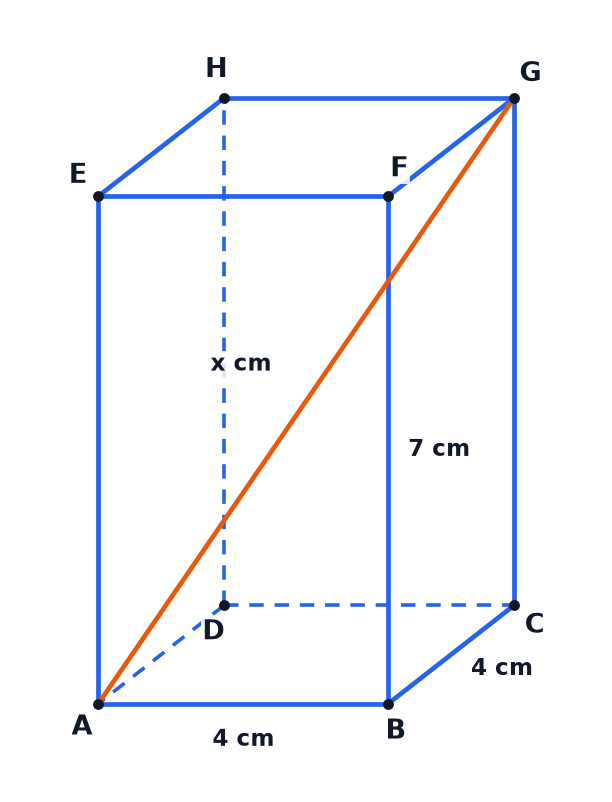
Diagram NOT accurately drawn. The diagram shows a cuboid. Work out the length of the diagonal \(AG\). (3 marks)
Show answerHide answer
Model answer
\(AG^2 = 4^2 + 4^2 + 7^2 = 16 + 16 + 49 = 81\), so \(AG = 9\) cm.
Mark scheme
- \(4^2 + 4^2 + 7^2\), or a base diagonal \(AC^2 = 4^2 + 4^2\) then \(AG^2 = AC^2 + 7^2\) — M1
- \(81\) — M1
- \(9\) — A1
-
2 Work out [4 marks]
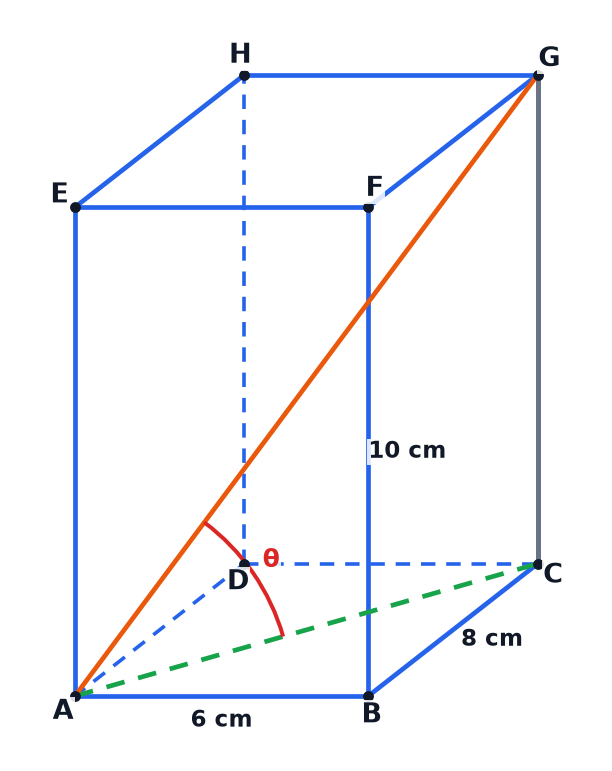
Diagram NOT accurately drawn. The diagram shows a cuboid. Work out the size of angle \(\theta\), the angle between \(AG\) and the base \(ABCD\). (4 marks)
Show answerHide answer
Model answer
\(AC^2 = 6^2 + 8^2 = 100\), so \(AC = 10\) cm. In the right-angled triangle \(ACG\), \(\tan\theta = \dfrac{CG}{AC} = \dfrac{10}{10} = 1\), so \(\theta = 45^\circ\).
Mark scheme
- \(AC = 10\) — B1
- \(\tan\theta = \dfrac{10}{10}\) — M1
- \(\tan\theta = 1\) — A1
- \(45\) — A1
-
3 Work out [5 marks]
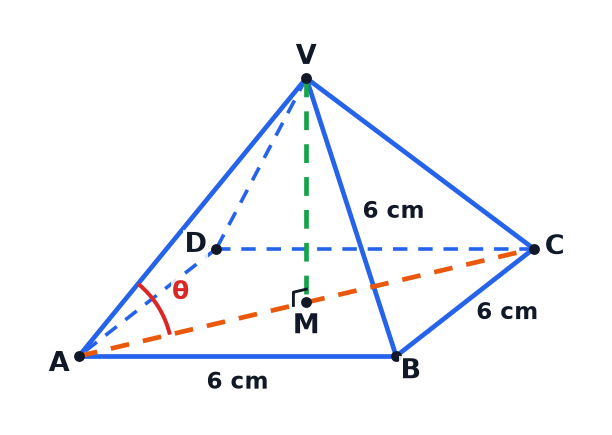
Diagram NOT accurately drawn. The diagram shows a pyramid with a square base \(ABCD\). The apex \(V\) is directly above the centre \(M\) of the base. All the edges are 6 cm long. (a) Work out the exact height \(VM\) of the pyramid. (3 marks) (b) Work out the size of angle \(\theta\), the angle between \(VA\) and the base. (2 marks)
Show answerHide answer
Model answer
(a) \(AC^2 = 6^2 + 6^2 = 72\), so \(AM = \dfrac{1}{2}AC = 3\sqrt{2}\). \(VM^2 = 6^2 - (3\sqrt{2})^2 = 36 - 18 = 18\), so \(VM = 3\sqrt{2}\) cm. (b) \(\cos\theta = \dfrac{AM}{VA} = \dfrac{3\sqrt{2}}{6} = \dfrac{\sqrt{2}}{2}\), so \(\theta = 45^\circ\).
Mark scheme
- (a) \(AM = 3\sqrt{2}\) — M1
- (a) \(VM^2 = 6^2 - 18\) — M1
- (a) \(3\sqrt{2}\) — A1
- (b) \(\cos\theta = \dfrac{3\sqrt{2}}{6}\) or \(\tan\theta = 1\) — M1
- (b) \(45\) — A1
-
4 Work out [4 marks]
A ship sails 50 km from \(P\) to \(Q\) on a bearing of \(060^\circ\). It then sails 80 km from \(Q\) to \(R\) on a bearing of \(180^\circ\). Work out the distance \(PR\). (4 marks)
Show answerHide answer
Model answer
The bearing of \(P\) from \(Q\) is \(240^\circ\), so angle \(PQR = 240 - 180 = 60^\circ\). \(PR^2 = 50^2 + 80^2 - 2 \times 50 \times 80 \times \cos 60^\circ = 2500 + 6400 - 4000 = 4900\), so \(PR = 70\) km.
Mark scheme
- Angle \(PQR = 60^\circ\) — M1
- \(PR^2 = 50^2 + 80^2 - 2 \times 50 \times 80 \times \cos 60^\circ\) — M1
- \(4900\) — A1
- \(70\) — A1
-
5 Work out [5 marks]
\(BT\) is a vertical tower on horizontal ground. The angle of elevation of \(T\) from a point \(A\) is \(30^\circ\), and from a point \(C\) is \(45^\circ\). Angle \(ABC = 90^\circ\) and \(AC = 80\) m. Work out the height of the tower. (5 marks)
Show answerHide answer
Model answer
Let \(BT = h\). \(BA = \dfrac{h}{\tan 30^\circ} = h\sqrt{3}\) and \(BC = \dfrac{h}{\tan 45^\circ} = h\). In the right-angled triangle \(ABC\), \(AC^2 = 3h^2 + h^2 = 4h^2 = 6400\), so \(h^2 = 1600\) and \(h = 40\) m.
Mark scheme
- \(BA = h\sqrt{3}\), or \(\tan 30^\circ = \dfrac{h}{BA}\) — B1
- \(BC = h\) — B1
- \(AC^2 = BA^2 + BC^2 = 4h^2\) — M1
- \(4h^2 = 6400\) — M1
- \(40\) — A1
-
6 Show that [3 marks]
\(ABCDEFGH\) is a cube with edges of length 4 cm. Show that triangle \(ACF\) is equilateral, and write down the size of angle \(CAF\). (3 marks)
Show answerHide answer
Model answer
\(AC\), \(AF\) and \(CF\) are diagonals of faces of the cube. \(AC^2 = 4^2 + 4^2 = 32\), so \(AC = 4\sqrt{2}\). The other two face diagonals are the same length, so the triangle is equilateral and angle \(CAF = 60^\circ\).
Mark scheme
- \(AC^2 = 4^2 + 4^2 = 32\), so \(AC = 4\sqrt{2}\) — M1
- \(AF\) and \(CF\) are also face diagonals, so all three sides are \(4\sqrt{2}\) — B1
- Equilateral, so angle \(CAF = 60^\circ\) — C1
Quick check
-
1
What is the formula for the space diagonal of a cuboid?
Show answerHide answer
B: \(\sqrt{l^2 + w^2 + h^2}\)
Use Pythagoras' theorem twice.
-
2
A rectangle is 4 cm by 3 cm. What is the length of its diagonal?
Show answerHide answer
A: 5 cm
\(\sqrt{16 + 9} = 5\).
-
3
Where is the apex of a square-based pyramid?
Show answerHide answer
D: Directly above the centre of the base
For a right pyramid the apex is above the centre.
-
4
A cuboid has edges 2 cm, 3 cm and 6 cm. What is the length of the space diagonal?
Show answerHide answer
C: 7 cm
\(\sqrt{4 + 9 + 36} = \sqrt{49} = 7\).
-
5
What is the angle between a line and a plane?
Show answerHide answer
B: The angle between the line and its shadow on the plane
The shadow of the line on the plane is used.
-
6
A cuboid has a base 4 cm by 3 cm and a height of 5 cm. What is \(\tan\theta\), where \(\theta\) is the angle between the diagonal \(AG\) and the base?
Show answerHide answer
A: 1
The base diagonal is 5 cm and the height is 5 cm, so \(\tan\theta = \dfrac{5}{5} = 1\).
-
7
A cube has edges of length 2 cm. What is the length of its space diagonal?
Show answerHide answer
D: \(2\sqrt{3}\) cm
\(\sqrt{4 + 4 + 4} = \sqrt{12} = 2\sqrt{3}\).
-
8
A square-based pyramid has a base with side 6 cm and a height of \(3\sqrt{2}\) cm. What is the angle between a sloping edge and the base?
Show answerHide answer
C: \(45^\circ\)
Half the base diagonal is \(3\sqrt{2}\), the same as the height, so \(\tan\theta = 1\).
-
9
In a 3D problem, which triangle contains the angle between the space diagonal of a cuboid and the base?
Show answerHide answer
B: A right-angled triangle with the base diagonal, the vertical edge and the space diagonal
The vertical edge is perpendicular to the base, so the triangle is right-angled.