Exam questions · Maths · Geometry and Measures
Angles in Parallel Lines and Polygons
- 6 exam questions
- 19 marks
- 9 quick checks
-
1 Work out [2 marks]
Three angles at a point are \(130^\circ\), \(95^\circ\) and \(x^\circ\). Work out the value of \(x\). Give a reason for your answer.
Show answerHide answer
Model answer
Angles around a point add up to \(360^\circ\), so \(x = 360 - 130 - 95 = 135\).
Mark scheme
- \(360 - 130 - 95\) or \(130 + 95 = 225\) — M1
- \(x = 135\) with the reason angles around a point add up to \(360^\circ\) — A1
-
2 Work out [3 marks]
Triangle \(ABC\) is isosceles with \(AB = AC\). Angle \(BAC = 40^\circ\). Work out the size of angle \(ABC\). Give a reason for each step of your working.
Show answerHide answer
Model answer
The angles in a triangle add up to \(180^\circ\), so angles \(B\) and \(C\) add up to \(180 - 40 = 140^\circ\). The base angles of an isosceles triangle are equal, so angle \(ABC = 140 \div 2 = 70^\circ\).
Mark scheme
- \(180 - 40 = 140\) — M1
- \(140 \div 2 = 70\) — A1
- Reasons given: angles in a triangle add up to 180 degrees and base angles of an isosceles triangle are equal — C1
-
3 Work out [4 marks]
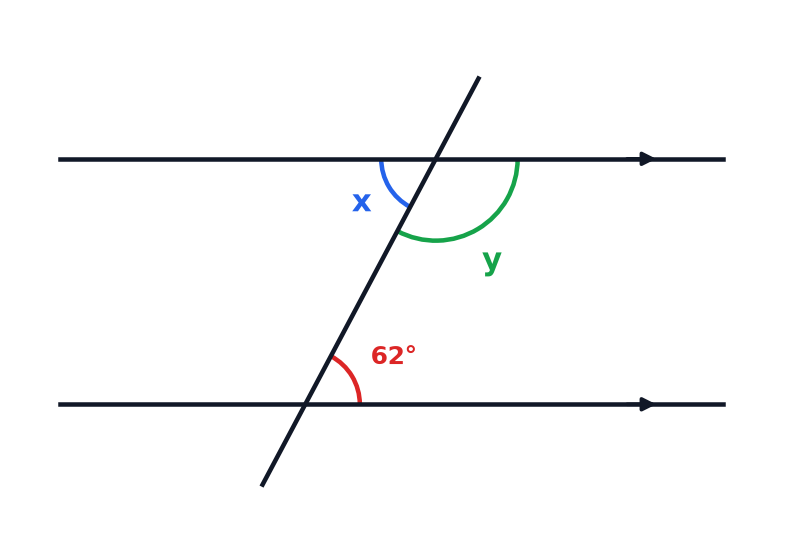
The diagram shows two parallel lines crossed by a straight line. (a) Write down the size of angle \(x\). Give a reason for your answer. (2 marks) (b) Work out the size of angle \(y\). (2 marks)
Show answerHide answer
Model answer
(a) \(x = 62^\circ\) because alternate angles are equal. (b) \(x\) and \(y\) lie on a straight line, so \(y = 180 - 62 = 118^\circ\).
Mark scheme
- (a) \(62^\circ\) — B1
- (a) Alternate angles are equal — C1
- (b) \(180 - 62\) or \(180 - x\) — M1
- (b) \(118^\circ\) — A1
-
4 Work out [3 marks]
Work out the size of one interior angle of a regular hexagon. You must show your working.
Show answerHide answer
Model answer
The exterior angle is \(360 \div 6 = 60^\circ\), so the interior angle is \(180 - 60 = 120^\circ\). Alternatively the sum of the angles is \((6 - 2) \times 180 = 720^\circ\) and \(720 \div 6 = 120^\circ\).
Mark scheme
- \(360 \div 6 = 60\) or \((6 - 2) \times 180 = 720\) — M1
- \(180 - 60\) or \(720 \div 6\) — M1
- \(120^\circ\) — A1
-
5 Work out [3 marks]
Each exterior angle of a regular polygon is \(20^\circ\). (a) Work out the number of sides of the polygon. (2 marks) (b) Work out the size of one interior angle. (1 mark)
Show answerHide answer
Model answer
(a) \(360 \div 20 = 18\) sides. (b) \(180 - 20 = 160^\circ\).
Mark scheme
- (a) \(360 \div 20\) — M1
- (a) 18 — A1
- (b) \(160^\circ\) — B1
-
6 Work out [4 marks]
The angles of a quadrilateral are \(x^\circ\), \(2x^\circ\), \((3x - 10)^\circ\) and \(4x^\circ\). Work out the size of the largest angle of the quadrilateral.
Show answerHide answer
Model answer
The angles add up to \(360^\circ\), so \(x + 2x + 3x - 10 + 4x = 360\). That gives \(10x - 10 = 360\), so \(x = 37\). The largest angle is \(4x = 148^\circ\).
Mark scheme
- \(x + 2x + 3x - 10 + 4x = 360\) — M1
- \(10x = 370\) or \(10x - 10 = 360\) — M1
- \(x = 37\) — A1
- \(148^\circ\) — A1
Quick check
-
1
Three angles on a straight line are \(47^\circ\), \(68^\circ\) and \(x\). What is \(x\)?
Show answerHide answer
B: \(65^\circ\)
Angles on a straight line add up to \(180^\circ\). \(180 - 47 - 68 = 65\).
-
2
Three angles of a quadrilateral are \(80^\circ\), \(95^\circ\) and \(110^\circ\). What is the fourth angle?
Show answerHide answer
A: \(75^\circ\)
The angles of a quadrilateral add up to \(360^\circ\). \(80 + 95 + 110 = 285\) and \(360 - 285 = 75\).
-
3
Which type of angles are equal and form a Z shape between parallel lines?
Show answerHide answer
D: Alternate angles
Alternate angles are on opposite sides of the transversal, and make a Z shape.
-
4
Two co-interior angles lie between parallel lines. One is \(72^\circ\). What is the other?
Show answerHide answer
C: \(108^\circ\)
Co-interior angles add up to \(180^\circ\), so \(180 - 72 = 108\).
-
5
What is the sum of the interior angles of a hexagon?
Show answerHide answer
B: \(720^\circ\)
A hexagon has 6 sides, so the sum is \((6 - 2) \times 180 = 720\).
-
6
What is each exterior angle of a regular octagon?
Show answerHide answer
A: \(45^\circ\)
\(360 \div 8 = 45\). The interior angle is \(135^\circ\).
-
7
Each exterior angle of a regular polygon is \(24^\circ\). How many sides does it have?
Show answerHide answer
D: 15
\(360 \div 24 = 15\). The number 156 is the interior angle.
-
8
An exterior angle of a triangle is \(118^\circ\). One of the interior opposite angles is \(54^\circ\). What is the other interior opposite angle?
Show answerHide answer
C: \(64^\circ\)
The exterior angle equals the sum of the two interior opposite angles, so \(118 - 54 = 64\).
-
9
The angles of a triangle are \(x\), \(2x + 10\) and \(3x - 10\) degrees. What is the size of the largest angle?
Show answerHide answer
B: \(80^\circ\)
\(6x = 180\), so \(x = 30\). The angles are \(30^\circ\), \(70^\circ\) and \(80^\circ\).