Exam questions · Maths · Geometry and Measures
Pythagoras' Theorem
- 7 exam questions
- 24 marks
- 9 quick checks
-
1 Work out [3 marks]
A right-angled triangle has shorter sides of length 20 cm and 21 cm. Work out the length of the hypotenuse of the triangle.
Show answerHide answer
Model answer
\(20^2 + 21^2 = 400 + 441 = 841\), and \(\sqrt{841} = 29\) cm.
Mark scheme
- \(20^2 + 21^2\) — M1
- \(841\) — M1
- 29 cm — A1
-
2 Work out [3 marks]
A right-angled triangle has a hypotenuse of length 25 cm. One of the shorter sides has length 7 cm. Work out the length of the other shorter side.
Show answerHide answer
Model answer
\(25^2 - 7^2 = 625 - 49 = 576\), and \(\sqrt{576} = 24\) cm.
Mark scheme
- \(25^2 - 7^2\) — M1
- \(576\) — M1
- 24 cm — A1
-
3 Work out [4 marks]
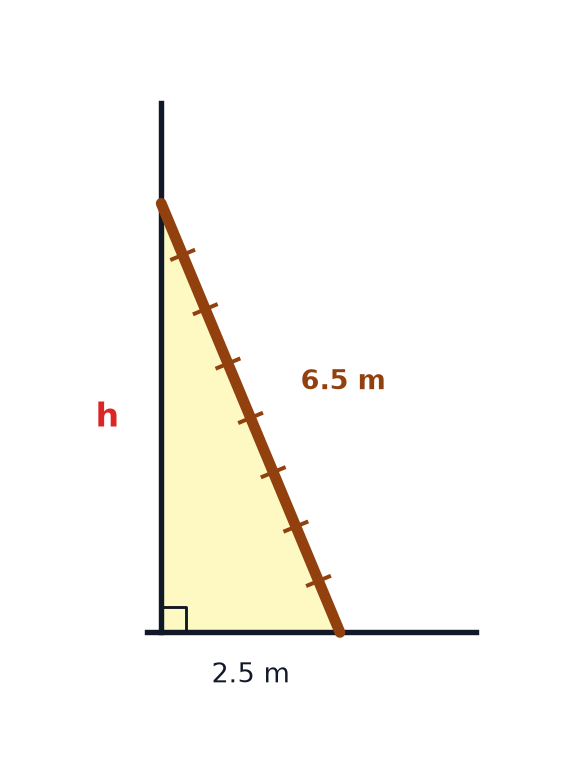
A ladder is 6.5 m long. It leans against a vertical wall. The foot of the ladder is on horizontal ground, 2.5 m from the wall. (a) Work out the height, \(h\), that the ladder reaches up the wall. (3 marks) (b) A safety rule says that the distance from the foot of the ladder to the wall should be one quarter of the height reached. Does the ladder follow this rule? (1 mark)
Show answerHide answer
Model answer
(a) \(h^2 = 6.5^2 - 2.5^2 = 42.25 - 6.25 = 36\), so \(h = 6\) m. (b) One quarter of 6 is 1.5 m, but the foot is 2.5 m from the wall, so the ladder does not follow the rule.
Mark scheme
- (a) \(6.5^2 - 2.5^2\) — M1
- (a) \(36\) — M1
- (a) 6 m — A1
- (b) No, with \(6 \div 4 = 1.5\) compared with 2.5 — C1
-
4 Show that [3 marks]
A triangle has sides of length 8 cm, 11 cm and 13 cm. Is the triangle right-angled? You must show your working.
Show answerHide answer
Model answer
The longest side is 13, so \(13^2 = 169\). The other two give \(8^2 + 11^2 = 64 + 121 = 185\). Since \(185 \neq 169\), the triangle is not right-angled.
Mark scheme
- \(8^2 + 11^2 = 185\) — M1
- \(13^2 = 169\) — M1
- Not right-angled, with the two values compared — C1
-
5 Work out [4 marks]
A rectangle has a diagonal of length 25 cm and a width of 7 cm. Work out the area of the rectangle.
Show answerHide answer
Model answer
The length is \(\sqrt{25^2 - 7^2} = \sqrt{576} = 24\) cm, so the area is \(24 \times 7 = 168\) cm\(^2\).
Mark scheme
- \(25^2 - 7^2\) — M1
- \(\sqrt{576} = 24\) — A1
- \(24 \times 7\) — M1
- 168 cm\(^2\) — A1
-
6 Work out [4 marks]
An isosceles triangle has a base of 16 cm and two equal sides of 17 cm. Work out the area of the triangle.
Show answerHide answer
Model answer
The height splits the base into two lots of 8 cm, so \(h = \sqrt{17^2 - 8^2} = \sqrt{289 - 64} = \sqrt{225} = 15\) cm. The area is \(\dfrac{1}{2} \times 16 \times 15 = 120\) cm\(^2\).
Mark scheme
- Half of the base \(= 8\) used — M1
- \(17^2 - 8^2 = 225\) — M1
- \(h = 15\) — A1
- 120 cm\(^2\) — A1
-
7 Work out [3 marks]
Point \(A\) has coordinates \((-3, 2)\) and point \(B\) has coordinates \((2, 14)\). Work out the length of the line \(AB\).
Show answerHide answer
Model answer
The horizontal difference is \(2 - (-3) = 5\) and the vertical difference is \(14 - 2 = 12\). So \(AB = \sqrt{5^2 + 12^2} = \sqrt{169} = 13\).
Mark scheme
- Differences 5 and 12 found — M1
- \(5^2 + 12^2 = 169\) — M1
- 13 — A1
Quick check
-
1
A right-angled triangle has shorter sides of 9 cm and 12 cm. What is the hypotenuse?
Show answerHide answer
A: 15 cm
\(9^2 + 12^2 = 81 + 144 = 225\), and \(\sqrt{225} = 15\).
-
2
A right-angled triangle has hypotenuse 13 cm and one shorter side 5 cm. What is the other shorter side?
Show answerHide answer
D: 12 cm
\(13^2 - 5^2 = 169 - 25 = 144\), and \(\sqrt{144} = 12\).
-
3
Which set of lengths makes a right-angled triangle?
Show answerHide answer
C: 6 cm, 8 cm, 10 cm
\(6^2 + 8^2 = 36 + 64 = 100 = 10^2\). The other sets do not satisfy \(a^2 + b^2 = c^2\).
-
4
Which side of a right-angled triangle is the hypotenuse?
Show answerHide answer
B: The longest side, opposite the right angle
The hypotenuse is always the longest side, and it is opposite the right angle.
-
5
A rectangle is 15 cm long and 8 cm wide. How long is its diagonal?
Show answerHide answer
A: 17 cm
\(15^2 + 8^2 = 225 + 64 = 289\), and \(\sqrt{289} = 17\).
-
6
A ladder 6.5 m long leans against a wall. Its foot is 2.5 m from the wall. How high up the wall does it reach?
Show answerHide answer
D: 6 m
\(6.5^2 - 2.5^2 = 42.25 - 6.25 = 36\), and \(\sqrt{36} = 6\).
-
7
An isosceles triangle has base 10 cm and equal sides of 13 cm. What is its height?
Show answerHide answer
C: 12 cm
The height splits the base into two lots of 5 cm. \(13^2 - 5^2 = 144\), so the height is 12 cm.
-
8
A right-angled triangle has shorter sides of 2 cm and 4 cm. What is the hypotenuse?
Show answerHide answer
B: \(2\sqrt{5}\) cm
\(2^2 + 4^2 = 20\), and \(\sqrt{20} = \sqrt{4 \times 5} = 2\sqrt{5}\).
-
9
What is the distance between the points \((1, 2)\) and \((7, 10)\)?
Show answerHide answer
A: 10
The horizontal difference is 6 and the vertical difference is 8, so the distance is \(\sqrt{6^2 + 8^2} = \sqrt{100} = 10\).