Exam questions · Maths · Probability
Tree Diagrams
- 6 exam questions
- 20 marks
- 9 quick checks
-
1 Work out [2 marks]
Tom flips a fair coin twice. Work out the probability that he gets two heads.
Show answerHide answer
Model answer
\(\dfrac{1}{2} \times \dfrac{1}{2} = \dfrac{1}{4}\).
Mark scheme
- \(\dfrac{1}{2} \times \dfrac{1}{2}\) — M1
- \(\dfrac{1}{4}\) — A1
-
2 Work out [4 marks]
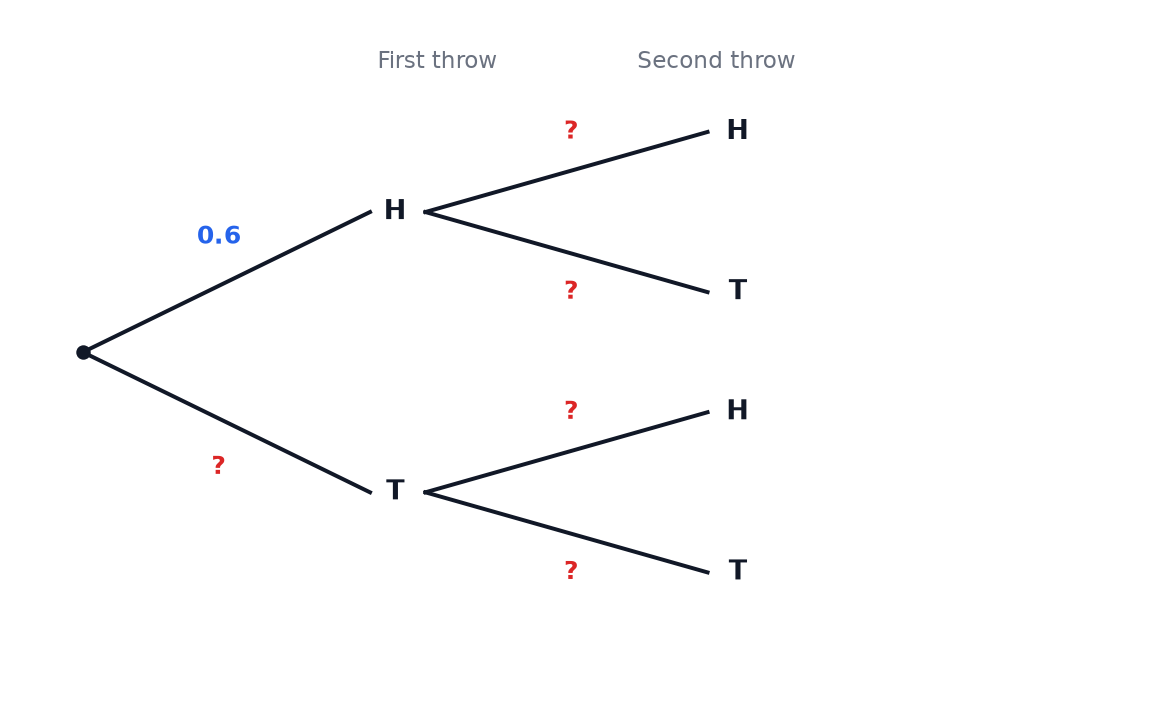
Mina throws a biased coin twice. The probability that it lands on heads is 0.6. The incomplete probability tree diagram shows the first throw and the second throw. (a) Complete the probability tree diagram. (2 marks) (b) Work out the probability that Mina gets one head and one tail. (2 marks)
Show answerHide answer
Model answer
(a) The probability of tails is \(1 - 0.6 = 0.4\). The first-throw tails branch is 0.4, and the second-throw branches are 0.6 for heads and 0.4 for tails on all four. (b) \(0.6 \times 0.4 + 0.4 \times 0.6 = 0.24 + 0.24 = 0.48\).
Mark scheme
- (a) 0.4 on the first tails branch — B1
- (a) 0.6 and 0.4 on each pair of second-throw branches — B1
- (b) \(0.6 \times 0.4\) and \(0.4 \times 0.6\) added — M1
- (b) \(0.48\) — A1
-
3 Work out [3 marks]
A bag contains 5 red pens and 3 blue pens. Eve takes two pens at random without replacement. Work out the probability that both pens are red.
Show answerHide answer
Model answer
\(\dfrac{5}{8} \times \dfrac{4}{7} = \dfrac{20}{56} = \dfrac{5}{14}\).
Mark scheme
- \(\dfrac{5}{8}\) and \(\dfrac{4}{7}\) seen — M1
- \(\dfrac{5}{8} \times \dfrac{4}{7}\) — M1
- \(\dfrac{5}{14}\) or \(\dfrac{20}{56}\) — A1
-
4 Work out [3 marks]
Sam has a written test and a practical test. The probability that he passes the written test is 0.7. The probability that he passes the practical test is 0.8. The tests are independent. Work out the probability that Sam passes at least one of the tests.
Show answerHide answer
Model answer
The probability that he fails both is \(0.3 \times 0.2 = 0.06\), so the probability he passes at least one is \(1 - 0.06 = 0.94\).
Mark scheme
- \(0.3\) and \(0.2\) seen — M1
- \(0.3 \times 0.2 = 0.06\) — M1
- \(0.94\) — A1
-
5 Work out [3 marks]
A fair dice is rolled twice. Work out the probability of getting at least one 6.
Show answerHide answer
Model answer
No sixes in two rolls: \(\dfrac{5}{6} \times \dfrac{5}{6} = \dfrac{25}{36}\). So the probability of at least one 6 is \(1 - \dfrac{25}{36} = \dfrac{11}{36}\).
Mark scheme
- \(\dfrac{5}{6} \times \dfrac{5}{6}\) — M1
- \(1 - \dfrac{25}{36}\) — M1
- \(\dfrac{11}{36}\) — A1
-
6 Show that [5 marks]
A bag contains 3 red counters and \(n\) blue counters. Two counters are taken at random without replacement. The probability that both counters are red is \(\dfrac{1}{15}\). (a) Show that \(n^2 + 5n - 84 = 0\). (3 marks) (b) Hence find the value of \(n\). (2 marks)
Show answerHide answer
Model answer
(a) There are \(n + 3\) counters, so \(\dfrac{3}{n + 3} \times \dfrac{2}{n + 2} = \dfrac{1}{15}\). Then \((n + 3)(n + 2) = 90\), so \(n^2 + 5n + 6 = 90\) and \(n^2 + 5n - 84 = 0\). (b) \((n + 12)(n - 7) = 0\), so \(n = 7\), because \(n\) cannot be negative.
Mark scheme
- (a) \(\dfrac{3}{n + 3} \times \dfrac{2}{n + 2}\) — M1
- (a) \(6 \times 15 = (n + 3)(n + 2)\) or equivalent — M1
- (a) \(n^2 + 5n - 84 = 0\) shown — C1
- (b) \((n + 12)(n - 7)\) — M1
- (b) \(n = 7\) — A1
Quick check
-
1
The probability of rain on any day is 0.3, and days are independent. What is the probability of rain on both of two days?
Show answerHide answer
C: \(0.09\)
\(0.3 \times 0.3 = 0.09\).
-
2
The probability of rain on any day is 0.3, and days are independent. What is the probability of rain on at least one of two days?
Show answerHide answer
B: \(0.51\)
\(1 - 0.7 \times 0.7 = 1 - 0.49 = 0.51\).
-
3
Two fair coins are tossed. What is the probability of two heads?
Show answerHide answer
A: \(\dfrac{1}{4}\)
\(\dfrac{1}{2} \times \dfrac{1}{2} = \dfrac{1}{4}\).
-
4
A bag has 3 red and 2 blue counters. Two are taken without replacement. What is the probability that both are red?
Show answerHide answer
D: \(\dfrac{3}{10}\)
\(\dfrac{3}{5} \times \dfrac{2}{4} = \dfrac{6}{20} = \dfrac{3}{10}\).
-
5
A bag has 3 red and 2 blue counters. Two are taken without replacement. What is the probability that they are different colours?
Show answerHide answer
C: \(\dfrac{3}{5}\)
\(\dfrac{3}{5} \times \dfrac{2}{4} + \dfrac{2}{5} \times \dfrac{3}{4} = \dfrac{12}{20} = \dfrac{3}{5}\).
-
6
A bag has 3 red and 2 blue counters. Two are taken without replacement. What is the probability that they are the same colour?
Show answerHide answer
B: \(\dfrac{2}{5}\)
\(\dfrac{6}{20} + \dfrac{2}{20} = \dfrac{8}{20} = \dfrac{2}{5}\).
-
7
On a tree diagram, one branch has probability 0.6. What is the other branch from the same point?
Show answerHide answer
A: \(0.4\)
The branches from one point add up to 1.
-
8
A bag has 4 red and 6 blue counters. Two are taken without replacement. What is the probability that both are blue?
Show answerHide answer
D: \(\dfrac{1}{3}\)
\(\dfrac{6}{10} \times \dfrac{5}{9} = \dfrac{30}{90} = \dfrac{1}{3}\).
-
9
A bag has 4 red counters and some blue counters, \(n\) in all. Two are taken without replacement and \(P(\text{two reds}) = \dfrac{2}{15}\). How many counters are in the bag?
Show answerHide answer
C: \(10\)
\(\dfrac{4}{10} \times \dfrac{3}{9} = \dfrac{12}{90} = \dfrac{2}{15}\), so \(n = 10\).