Exam questions · Maths · Probability
Venn Diagrams and Set Notation
- 6 exam questions
- 19 marks
- 9 quick checks
-
1 Write down [2 marks]
\(\xi = \{1, 2, 3, 4, 5, 6, 7, 8, 9, 10\}\). \(A\) is the set of even numbers and \(B = \{2, 3, 5, 7\}\). (a) Write down \(A \cap B\). (1 mark) (b) Write down \(A \cup B\). (1 mark)
Show answerHide answer
Model answer
(a) \(A \cap B = \{2\}\). (b) \(A \cup B = \{2, 3, 4, 5, 6, 7, 8, 10\}\).
Mark scheme
- (a) \(\{2\}\) — B1
- (b) \(\{2, 3, 4, 5, 6, 7, 8, 10\}\) — B1
-
2 Work out [4 marks]
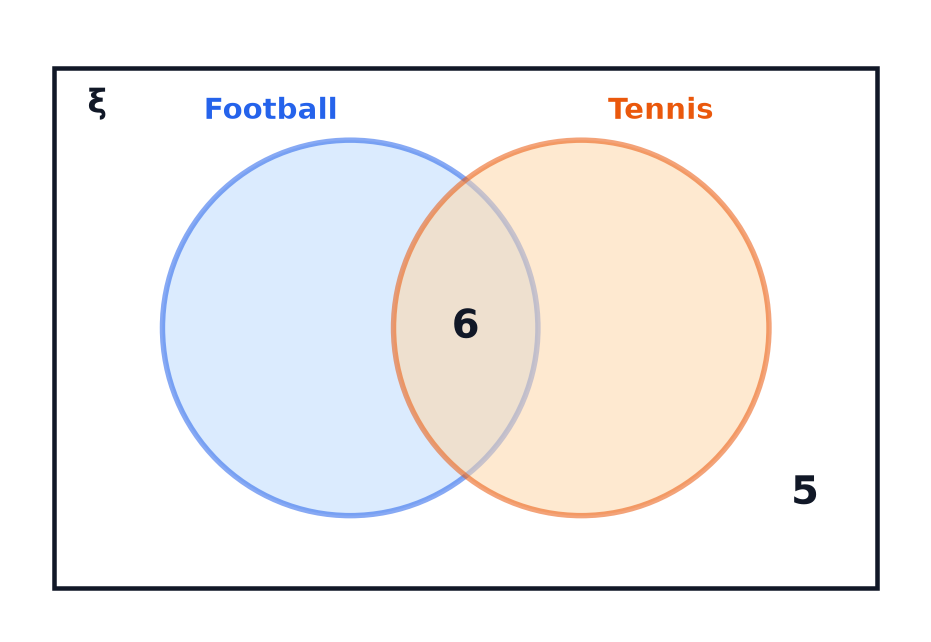
There are 40 students in a class. 22 play football and 19 play tennis. The incomplete Venn diagram shows 6 who play both sports and 5 who play neither. (a) Complete the Venn diagram. (2 marks) (b) A student is chosen at random. Work out the probability that the student plays exactly one of the two sports. (2 marks)
Show answerHide answer
Model answer
(a) Football only is \(22 - 6 = 16\) and tennis only is \(19 - 6 = 13\). Check: \(16 + 6 + 13 + 5 = 40\). (b) \(\dfrac{16 + 13}{40} = \dfrac{29}{40}\).
Mark scheme
- (a) 16 — B1
- (a) 13 — B1
- (b) \(16 + 13 = 29\) seen — M1
- (b) \(\dfrac{29}{40}\) — A1
-
3 Work out [3 marks]
\(\xi = \{1, 2, 3, \ldots, 12\}\). \(A\) is the set of multiples of 3 and \(B\) is the set of factors of 12. (a) List the members of \(A \cap B\). (1 mark) (b) Work out \(n((A \cup B)')\). (2 marks)
Show answerHide answer
Model answer
(a) \(A = \{3, 6, 9, 12\}\) and \(B = \{1, 2, 3, 4, 6, 12\}\), so \(A \cap B = \{3, 6, 12\}\). (b) \(A \cup B = \{1, 2, 3, 4, 6, 9, 12\}\), which has 7 members, so \(n((A \cup B)') = 12 - 7 = 5\).
Mark scheme
- (a) \(\{3, 6, 12\}\) — B1
- (b) Lists or counts 7 members of \(A \cup B\) — M1
- (b) 5 — A1
-
4 Work out [3 marks]
In a group of 50 people, 30 like tea and 25 like coffee. 8 people like neither drink. Work out the number of people who like both tea and coffee.
Show answerHide answer
Model answer
The number who like at least one drink is \(50 - 8 = 42\). Then \(30 + 25 - 42 = 13\) like both.
Mark scheme
- \(50 - 8 = 42\) — M1
- \(30 + 25 - 42\) — M1
- 13 — A1
-
5 Work out [4 marks]
In a Venn diagram of 52 people, the number in set \(A\) only is \(2x\), the number in both sets is \(x\), the number in set \(B\) only is \(x + 4\), and 8 people are in neither set. (a) Work out the value of \(x\). (2 marks) (b) A person is chosen at random. Work out the probability that the person is in set \(A\). Give your answer in its simplest form. (2 marks)
Show answerHide answer
Model answer
(a) \(2x + x + x + 4 + 8 = 52\), so \(4x + 12 = 52\) and \(x = 10\). (b) Set \(A\) has \(2x + x = 30\) people, so the probability is \(\dfrac{30}{52} = \dfrac{15}{26}\).
Mark scheme
- (a) \(4x + 12 = 52\) — M1
- (a) \(x = 10\) — A1
- (b) \(\dfrac{30}{52}\) — M1
- (b) \(\dfrac{15}{26}\) — A1
-
6 Work out [3 marks]
There are 30 students in a class. 18 study French and 12 study Spanish. 5 study both. A student is chosen at random. Work out the probability that the student studies neither French nor Spanish.
Show answerHide answer
Model answer
At least one language: \(18 + 12 - 5 = 25\). Neither: \(30 - 25 = 5\). The probability is \(\dfrac{5}{30} = \dfrac{1}{6}\).
Mark scheme
- \(18 + 12 - 5 = 25\) — M1
- 5 students study neither — A1
- \(\dfrac{1}{6}\) — A1
Quick check
-
1
What does \(A \cap B\) mean?
Show answerHide answer
D: The items in both \(A\) and \(B\)
\(\cap\) is the intersection, the overlap.
-
2
What does \(A \cup B\) mean?
Show answerHide answer
C: The items in \(A\) or \(B\) or both
\(\cup\) is the union, everything in either circle.
-
3
What does \(A'\) mean?
Show answerHide answer
B: The items not in \(A\)
\(A'\) is the complement of \(A\).
-
4
\(A = \{2, 4, 6, 8, 10\}\) and \(B = \{3, 6, 9\}\). What is \(A \cap B\)?
Show answerHide answer
A: \(\{6\}\)
Only 6 is in both sets.
-
5
18 students play football and 6 of them also play tennis. How many play football only?
Show answerHide answer
D: \(12\)
\(18 - 6 = 12\).
-
6
30 students: 18 play football, 14 play tennis and 6 play both. How many play neither?
Show answerHide answer
C: \(4\)
\(12 + 6 + 8 = 26\) play at least one, so \(30 - 26 = 4\).
-
7
In the same survey, what is the probability that a student chosen at random plays football only?
Show answerHide answer
B: \(\dfrac{2}{5}\)
\(\dfrac{12}{30} = \dfrac{2}{5}\). The fraction \(\dfrac{18}{30}\) would include those who play both.
-
8
In a class of 40, 22 play football, 19 play tennis and 5 play neither. How many play both?
Show answerHide answer
A: \(6\)
\(40 - 5 = 35\) play at least one, and \(22 + 19 - 35 = 6\).
-
9
\(n(A) = 15\), \(n(B) = 12\) and \(n(A \cap B) = 5\). What is \(n(A \cup B)\)?
Show answerHide answer
D: \(22\)
\(15 + 12 - 5 = 22\).