Exam questions · Maths · Ratio and Proportion
Speed, Distance, Time and Density
- 6 exam questions
- 21 marks
- 9 quick checks
-
1 Work out [3 marks]
A car travels 135 miles in 2 hours 30 minutes. Work out the average speed of the car in miles per hour.
Show answerHide answer
Model answer
2 hours 30 minutes is 2.5 hours. Speed \(= 135 \div 2.5 = 54\) mph.
Mark scheme
- Time converted to 2.5 hours, or \(135 \div 5 = 27\) seen — M1
- \(135 \div 2.5\) or \(135 \times 2 \div 5\) — M1
- 54 mph — A1
-
2 Work out [3 marks]
A cyclist travels at an average speed of 18 km/h for 2 hours 20 minutes. Work out the distance she travels.
Show answerHide answer
Model answer
2 hours 20 minutes is \(2\dfrac{1}{3}\) hours, so the distance is \(18 \times 2\dfrac{1}{3} = 36 + 6 = 42\) km.
Mark scheme
- Time as \(2\dfrac{1}{3}\) or \(\dfrac{7}{3}\) hours — M1
- \(18 \times \dfrac{7}{3}\) or \(36 + 6\) — M1
- 42 km — A1
-
3 Work out [5 marks]
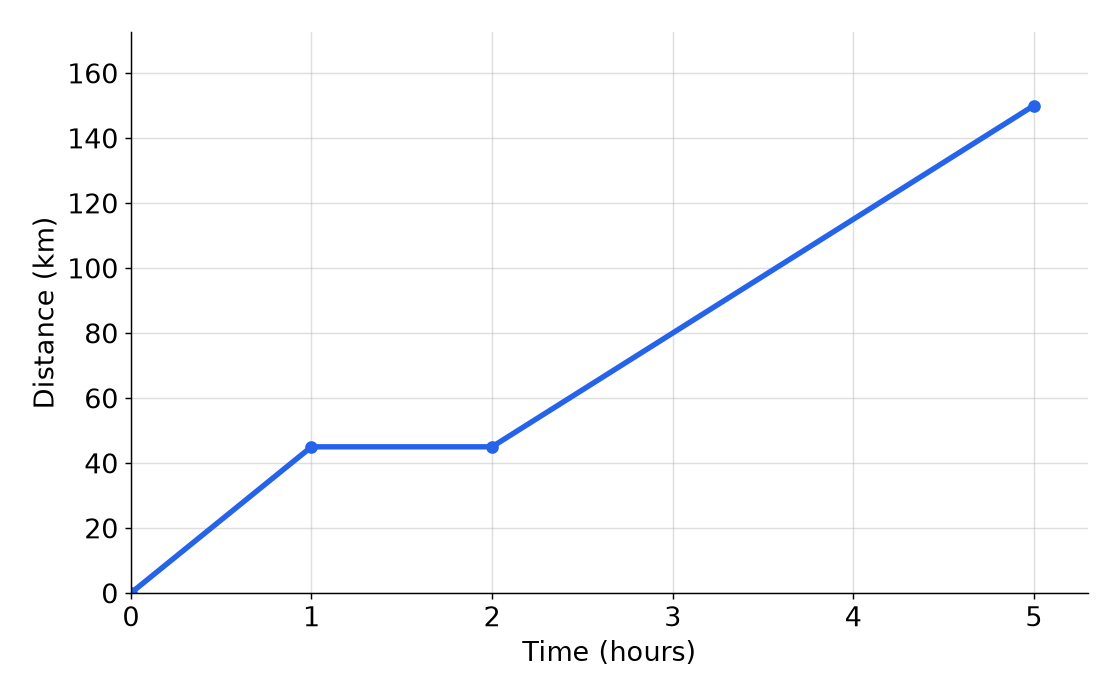
Anna drives from home to her gran's house. The graph shows her journey. (a) For how long did Anna stop? (1 mark) (b) Work out Anna's speed during the first hour of her journey. (1 mark) (c) Work out Anna's average speed for the whole journey. (3 marks)
Show answerHide answer
Model answer
(a) The flat part runs from 1 hour to 2 hours, so she stopped for 1 hour. (b) She travelled 45 km in 1 hour, so her speed was 45 km/h. (c) The whole journey was 150 km in 5 hours, so the average speed is \(150 \div 5 = 30\) km/h.
Mark scheme
- (a) 1 hour — B1
- (b) 45 km/h — B1
- (c) Total distance 150 km and total time 5 hours seen — M1
- (c) \(150 \div 5\) — M1
- (c) 30 km/h — A1
-
4 Explain [4 marks]
Raj drives 90 km at an average speed of 45 km/h. He then drives a further 90 km at an average speed of 90 km/h. Raj says, “My average speed for the whole journey was 67.5 km/h.” Is Raj correct? You must show your working.
Show answerHide answer
Model answer
The first part takes \(90 \div 45 = 2\) hours and the second part takes \(90 \div 90 = 1\) hour. The total is 180 km in 3 hours, so the average speed is \(180 \div 3 = 60\) km/h. Raj has averaged the two speeds, which is wrong, so he is not correct.
Mark scheme
- Times \(2\) hours and \(1\) hour found — M1
- Total distance \(180\) km and total time \(3\) hours — M1
- \(180 \div 3 = 60\) — A1
- No, with the correct average speed shown — C1
-
5 Work out [2 marks]
A block of wood has a volume of 400 cm\(^3\). The density of the wood is 0.6 g/cm\(^3\). Work out the mass of the block.
Show answerHide answer
Model answer
Mass \(=\) density \(\times\) volume \(= 0.6 \times 400 = 240\) g.
Mark scheme
- \(0.6 \times 400\) — M1
- 240 g — A1
-
6 Work out [4 marks]
(a) Change a speed of 54 km/h to metres per second. (2 marks) (b) A box exerts a force of 450 N on a floor. The area of the box in contact with the floor is 0.9 m\(^2\). Work out the pressure on the floor in N/m\(^2\). (2 marks)
Show answerHide answer
Model answer
(a) \(54 \times 1000 \div 3600 = 15\) m/s. (b) Pressure \(=\) force \(\div\) area \(= 450 \div 0.9 = 500\) N/m\(^2\).
Mark scheme
- (a) \(54 \times 1000 \div 3600\) or \(54 \div 3.6\) — M1
- (a) 15 — A1
- (b) \(450 \div 0.9\) — M1
- (b) 500 — A1
Quick check
-
1
A car travels 150 km in 2 hours 30 minutes. What is its average speed?
Show answerHide answer
D: 60 km/h
Write 2 hours 30 minutes as 2.5 hours. Then \(150 \div 2.5 = 60\) km/h.
-
2
What is 45 minutes as a decimal of an hour?
Show answerHide answer
C: 0.75 hours
\(45 \div 60 = 0.75\).
-
3
A train travels at 80 km/h for 3 hours 15 minutes. How far does it go?
Show answerHide answer
B: 260 km
3 hours 15 minutes is 3.25 hours, so the distance is \(80 \times 3.25 = 260\) km. Writing the time as 3.15 hours is a common error.
-
4
A cyclist rides 60 km at 30 km/h and then 60 km at 60 km/h. What is the average speed for the whole journey?
Show answerHide answer
A: 40 km/h
The times are 2 hours and 1 hour. The total distance is 120 km and the total time is 3 hours, so \(120 \div 3 = 40\) km/h.
-
5
What does a horizontal line on a distance-time graph show?
Show answerHide answer
D: The object is stationary
A flat line means the distance is not changing with time, so the speed is zero.
-
6
A metal block has mass 240 g and volume 30 cm\(^3\). What is its density?
Show answerHide answer
C: 8 g/cm\(^3\)
Density \(=\) mass \(\div\) volume \(= 240 \div 30 = 8\) g/cm\(^3\).
-
7
The density of a metal is 8 g/cm\(^3\). What is the mass of 25 cm\(^3\) of it?
Show answerHide answer
B: 200 g
Mass \(=\) density \(\times\) volume \(= 8 \times 25 = 200\) g.
-
8
Change 72 km/h into metres per second.
Show answerHide answer
A: 20 m/s
\(72 \times 1000 = 72\,000\) m per hour, and \(72\,000 \div 3600 = 20\) m/s.
-
9
A force of 600 N acts on an area of 0.5 m\(^2\). What is the pressure?
Show answerHide answer
D: 1200 N/m\(^2\)
Pressure \(=\) force \(\div\) area \(= 600 \div 0.5 = 1200\) N/m\(^2\).