Exam questions · Maths · Transformations and Similarity
Combined Transformations
- 6 exam questions
- 19 marks
- 9 quick checks
-
1 Describe [4 marks]
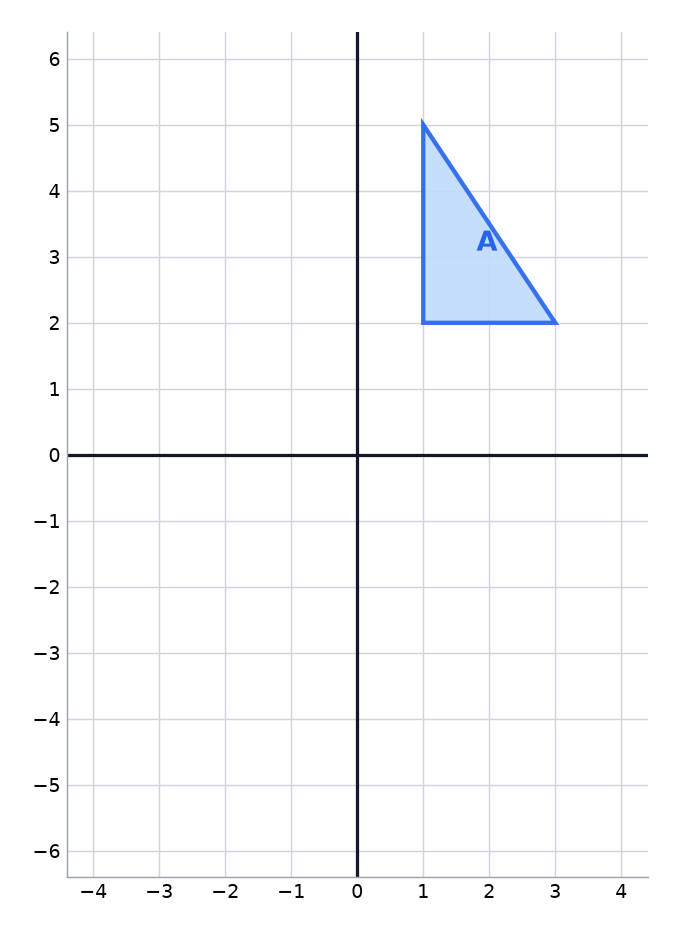
Triangle \(A\) is reflected in the \(y\)-axis to give triangle \(B\). Triangle \(B\) is reflected in the \(x\)-axis to give triangle \(C\). (a) Draw triangles \(B\) and \(C\). (2 marks) (b) Describe fully the single transformation that maps \(A\) onto \(C\). (2 marks)
Show answerHide answer
Model answer
(a) \(B\) has vertices \((-1, 2)\), \((-3, 2)\) and \((-1, 5)\), and \(C\) has vertices \((-1, -2)\), \((-3, -2)\) and \((-1, -5)\). (b) \((x, y)\) goes to \((-x, -y)\), which is a rotation of \(180^\circ\) about the origin.
Mark scheme
- (a) \(B\) correct — B1
- (a) \(C\) correct — B1
- (b) Rotation, \(180^\circ\) — B1
- (b) About the origin — B1
-
2 Describe [3 marks]
The point \((2, 3)\) is reflected in the line \(x = 1\), and the image is then reflected in the line \(x = 5\). Describe the single transformation that has the same effect.
Show answerHide answer
Model answer
The first reflection gives \((0, 3)\) and the second gives \((10, 3)\). The point has moved 8 to the right, which is twice the distance between the lines, \(2 \times 4 = 8\). So it is a translation by \(\begin{pmatrix} 8 \\ 0 \end{pmatrix}\).
Mark scheme
- \((0, 3)\) seen — M1
- \((10, 3)\) seen — M1
- Translation by \(\begin{pmatrix} 8 \\ 0 \end{pmatrix}\) — A1
-
3 Write down [2 marks]
(a) A shape is rotated through \(90^\circ\) about the point \((2, 1)\). Write down the coordinates of the point that does not move. (1 mark) (b) A shape is reflected in the line \(y = 3\). Describe the points that do not move. (1 mark)
Show answerHide answer
Model answer
(a) The centre of rotation, \((2, 1)\), is invariant. (b) Every point on the line \(y = 3\) stays where it is.
Mark scheme
- (a) \((2, 1)\) — B1
- (b) The points on the line \(y = 3\) — B1
-
4 Work out [3 marks]
The point \(P\) is \((3, 1)\). \(P\) is translated by the vector \(\begin{pmatrix} -2 \\ 3 \end{pmatrix}\) and the image is then reflected in the \(x\)-axis. Write down the coordinates of the final image.
Show answerHide answer
Model answer
The translation gives \((1, 4)\), and the reflection in the \(x\)-axis gives \((1, -4)\).
Mark scheme
- \((1, 4)\) — B1
- Changes the sign of the \(y\)-coordinate of their image — M1
- \((1, -4)\) — A1
-
5 Show that [3 marks]
Show that a reflection in the line \(y = x\) followed by a reflection in the line \(y = -x\) is the same as a rotation of \(180^\circ\) about the origin. Use the point \((2, 5)\).
Show answerHide answer
Model answer
Reflecting \((2, 5)\) in \(y = x\) swaps the coordinates, giving \((5, 2)\). Reflecting in \(y = -x\) swaps and changes both signs, giving \((-2, -5)\). A \(180^\circ\) rotation about the origin sends \((2, 5)\) to \((-2, -5)\), the same point.
Mark scheme
- \((5, 2)\) seen — M1
- \((-2, -5)\) seen — M1
- Compares with the \(180^\circ\) rotation, \((-2, -5)\) — C1
-
6 Describe [4 marks]
The point \((4, -1)\) is rotated through \(90^\circ\) clockwise about the origin, and the image is then reflected in the \(y\)-axis. Describe fully the single transformation that has the same effect.
Show answerHide answer
Model answer
The rotation gives \((-1, -4)\), and the reflection gives \((1, -4)\). In general \((x, y)\) goes to \((y, -x)\) and then to \((-y, -x)\). That is a reflection in the line \(y = -x\).
Mark scheme
- \((-1, -4)\) seen — M1
- \((1, -4)\) seen — M1
- Reflection — A1
- In the line \(y = -x\) — A1
Quick check
-
1
What single transformation is a reflection in the \(x\)-axis followed by a reflection in the \(y\)-axis?
Show answerHide answer
A: A rotation of \(180^\circ\) about the origin
\((x, y)\) goes to \((x, -y)\) and then to \((-x, -y)\), which is a half turn.
-
2
What do two reflections in parallel lines give?
Show answerHide answer
D: A translation
The shape is moved in a straight line, at right angles to the mirror lines.
-
3
The point \((1, 1)\) is reflected in \(x = 2\) and then in \(x = 5\). Which translation has the same effect?
Show answerHide answer
C: \(\begin{pmatrix} 6 \\ 0 \end{pmatrix}\)
The lines are 3 apart, and the translation is twice that distance, 6, at right angles to them.
-
4
Which points are invariant in a reflection?
Show answerHide answer
B: The points on the mirror line
Points on the mirror line do not move.
-
5
Which point is invariant in a rotation?
Show answerHide answer
A: The centre of rotation
The centre stays fixed while everything else turns around it.
-
6
The point \((2, 1)\) is reflected in the line \(y = x\) and then in the \(x\)-axis. What is the final image?
Show answerHide answer
D: \((1, -2)\)
Swapping gives \((1, 2)\), and changing the sign of \(y\) gives \((1, -2)\).
-
7
Two mirror lines cross at a point, with an angle of \(30^\circ\) between them. What single transformation is a reflection in one followed by the other?
Show answerHide answer
C: A rotation of \(60^\circ\) about the crossing point
The rotation is through twice the angle between the lines.
-
8
Does a translation have an invariant point?
Show answerHide answer
B: No, every point moves
A translation moves every point by the same vector.
-
9
Two rotations of \(90^\circ\) clockwise about the same centre are carried out one after the other. What single transformation is this?
Show answerHide answer
A: A rotation of \(180^\circ\) about that centre
\(90^\circ + 90^\circ = 180^\circ\).