Exam questions · Maths
Algebra
- 35 exam questions
- 99 marks
- 50 quick checks
Simplifying and Expanding Expressions
Just this lesson-
1 Simplify [2 marks]
Simplify \(8a - 3b + 2a + 5b\).
Show answerHide answer
Model answer
\(8a + 2a = 10a\) and \(-3b + 5b = 2b\), so the answer is \(10a + 2b\).
Mark scheme
- \(10a\) or \(2b\) correct — M1
- \(10a + 2b\) — A1
-
2 Expand [3 marks]
Expand and simplify \(2(3x - 4) - 3(x - 5)\).
Show answerHide answer
Model answer
\(2(3x - 4) = 6x - 8\) and \(-3(x - 5) = -3x + 15\). So the total is \(6x - 8 - 3x + 15 = 3x + 7\).
Mark scheme
- \(6x - 8\) or \(-3x + 15\) correct — M1
- \(6x - 8 - 3x + 15\) — M1
- \(3x + 7\) — A1
-
3 Simplify [3 marks]
(a) Simplify \(4x^2y \times 3xy^2\). [2 marks] (b) Expand \(x(x - 7)\). [1 mark]
Show answerHide answer
Model answer
(a) \(4 \times 3 = 12\), \(x^2 \times x = x^3\) and \(y \times y^2 = y^3\), so \(12x^3y^3\). (b) \(x \times x - x \times 7 = x^2 - 7x\).
Mark scheme
- (a) Two of \(12\), \(x^3\), \(y^3\) correct — M1
- (a) \(12x^3y^3\) — A1
- (b) \(x^2 - 7x\) — B1
-
4 Expand [2 marks]
Expand and simplify \((x + 8)(x - 3)\).
Show answerHide answer
Model answer
\(x^2 - 3x + 8x - 24 = x^2 + 5x - 24\).
Mark scheme
- Three of the four terms correct, or \(x^2 - 3x + 8x - 24\) — M1
- \(x^2 + 5x - 24\) — A1
-
5 Expand [3 marks]
Expand and simplify \((4x - 3)(x + 2)\).
Show answerHide answer
Model answer
\(4x^2 + 8x - 3x - 6 = 4x^2 + 5x - 6\).
Mark scheme
- At least three of the four terms correct — M1
- \(4x^2 + 8x - 3x - 6\) — M1
- \(4x^2 + 5x - 6\) — A1
-
6 Show that [3 marks]
Show that \((2x + 1)^2 - (2x - 1)^2 = 8x\).
Show answerHide answer
Model answer
\((2x + 1)^2 = 4x^2 + 4x + 1\) and \((2x - 1)^2 = 4x^2 - 4x + 1\). Subtracting: \(4x^2 + 4x + 1 - 4x^2 + 4x - 1 = 8x\), as required.
Mark scheme
- \((2x + 1)^2 = 4x^2 + 4x + 1\) — M1
- \((2x - 1)^2 = 4x^2 - 4x + 1\) — M1
- Subtracts correctly to reach \(8x\) — A1
-
7 Explain [3 marks]
Dan says that \((x + 3)^2 = x^2 + 9\). (a) Explain what Dan has done wrong. [1 mark] (b) Expand and simplify \((x + 3)^2\). [2 marks]
Show answerHide answer
Model answer
(a) Dan has squared each term separately instead of multiplying the bracket by itself, so he has missed the middle term. (b) \((x + 3)(x + 3) = x^2 + 3x + 3x + 9 = x^2 + 6x + 9\).
Mark scheme
- (a) States that the middle term is missing, or that he has squared each term — B1
- (b) \(x^2 + 3x + 3x + 9\) — M1
- (b) \(x^2 + 6x + 9\) — A1
Quick check
-
1
Expand and simplify \((x + 3)(x - 3)\).
Show answerHide answer
D: \(x^2 - 9\)
\(x^2 - 3x + 3x - 9 = x^2 - 9\), because the middle terms cancel.
-
2
\(n\) is an integer. Which of these expressions is always an odd number?
Show answerHide answer
A: \(2n + 1\)
\(2n\) is always even, so \(2n + 1\) is always odd.
-
3
Simplify \(4x + 3y - x + 2y\).
Show answerHide answer
A: \(3x + 5y\)
Collect the \(x\) terms: \(4x - x = 3x\). Collect the \(y\) terms: \(3y + 2y = 5y\).
-
4
Simplify \(3x \times 4x^2\).
Show answerHide answer
A: \(12x^3\)
Multiply the numbers (\(3 \times 4 = 12\)) and add the powers (\(x^1 \times x^2 = x^3\)).
-
5
Expand \(3(2x - 5)\).
Show answerHide answer
D: \(6x - 15\)
Multiply both terms inside by 3: \(3 \times 2x = 6x\) and \(3 \times (-5) = -15\).
-
6
Expand \(-2(x - 4)\).
Show answerHide answer
D: \(-2x + 8\)
\(-2 \times x = -2x\) and \(-2 \times (-4) = +8\), so the answer is \(-2x + 8\).
-
7
Expand and simplify \((x + 3)(x + 5)\).
Show answerHide answer
D: \(x^2 + 8x + 15\)
\(x^2 + 5x + 3x + 15 = x^2 + 8x + 15\).
-
8
Expand and simplify \((x - 4)^2\).
Show answerHide answer
C: \(x^2 - 8x + 16\)
\((x - 4)(x - 4) = x^2 - 4x - 4x + 16 = x^2 - 8x + 16\).
-
9
Which of these is an identity, true for every value of \(x\)?
Show answerHide answer
C: \(2(x + 3) \equiv 2x + 6\)
Expanding the bracket shows \(2(x + 3)\) is always equal to \(2x + 6\). The others are true only for certain values.
-
10
Simplify \((2x^3)^2\).
Show answerHide answer
C: \(4x^6\)
Square the 2 to get 4 and multiply the powers: \((x^3)^2 = x^6\).
Factorising Expressions
Just this lesson-
1 Factorise [2 marks]
Factorise \(10x^2 + 15x\).
Show answerHide answer
Model answer
The HCF of 10 and 15 is 5, and \(x\) is in both terms, so the common factor is \(5x\). \(10x^2 \div 5x = 2x\) and \(15x \div 5x = 3\), so \(5x(2x + 3)\).
Mark scheme
- A correct partial factorisation, such as \(5(2x^2 + 3x)\) or \(x(10x + 15)\) — M1
- \(5x(2x + 3)\) — A1
-
2 Factorise [2 marks]
Factorise \(x^2 - 6x + 8\).
Show answerHide answer
Model answer
The numbers that multiply to 8 and add to \(-6\) are \(-2\) and \(-4\), so \((x - 2)(x - 4)\).
Mark scheme
- \((x + a)(x + b)\) with \(ab = 8\) or \(a + b = -6\) — M1
- \((x - 2)(x - 4)\) — A1
-
3 Factorise [2 marks]
Factorise \(x^2 + 3x - 10\).
Show answerHide answer
Model answer
The numbers that multiply to \(-10\) and add to 3 are \(5\) and \(-2\), so \((x + 5)(x - 2)\).
Mark scheme
- \((x + a)(x + b)\) with \(ab = -10\) or \(a + b = 3\) — M1
- \((x + 5)(x - 2)\) — A1
-
4 Factorise [2 marks]
Factorise \(16x^2 - 9\).
Show answerHide answer
Model answer
This is a difference of two squares: \((4x)^2 - 3^2 = (4x + 3)(4x - 3)\).
Mark scheme
- \((4x)^2 - 3^2\) or one bracket correct — M1
- \((4x + 3)(4x - 3)\) — A1
-
5 Factorise [3 marks]
Factorise fully \(3x^3 - 12x\).
Show answerHide answer
Model answer
Take out the common factor \(3x\): \(3x(x^2 - 4)\). Then \(x^2 - 4\) is a difference of two squares, so \(3x(x + 2)(x - 2)\).
Mark scheme
- \(3x(x^2 - 4)\) or a partial factorisation with a common factor — M1
- \(x^2 - 4 = (x + 2)(x - 2)\) — M1
- \(3x(x + 2)(x - 2)\) — A1
-
6 Factorise [3 marks]
Factorise \(6x^2 + x - 2\).
Show answerHide answer
Model answer
\(6 \times (-2) = -12\), and \(4\) and \(-3\) multiply to \(-12\) and add to 1. So \(6x^2 + 4x - 3x - 2 = 2x(3x + 2) - 1(3x + 2) = (3x + 2)(2x - 1)\).
Mark scheme
- \(6x^2 + 4x - 3x - 2\), splitting the middle term — M1
- A correct factorisation in pairs, such as \(2x(3x + 2) - 1(3x + 2)\) — M1
- \((3x + 2)(2x - 1)\) — A1
-
7 Work out [2 marks]
Work out the value of \(63^2 - 37^2\) without using a calculator. You must show your working.
Show answerHide answer
Model answer
Using \(a^2 - b^2 = (a + b)(a - b)\): \(63^2 - 37^2 = (63 + 37)(63 - 37) = 100 \times 26 = 2600\).
Mark scheme
- \((63 + 37)(63 - 37)\) — M1
- 2600 — A1
Quick check
-
1
Factorise \(x^2 - 10x + 25\).
Show answerHide answer
A: \((x - 5)^2\)
The numbers are \(-5\) and \(-5\), so this is the perfect square \((x - 5)^2\).
-
2
Simplify \(\dfrac{x^2 - 9}{x + 3}\).
Show answerHide answer
A: \(x - 3\)
\(x^2 - 9 = (x + 3)(x - 3)\), so the \((x + 3)\) cancels, leaving \(x - 3\).
-
3
Factorise \(6x + 15\).
Show answerHide answer
D: \(3(2x + 5)\)
The highest common factor of 6 and 15 is 3, and \(3(2x + 5) = 6x + 15\).
-
4
Factorise fully \(8x^2 - 12x\).
Show answerHide answer
C: \(4x(2x - 3)\)
The HCF of 8 and 12 is 4, and \(x\) is in both terms, so \(4x\) comes out: \(4x(2x - 3)\).
-
5
Which expression expands to \(x^2 + x - 12\)?
Show answerHide answer
A: \((x + 4)(x - 3)\)
\((x + 4)(x - 3) = x^2 - 3x + 4x - 12 = x^2 + x - 12\).
-
6
Factorise \(x^2 + 9x + 18\).
Show answerHide answer
B: \((x + 3)(x + 6)\)
The numbers that multiply to 18 and add to 9 are 3 and 6.
-
7
Factorise \(x^2 - 36\).
Show answerHide answer
B: \((x + 6)(x - 6)\)
This is the difference of two squares: \(x^2 - 6^2 = (x + 6)(x - 6)\).
-
8
Which of these cannot be factorised as a difference of two squares?
Show answerHide answer
B: \(x^2 + 16\)
A difference of two squares needs a minus sign. \(x^2 + 16\) is a sum of squares, so it does not factorise this way.
-
9
Using \(a^2 - b^2 = (a + b)(a - b)\), work out \(52^2 - 48^2\).
Show answerHide answer
B: 400
\((52 + 48)(52 - 48) = 100 \times 4 = 400\).
-
10
Factorise \(2x^2 + 7x + 3\).
Show answerHide answer
B: \((2x + 1)(x + 3)\)
\(2 \times 3 = 6\), and 6 and 1 add to 7, so \(2x^2 + 6x + x + 3 = 2x(x + 3) + (x + 3) = (2x + 1)(x + 3)\).
Solving Linear Equations and Inequalities
Just this lesson-
1 Solve [2 marks]
Solve \(5x + 7 = 32\).
Show answerHide answer
Model answer
Subtract 7 from both sides to get \(5x = 25\), then divide by 5 to get \(x = 5\).
Mark scheme
- \(5x = 25\) or \(\dfrac{32 - 7}{5}\) — M1
- \(x = 5\) — A1
-
2 Solve [3 marks]
Solve \(9 - 2x = 3x - 11\).
Show answerHide answer
Model answer
Add \(2x\) to both sides to get \(9 = 5x - 11\). Add 11 to get \(20 = 5x\). So \(x = 4\). Check: \(9 - 8 = 1\) and \(12 - 11 = 1\).
Mark scheme
- \(9 = 5x - 11\) or \(20 - 2x = 3x\) — M1
- \(5x = 20\) — M1
- \(x = 4\) — A1
-
3 Solve [3 marks]
Solve \(2(3x + 4) = 5(x + 2) + 3\).
Show answerHide answer
Model answer
Expand both sides: \(6x + 8 = 5x + 10 + 3\), which is \(6x + 8 = 5x + 13\). Subtract \(5x\): \(x + 8 = 13\). So \(x = 5\).
Mark scheme
- Expands correctly: \(6x + 8\) and \(5x + 10\) — M1
- \(6x + 8 = 5x + 13\) or \(x + 8 = 13\) — M1
- \(x = 5\) — A1
-
4 Solve [3 marks]
Solve \(\dfrac{3x + 1}{2} = x + 3\).
Show answerHide answer
Model answer
Multiply both sides by 2 to get \(3x + 1 = 2(x + 3)\), which is \(3x + 1 = 2x + 6\). Subtract \(2x\) and 1: \(x = 5\).
Mark scheme
- \(3x + 1 = 2(x + 3)\) or equivalent — M1
- \(3x + 1 = 2x + 6\) — M1
- \(x = 5\) — A1
-
5 Work out [4 marks]
Ben is \(x\) years old. His sister is 3 years older than Ben. Their mother is 4 times as old as Ben. The sum of their three ages is 69 years. Work out Ben's age and his mother's age.
Show answerHide answer
Model answer
Ben is \(x\), his sister is \(x + 3\) and his mother is \(4x\). So \(x + (x + 3) + 4x = 69\), which gives \(6x + 3 = 69\), so \(6x = 66\) and \(x = 11\). Ben is 11 and his mother is \(4 \times 11 = 44\).
Mark scheme
- \(x + 3\) and \(4x\) as expressions for the sister and mother — M1
- \(x + (x + 3) + 4x = 69\) or equivalent — M1
- Ben is 11 — A1
- Mother is 44 — A1
-
6 Solve [3 marks]
Solve \(2 - 3x \leq 14\).
Show answerHide answer
Model answer
Subtract 2 from both sides to get \(-3x \leq 12\). Divide both sides by \(-3\) and reverse the inequality sign, giving \(x \geq -4\).
Mark scheme
- \(-3x \leq 12\) — M1
- Divides by \(-3\) and reverses the sign — M1
- \(x \geq -4\) — A1
-
7 Solve [3 marks]
(a) Solve \(4x + 3 > 15\). [2 marks] (b) Write down the smallest integer that satisfies \(4x + 3 > 15\). [1 mark]
Show answerHide answer
Model answer
(a) Subtract 3 to get \(4x > 12\), then divide by 4 to get \(x > 3\). (b) 3 is not included because the sign is \(>\), so the smallest integer is 4.
Mark scheme
- (a) \(4x > 12\) — M1
- (a) \(x > 3\) — A1
- (b) 4 — B1
Quick check
-
1
Three consecutive integers add up to 72. What is the smallest of them?
Show answerHide answer
B: 23
Let the numbers be \(n\), \(n + 1\) and \(n + 2\). Then \(3n + 3 = 72\), so \(n = 23\).
-
2
Which inequality means "at most 20"?
Show answerHide answer
D: \(x \leq 20\)
"At most 20" means 20 or less, which is \(x \leq 20\).
-
3
Solve \(2x + 7 = 19\).
Show answerHide answer
C: \(x = 6\)
Subtract 7 to get \(2x = 12\), then divide by 2.
-
4
Solve \(5x - 3 = 2x + 9\).
Show answerHide answer
D: \(x = 4\)
Subtract \(2x\) to get \(3x - 3 = 9\), add 3 to get \(3x = 12\), and divide by 3.
-
5
Solve \(3(x + 2) = 18\).
Show answerHide answer
B: \(x = 4\)
Expand to get \(3x + 6 = 18\), so \(3x = 12\) and \(x = 4\).
-
6
Solve \(\dfrac{x}{5} - 2 = 3\).
Show answerHide answer
D: \(x = 25\)
Add 2 to get \(\dfrac{x}{5} = 5\), then multiply both sides by 5.
-
7
Solve \(-2x > 6\).
Show answerHide answer
D: \(x < -3\)
Dividing by \(-2\) reverses the inequality sign, so \(x < -3\).
-
8
Which list shows all the integers that satisfy \(-2 \leq x < 2\)?
Show answerHide answer
A: \(-2, -1, 0, 1\)
\(-2\) is included because of \(\leq\), but 2 is not included because of \(<\).
-
9
Which inequality is shown by an open circle at 5 with an arrow pointing to the right?
Show answerHide answer
A: \(x > 5\)
An open circle means 5 is not included, and the arrow to the right means larger numbers, so \(x > 5\).
-
10
I think of a number, double it and subtract 3. The answer is 11. Which equation represents this?
Show answerHide answer
B: \(2x - 3 = 11\)
Doubling gives \(2x\) and subtracting 3 gives \(2x - 3\), which equals 11.
Substitution and Rearranging Formulae
Just this lesson-
1 Work out [2 marks]
Work out the value of \(4x - 3y\) when \(x = -2\) and \(y = 5\).
Show answerHide answer
Model answer
\(4 \times (-2) - 3 \times 5 = -8 - 15 = -23\).
Mark scheme
- \(-8\) or \(-15\) seen — M1
- \(-23\) — A1
-
2 Work out [2 marks]
Work out the value of \((a - 3)^2\) when \(a = -1\).
Show answerHide answer
Model answer
\((-1 - 3)^2 = (-4)^2 = 16\).
Mark scheme
- \(-1 - 3 = -4\) — M1
- 16 — A1
-
3 Work out [4 marks]
The formula \(F = \dfrac{9C}{5} + 32\) converts a temperature in degrees Celsius, \(C\), to degrees Fahrenheit, \(F\). (a) Work out \(F\) when \(C = -10\). [2 marks] (b) Make \(C\) the subject of the formula. [2 marks]
Show answerHide answer
Model answer
(a) \(F = \dfrac{9 \times (-10)}{5} + 32 = -18 + 32 = 14\). (b) Subtract 32 to get \(F - 32 = \dfrac{9C}{5}\). Multiply by 5 to get \(5(F - 32) = 9C\). Divide by 9 to get \(C = \dfrac{5(F - 32)}{9}\).
Mark scheme
- (a) \(\dfrac{9 \times (-10)}{5}\) or \(-18\) — M1
- (a) 14 — A1
- (b) \(F - 32 = \dfrac{9C}{5}\) or \(5(F - 32) = 9C\) — M1
- (b) \(C = \dfrac{5(F - 32)}{9}\) — A1
-
4 Make [2 marks]
Make \(x\) the subject of \(y = 2(x + 3)\).
Show answerHide answer
Model answer
Divide both sides by 2 to get \(\dfrac{y}{2} = x + 3\), then subtract 3 to get \(x = \dfrac{y}{2} - 3\). Alternatively, \(x = \dfrac{y - 6}{2}\).
Mark scheme
- \(\dfrac{y}{2} = x + 3\) or \(y = 2x + 6\) — M1
- \(x = \dfrac{y}{2} - 3\) or \(x = \dfrac{y - 6}{2}\) — A1
-
5 Make [3 marks]
Make \(b\) the subject of \(a = \dfrac{3b + 1}{c}\).
Show answerHide answer
Model answer
Multiply both sides by \(c\) to get \(ac = 3b + 1\). Subtract 1 to get \(ac - 1 = 3b\). Divide by 3 to get \(b = \dfrac{ac - 1}{3}\).
Mark scheme
- \(ac = 3b + 1\) — M1
- \(ac - 1 = 3b\) — M1
- \(b = \dfrac{ac - 1}{3}\) — A1
-
6 Make [3 marks]
Make \(y\) the subject of \(x^2 + y^2 = r^2\).
Show answerHide answer
Model answer
Subtract \(x^2\) from both sides to get \(y^2 = r^2 - x^2\). Take the square root of both sides to get \(y = \sqrt{r^2 - x^2}\).
Mark scheme
- \(y^2 = r^2 - x^2\) — M1
- Takes the square root of the whole right-hand side — M1
- \(y = \sqrt{r^2 - x^2}\) — A1
-
7 Make [4 marks]
Make \(x\) the subject of \(y = \dfrac{3x + 1}{x - 2}\).
Show answerHide answer
Model answer
Multiply by \((x - 2)\): \(y(x - 2) = 3x + 1\). Expand: \(xy - 2y = 3x + 1\). Collect the \(x\) terms: \(xy - 3x = 1 + 2y\). Factorise: \(x(y - 3) = 1 + 2y\). So \(x = \dfrac{1 + 2y}{y - 3}\).
Mark scheme
- \(y(x - 2) = 3x + 1\) — M1
- \(xy - 2y = 3x + 1\) — M1
- \(xy - 3x = 1 + 2y\) and \(x(y - 3)\) — M1
- \(x = \dfrac{1 + 2y}{y - 3}\) — A1
Quick check
-
1
Make \(a\) the subject of \(P = 2(a + b)\).
Show answerHide answer
C: \(a = \dfrac{P}{2} - b\)
Divide both sides by 2 to get \(\dfrac{P}{2} = a + b\), then subtract \(b\).
-
2
Use \(A = \tfrac{1}{2}(a + b)h\) to work out \(A\) when \(a = 7\), \(b = 11\) and \(h = 5\).
Show answerHide answer
A: 45
\(\tfrac{1}{2} \times 18 \times 5 = 45\).
-
3
Work out the value of \(2a + b\) when \(a = 4\) and \(b = -3\).
Show answerHide answer
B: 5
\(2 \times 4 + (-3) = 8 - 3 = 5\).
-
4
Work out the value of \(x^2\) when \(x = -5\).
Show answerHide answer
A: 25
\((-5) \times (-5) = 25\), because a negative multiplied by a negative is positive.
-
5
Work out the value of \(3x^2\) when \(x = -2\).
Show answerHide answer
C: 12
The power is done first: \((-2)^2 = 4\), then \(3 \times 4 = 12\).
-
6
Make \(x\) the subject of \(y = x + 7\).
Show answerHide answer
D: \(x = y - 7\)
Subtract 7 from both sides to get \(x = y - 7\).
-
7
Make \(x\) the subject of \(y = 4x - 1\).
Show answerHide answer
A: \(x = \dfrac{y + 1}{4}\)
Add 1 to both sides to get \(y + 1 = 4x\), then divide by 4.
-
8
Make \(t\) the subject of \(v = u + at\).
Show answerHide answer
B: \(t = \dfrac{v - u}{a}\)
Subtract \(u\) from both sides to get \(v - u = at\), then divide by \(a\).
-
9
What is the value of \((2x)^2\) when \(x = 3\)?
Show answerHide answer
B: 36
\(2x = 6\), and \(6^2 = 36\). Note that \(2x^2\) would be \(2 \times 9 = 18\).
-
10
Make \(r\) the subject of \(A = \pi r^2\).
Show answerHide answer
D: \(r = \sqrt{\dfrac{A}{\pi}}\)
Divide by \(\pi\) to get \(r^2 = \dfrac{A}{\pi}\), then take the square root of both sides.
Sequences and the nth Term
Just this lesson-
1 Find [2 marks]
Find an expression for the nth term of the sequence \(5, 12, 19, 26, \ldots\)
Show answerHide answer
Model answer
The difference is 7, so the nth term begins \(7n\). \(7n\) is \(7, 14, 21, 28\), and each term is 2 less, so the nth term is \(7n - 2\).
Mark scheme
- \(7n\) seen — M1
- \(7n - 2\) — A1
-
2 Work out [5 marks]
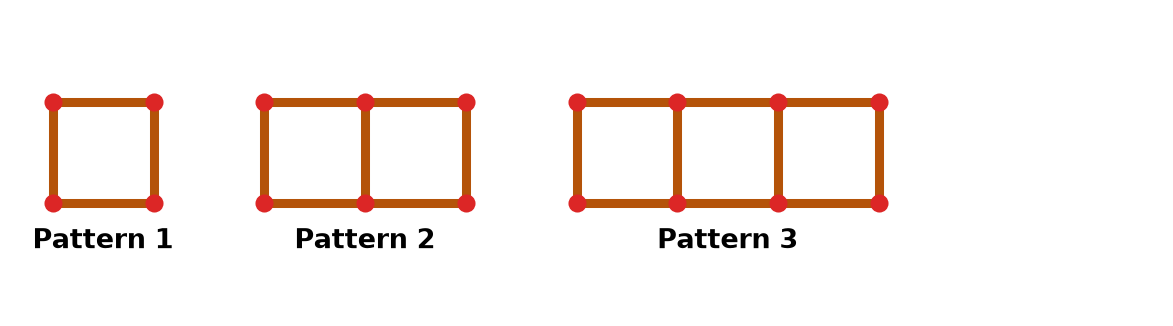
Here are the first three patterns in a sequence. The patterns are made from matchsticks. (a) Work out the number of matchsticks in Pattern 10. [1 mark] (b) Find an expression, in terms of \(n\), for the number of matchsticks in Pattern \(n\). [2 marks] (c) Which pattern number uses exactly 70 matchsticks? [2 marks]
Show answerHide answer
Model answer
(b) Each new square needs 3 more matchsticks and Pattern 1 has 4, so the nth term is \(3n + 1\). (a) \(3 \times 10 + 1 = 31\). (c) \(3n + 1 = 70\), so \(3n = 69\) and \(n = 23\). It is Pattern 23.
Mark scheme
- (a) 31, or \(3 \times 10 + 1\) — B1
- (b) \(3n\) seen — M1
- (b) \(3n + 1\) — A1
- (c) \(3n + 1 = 70\) or \(3n = 69\) — M1
- (c) Pattern 23 — A1
-
3 Work out [4 marks]
The nth term of a sequence is \(2n^2 + 1\). (a) Work out the first three terms of the sequence. [2 marks] (b) Is 51 a term of this sequence? You must show how you decide. [2 marks]
Show answerHide answer
Model answer
(a) \(2 \times 1^2 + 1 = 3\), \(2 \times 2^2 + 1 = 9\) and \(2 \times 3^2 + 1 = 19\). (b) \(2n^2 + 1 = 51\) gives \(2n^2 = 50\), so \(n^2 = 25\) and \(n = 5\). Yes, 51 is the 5th term.
Mark scheme
- (a) Two terms correct — M1
- (a) 3, 9, 19 — A1
- (b) \(2n^2 = 50\) or \(n^2 = 25\) — M1
- (b) Yes, it is the 5th term — A1
-
4 Work out [3 marks]
Here are the first four terms of a geometric sequence. \(2\) \(6\) \(18\) \(54\) (a) Write down the next term. [1 mark] (b) Work out the 7th term. [2 marks]
Show answerHide answer
Model answer
(a) Each term is multiplied by 3, so the next term is \(54 \times 3 = 162\). (b) The 7th term is \(2 \times 3^6 = 2 \times 729 = 1458\).
Mark scheme
- (a) 162 — B1
- (b) \(2 \times 3^6\) or continues the sequence to 486 and 1458 — M1
- (b) 1458 — A1
-
5 Work out [2 marks]
The nth term of a sequence is \(3n + 5\). Sally says that 80 is a term in this sequence. Is Sally correct? You must show how you decide.
Show answerHide answer
Model answer
Solve \(3n + 5 = 80\): \(3n = 75\), so \(n = 25\). Since 25 is a whole number, 80 is the 25th term, so Sally is correct.
Mark scheme
- \(3n + 5 = 80\) or \(3n = 75\) — M1
- Yes, with \(n = 25\) — A1
-
6 Find [3 marks]
Here are the first four terms of a quadratic sequence. \(3\) \(10\) \(21\) \(36\) Find an expression for the nth term.
Show answerHide answer
Model answer
The first differences are 7, 11, 15 and the second difference is 4, so the nth term starts \(2n^2\), which is 2, 8, 18, 32. Subtracting leaves 1, 2, 3, 4, which is \(n\). The nth term is \(2n^2 + n\).
Mark scheme
- Second difference 4 found, or \(2n^2\) seen — M1
- Subtracts \(2n^2\) to leave 1, 2, 3, 4 — M1
- \(2n^2 + n\) — A1
-
7 Work out [4 marks]
Here are the first three terms of a sequence. \(17\) \(13\) \(9\) (a) Find an expression for the nth term. [2 marks] (b) Work out the first term in the sequence that is negative. [2 marks]
Show answerHide answer
Model answer
(a) The sequence goes down by 4, so it begins \(-4n\). \(-4n\) is \(-4, -8, -12\), and each term is 21 more, so the nth term is \(-4n + 21\). (b) \(-4n + 21 < 0\) gives \(n > 5.25\), so the first negative term is when \(n = 6\): \(-4 \times 6 + 21 = -3\).
Mark scheme
- (a) \(-4n\) seen — M1
- (a) \(-4n + 21\) — A1
- (b) \(-4n + 21 < 0\), or finds the terms 5 and 1 then \(-3\) — M1
- (b) \(-3\) — A1
Quick check
-
1
The nth term of a sequence is \(3n + 2\). What is the first term that is greater than 100?
Show answerHide answer
C: 101
\(3n + 2 > 100\) gives \(n > 32.67\ldots\), so \(n = 33\) and the term is \(3 \times 33 + 2 = 101\).
-
2
What is the common ratio of the geometric sequence 5, 10, 20, 40, ...?
Show answerHide answer
B: 2
Each term is the previous term multiplied by 2.
-
3
What is the next term in the sequence 2, 5, 8, 11, ...?
Show answerHide answer
D: 14
The sequence goes up by 3 each time, so the next term is \(11 + 3 = 14\).
-
4
What is the nth term of the sequence 4, 7, 10, 13, ...?
Show answerHide answer
C: \(3n + 1\)
The difference is 3, so it begins \(3n\). The sequence is 1 more than \(3n\), so the nth term is \(3n + 1\).
-
5
Which sequence has nth term \(2n - 3\)?
Show answerHide answer
A: \(-1, 1, 3, 5\)
Substituting \(n = 1, 2, 3, 4\) gives \(-1, 1, 3, 5\).
-
6
What is the nth term of the sequence 20, 17, 14, 11, ...?
Show answerHide answer
A: \(-3n + 23\)
The sequence goes down by 3, so it begins \(-3n\). Adding 23 gives 20 when \(n = 1\).
-
7
Which of these numbers is a term in the sequence with nth term \(4n + 1\)?
Show answerHide answer
B: 61
\(4n + 1 = 61\) gives \(n = 15\). The other numbers do not give a whole number for \(n\).
-
8
Which of these is a geometric sequence?
Show answerHide answer
B: \(3, 6, 12, 24\)
Each term is multiplied by 2: \(3 \times 2 = 6\), \(6 \times 2 = 12\), \(12 \times 2 = 24\).
-
9
The first four terms of a Fibonacci-type sequence are 1, 3, 4, 7. What is the 5th term?
Show answerHide answer
A: 11
Each term is the sum of the two before it, so the 5th term is \(4 + 7 = 11\).
-
10
A sequence has a constant second difference of 2. Its nth term begins with which term?
Show answerHide answer
B: \(n^2\)
The coefficient of \(n^2\) is half the second difference, so it is \(1\), giving \(n^2\).