Exam questions · Maths
Circle Theorems
- 30 exam questions
- 103 marks
- 45 quick checks
Angles at the Centre and in a Semicircle
Just this lesson-
1 Calculate [2 marks]
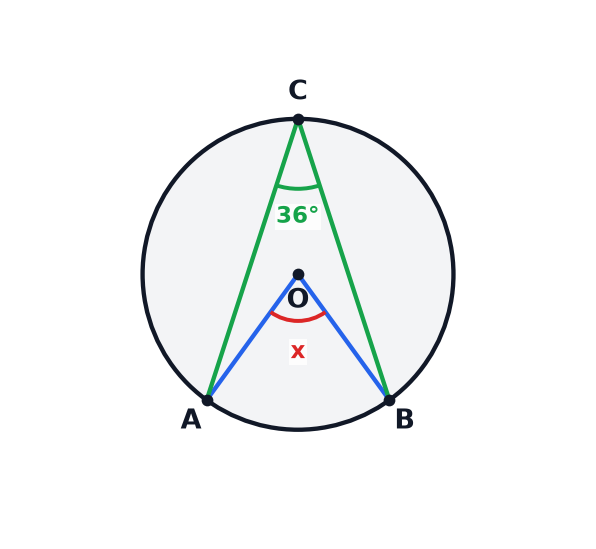
The diagram is not drawn to scale. \(A\), \(B\) and \(C\) are points on a circle, centre \(O\). Angle \(ACB = 36^\circ\). Calculate angle \(AOB\), giving a reason for your answer. [2 marks]
Show answerHide answer
Model answer
Angle \(AOB = 2 \times 36 = 72^\circ\), because the angle at the centre is twice the angle at the circumference.
Mark scheme
- \(72\) — B1
- The angle at the centre is twice the angle at the circumference — B1
-
2 Calculate [3 marks]
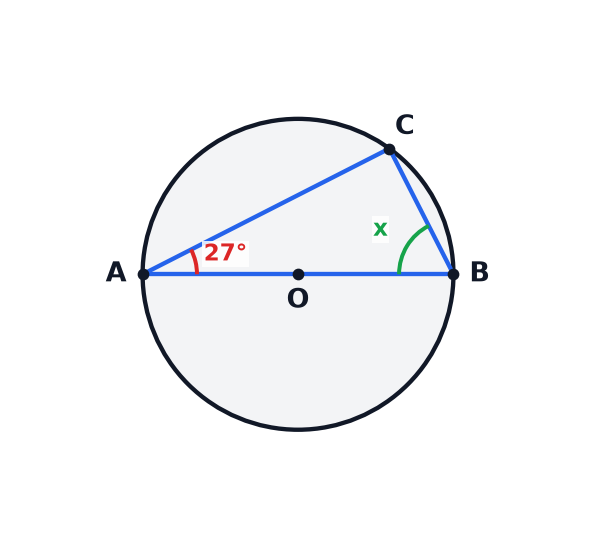
The diagram is not drawn to scale. \(AB\) is a diameter of a circle and \(C\) is a point on the circle. Angle \(BAC = 27^\circ\). Calculate angle \(ABC\), giving a reason for each step. [3 marks]
Show answerHide answer
Model answer
Angle \(ACB = 90^\circ\), because the angle in a semicircle is a right angle. Then \(ABC = 180 - 90 - 27 = 63^\circ\).
Mark scheme
- Angle \(ACB = 90^\circ\) — B1
- The angle in a semicircle is a right angle — B1
- \(63\) — B1
-
3 Calculate [3 marks]
\(A\), \(B\) and \(C\) are points on a circle, centre \(O\), with \(C\) on the major arc \(AB\). Angle \(AOB = 7x - 6\) and angle \(ACB = 3x + 4\). Calculate the value of \(x\). [3 marks]
Show answerHide answer
Model answer
The angle at the centre is twice the angle at the circumference, so \(7x - 6 = 2(3x + 4) = 6x + 8\). Then \(x = 14\).
Mark scheme
- \(7x - 6 = 2(3x + 4)\) — M1
- \(7x - 6 = 6x + 8\) — M1
- \(14\) — A1
-
4 Calculate [4 marks]
\(A\), \(B\) and \(C\) are points on a circle, centre \(O\), with \(C\) on the major arc \(AB\). Angle \(OAB = 22^\circ\). Calculate angle \(ACB\), giving reasons for your answer. [4 marks]
Show answerHide answer
Model answer
\(OA = OB\) because they are radii, so angle \(OBA = 22^\circ\). Angle \(AOB = 180 - 22 - 22 = 136^\circ\). The angle at the circumference is half the angle at the centre, so \(ACB = 68^\circ\).
Mark scheme
- \(180 - 22 - 22\) or angle \(OBA = 22^\circ\) — M1
- \(136\) — A1
- \(68\) — A1
- Radii make an isosceles triangle, and the angle at the centre is twice the angle at the circumference — B1
-
5 Calculate [4 marks]
\(AB\) is a diameter of a circle and \(C\) is a point on the circle. \(AC = 5\) cm and \(BC = 12\) cm. Calculate the radius of the circle, giving a reason for your answer. [4 marks]
Show answerHide answer
Model answer
Angle \(ACB = 90^\circ\), because the angle in a semicircle is a right angle. \(AB^2 = 5^2 + 12^2 = 25 + 144 = 169\), so \(AB = 13\) cm and the radius is \(6.5\) cm.
Mark scheme
- The angle in a semicircle is a right angle — B1
- \(5^2 + 12^2\) or \(25 + 144\) — M1
- \(AB = 13\) — A1
- \(6.5\) — A1
-
6 Calculate [3 marks]
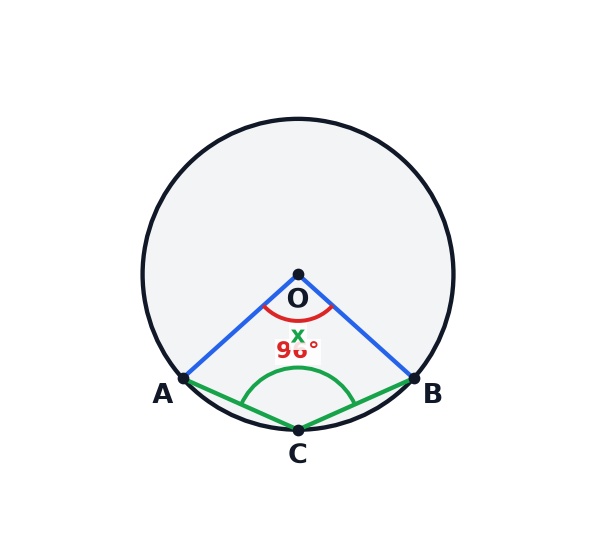
The diagram is not drawn to scale. \(A\), \(B\) and \(C\) are points on a circle, centre \(O\). Angle \(AOB = 96^\circ\), and \(C\) is on the minor arc \(AB\). Calculate angle \(ACB\), giving a reason for your answer. [3 marks]
Show answerHide answer
Model answer
The reflex angle \(AOB = 360 - 96 = 264^\circ\). The angle at the circumference is half of this, so \(ACB = 132^\circ\).
Mark scheme
- \(360 - 96 = 264\) — M1
- \(132\) — A1
- The angle at the centre is twice the angle at the circumference — B1
Quick check
-
1
The angle at the centre of a circle is \(84^\circ\). What is the angle at the circumference made by the same arc?
Show answerHide answer
B: \(42^\circ\)
The angle at the centre is twice the angle at the circumference, so the angle at the circumference is \(84 \div 2 = 42^\circ\).
-
2
What is the size of an angle in a semicircle?
Show answerHide answer
A: \(90^\circ\)
The angle at the centre on a diameter is \(180^\circ\), so the angle at the circumference is half of it, \(90^\circ\).
-
3
Which reason fits this statement? \(\angle AOB = 2 \times \angle ACB\)
Show answerHide answer
D: The angle at the centre is twice the angle at the circumference
The angle at \(O\), the centre, is double the angle at \(C\), on the circumference.
-
4
\(AB\) is a diameter and \(C\) is on the circle. Angle \(CAB = 35^\circ\). What is angle \(CBA\)?
Show answerHide answer
C: \(55^\circ\)
Angle \(ACB = 90^\circ\) in a semicircle, so \(CBA = 180 - 90 - 35 = 55^\circ\).
-
5
The angle at the circumference is \(3x\) and the angle at the centre on the same arc is \(5x + 20\). What is \(x\)?
Show answerHide answer
B: \(20\)
\(5x + 20 = 2 \times 3x = 6x\), so \(x = 20\).
-
6
In triangle \(OAB\), \(O\) is the centre and \(\angle OAB = 28^\circ\). What is angle \(AOB\)?
Show answerHide answer
A: \(124^\circ\)
\(OA = OB\) are radii, so \(\angle OBA = 28^\circ\) and \(\angle AOB = 180 - 28 - 28 = 124^\circ\).
-
7
\(AB\) is a diameter of length 10 cm and \(AC = 6\) cm. What is \(BC\)?
Show answerHide answer
D: 8 cm
Angle \(ACB = 90^\circ\) in a semicircle, so \(BC^2 = 10^2 - 6^2 = 64\) and \(BC = 8\).
-
8
Two points \(A\) and \(B\) are on a circle with centre \(O\), and \(\angle AOB = 130^\circ\). \(C\) is on the minor arc \(AB\). What is angle \(ACB\)?
Show answerHide answer
C: \(115^\circ\)
The reflex angle at the centre is \(360 - 130 = 230^\circ\), so \(ACB = 230 \div 2 = 115^\circ\).
-
9
Which statement is true for every triangle with a diameter as one side and its third corner on the circle?
Show answerHide answer
B: It is right-angled
The angle opposite the diameter is in a semicircle, so it is always \(90^\circ\).
Same Segment and Cyclic Quadrilaterals
Just this lesson-
1 Calculate [2 marks]
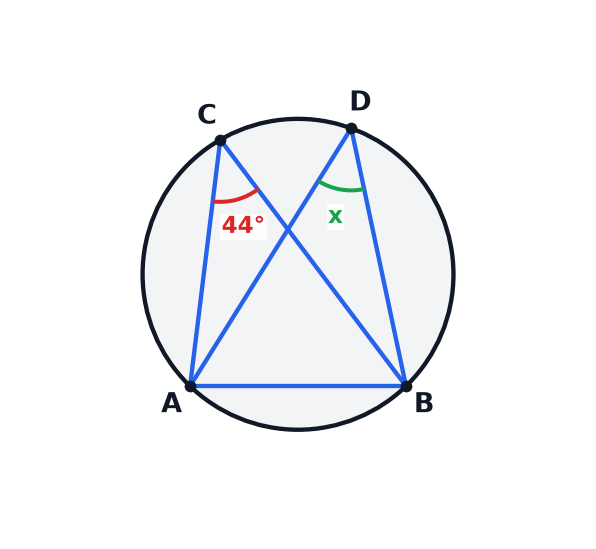
The diagram is not drawn to scale. \(A\), \(B\), \(C\) and \(D\) are points on a circle. Angle \(ACB = 44^\circ\). Calculate angle \(ADB\), giving a reason for your answer. [2 marks]
Show answerHide answer
Model answer
Angle \(ADB = 44^\circ\), because angles in the same segment are equal.
Mark scheme
- \(44\) — B1
- Angles in the same segment are equal — B1
-
2 Calculate [4 marks]
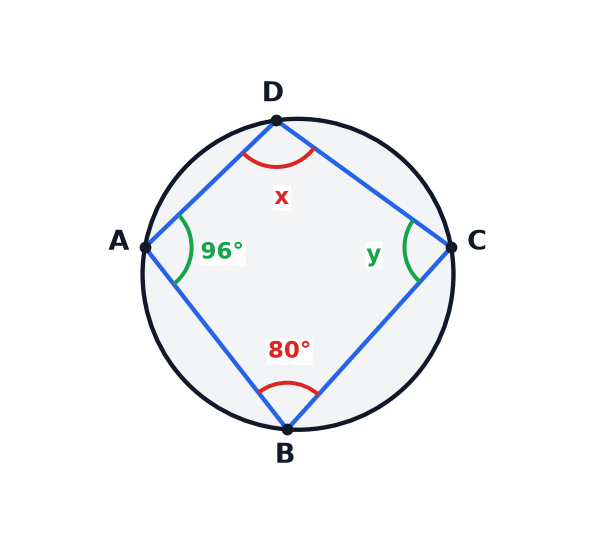
The diagram is not drawn to scale. \(ABCD\) is a cyclic quadrilateral. Angle \(ABC = 80^\circ\) and angle \(BAD = 96^\circ\). (a) Calculate angle \(ADC\), giving a reason for your answer. [2 marks] (b) Calculate angle \(BCD\). [2 marks]
Show answerHide answer
Model answer
(a) \(ADC = 180 - 80 = 100^\circ\), because opposite angles of a cyclic quadrilateral add up to \(180^\circ\). (b) \(BCD = 180 - 96 = 84^\circ\).
Mark scheme
- (a) \(100\) — B1
- (a) Opposite angles of a cyclic quadrilateral add up to 180 degrees — B1
- (b) \(180 - 96\) — M1
- (b) \(84\) — A1
-
3 Calculate [3 marks]
\(ABCD\) is a cyclic quadrilateral. Angle \(A = 5x - 10\) and angle \(C = 3x + 30\). Calculate the value of \(x\). [3 marks]
Show answerHide answer
Model answer
Opposite angles add up to \(180^\circ\), so \(5x - 10 + 3x + 30 = 180\). Then \(8x = 160\) and \(x = 20\).
Mark scheme
- \((5x - 10) + (3x + 30) = 180\) — M1
- \(8x + 20 = 180\) or \(8x = 160\) — M1
- \(20\) — A1
-
4 Calculate [3 marks]
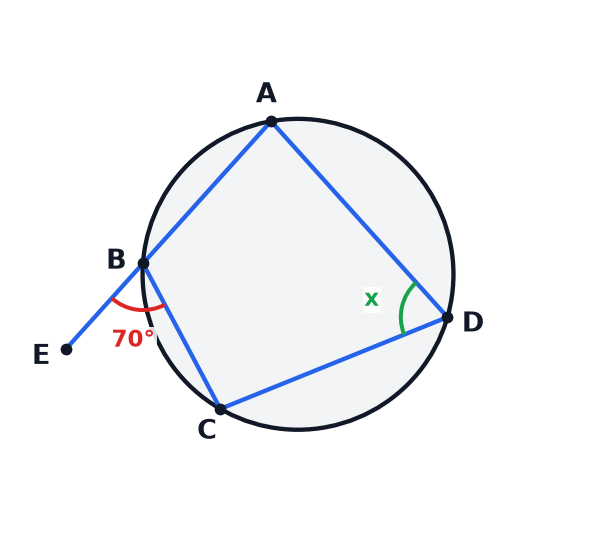
The diagram is not drawn to scale. \(ABCD\) is a cyclic quadrilateral. The side \(AB\) is extended to the point \(E\). Angle \(CBE = 70^\circ\). (a) Calculate angle \(ABC\). [1 mark] (b) Calculate angle \(ADC\), giving a reason for your answer. [2 marks]
Show answerHide answer
Model answer
(a) \(ABC = 180 - 70 = 110^\circ\). (b) \(ADC = 180 - 110 = 70^\circ\), because opposite angles of a cyclic quadrilateral add up to \(180^\circ\).
Mark scheme
- (a) \(110\) — B1
- (b) \(70\) — B1
- (b) Opposite angles of a cyclic quadrilateral add up to 180 degrees — B1
-
5 Calculate [4 marks]
\(A\), \(B\), \(C\) and \(D\) are points on a circle. The lines \(AC\) and \(BD\) cross at \(E\). Angle \(CAD = 48^\circ\) and angle \(ABC = 110^\circ\). (a) Calculate angle \(CBD\), giving a reason for your answer. [2 marks] (b) Calculate angle \(ADC\), giving a reason for your answer. [2 marks]
Show answerHide answer
Model answer
(a) \(CBD = 48^\circ\), because angles in the same segment are equal. (b) \(ADC = 180 - 110 = 70^\circ\), because opposite angles of a cyclic quadrilateral add up to \(180^\circ\).
Mark scheme
- (a) \(48\) — B1
- (a) Angles in the same segment are equal — B1
- (b) \(70\) — B1
- (b) Opposite angles of a cyclic quadrilateral add up to 180 degrees — B1
-
6 Calculate [3 marks]
\(ABCD\) is a cyclic quadrilateral. Angle \(A = x\), angle \(B = 2x\) and angle \(C = 3x\). Calculate the size of angle \(D\). [3 marks]
Show answerHide answer
Model answer
\(A\) and \(C\) are opposite, so \(x + 3x = 180\), which gives \(x = 45\). Angle \(D\) is opposite angle \(B\), so \(D = 180 - 2 \times 45 = 90^\circ\).
Mark scheme
- \(x + 3x = 180\) — M1
- \(x = 45\) — A1
- \(D = 90\) — A1
Quick check
-
1
Two angles are in the same segment of a circle. One is \(47^\circ\). What is the other?
Show answerHide answer
C: \(47^\circ\)
Angles in the same segment are equal.
-
2
What do opposite angles of a cyclic quadrilateral add up to?
Show answerHide answer
B: \(180^\circ\)
This is the cyclic quadrilateral theorem.
-
3
A cyclic quadrilateral has an angle of \(112^\circ\). What is the opposite angle?
Show answerHide answer
A: \(68^\circ\)
\(180 - 112 = 68\).
-
4
What is a cyclic quadrilateral?
Show answerHide answer
D: A quadrilateral with all four corners on a circle
“Cyclic” means all the corners lie on one circle.
-
5
In a cyclic quadrilateral \(ABCD\), \(\angle A = 2x + 10\) and \(\angle C = 3x + 20\). What is \(x\)?
Show answerHide answer
C: \(30\)
\(5x + 30 = 180\), so \(5x = 150\) and \(x = 30\).
-
6
\(ABCD\) is cyclic and the side \(AB\) is extended to \(E\). Angle \(CBE = 70^\circ\). What is angle \(ADC\)?
Show answerHide answer
B: \(70^\circ\)
An exterior angle of a cyclic quadrilateral equals the interior opposite angle.
-
7
Which of these must be true for the angles \(ACB\) and \(ADB\) to be equal?
Show answerHide answer
A: \(C\) and \(D\) are on the same side of the chord \(AB\)
Angles in the same segment are made on the same side of a chord.
-
8
A quadrilateral has opposite angles of \(95^\circ\) and \(80^\circ\). Can it be cyclic?
Show answerHide answer
D: No, because \(95 + 80 \ne 180\)
Opposite angles of a cyclic quadrilateral must add up to \(180^\circ\), and \(95 + 80 = 175\).
-
9
\(A\), \(B\), \(C\) and \(D\) are on a circle, with \(AC\) and \(BD\) meeting at \(E\). Angle \(CAD = 36^\circ\). What is angle \(CBD\)?
Show answerHide answer
C: \(36^\circ\)
Angles \(CAD\) and \(CBD\) are made by the chord \(CD\) on the same side, so they are equal.
Tangents and Chords
Just this lesson-
1 Calculate [3 marks]
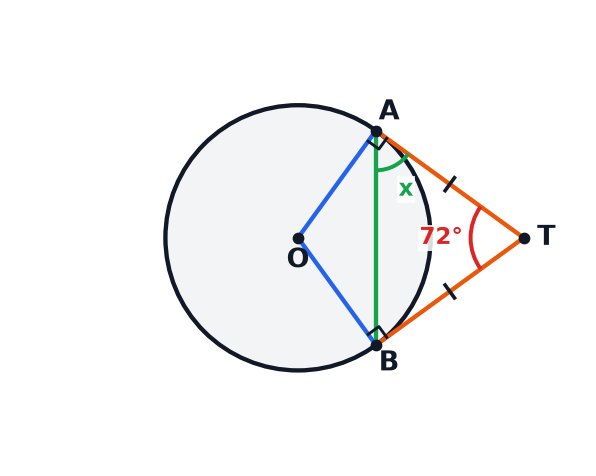
The diagram is not drawn to scale. \(TA\) and \(TB\) are tangents to a circle, centre \(O\). Angle \(ATB = 72^\circ\). Calculate angle \(TAB\), giving a reason for your answer. [3 marks]
Show answerHide answer
Model answer
\(TA = TB\), because tangents from a point to a circle are equal, so triangle \(TAB\) is isosceles. Angle \(TAB = (180 - 72) \div 2 = 54^\circ\).
Mark scheme
- Tangents from a point are equal, so triangle TAB is isosceles — B1
- \((180 - 72) \div 2\) — M1
- \(54\) — A1
-
2 Calculate [3 marks]
\(PT\) is a tangent to a circle, centre \(O\), touching the circle at \(T\). The radius of the circle is 7 cm and \(PT = 24\) cm. Calculate the length of \(OP\). [3 marks]
Show answerHide answer
Model answer
The tangent is perpendicular to the radius, so angle \(OTP = 90^\circ\). \(OP^2 = 7^2 + 24^2 = 49 + 576 = 625\), so \(OP = 25\) cm.
Mark scheme
- Angle OTP is a right angle, as a tangent is perpendicular to the radius — B1
- \(7^2 + 24^2\) or \(49 + 576\) — M1
- \(25\) — A1
-
3 Calculate [3 marks]
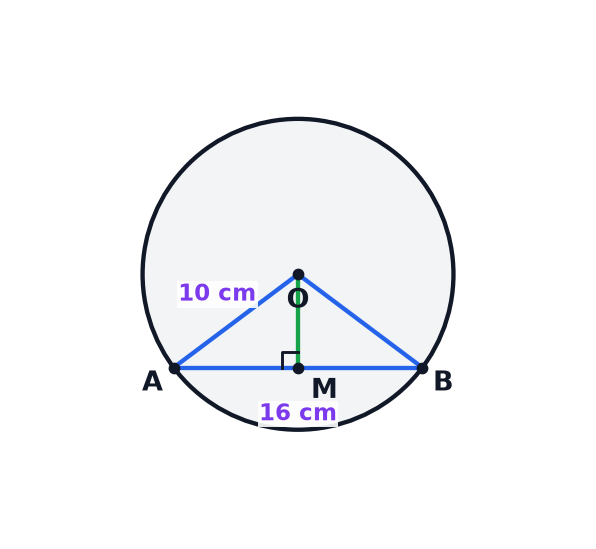
The diagram is not drawn to scale. \(AB\) is a chord of a circle, centre \(O\), with radius 10 cm. \(AB = 16\) cm. \(M\) is the point on \(AB\) where \(OM\) is perpendicular to \(AB\). Calculate the length of \(OM\). [3 marks]
Show answerHide answer
Model answer
The perpendicular from the centre bisects the chord, so \(AM = 8\) cm. \(OM^2 = 10^2 - 8^2 = 100 - 64 = 36\), so \(OM = 6\) cm.
Mark scheme
- \(AM = 8\) — M1
- \(10^2 - 8^2\) — M1
- \(6\) — A1
-
4 Calculate [4 marks]
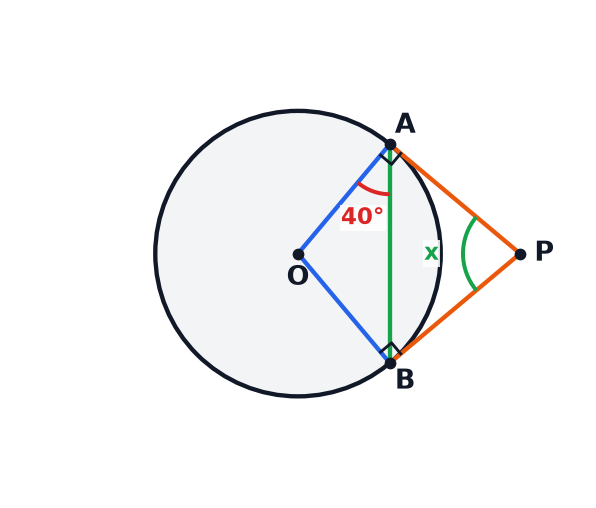
The diagram is not drawn to scale. \(PA\) and \(PB\) are tangents to a circle, centre \(O\). Angle \(OAB = 40^\circ\). Calculate angle \(APB\), giving reasons for your answer. [4 marks]
Show answerHide answer
Model answer
Angle \(OAP = 90^\circ\), because a tangent is perpendicular to the radius, so \(PAB = 90 - 40 = 50^\circ\). \(PA = PB\), so \(PBA = 50^\circ\) and \(APB = 180 - 50 - 50 = 80^\circ\).
Mark scheme
- Angle \(PAB = 90 - 40 = 50\) — M1
- \(180 - 50 - 50\) — M1
- \(80\) — A1
- Tangent perpendicular to the radius, and tangents from a point are equal — B1
-
5 Calculate [3 marks]
A circle has centre \(O\) and radius 13 cm. A chord is 12 cm from \(O\). Calculate the length of the chord. [3 marks]
Show answerHide answer
Model answer
Half the chord is \(\sqrt{13^2 - 12^2} = \sqrt{25} = 5\) cm, so the chord is 10 cm.
Mark scheme
- \(13^2 - 12^2\) or \(169 - 144\) — M1
- \(5\) found as half the chord — M1
- \(10\) — A1
-
6 Prove [4 marks]
\(TA\) and \(TB\) are tangents to a circle, centre \(O\), touching the circle at \(A\) and \(B\). Prove that triangles \(OAT\) and \(OBT\) are congruent, and so that \(TA = TB\). [4 marks]
Show answerHide answer
Model answer
\(OA = OB\), because they are radii. Angles \(OAT\) and \(OBT\) are both \(90^\circ\), because a tangent is perpendicular to the radius. \(OT\) is common to both triangles. So the triangles are congruent (RHS), and \(TA = TB\).
Mark scheme
- OA = OB because they are radii — B1
- Angles \(OAT = OBT = 90^\circ\), because a tangent is perpendicular to the radius — B1
- OT is common, so the triangles are congruent (right angle, hypotenuse, side) — B1
- Concludes TA = TB because corresponding sides of congruent triangles are equal — B1
Quick check
-
1
What is the angle between a tangent and the radius at the point of contact?
Show answerHide answer
D: \(90^\circ\)
A tangent is perpendicular to the radius.
-
2
Two tangents from the point \(P\) touch a circle at \(A\) and \(B\). \(PA = 9\) cm. What is \(PB\)?
Show answerHide answer
C: 9 cm
Tangents from the same point are equal in length.
-
3
A perpendicular from the centre of a circle meets a chord. What does it do to the chord?
Show answerHide answer
B: It bisects the chord
The perpendicular from the centre bisects the chord.
-
4
\(PT\) is a tangent, \(O\) is the centre, the radius is 3 cm and \(OP = 5\) cm. How long is \(PT\)?
Show answerHide answer
A: 4 cm
\(OTP\) is right-angled at \(T\), so \(PT^2 = 5^2 - 3^2 = 16\).
-
5
Tangents \(PA\) and \(PB\) touch a circle with centre \(O\). Angle \(AOB = 100^\circ\). What is angle \(APB\)?
Show answerHide answer
D: \(80^\circ\)
\(OAPB\) is a quadrilateral with two right angles, so \(APB = 360 - 90 - 90 - 100 = 80^\circ\).
-
6
A circle has radius 5 cm and a chord is 8 cm long. How far is the chord from the centre?
Show answerHide answer
C: 3 cm
Half the chord is 4 cm, so the distance is \(\sqrt{5^2 - 4^2} = 3\).
-
7
Tangents \(PA\) and \(PB\) touch a circle at \(A\) and \(B\). Angle \(APB = 50^\circ\). What is angle \(PAB\)?
Show answerHide answer
B: \(65^\circ\)
\(PA = PB\), so triangle \(PAB\) is isosceles and \(PAB = (180 - 50) \div 2 = 65^\circ\).
-
8
The distance from the centre of a circle of radius 13 cm to a chord is 5 cm. How long is the chord?
Show answerHide answer
A: 24 cm
Half the chord is \(\sqrt{13^2 - 5^2} = 12\), so the chord is 24 cm.
-
9
A line from the centre to a point \(P\) outside a circle of radius \(r\) has length \(d\). Which expression gives the tangent length from \(P\)?
Show answerHide answer
D: \(\sqrt{d^2 - r^2}\)
The radius and tangent make a right angle, with \(d\) as the hypotenuse.
The Alternate Segment Theorem
Just this lesson-
1 Calculate [2 marks]
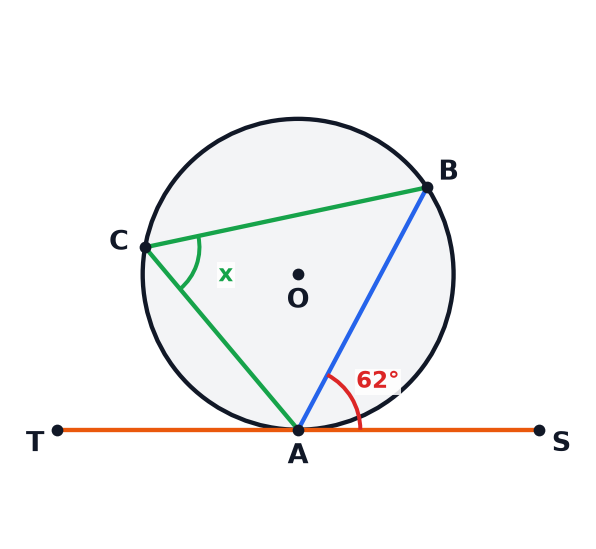
The diagram is not drawn to scale. \(TAS\) is a tangent to the circle at \(A\). \(B\) and \(C\) are points on the circle. Angle \(SAB = 62^\circ\). Calculate angle \(ACB\), giving a reason for your answer. [2 marks]
Show answerHide answer
Model answer
Angle \(ACB = 62^\circ\), because the angle between a tangent and a chord equals the angle in the alternate segment.
Mark scheme
- \(62\) — B1
- The angle between a tangent and a chord equals the angle in the alternate segment — B1
-
2 Calculate [4 marks]
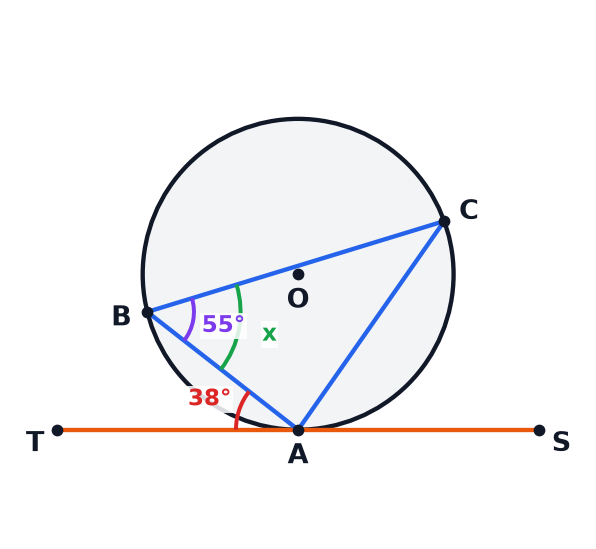
The diagram is not drawn to scale. \(TAS\) is a tangent to the circle at \(A\). \(B\) and \(C\) are points on the circle. Angle \(TAB = 38^\circ\) and angle \(ABC = 55^\circ\). Calculate angle \(BAC\), giving reasons for your answer. [4 marks]
Show answerHide answer
Model answer
Angle \(ACB = 38^\circ\), because the angle between a tangent and a chord equals the angle in the alternate segment. Then \(BAC = 180 - 38 - 55 = 87^\circ\).
Mark scheme
- \(ACB = 38\) — B1
- \(180 - 38 - 55\) — M1
- \(87\) — A1
- Alternate segment theorem, and the angles in a triangle add up to 180 degrees — B1
-
3 Calculate [3 marks]
\(TA\) is a tangent to a circle at \(A\), and \(B\) and \(C\) are points on the circle, with \(C\) in the alternate segment. Angle \(TAB = 3x + 4\) and angle \(ACB = 5x - 22\). Calculate the value of \(x\). [3 marks]
Show answerHide answer
Model answer
By the alternate segment theorem, \(3x + 4 = 5x - 22\). Then \(26 = 2x\), so \(x = 13\).
Mark scheme
- \(3x + 4 = 5x - 22\) — M1
- \(2x = 26\) — M1
- \(13\) — A1
-
4 Calculate [4 marks]
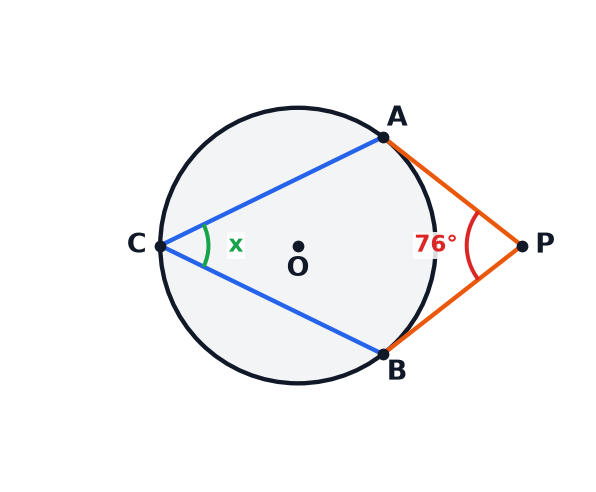
The diagram is not drawn to scale. \(PA\) and \(PB\) are tangents to a circle, centre \(O\). \(C\) is a point on the circle. Angle \(APB = 76^\circ\). Calculate angle \(ACB\), giving reasons for your answer. [4 marks]
Show answerHide answer
Model answer
\(PA = PB\), so triangle \(PAB\) is isosceles and \(PAB = (180 - 76) \div 2 = 52^\circ\). By the alternate segment theorem, \(ACB = PAB = 52^\circ\).
Mark scheme
- \((180 - 76) \div 2\) — M1
- \(PAB = 52\) — A1
- \(ACB = 52\) — B1
- Alternate segment theorem stated — B1
-
5 Calculate [4 marks]
\(AD\) is a diameter of a circle. \(TA\) is a tangent to the circle at \(A\). \(B\) is a point on the circle. Angle \(TAB = 29^\circ\). (a) Calculate angle \(ADB\), giving a reason for your answer. [2 marks] (b) Calculate angle \(DAB\). [2 marks]
Show answerHide answer
Model answer
(a) \(ADB = 29^\circ\), by the alternate segment theorem. (b) \(TAD = 90^\circ\), because a tangent is perpendicular to the radius, so \(DAB = 90 - 29 = 61^\circ\).
Mark scheme
- (a) \(29\) — B1
- (a) Alternate segment theorem stated — B1
- (b) \(90 - 29\), using angle \(TAD = 90^\circ\) — M1
- (b) \(61\) — A1
-
6 Prove [4 marks]
\(TA\) is a tangent to a circle at \(A\). \(AD\) is a diameter. \(B\) is a point on the circle. Prove that angle \(TAB\) equals angle \(ADB\). [4 marks]
Show answerHide answer
Model answer
Angle \(TAD = 90^\circ\), because a tangent is perpendicular to the radius. Angle \(ABD = 90^\circ\), because the angle in a semicircle is \(90^\circ\). So \(TAB = 90 - BAD\), and in triangle \(ABD\), \(ADB = 90 - BAD\). Therefore \(TAB = ADB\).
Mark scheme
- Angle \(TAD = 90^\circ\), because a tangent is perpendicular to the radius — B1
- Angle \(ABD = 90^\circ\), because the angle in a semicircle is a right angle — B1
- \(TAB = 90 - BAD\) and \(ADB = 90 - BAD\) — M1
- Concludes that the angles are equal — B1
Quick check
-
1
What does the alternate segment theorem say?
Show answerHide answer
A: The angle between a tangent and a chord equals the angle in the alternate segment
This is the alternate segment theorem.
-
2
Where must the chord start for the alternate segment theorem to apply?
Show answerHide answer
D: At the point of contact of the tangent
The chord starts at the point where the tangent touches the circle.
-
3
The angle between a tangent and a chord is \(58^\circ\). What is the angle in the alternate segment?
Show answerHide answer
C: \(58^\circ\)
They are equal.
-
4
What does “alternate” mean in the alternate segment theorem?
Show answerHide answer
B: On the other side of the chord
The alternate segment is the one on the opposite side of the chord from the angle.
-
5
\(TA\) is a tangent at \(A\). Angle \(TAB = 40^\circ\) and angle \(ABC = 75^\circ\), where \(C\) is in the alternate segment. What is angle \(BAC\)?
Show answerHide answer
A: \(65^\circ\)
\(ACB = 40^\circ\) by the alternate segment theorem, so \(BAC = 180 - 75 - 40 = 65^\circ\).
-
6
\(PA\) and \(PB\) are tangents and \(\angle APB = 64^\circ\). \(C\) is on the major arc. What is angle \(ACB\)?
Show answerHide answer
D: \(58^\circ\)
\(PAB = (180 - 64) \div 2 = 58^\circ\), and this equals the angle in the alternate segment.
-
7
The angle between the tangent and the chord is \(2x + 4\) and the angle in the alternate segment is \(3x - 10\). What is \(x\)?
Show answerHide answer
C: \(14\)
\(2x + 4 = 3x - 10\), so \(x = 14\).
-
8
\(AD\) is a diameter, \(TA\) is a tangent at \(A\) and \(B\) is on the circle. Angle \(TAB = 36^\circ\). What is angle \(DAB\)?
Show answerHide answer
B: \(54^\circ\)
\(TAD = 90^\circ\) because a tangent is perpendicular to the radius, so \(DAB = 90 - 36 = 54^\circ\).
-
9
A tangent at \(A\) makes an angle of \(x\) with the chord \(AB\). What is the angle \(AOB\) at the centre, on the same side as that angle?
Show answerHide answer
A: \(2x\)
The angle in the alternate segment is \(x\), and the angle at the centre is twice that.
Circle Theorem Proofs and Problems
Just this lesson-
1 Prove [4 marks]
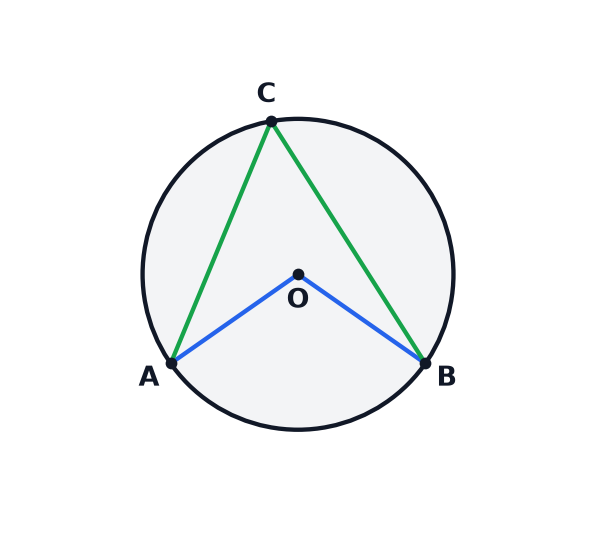
The diagram is not drawn to scale. \(A\), \(B\) and \(C\) are points on a circle, centre \(O\). Prove that angle \(AOB\) is twice angle \(ACB\). You may add lines to the diagram. [4 marks]
Show answerHide answer
Model answer
Draw the line \(CO\) and extend it to meet the circle at \(D\). \(OA = OC = OB\), because they are radii. Triangles \(OAC\) and \(OBC\) are isosceles, so \(OAC = OCA\) and \(OBC = OCB\). The exterior angle \(AOD = 2 \times OCA\) and \(BOD = 2 \times OCB\). So \(AOB = 2(OCA + OCB) = 2 \times ACB\).
Mark scheme
- Draws CO extended to D and states OA = OB = OC as radii — B1
- Isosceles triangles, so OCA = OAC and OCB = OBC — M1
- Exterior angles: AOD = 2 x OCA and BOD = 2 x OCB — M1
- Concludes AOB = 2 x ACB — B1
-
2 Calculate [4 marks]
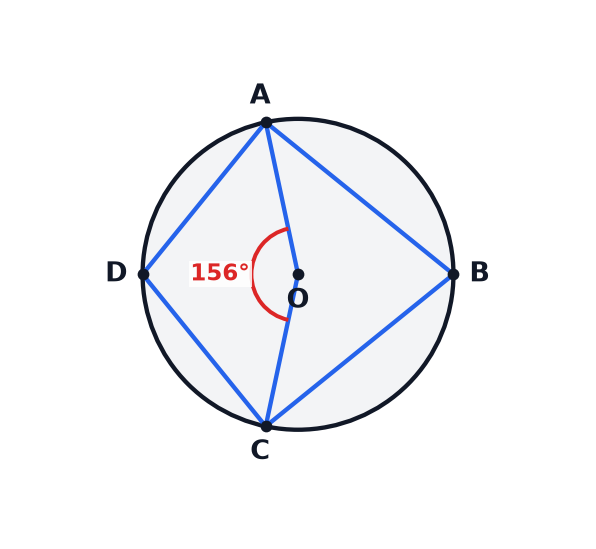
The diagram is not drawn to scale. \(A\), \(B\), \(C\) and \(D\) are points on a circle, centre \(O\). Angle \(AOC = 156^\circ\). (a) Calculate angle \(ABC\), giving a reason for your answer. [2 marks] (b) Calculate angle \(ADC\), giving a reason for your answer. [2 marks]
Show answerHide answer
Model answer
(a) \(ABC = 156 \div 2 = 78^\circ\), because the angle at the centre is twice the angle at the circumference. (b) \(ADC = 180 - 78 = 102^\circ\), because opposite angles of a cyclic quadrilateral add up to \(180^\circ\).
Mark scheme
- (a) \(78\) — B1
- (a) The angle at the centre is twice the angle at the circumference — B1
- (b) \(102\) — B1
- (b) Opposite angles of a cyclic quadrilateral add up to 180 degrees — B1
-
3 Calculate [4 marks]
The point \(P(5, 12)\) is on the circle \(x^2 + y^2 = 169\). Calculate an equation of the tangent to the circle at \(P\). [4 marks]
Show answerHide answer
Model answer
The radius \(OP\) has gradient \(\dfrac{12}{5}\), so the tangent has gradient \(-\dfrac{5}{12}\). Then \(y - 12 = -\dfrac{5}{12}(x - 5)\), which gives \(y = -\dfrac{5}{12}x + \dfrac{169}{12}\).
Mark scheme
- Gradient of \(OP = \dfrac{12}{5}\) — B1
- Gradient of the tangent \(= -\dfrac{5}{12}\) — B1
- \(y - 12 = -\dfrac{5}{12}(x - 5)\) or equivalent — M1
- \(y = -\dfrac{5}{12}x + \dfrac{169}{12}\) or \(5x + 12y = 169\) — A1
-
4 Calculate [4 marks]
The point \(P(-8, 6)\) is on the circle \(x^2 + y^2 = 100\). Calculate an equation of the tangent to the circle at \(P\). [4 marks]
Show answerHide answer
Model answer
The radius \(OP\) has gradient \(\dfrac{6}{-8} = -\dfrac{3}{4}\), so the tangent has gradient \(\dfrac{4}{3}\). Then \(y - 6 = \dfrac{4}{3}(x + 8)\), which gives \(y = \dfrac{4}{3}x + \dfrac{50}{3}\).
Mark scheme
- Gradient of \(OP = -\dfrac{3}{4}\) — B1
- Gradient of the tangent \(= \dfrac{4}{3}\) — B1
- \(y - 6 = \dfrac{4}{3}(x + 8)\) or equivalent — M1
- \(y = \dfrac{4}{3}x + \dfrac{50}{3}\) or \(4x - 3y = -50\) — A1
-
5 Calculate [5 marks]
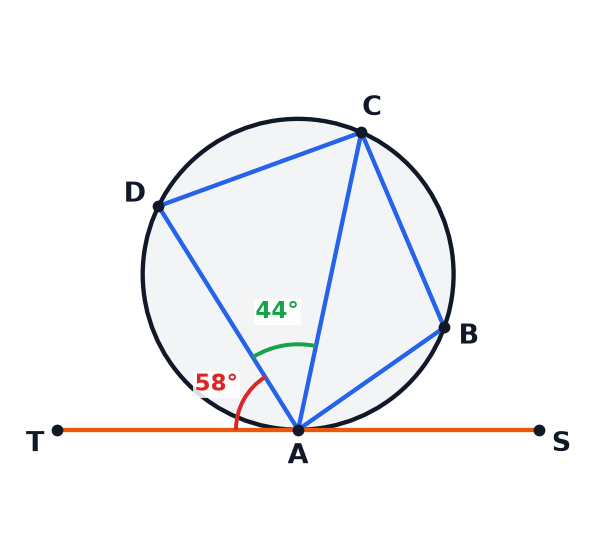
The diagram is not drawn to scale. \(TAS\) is a tangent to the circle at \(A\). \(A\), \(B\), \(C\) and \(D\) are points on the circle. Angle \(TAD = 58^\circ\) and angle \(CAD = 44^\circ\). (a) Write down angle \(ACD\), giving a reason for your answer. [2 marks] (b) Calculate angle \(ADC\). [2 marks] (c) Calculate angle \(ABC\), giving a reason for your answer. [1 mark]
Show answerHide answer
Model answer
(a) \(ACD = 58^\circ\), by the alternate segment theorem. (b) \(ADC = 180 - 58 - 44 = 78^\circ\). (c) \(ABC = 180 - 78 = 102^\circ\), because opposite angles of a cyclic quadrilateral add up to \(180^\circ\).
Mark scheme
- (a) \(58\) — B1
- (a) Alternate segment theorem stated — B1
- (b) \(180 - 58 - 44\) — M1
- (b) \(78\) — A1
- (c) \(102\) with the cyclic quadrilateral reason — A1
-
6 Prove [3 marks]
\(AB\) is a diameter of a circle, centre \(O\), and \(C\) is a point on the circle. Prove that angle \(ACB = 90^\circ\). [3 marks]
Show answerHide answer
Model answer
\(AOB\) is a straight line, so the angle at the centre is \(180^\circ\). The angle at the centre is twice the angle at the circumference, so \(ACB = 180 \div 2 = 90^\circ\).
Mark scheme
- The angle at the centre on the diameter is 180 degrees, because AOB is a straight line — B1
- The angle at the centre is twice the angle at the circumference — M1
- Concludes that \(ACB = 180 \div 2 = 90^\circ\) — B1
Quick check
-
1
Why is a triangle made by two radii and a chord isosceles?
Show answerHide answer
B: Two of its sides are radii, so they are equal
Two radii are always equal.
-
2
In a proof, what should be written next to every step?
Show answerHide answer
A: A reason
Each step needs a reason.
-
3
What does the exterior angle of a triangle equal?
Show answerHide answer
D: The sum of the two opposite interior angles
This is the exterior angle theorem.
-
4
The radius to a point on a circle has gradient \(\dfrac{2}{3}\). What is the gradient of the tangent at that point?
Show answerHide answer
C: \(-\dfrac{3}{2}\)
A tangent is perpendicular to the radius, so its gradient is the negative reciprocal.
-
5
What is the gradient of the radius from the origin to \((3, 4)\)?
Show answerHide answer
B: \(\dfrac{4}{3}\)
\(\dfrac{4 - 0}{3 - 0} = \dfrac{4}{3}\).
-
6
What is the gradient of the tangent to \(x^2 + y^2 = 25\) at \((3, 4)\)?
Show answerHide answer
A: \(-\dfrac{3}{4}\)
The radius has gradient \(\dfrac{4}{3}\), so the tangent has gradient \(-\dfrac{3}{4}\).
-
7
\(AOC\) is \(150^\circ\) at the centre, and \(D\) is on the minor arc \(AC\). What is angle \(ADC\)?
Show answerHide answer
D: \(105^\circ\)
\(B\) on the major arc gives \(ABC = 75^\circ\), and \(ADC = 180 - 75 = 105^\circ\).
-
8
Which line is the tangent to \(x^2 + y^2 = 25\) at \((3, 4)\)?
Show answerHide answer
C: \(3x + 4y = 25\)
Gradient \(-\dfrac{3}{4}\) through \((3, 4)\) gives \(y - 4 = -\dfrac{3}{4}(x - 3)\), which rearranges to \(3x + 4y = 25\).
-
9
Why must a proof not rely on measuring angles in a diagram?
Show answerHide answer
B: The proof must work for every case, not just the one drawn
A proof uses letters and reasons so that it works for any angle.