Exam questions · Maths
Further Trigonometry
- 30 exam questions
- 98 marks
- 45 quick checks
Trigonometric Graphs and Exact Values
Just this lesson-
1 Solve [2 marks]
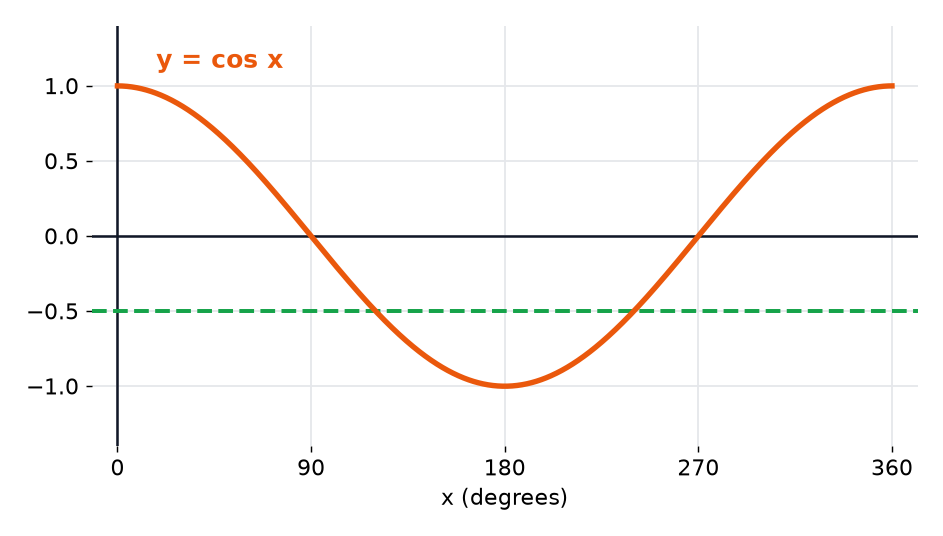
The diagram shows the graph of \(y = \cos x\) for \(0^\circ \le x \le 360^\circ\), and the line \(y = -0.5\). Solve \(\cos x = -0.5\) for \(0^\circ \le x \le 360^\circ\). [2 marks]
Show answerHide answer
Model answer
\(\cos 60^\circ = 0.5\), and cosine is negative between \(90^\circ\) and \(270^\circ\), so \(x = 180 - 60 = 120^\circ\) or \(x = 180 + 60 = 240^\circ\).
Mark scheme
- \(120\) — M1
- \(240\) — A1
-
2 Write down [3 marks]
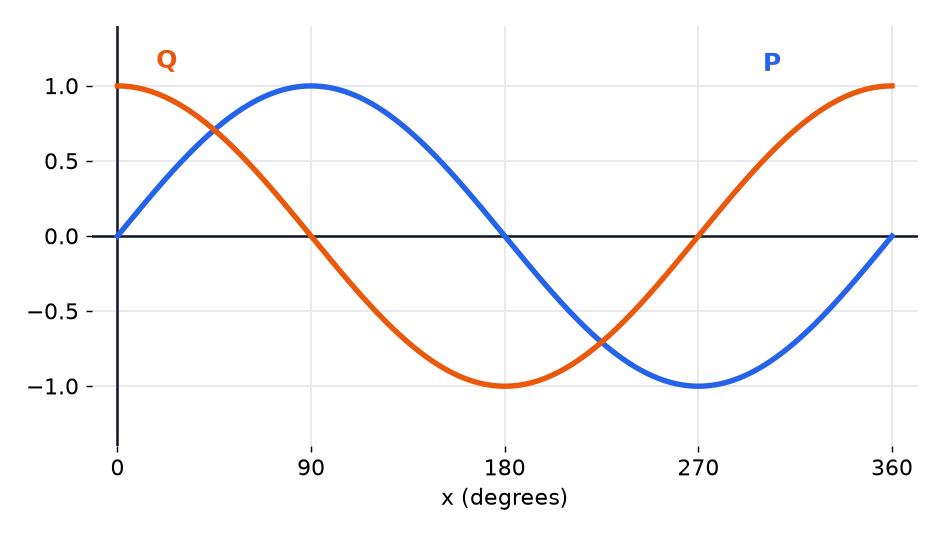
The diagram shows the graphs of two curves, \(P\) and \(Q\), for \(0^\circ \le x \le 360^\circ\). One is \(y = \sin x\) and the other is \(y = \cos x\). (a) State which curve is \(y = \sin x\). [1 mark] (b) Solve \(\sin x = \cos x\) for \(0^\circ \le x \le 360^\circ\). [2 marks]
Show answerHide answer
Model answer
(a) \(P\), because it passes through the origin. (b) The curves cross at \(x = 45^\circ\), where \(\sin 45^\circ = \cos 45^\circ = \dfrac{\sqrt{2}}{2}\), and at \(x = 225^\circ\).
Mark scheme
- (a) Curve P, because it starts at the origin — B1
- (b) \(45\) — B1
- (b) \(225\) — B1
-
3 Write down [3 marks]
Write down the exact value of (a) \(\sin 135^\circ\) [1 mark] (b) \(\cos 135^\circ\) [1 mark] (c) \(\tan 150^\circ\) [1 mark]
Show answerHide answer
Model answer
(a) \(\dfrac{\sqrt{2}}{2}\). (b) \(-\dfrac{\sqrt{2}}{2}\). (c) \(-\dfrac{\sqrt{3}}{3}\), which is the same as \(-\dfrac{1}{\sqrt{3}}\).
Mark scheme
- (a) \(\dfrac{\sqrt{2}}{2}\) — B1
- (b) \(-\dfrac{\sqrt{2}}{2}\) — B1
- (c) \(-\dfrac{1}{\sqrt{3}}\) or \(-\dfrac{\sqrt{3}}{3}\) — B1
-
4 Solve [3 marks]
Solve \(2\cos x + 1 = 0\) for \(0^\circ \le x \le 360^\circ\). [3 marks]
Show answerHide answer
Model answer
\(\cos x = -\dfrac{1}{2}\), so \(x = 120^\circ\) or \(x = 240^\circ\).
Mark scheme
- \(\cos x = -\dfrac{1}{2}\) — M1
- \(120\) — A1
- \(240\) — A1
-
5 Solve [3 marks]
Solve \(\tan x = -\sqrt{3}\) for \(0^\circ \le x \le 360^\circ\). [3 marks]
Show answerHide answer
Model answer
\(\tan 60^\circ = \sqrt{3}\), and tangent is negative between \(90^\circ\) and \(180^\circ\), and between \(270^\circ\) and \(360^\circ\). So \(x = 180 - 60 = 120^\circ\) or \(x = 360 - 60 = 300^\circ\).
Mark scheme
- Uses \(60^\circ\) as the related angle — M1
- \(120\) — A1
- \(300\) — A1
-
6 Write down [2 marks]
(a) Write down the period of the graph of \(y = \tan x\). [1 mark] (b) How many solutions does \(\cos x = 0.3\) have for \(0^\circ \le x \le 720^\circ\)? [1 mark]
Show answerHide answer
Model answer
(a) \(180^\circ\). (b) Four solutions, two in each \(360^\circ\).
Mark scheme
- (a) \(180^\circ\) — B1
- (b) 4 — B1
Quick check
-
1
What is the maximum value of \(y = \sin x\)?
Show answerHide answer
B: 1
The sine graph is a wave between \(-1\) and \(1\).
-
2
What is \(\cos 0^\circ\)?
Show answerHide answer
A: 1
The cosine graph starts at its maximum, 1.
-
3
Where are the asymptotes of \(y = \tan x\) between \(0^\circ\) and \(360^\circ\)?
Show answerHide answer
D: \(x = 90^\circ\) and \(x = 270^\circ\)
The tangent is undefined at \(90^\circ\) and \(270^\circ\).
-
4
How many solutions does \(\sin x = \dfrac{1}{2}\) have for \(0^\circ \le x \le 360^\circ\)?
Show answerHide answer
C: 2
The line \(y = \dfrac{1}{2}\) crosses the sine curve twice, at \(30^\circ\) and \(150^\circ\).
-
5
If \(\sin 30^\circ = \dfrac{1}{2}\), what is the other solution of \(\sin x = \dfrac{1}{2}\) between \(0^\circ\) and \(360^\circ\)?
Show answerHide answer
B: \(150^\circ\)
The second solution is \(180^\circ - 30^\circ = 150^\circ\).
-
6
What is the period of \(y = \tan x\)?
Show answerHide answer
A: \(180^\circ\)
The tangent graph repeats every \(180^\circ\).
-
7
Solve \(\cos x = \dfrac{1}{2}\) for \(0^\circ \le x \le 360^\circ\).
Show answerHide answer
D: \(60^\circ\) and \(300^\circ\)
\(\cos 60^\circ = \dfrac{1}{2}\), and the second solution is \(360^\circ - 60^\circ = 300^\circ\).
-
8
Solve \(\sin x = -\dfrac{1}{2}\) for \(0^\circ \le x \le 360^\circ\).
Show answerHide answer
C: \(210^\circ\) and \(330^\circ\)
Sine is negative between \(180^\circ\) and \(360^\circ\), so the solutions are \(180 + 30 = 210\) and \(360 - 30 = 330\).
-
9
Which equation has no solutions?
Show answerHide answer
B: \(\sin x = 1.5\)
Sine and cosine are never greater than 1, so \(\sin x = 1.5\) has no solution.
The Sine Rule
Just this lesson-
1 Calculate [3 marks]
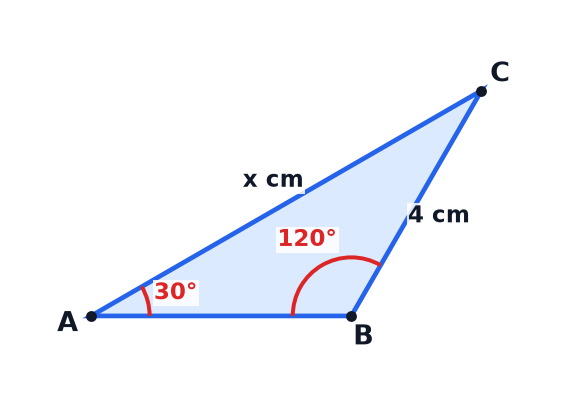
The diagram is not drawn to scale. Calculate the length of \(AC\). Give your answer as a surd. [3 marks]
Show answerHide answer
Model answer
\(\dfrac{x}{\sin 120^\circ} = \dfrac{4}{\sin 30^\circ}\), so \(x = \dfrac{4 \times \frac{\sqrt{3}}{2}}{\frac{1}{2}} = 4\sqrt{3}\) cm.
Mark scheme
- Uses \(\dfrac{x}{\sin 120^\circ} = \dfrac{4}{\sin 30^\circ}\) — M1
- Uses \(\sin 120^\circ = \dfrac{\sqrt{3}}{2}\) and \(\sin 30^\circ = \dfrac{1}{2}\) — M1
- \(4\sqrt{3}\) — A1
-
2 Calculate [3 marks]
In triangle \(ABC\), angle \(A = 45^\circ\), \(a = 6\) cm and \(b = 3\sqrt{2}\) cm. Angle \(B\) is acute. Calculate the size of angle \(B\). [3 marks]
Show answerHide answer
Model answer
\(\dfrac{\sin B}{3\sqrt{2}} = \dfrac{\sin 45^\circ}{6}\), so \(\sin B = \dfrac{3\sqrt{2} \times \frac{\sqrt{2}}{2}}{6} = \dfrac{3}{6} = \dfrac{1}{2}\). So \(B = 30^\circ\).
Mark scheme
- \(\dfrac{\sin B}{3\sqrt{2}} = \dfrac{\sin 45^\circ}{6}\) or equivalent — M1
- \(\sin B = \dfrac{1}{2}\) — M1
- \(30\) — A1
-
3 Calculate [3 marks]
In triangle \(ABC\), angle \(A = 120^\circ\), angle \(B = 30^\circ\) and \(a = 6\sqrt{3}\) cm. Calculate the length of \(b\). [3 marks]
Show answerHide answer
Model answer
\(\dfrac{b}{\sin 30^\circ} = \dfrac{6\sqrt{3}}{\sin 120^\circ}\), so \(b = \dfrac{6\sqrt{3} \times \frac{1}{2}}{\frac{\sqrt{3}}{2}} = 6\) cm.
Mark scheme
- \(\dfrac{b}{\sin 30^\circ} = \dfrac{6\sqrt{3}}{\sin 120^\circ}\) — M1
- Uses \(\sin 30^\circ = \dfrac{1}{2}\) and \(\sin 120^\circ = \dfrac{\sqrt{3}}{2}\) — M1
- \(6\) — A1
-
4 Calculate [3 marks]
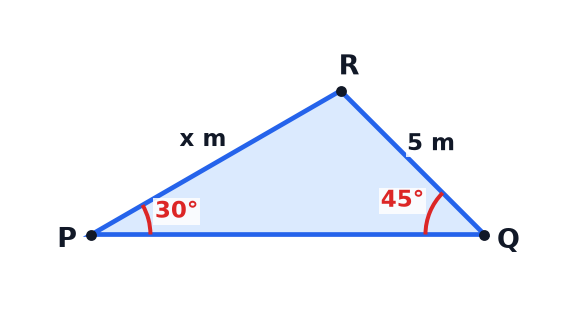
The diagram is not drawn to scale. The diagram shows a triangular park \(PQR\). Calculate the length of \(PR\). Give your answer in surd form. [3 marks]
Show answerHide answer
Model answer
\(\dfrac{x}{\sin 45^\circ} = \dfrac{5}{\sin 30^\circ}\), so \(x = \dfrac{5 \times \frac{\sqrt{2}}{2}}{\frac{1}{2}} = 5\sqrt{2}\) m.
Mark scheme
- \(\dfrac{x}{\sin 45^\circ} = \dfrac{5}{\sin 30^\circ}\) — M1
- Uses the exact values of \(\sin 45^\circ\) and \(\sin 30^\circ\) — M1
- \(5\sqrt{2}\) — A1
-
5 Explain [3 marks]
In triangle \(ABC\), angle \(A = 45^\circ\), \(a = 6\) cm and \(b = 6\sqrt{3}\) cm. Show that no such triangle exists. [3 marks]
Show answerHide answer
Model answer
\(\sin B = \dfrac{6\sqrt{3} \times \sin 45^\circ}{6} = \sqrt{3} \times \dfrac{\sqrt{2}}{2} = \dfrac{\sqrt{6}}{2}\). Since \(\sqrt{6} > 2\), \(\sin B > 1\), which is impossible, so the triangle does not exist.
Mark scheme
- \(\dfrac{\sin B}{6\sqrt{3}} = \dfrac{\sin 45^\circ}{6}\) — M1
- \(\sin B = \dfrac{\sqrt{6}}{2}\) — A1
- States that \(\sqrt{6} > 2\), so \(\sin B > 1\), which is impossible — B1
-
6 Show that [3 marks]
In triangle \(ABC\), angle \(A = 60^\circ\), angle \(B = 45^\circ\) and \(a = 3\sqrt{3}\) cm. Show that \(b = 3\sqrt{2}\) cm. [3 marks]
Show answerHide answer
Model answer
\(\dfrac{b}{\sin 45^\circ} = \dfrac{3\sqrt{3}}{\sin 60^\circ}\), so \(b = \dfrac{3\sqrt{3} \times \frac{\sqrt{2}}{2}}{\frac{\sqrt{3}}{2}} = 3\sqrt{2}\).
Mark scheme
- \(\dfrac{b}{\sin 45^\circ} = \dfrac{3\sqrt{3}}{\sin 60^\circ}\) — M1
- \(b = \dfrac{3\sqrt{3} \times \frac{\sqrt{2}}{2}}{\frac{\sqrt{3}}{2}}\) — M1
- \(3\sqrt{2}\), with the working shown to the end — B1
Quick check
-
1
In triangle \(ABC\), which side is opposite angle \(A\)?
Show answerHide answer
C: \(a\)
Each side is opposite the angle with the same letter.
-
2
Which is the sine rule for finding a side?
Show answerHide answer
B: \(\dfrac{a}{\sin A} = \dfrac{b}{\sin B}\)
The sine rule says that side over the sine of its opposite angle is constant.
-
3
What do you need to use the sine rule?
Show answerHide answer
A: A side and its opposite angle, plus one more side or angle
The sine rule needs a matching pair.
-
4
What is \(\sin 45^\circ\)?
Show answerHide answer
D: \(\dfrac{\sqrt{2}}{2}\)
This is one of the exact values.
-
5
In triangle \(ABC\), \(A = 30^\circ\), \(B = 90^\circ\) and \(a = 5\). What is \(b\)?
Show answerHide answer
C: 10
\(\dfrac{b}{\sin 90^\circ} = \dfrac{5}{\sin 30^\circ}\), so \(b = \dfrac{5}{\frac{1}{2}} = 10\).
-
6
In triangle \(ABC\), \(A = 30^\circ\), \(B = 45^\circ\) and \(a = 4\). What is \(b\)?
Show answerHide answer
B: \(4\sqrt{2}\)
\(b = \dfrac{4\sin 45^\circ}{\sin 30^\circ} = \dfrac{4 \times \frac{\sqrt{2}}{2}}{\frac{1}{2}} = 4\sqrt{2}\).
-
7
In triangle \(ABC\), \(a = 6\), \(b = 6\sqrt{2}\) and \(A = 30^\circ\). What is \(\sin B\)?
Show answerHide answer
A: \(\dfrac{\sqrt{2}}{2}\)
\(\sin B = \dfrac{b\sin A}{a} = \dfrac{6\sqrt{2} \times \frac{1}{2}}{6} = \dfrac{\sqrt{2}}{2}\).
-
8
In triangle \(ABC\), \(A = 60^\circ\) and \(B = 45^\circ\). What is angle \(C\)?
Show answerHide answer
D: \(75^\circ\)
\(180 - 60 - 45 = 75\).
-
9
In triangle \(ABC\), \(A = 60^\circ\), \(B = 45^\circ\) and \(a = 3\sqrt{3}\). What is \(b\)?
Show answerHide answer
C: \(3\sqrt{2}\)
\(b = \dfrac{3\sqrt{3} \times \frac{\sqrt{2}}{2}}{\frac{\sqrt{3}}{2}} = 3\sqrt{2}\).
The Cosine Rule
Just this lesson-
1 Calculate [3 marks]
The diagram is not drawn to scale. Calculate the length of \(BC\). [3 marks]
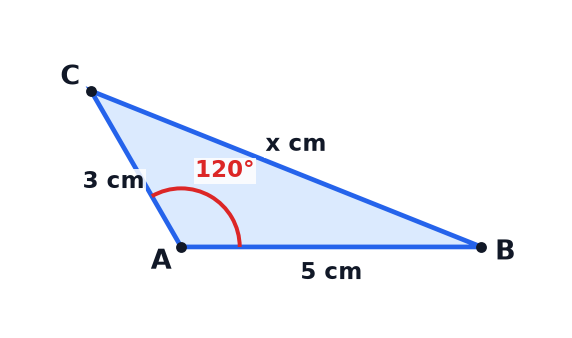
Show answerHide answer
Model answer
\(x^2 = 3^2 + 5^2 - 2 \times 3 \times 5 \times \cos 120^\circ = 9 + 25 + 15 = 49\), so \(x = 7\) cm.
Mark scheme
- \(x^2 = 3^2 + 5^2 - 2 \times 3 \times 5 \times \cos 120^\circ\) — M1
- \(9 + 25 + 15 = 49\) — M1
- \(7\) — A1
-
2 Calculate [3 marks]
A triangle has sides of length 7 cm, 8 cm and 13 cm. Calculate the size of the largest angle. [3 marks]
Show answerHide answer
Model answer
\(\cos A = \dfrac{7^2 + 8^2 - 13^2}{2 \times 7 \times 8} = \dfrac{-56}{112} = -\dfrac{1}{2}\), so \(A = 120^\circ\).
Mark scheme
- \(\cos A = \dfrac{7^2 + 8^2 - 13^2}{2 \times 7 \times 8}\) — M1
- \(-\dfrac{1}{2}\) — A1
- \(120\) — A1
-
3 Calculate [3 marks]
The diagram is not drawn to scale. Two ships leave a port \(P\) at the same time. Ship \(Q\) sails 70 km and ship \(R\) sails 80 km. The angle between their paths is \(120^\circ\). Calculate the distance \(QR\) between the ships. [3 marks]
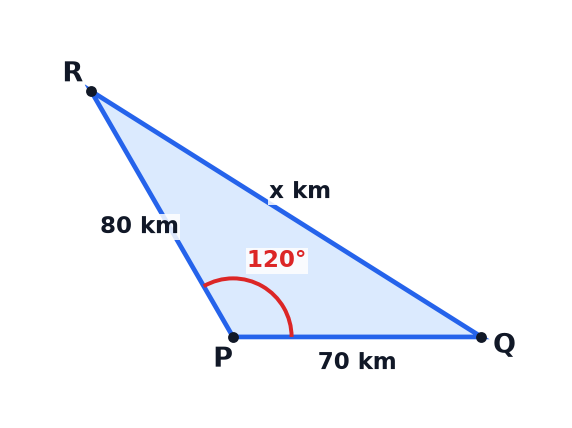
Show answerHide answer
Model answer
\(x^2 = 70^2 + 80^2 - 2 \times 70 \times 80 \times \cos 120^\circ = 4900 + 6400 + 5600 = 16\,900\), so \(x = 130\) km.
Mark scheme
- \(x^2 = 70^2 + 80^2 - 2 \times 70 \times 80 \times \cos 120^\circ\) — M1
- \(4900 + 6400 + 5600 = 16\,900\) — M1
- \(130\) — A1
-
4 Calculate [3 marks]
In triangle \(ABC\), \(AB = AC = 4\) cm and angle \(A = 120^\circ\). Calculate the length of \(BC\). Give your answer as a surd in its simplest form. [3 marks]
Show answerHide answer
Model answer
\(BC^2 = 4^2 + 4^2 - 2 \times 4 \times 4 \times \cos 120^\circ = 16 + 16 + 16 = 48\), so \(BC = \sqrt{48} = 4\sqrt{3}\) cm.
Mark scheme
- \(BC^2 = 4^2 + 4^2 - 2 \times 4 \times 4 \times \cos 120^\circ\) — M1
- \(48\) — M1
- \(4\sqrt{3}\) — A1
-
5 Calculate [5 marks]
In triangle \(ABC\), \(AB = 3\) cm, \(BC = 8\) cm and \(AC = 7\) cm. (a) Calculate the size of angle \(ABC\). [3 marks] (b) Calculate the exact area of the triangle. [2 marks]
Show answerHide answer
Model answer
(a) \(\cos B = \dfrac{3^2 + 8^2 - 7^2}{2 \times 3 \times 8} = \dfrac{24}{48} = \dfrac{1}{2}\), so \(B = 60^\circ\). (b) Area \(= \dfrac{1}{2} \times 3 \times 8 \times \sin 60^\circ = 12 \times \dfrac{\sqrt{3}}{2} = 6\sqrt{3}\) cm\(^2\).
Mark scheme
- (a) \(\cos B = \dfrac{3^2 + 8^2 - 7^2}{2 \times 3 \times 8}\) — M1
- (a) \(\dfrac{1}{2}\) — A1
- (a) \(60\) — A1
- (b) \(\dfrac{1}{2} \times 3 \times 8 \times \sin 60^\circ\) — M1
- (b) \(6\sqrt{3}\) — A1
-
6 Calculate [3 marks]
A triangle has sides of length 4 cm, 4 cm and \(4\sqrt{3}\) cm. Calculate the size of the largest angle. [3 marks]
Show answerHide answer
Model answer
\(\cos A = \dfrac{4^2 + 4^2 - (4\sqrt{3})^2}{2 \times 4 \times 4} = \dfrac{16 + 16 - 48}{32} = -\dfrac{1}{2}\), so \(A = 120^\circ\).
Mark scheme
- \(\cos A = \dfrac{4^2 + 4^2 - (4\sqrt{3})^2}{2 \times 4 \times 4}\) — M1
- \(-\dfrac{1}{2}\) — A1
- \(120\) — A1
Quick check
-
1
Which is the cosine rule for the side \(a\)?
Show answerHide answer
D: \(a^2 = b^2 + c^2 - 2bc\cos A\)
The cosine rule takes \(2bc\cos A\) away from the sum of the squares.
-
2
When do you use the cosine rule to find a side?
Show answerHide answer
C: When you know two sides and the angle between them
Two sides and the included angle is the cosine rule situation.
-
3
What is \(\cos 60^\circ\)?
Show answerHide answer
B: \(\dfrac{1}{2}\)
This is an exact value.
-
4
What does the cosine rule become when \(A = 90^\circ\)?
Show answerHide answer
A: Pythagoras' theorem
\(\cos 90^\circ = 0\), so \(a^2 = b^2 + c^2\).
-
5
In triangle \(ABC\), \(b = 3\), \(c = 8\) and \(A = 60^\circ\). What is \(a^2\)?
Show answerHide answer
D: 49
\(a^2 = 9 + 64 - 2 \times 3 \times 8 \times \frac{1}{2} = 73 - 24 = 49\).
-
6
In triangle \(ABC\), \(b = 6\), \(c = 10\) and \(A = 120^\circ\). What is \(a\)?
Show answerHide answer
C: 14
\(a^2 = 36 + 100 - 120 \times (-\frac{1}{2}) = 136 + 60 = 196\), so \(a = 14\).
-
7
A triangle has sides 5, 7 and 8. What is \(\cos\) of the angle opposite the side of length 7?
Show answerHide answer
B: \(\dfrac{1}{2}\)
\(\cos A = \dfrac{5^2 + 8^2 - 7^2}{2 \times 5 \times 8} = \dfrac{40}{80} = \dfrac{1}{2}\).
-
8
A triangle has sides 3, 5 and 7. What is the largest angle?
Show answerHide answer
A: \(120^\circ\)
\(\cos A = \dfrac{9 + 25 - 49}{30} = -\dfrac{1}{2}\), so \(A = 120^\circ\).
-
9
A triangle has sides 7, 8 and 13. What is the angle opposite the longest side?
Show answerHide answer
D: \(120^\circ\)
\(\cos A = \dfrac{49 + 64 - 169}{112} = \dfrac{-56}{112} = -\dfrac{1}{2}\), so \(A = 120^\circ\).
Area of a Triangle and Segments
Just this lesson-
1 Calculate [2 marks]
The diagram is not drawn to scale. Calculate the exact area of triangle \(ABC\). [2 marks]
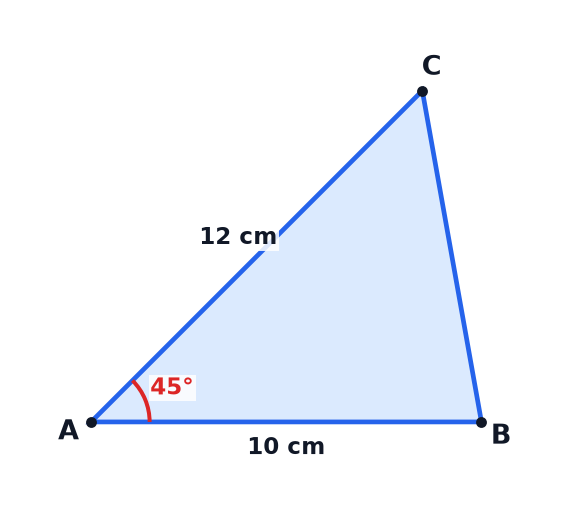
Show answerHide answer
Model answer
Area \(= \dfrac{1}{2} \times 10 \times 12 \times \sin 45^\circ = 60 \times \dfrac{\sqrt{2}}{2} = 30\sqrt{2}\) cm\(^2\).
Mark scheme
- \(\dfrac{1}{2} \times 10 \times 12 \times \sin 45^\circ\) — M1
- \(30\sqrt{2}\) — A1
-
2 Calculate [3 marks]
A triangle has two sides of length 10 cm and 4 cm. Its area is \(10\sqrt{2}\) cm\(^2\). The angle between the two sides is acute. Calculate the size of this angle. [3 marks]
Show answerHide answer
Model answer
\(10\sqrt{2} = \dfrac{1}{2} \times 10 \times 4 \times \sin C = 20\sin C\), so \(\sin C = \dfrac{\sqrt{2}}{2}\) and \(C = 45^\circ\).
Mark scheme
- \(10\sqrt{2} = \dfrac{1}{2} \times 10 \times 4 \times \sin C\) — M1
- \(\sin C = \dfrac{\sqrt{2}}{2}\) — M1
- \(45\) — A1
-
3 Calculate [3 marks]
In triangle \(ABC\), \(b = 8\) cm and angle \(C = 45^\circ\). The area of the triangle is \(20\sqrt{2}\) cm\(^2\). Calculate the length of \(a\). [3 marks]
Show answerHide answer
Model answer
\(20\sqrt{2} = \dfrac{1}{2} \times a \times 8 \times \sin 45^\circ = 2\sqrt{2}a\), so \(a = 10\) cm.
Mark scheme
- \(20\sqrt{2} = \dfrac{1}{2} \times a \times 8 \times \sin 45^\circ\) — M1
- \(20\sqrt{2} = 2\sqrt{2}a\) or equivalent — M1
- \(10\) — A1
-
4 Calculate [3 marks]
The diagram is not drawn to scale. The diagram shows a triangular plot of land \(PQR\). Calculate the exact area of the plot. [3 marks]
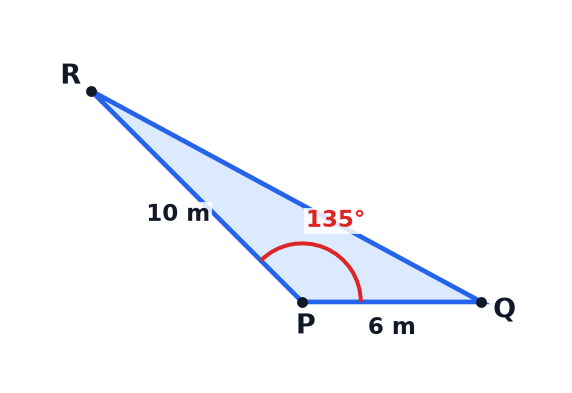
Show answerHide answer
Model answer
Area \(= \dfrac{1}{2} \times 6 \times 10 \times \sin 135^\circ = 30 \times \dfrac{\sqrt{2}}{2} = 15\sqrt{2}\) m\(^2\).
Mark scheme
- \(\dfrac{1}{2} \times 6 \times 10 \times \sin 135^\circ\) — M1
- \(\sin 135^\circ = \dfrac{\sqrt{2}}{2}\) — M1
- \(15\sqrt{2}\) — A1
-
5 Calculate [5 marks]
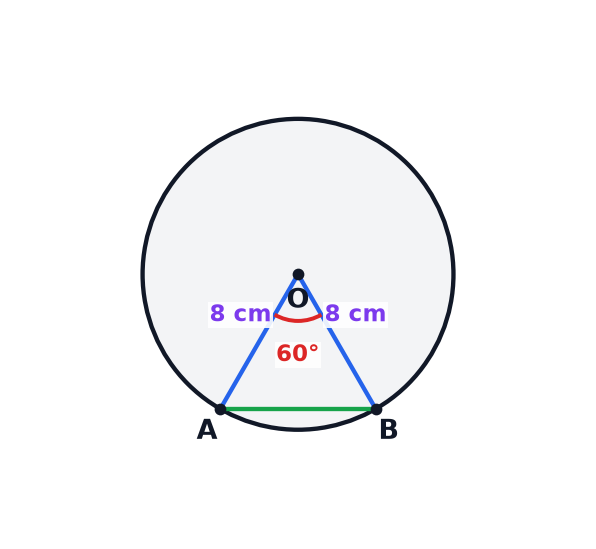
The diagram is not drawn to scale. The diagram shows a circle, centre \(O\), with radius 8 cm. \(A\) and \(B\) are points on the circle and angle \(AOB = 60^\circ\). Calculate the exact area of the segment bounded by the chord \(AB\) and the minor arc \(AB\). [5 marks]
Show answerHide answer
Model answer
Sector \(= \dfrac{60}{360} \times \pi \times 8^2 = \dfrac{32\pi}{3}\). Triangle \(= \dfrac{1}{2} \times 8 \times 8 \times \sin 60^\circ = 32 \times \dfrac{\sqrt{3}}{2} = 16\sqrt{3}\). Segment \(= \dfrac{32\pi}{3} - 16\sqrt{3}\) cm\(^2\).
Mark scheme
- \(\dfrac{60}{360} \times \pi \times 8^2\) — M1
- \(\dfrac{32\pi}{3}\) — A1
- \(\dfrac{1}{2} \times 8 \times 8 \times \sin 60^\circ\) — M1
- \(16\sqrt{3}\) — A1
- \(\dfrac{32\pi}{3} - 16\sqrt{3}\) — A1
-
6 Calculate [4 marks]
A regular hexagon has sides of length 2 cm. Calculate the exact area of the hexagon. [4 marks]
Show answerHide answer
Model answer
The hexagon is made of 6 triangles with two sides of 2 cm and an angle of \(60^\circ\) between them. Each has area \(\dfrac{1}{2} \times 2 \times 2 \times \sin 60^\circ = \sqrt{3}\). So the total is \(6\sqrt{3}\) cm\(^2\).
Mark scheme
- Splits the hexagon into 6 triangles, each with an angle of \(60^\circ\) at the centre — M1
- \(\dfrac{1}{2} \times 2 \times 2 \times \sin 60^\circ\) — M1
- \(\sqrt{3}\) for each triangle — A1
- \(6\sqrt{3}\) — A1
Quick check
-
1
What is the formula for the area of a triangle using a sine?
Show answerHide answer
A: \(\dfrac{1}{2}ab\sin C\)
The area is half the product of two sides and the sine of the angle between them.
-
2
Which angle is used in \(\dfrac{1}{2}ab\sin C\)?
Show answerHide answer
D: The angle between sides \(a\) and \(b\)
\(C\) is the included angle.
-
3
What is \(\sin 90^\circ\)?
Show answerHide answer
C: 1
This is on the sine graph at its maximum.
-
4
A triangle has sides 8 cm and 5 cm with an angle of \(30^\circ\) between them. What is the area?
Show answerHide answer
B: 10 cm\(^2\)
\(\dfrac{1}{2} \times 8 \times 5 \times \dfrac{1}{2} = 10\).
-
5
A triangle has sides 6 cm and 8 cm with an angle of \(60^\circ\) between them. What is the exact area?
Show answerHide answer
A: \(12\sqrt{3}\) cm\(^2\)
\(\dfrac{1}{2} \times 6 \times 8 \times \dfrac{\sqrt{3}}{2} = 12\sqrt{3}\).
-
6
A triangle has sides of 10 cm and 8 cm and an area of 20 cm\(^2\). The included angle is acute. What is it?
Show answerHide answer
D: \(30^\circ\)
\(20 = 40\sin C\), so \(\sin C = \dfrac{1}{2}\) and \(C = 30^\circ\).
-
7
What is the area of a segment of a circle?
Show answerHide answer
C: Area of the sector minus area of the triangle
The segment is the sector with the triangle removed.
-
8
A sector of a circle with radius 6 cm has an angle of \(60^\circ\). What is the area of the sector?
Show answerHide answer
B: \(6\pi\) cm\(^2\)
\(\dfrac{60}{360} \times \pi \times 36 = 6\pi\).
-
9
A triangle has two sides of 4 cm and 6 cm and an area of 6 cm\(^2\). What could the included angle be?
Show answerHide answer
A: \(30^\circ\) or \(150^\circ\)
\(6 = 12\sin C\), so \(\sin C = \dfrac{1}{2}\), which gives \(30^\circ\) or \(150^\circ\).
Trigonometry in 3D and Mixed Problems
Just this lesson-
1 Calculate [3 marks]
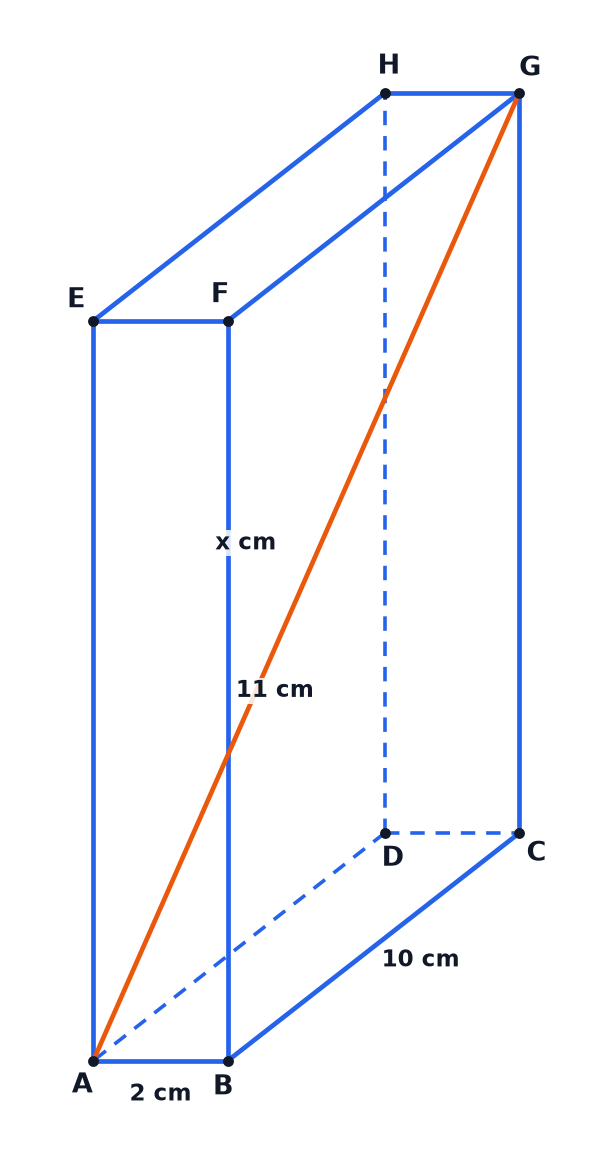
The diagram is not drawn to scale. The diagram shows a cuboid. Calculate the length of the diagonal \(AG\). [3 marks]
Show answerHide answer
Model answer
\(AG^2 = 2^2 + 10^2 + 11^2 = 4 + 100 + 121 = 225\), so \(AG = 15\) cm.
Mark scheme
- \(2^2 + 10^2 + 11^2\), or a base diagonal \(AC^2 = 2^2 + 10^2\) then \(AG^2 = AC^2 + 11^2\) — M1
- \(225\) — M1
- \(15\) — A1
-
2 Calculate [4 marks]
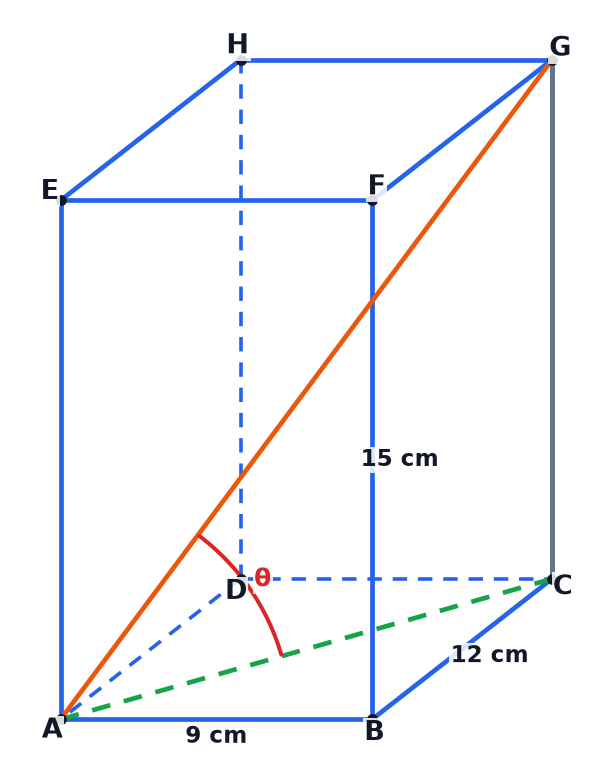
The diagram is not drawn to scale. The diagram shows a cuboid. Calculate the size of angle \(\theta\), the angle between \(AG\) and the base \(ABCD\). [4 marks]
Show answerHide answer
Model answer
\(AC^2 = 9^2 + 12^2 = 225\), so \(AC = 15\) cm. In the right-angled triangle \(ACG\), \(\tan\theta = \dfrac{CG}{AC} = \dfrac{15}{15} = 1\), so \(\theta = 45^\circ\).
Mark scheme
- \(AC = 15\) — B1
- \(\tan\theta = \dfrac{15}{15}\) — M1
- \(\tan\theta = 1\) — A1
- \(45\) — A1
-
3 Calculate [5 marks]
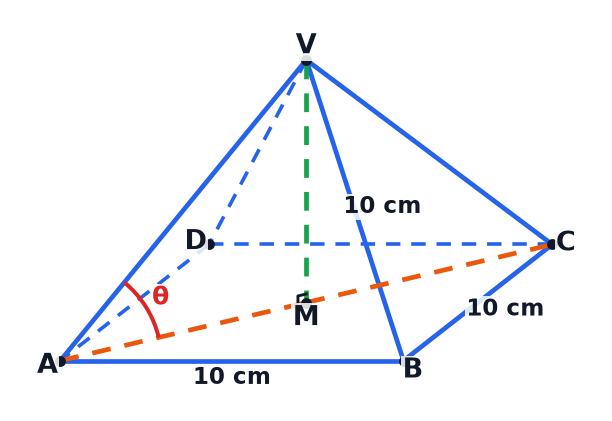
The diagram is not drawn to scale. The diagram shows a pyramid with a square base \(ABCD\). The apex \(V\) is directly above the centre \(M\) of the base. All the edges are 10 cm long. (a) Calculate the exact height \(VM\) of the pyramid. [3 marks] (b) Calculate the size of angle \(\theta\), the angle between \(VA\) and the base. [2 marks]
Show answerHide answer
Model answer
(a) \(AC^2 = 10^2 + 10^2 = 200\), so \(AM = \dfrac{1}{2}AC = 5\sqrt{2}\). \(VM^2 = 10^2 - (5\sqrt{2})^2 = 100 - 50 = 50\), so \(VM = 5\sqrt{2}\) cm. (b) \(\cos\theta = \dfrac{AM}{VA} = \dfrac{5\sqrt{2}}{10} = \dfrac{\sqrt{2}}{2}\), so \(\theta = 45^\circ\).
Mark scheme
- (a) \(AM = 5\sqrt{2}\) — M1
- (a) \(VM^2 = 10^2 - 50\) — M1
- (a) \(5\sqrt{2}\) — A1
- (b) \(\cos\theta = \dfrac{5\sqrt{2}}{10}\) or \(\tan\theta = 1\) — M1
- (b) \(45\) — A1
-
4 Calculate [4 marks]
A ship sails 70 km from \(P\) to \(Q\) on a bearing of \(000^\circ\). It then sails 80 km from \(Q\) to \(R\) on a bearing of \(060^\circ\). Calculate the distance \(PR\). [4 marks]
Show answerHide answer
Model answer
The bearing of \(P\) from \(Q\) is \(180^\circ\), so angle \(PQR = 180 - 60 = 120^\circ\). \(PR^2 = 70^2 + 80^2 - 2 \times 70 \times 80 \times \cos 120^\circ = 4900 + 6400 + 5600 = 16\,900\), so \(PR = 130\) km.
Mark scheme
- Angle \(PQR = 120^\circ\) — M1
- \(PR^2 = 70^2 + 80^2 - 2 \times 70 \times 80 \times \cos 120^\circ\) — M1
- \(16\,900\) — A1
- \(130\) — A1
-
5 Calculate [5 marks]
\(BT\) is a vertical tower on horizontal ground. The angle of elevation of \(T\) from a point \(A\) is \(30^\circ\), and from a point \(C\) is \(45^\circ\). Angle \(ABC = 90^\circ\) and \(AC = 100\) m. Calculate the height of the tower. [5 marks]
Show answerHide answer
Model answer
Let \(BT = h\). \(BA = \dfrac{h}{\tan 30^\circ} = h\sqrt{3}\) and \(BC = \dfrac{h}{\tan 45^\circ} = h\). In the right-angled triangle \(ABC\), \(AC^2 = 3h^2 + h^2 = 4h^2 = 10\,000\), so \(h^2 = 2500\) and \(h = 50\) m.
Mark scheme
- \(BA = h\sqrt{3}\), or \(\tan 30^\circ = \dfrac{h}{BA}\) — B1
- \(BC = h\) — B1
- \(AC^2 = BA^2 + BC^2 = 4h^2\) — M1
- \(4h^2 = 10\,000\) — M1
- \(50\) — A1
-
6 Show that [3 marks]
\(ABCDEFGH\) is a cube with edges of length 2 cm. \(\theta\) is the angle between the diagonal \(AG\) and the base \(ABCD\). Show that \(\tan\theta = \dfrac{\sqrt{2}}{2}\). [3 marks]
Show answerHide answer
Model answer
\(AC^2 = 2^2 + 2^2 = 8\), so \(AC = 2\sqrt{2}\). In the right-angled triangle \(ACG\), \(CG = 2\), so \(\tan\theta = \dfrac{2}{2\sqrt{2}} = \dfrac{1}{\sqrt{2}} = \dfrac{\sqrt{2}}{2}\).
Mark scheme
- \(AC^2 = 2^2 + 2^2 = 8\), so \(AC = 2\sqrt{2}\) — M1
- \(\tan\theta = \dfrac{CG}{AC} = \dfrac{2}{2\sqrt{2}}\) — M1
- \(\dfrac{1}{\sqrt{2}} = \dfrac{\sqrt{2}}{2}\), with the rationalising shown — B1
Quick check
-
1
What is the formula for the space diagonal of a cuboid?
Show answerHide answer
B: \(\sqrt{l^2 + w^2 + h^2}\)
Use Pythagoras' theorem twice.
-
2
A rectangle is 4 cm by 3 cm. What is the length of its diagonal?
Show answerHide answer
A: 5 cm
\(\sqrt{16 + 9} = 5\).
-
3
Where is the apex of a square-based pyramid?
Show answerHide answer
D: Directly above the centre of the base
For a right pyramid the apex is above the centre.
-
4
A cuboid has edges 2 cm, 3 cm and 6 cm. What is the length of the space diagonal?
Show answerHide answer
C: 7 cm
\(\sqrt{4 + 9 + 36} = \sqrt{49} = 7\).
-
5
What is the angle between a line and a plane?
Show answerHide answer
B: The angle between the line and its shadow on the plane
The shadow of the line on the plane is used.
-
6
A cuboid has a base 4 cm by 3 cm and a height of 5 cm. What is \(\tan\theta\), where \(\theta\) is the angle between the diagonal \(AG\) and the base?
Show answerHide answer
A: 1
The base diagonal is 5 cm and the height is 5 cm, so \(\tan\theta = \dfrac{5}{5} = 1\).
-
7
A cube has edges of length 2 cm. What is the length of its space diagonal?
Show answerHide answer
D: \(2\sqrt{3}\) cm
\(\sqrt{4 + 4 + 4} = \sqrt{12} = 2\sqrt{3}\).
-
8
A square-based pyramid has a base with side 6 cm and a height of \(3\sqrt{2}\) cm. What is the angle between a sloping edge and the base?
Show answerHide answer
C: \(45^\circ\)
Half the base diagonal is \(3\sqrt{2}\), the same as the height, so \(\tan\theta = 1\).
-
9
In a 3D problem, which triangle contains the angle between the space diagonal of a cuboid and the base?
Show answerHide answer
B: A right-angled triangle with the base diagonal, the vertical edge and the space diagonal
The vertical edge is perpendicular to the base, so the triangle is right-angled.