Exam questions · Maths · Probability
Tree Diagrams
- 6 exam questions
- 19 marks
- 9 quick checks
-
1 Find [2 marks]
A spinner lands on red with probability 0.4. It is spun twice. Find the probability that it lands on red both times. [2 marks]
Show answerHide answer
Model answer
\(0.4 \times 0.4 = 0.16\).
Mark scheme
- \(0.4 \times 0.4\) — M1
- \(0.16\) — A1
-
2 Calculate [4 marks]
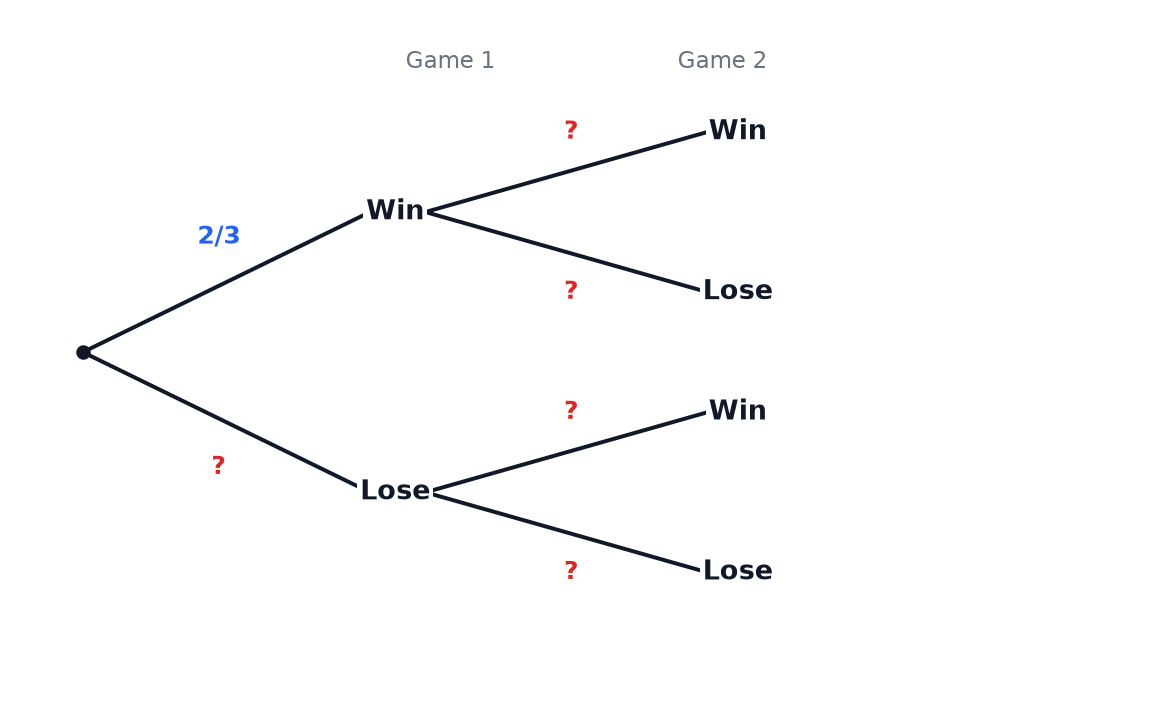
Zara plays two games of chess against Ahmed. The probability that Zara wins a game is \(\dfrac{2}{3}\). The games are independent. The incomplete tree diagram shows the first game and the second game. (a) Complete the tree diagram. [2 marks] (b) Calculate the probability that Zara wins exactly one of the two games. [2 marks]
Show answerHide answer
Model answer
(a) The probability of losing is \(1 - \dfrac{2}{3} = \dfrac{1}{3}\). Every second-game branch is \(\dfrac{2}{3}\) for win and \(\dfrac{1}{3}\) for lose. (b) \(\dfrac{2}{3} \times \dfrac{1}{3} + \dfrac{1}{3} \times \dfrac{2}{3} = \dfrac{4}{9}\).
Mark scheme
- (a) \(\dfrac{1}{3}\) on the first lose branch — B1
- (a) \(\dfrac{2}{3}\) and \(\dfrac{1}{3}\) on all second-game branches — B1
- (b) \(\dfrac{2}{3} \times \dfrac{1}{3}\) and \(\dfrac{1}{3} \times \dfrac{2}{3}\) added — M1
- (b) \(\dfrac{4}{9}\) — A1
-
3 Calculate [3 marks]
A bag contains 4 lemon sweets and 3 mint sweets. Two sweets are taken at random without replacement. Calculate the probability that the two sweets have different flavours. [3 marks]
Show answerHide answer
Model answer
Lemon then mint: \(\dfrac{4}{7} \times \dfrac{3}{6} = \dfrac{12}{42}\). Mint then lemon: \(\dfrac{3}{7} \times \dfrac{4}{6} = \dfrac{12}{42}\). The total is \(\dfrac{24}{42} = \dfrac{4}{7}\).
Mark scheme
- \(\dfrac{4}{7} \times \dfrac{3}{6}\) or \(\dfrac{3}{7} \times \dfrac{4}{6}\) — M1
- Both products added — M1
- \(\dfrac{4}{7}\) or \(\dfrac{24}{42}\) — A1
-
4 Calculate [3 marks]
Two machines work independently. The probability that machine \(A\) works is 0.9 and the probability that machine \(B\) works is 0.8. Calculate the probability that at least one of the machines works. [3 marks]
Show answerHide answer
Model answer
The probability that neither works is \(0.1 \times 0.2 = 0.02\), so the probability that at least one works is \(1 - 0.02 = 0.98\).
Mark scheme
- \(0.1\) and \(0.2\) seen — M1
- \(0.1 \times 0.2\) — M1
- \(0.98\) — A1
-
5 Calculate [4 marks]
A bag contains 5 blue counters and 3 green counters. Two counters are taken at random without replacement. (a) Show that the probability that both counters are blue is \(\dfrac{5}{14}\). [2 marks] (b) Calculate the probability that at least one counter is green. [2 marks]
Show answerHide answer
Model answer
(a) \(\dfrac{5}{8} \times \dfrac{4}{7} = \dfrac{20}{56} = \dfrac{5}{14}\). (b) \(1 - \dfrac{5}{14} = \dfrac{9}{14}\).
Mark scheme
- (a) \(\dfrac{5}{8} \times \dfrac{4}{7}\) — M1
- (a) \(\dfrac{20}{56} = \dfrac{5}{14}\) shown — A1
- (b) \(1 - \dfrac{5}{14}\) — M1
- (b) \(\dfrac{9}{14}\) — A1
-
6 Calculate [3 marks]
Three cards are numbered 1, 2 and 3. Two cards are taken at random without replacement, and the two numbers are added. Calculate the probability that the total is even. [3 marks]
Show answerHide answer
Model answer
The possible pairs are 1 and 2, 1 and 3, and 2 and 3, which are equally likely. The totals are 3, 4 and 5, so only one total is even. The probability is \(\dfrac{1}{3}\).
Mark scheme
- Lists the three possible pairs or totals — M1
- Totals 3, 4 and 5 — A1
- \(\dfrac{1}{3}\) — A1
Quick check
-
1
The probability of rain on any day is 0.3, and days are independent. What is the probability of rain on both of two days?
Show answerHide answer
C: \(0.09\)
\(0.3 \times 0.3 = 0.09\).
-
2
The probability of rain on any day is 0.3, and days are independent. What is the probability of rain on at least one of two days?
Show answerHide answer
B: \(0.51\)
\(1 - 0.7 \times 0.7 = 1 - 0.49 = 0.51\).
-
3
Two fair coins are tossed. What is the probability of two heads?
Show answerHide answer
A: \(\dfrac{1}{4}\)
\(\dfrac{1}{2} \times \dfrac{1}{2} = \dfrac{1}{4}\).
-
4
A bag has 3 red and 2 blue counters. Two are taken without replacement. What is the probability that both are red?
Show answerHide answer
D: \(\dfrac{3}{10}\)
\(\dfrac{3}{5} \times \dfrac{2}{4} = \dfrac{6}{20} = \dfrac{3}{10}\).
-
5
A bag has 3 red and 2 blue counters. Two are taken without replacement. What is the probability that they are different colours?
Show answerHide answer
C: \(\dfrac{3}{5}\)
\(\dfrac{3}{5} \times \dfrac{2}{4} + \dfrac{2}{5} \times \dfrac{3}{4} = \dfrac{12}{20} = \dfrac{3}{5}\).
-
6
A bag has 3 red and 2 blue counters. Two are taken without replacement. What is the probability that they are the same colour?
Show answerHide answer
B: \(\dfrac{2}{5}\)
\(\dfrac{6}{20} + \dfrac{2}{20} = \dfrac{8}{20} = \dfrac{2}{5}\).
-
7
On a tree diagram, one branch has probability 0.6. What is the other branch from the same point?
Show answerHide answer
A: \(0.4\)
The branches from one point add up to 1.
-
8
A bag has 4 red and 6 blue counters. Two are taken without replacement. What is the probability that both are blue?
Show answerHide answer
D: \(\dfrac{1}{3}\)
\(\dfrac{6}{10} \times \dfrac{5}{9} = \dfrac{30}{90} = \dfrac{1}{3}\).
-
9
A bag has 4 red counters and some blue counters, \(n\) in all. Two are taken without replacement and \(P(\text{two reds}) = \dfrac{2}{15}\). How many counters are in the bag?
Show answerHide answer
C: \(10\)
\(\dfrac{4}{10} \times \dfrac{3}{9} = \dfrac{12}{90} = \dfrac{2}{15}\), so \(n = 10\).