Exam questions · Maths · Transformations and Similarity
Congruence and Similarity
- 6 exam questions
- 18 marks
- 9 quick checks
-
1 Explain [2 marks]
Two triangles each have angles of \(40^\circ\), \(60^\circ\) and \(80^\circ\). Are the triangles congruent? Explain your answer. [2 marks]
Show answerHide answer
Model answer
Not necessarily. Equal angles show the triangles are similar, but they could be different sizes, so they are not necessarily congruent.
Mark scheme
- Not necessarily — B1
- They could be different sizes, or the angles only show similarity — B1
-
2 Prove [4 marks]
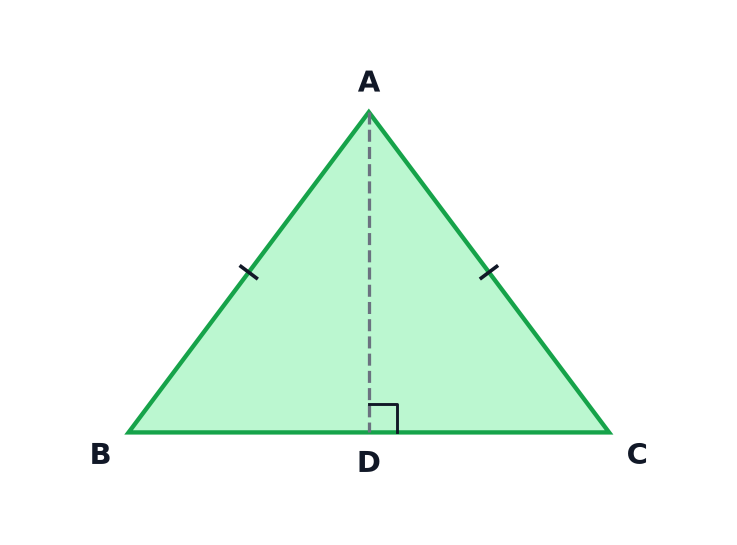
Triangle \(ABC\) is isosceles with \(AB = AC\). \(D\) is a point on \(BC\) such that \(AD\) is perpendicular to \(BC\). (a) Prove that triangles \(ABD\) and \(ACD\) are congruent. [3 marks] (b) Hence show that \(BD = DC\). [1 mark]
Show answerHide answer
Model answer
(a) Both triangles have a right angle at \(D\), the hypotenuses \(AB\) and \(AC\) are equal (given), and \(AD\) is a common side. The triangles are congruent by RHS. (b) Corresponding sides of congruent triangles are equal, so \(BD = DC\).
Mark scheme
- Right angle at D in both triangles — M1
- \(AB = AC\) and \(AD\) common — M1
- RHS, so the triangles are congruent — A1
- (b) \(BD = DC\) from the congruent triangles — B1
-
3 Calculate [3 marks]
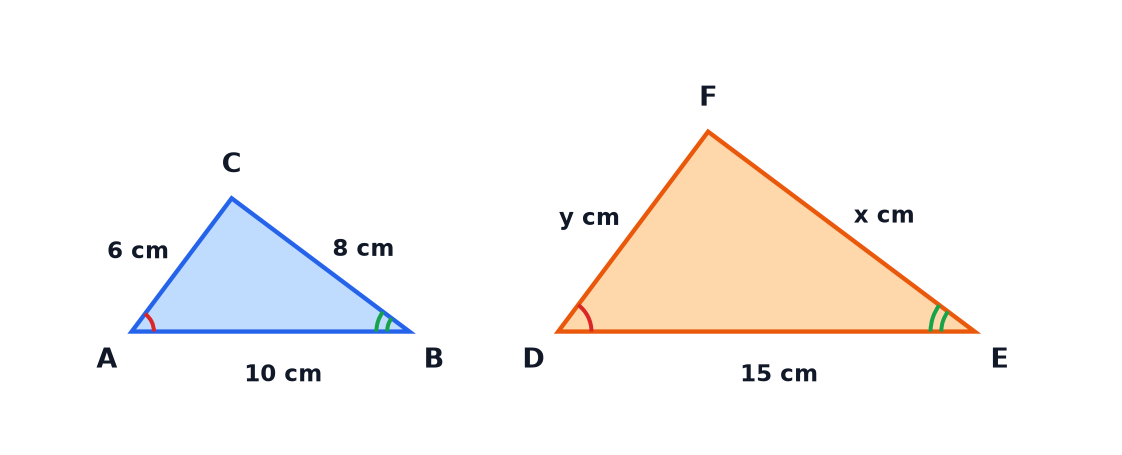
Triangles \(ABC\) and \(DEF\) are similar. (a) Calculate the scale factor from \(ABC\) to \(DEF\). [1 mark] (b) Calculate the length of \(EF\). [1 mark] (c) Calculate the length of \(FD\). [1 mark]
Show answerHide answer
Model answer
(a) \(DE\) matches \(AB\), so the scale factor is \(\dfrac{15}{10} = 1.5\). (b) \(EF = 8 \times 1.5 = 12\) cm. (c) \(FD = 6 \times 1.5 = 9\) cm.
Mark scheme
- (a) 1.5 — B1
- (b) 12 — B1
- (c) 9 — B1
-
4 Calculate [3 marks]
A photograph is 10 cm by 15 cm. It is enlarged so that the shorter side is 25 cm. (a) Calculate the length of the longer side of the enlarged photograph. [2 marks] (b) Calculate the perimeter of the enlarged photograph. [1 mark]
Show answerHide answer
Model answer
(a) The scale factor is \(\dfrac{25}{10} = 2.5\), so the longer side is \(15 \times 2.5 = 37.5\) cm. (b) \(2 \times (25 + 37.5) = 125\) cm.
Mark scheme
- (a) \(\dfrac{25}{10}\) or 2.5 — M1
- (a) 37.5 cm — A1
- (b) 125 cm — B1 (follow through from (a))
-
5 Calculate [3 marks]
Two similar shapes have corresponding lengths of 6 cm and 15 cm. The area of the smaller shape is 8 cm\(^2\). Calculate the area of the larger shape. [3 marks]
Show answerHide answer
Model answer
The length scale factor is \(\dfrac{15}{6} = 2.5\), so the area scale factor is \(2.5^2 = 6.25\). The larger area is \(8 \times 6.25 = 50\) cm\(^2\).
Mark scheme
- \(\dfrac{15}{6}\) or 2.5 — M1
- \(8 \times 2.5^2\) or \(8 \times 6.25\) — M1
- 50 cm\(^2\) — A1
-
6 Calculate [3 marks]
Two similar bottles have heights of 15 cm and 20 cm. The smaller bottle holds 270 ml. Calculate the volume of the larger bottle. [3 marks]
Show answerHide answer
Model answer
The length scale factor is \(\dfrac{20}{15} = \dfrac{4}{3}\), so the volume scale factor is \(\left(\dfrac{4}{3}\right)^3 = \dfrac{64}{27}\). The larger bottle holds \(270 \times \dfrac{64}{27} = 640\) ml.
Mark scheme
- \(\dfrac{20}{15}\) or \(\dfrac{4}{3}\) — M1
- \(270 \times \left(\dfrac{4}{3}\right)^3\) or \(270 \times \dfrac{64}{27}\) — M1
- 640 ml — A1
Quick check
-
1
Which of these is not enough to show that two triangles are congruent?
Show answerHide answer
B: Three equal angles
Three equal angles give similar triangles, which may be different sizes.
-
2
Two triangles have two equal sides and the equal angle between them. Which condition is this?
Show answerHide answer
A: SAS
Side, angle, side with the angle between the sides is SAS.
-
3
Two similar triangles have matching sides of 6 cm and 15 cm. What is the scale factor from the smaller to the larger?
Show answerHide answer
D: \(2.5\)
\(\dfrac{15}{6} = 2.5\).
-
4
A triangle with sides 3, 4 and 5 cm is similar to a triangle with sides 9 cm, \(x\) cm and 15 cm. What is \(x\)?
Show answerHide answer
C: \(12\)
The scale factor is \(\dfrac{9}{3} = 3\), so \(x = 4 \times 3 = 12\).
-
5
Triangles \(ABC\) and \(DEF\) are similar, with \(AB = 4\), \(DE = 10\) and \(BC = 6\). What is \(EF\)?
Show answerHide answer
B: 15 cm
The scale factor is \(\dfrac{10}{4} = 2.5\), so \(EF = 6 \times 2.5 = 15\) cm.
-
6
Two triangles have all three angles equal. What can you say?
Show answerHide answer
A: They are similar
Equal angles make the shapes similar, but not necessarily the same size.
-
7
The lengths of a shape are doubled. By what factor is the area multiplied?
Show answerHide answer
D: 4
The area scale factor is \(2^2 = 4\).
-
8
The lengths of a solid are multiplied by 3. By what factor is the volume multiplied?
Show answerHide answer
C: 27
The volume scale factor is \(3^3 = 27\).
-
9
Two similar shapes have areas in the ratio \(9 : 25\). What is the ratio of their lengths?
Show answerHide answer
B: \(3 : 5\)
Take square roots: \(\sqrt{9} : \sqrt{25} = 3 : 5\).