Exam questions · Maths · Transformations and Similarity
Enlargements
- 6 exam questions
- 17 marks
- 9 quick checks
-
1 Write down [2 marks]
A line is 7 cm long. It is enlarged by a scale factor of 3. Write down the length of the enlarged line. [2 marks]
Show answerHide answer
Model answer
\(7 \times 3 = 21\) cm.
Mark scheme
- \(7 \times 3\) — M1
- 21 cm — A1
-
2 Enlarge [3 marks]
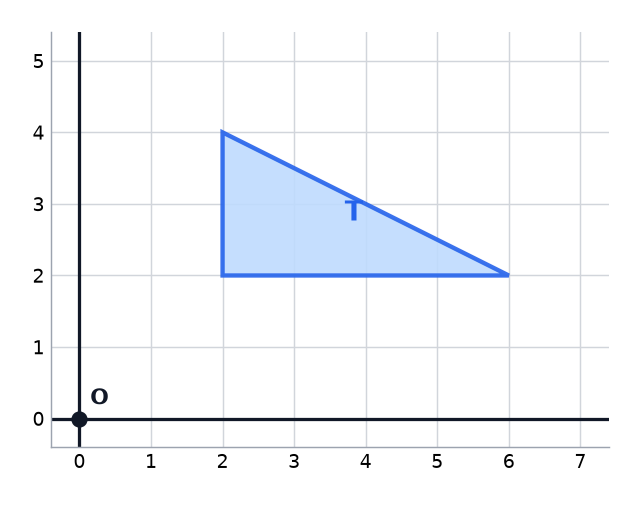
Enlarge triangle \(T\) by a scale factor of \(\dfrac{1}{2}\) with the centre \(O\), the origin. [3 marks]
Show answerHide answer
Model answer
Multiply each coordinate by \(\dfrac{1}{2}\): \((2, 2)\) goes to \((1, 1)\), \((6, 2)\) goes to \((3, 1)\) and \((2, 4)\) goes to \((1, 2)\).
Mark scheme
- Enlarges at least two vertices by a scale factor of \(\dfrac{1}{2}\) — M1
- At least two vertices correct — A1
- Triangle with vertices \((1, 1)\), \((3, 1)\) and \((1, 2)\) — A1
-
3 Describe [3 marks]
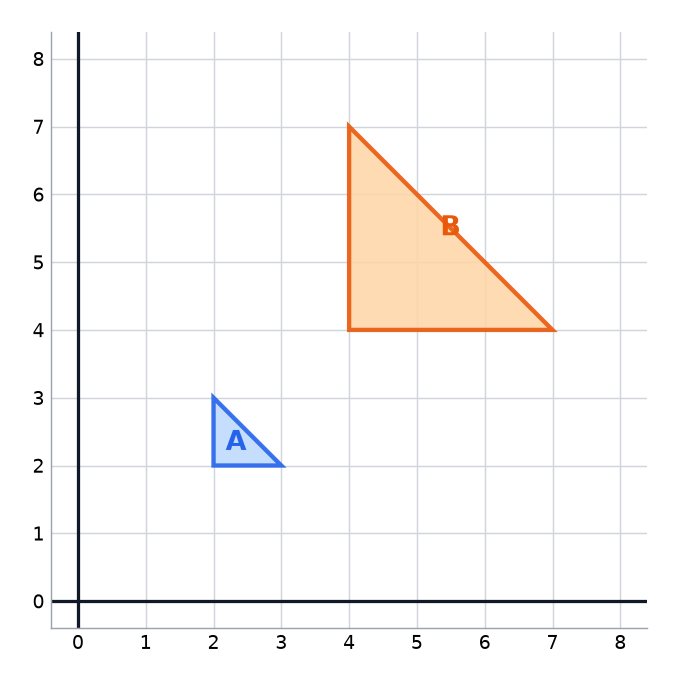
Describe fully the single transformation that maps triangle \(A\) onto triangle \(B\). [3 marks]
Show answerHide answer
Model answer
The bottom of \(A\) is 1 long and the bottom of \(B\) is 3 long, so the scale factor is 3. The lines through \((2, 2)\) and \((4, 4)\), and \((3, 2)\) and \((7, 4)\), meet at \((1, 1)\). It is an enlargement, scale factor 3, centre \((1, 1)\).
Mark scheme
- Enlargement — B1
- Scale factor 3 — B1
- Centre \((1, 1)\) — B1
-
4 Calculate [3 marks]
A triangle has sides of 2 cm, 3 cm and 4 cm. It is enlarged to give a similar triangle with sides of 5 cm, 7.5 cm and 10 cm. (a) Calculate the scale factor. [2 marks] (b) Calculate the perimeter of the enlarged triangle. [1 mark]
Show answerHide answer
Model answer
(a) \(\dfrac{5}{2} = 2.5\). (b) \(5 + 7.5 + 10 = 22.5\) cm.
Mark scheme
- (a) \(\dfrac{5}{2}\) or \(\dfrac{10}{4}\) — M1
- (a) 2.5 — A1
- (b) 22.5 cm — B1
-
5 Calculate [3 marks]
The point \(A\) is \((1, 4)\). \(A\) is enlarged by a scale factor of 3 with the centre \((0, 1)\). Calculate the coordinates of the image of \(A\). [3 marks]
Show answerHide answer
Model answer
\(A\) is 1 right and 3 up from the centre. The image is 3 right and 9 up, at \((0 + 3, 1 + 9) = (3, 10)\).
Mark scheme
- Position relative to the centre, \((1, 3)\) — M1
- \((3, 9)\) relative to the centre — M1
- \((3, 10)\) — A1
-
6 Calculate [3 marks]
The point \(A\) is \((5, 4)\). \(A\) is enlarged by a scale factor of \(-1\) with the centre \((2, 3)\). Calculate the coordinates of the image of \(A\). [3 marks]
Show answerHide answer
Model answer
\(A\) is 3 right and 1 up from the centre. With a scale factor of \(-1\), the image is 3 left and 1 down, at \((2 - 3, 3 - 1) = (-1, 2)\).
Mark scheme
- Position relative to the centre, \((3, 1)\) — M1
- \((-3, -1)\) relative to the centre — M1
- \((-1, 2)\) — A1
Quick check
-
1
A side of 3 cm is enlarged to 12 cm. What is the scale factor?
Show answerHide answer
D: \(4\)
\(\dfrac{12}{3} = 4\).
-
2
The point \((2, 3)\) is enlarged by scale factor 3 with centre \((0, 0)\). What is the image?
Show answerHide answer
C: \((6, 9)\)
Multiply both coordinates by 3.
-
3
What happens to the angles in an enlargement?
Show answerHide answer
B: They stay the same
An enlargement keeps the angles, so the shapes are similar.
-
4
What does an enlargement with scale factor \(\dfrac{1}{2}\) do to a shape?
Show answerHide answer
A: It halves every length
A fractional scale factor less than 1 makes the shape smaller.
-
5
The centre of enlargement is \((1, 2)\) and the scale factor is 3. What is the image of \((3, 3)\)?
Show answerHide answer
D: \((7, 5)\)
\((3, 3)\) is 2 right and 1 up from the centre, so the image is 6 right and 3 up: \((7, 5)\).
-
6
What must you give to describe an enlargement fully?
Show answerHide answer
C: The scale factor and the centre
An enlargement is described by its scale factor and its centre.
-
7
A triangle with sides 4, 6 and 8 is enlarged to give a triangle with sides 10, 15 and 20. What is the scale factor?
Show answerHide answer
B: \(2.5\)
\(\dfrac{10}{4} = 2.5\).
-
8
Which transformation is the same as an enlargement with scale factor \(-1\)?
Show answerHide answer
A: A rotation of \(180^\circ\) about the centre
Every point goes to the opposite side of the centre at the same distance.
-
9
The point \((1, 3)\) is enlarged by scale factor \(-2\) with centre \((0, 0)\). What is the image?
Show answerHide answer
D: \((-2, -6)\)
Multiply both coordinates by \(-2\).