Flashcards · Biology
Human Impact on Ecosystems
-
What is biodiversity?
The variety of different species in an ecosystem or on Earth.
-
What is fish farming?
Rearing fish in cages, tanks or ponds and feeding them until they are harvested.
-
Give two positive effects of fish farming.
A reliable supply of protein, and less overfishing of wild fish.
-
Give two negative effects of fish farming.
Pollution from waste and spread of parasites and disease to wild fish.
-
Why can escaped farmed fish harm wild fish?
They compete with them and breed with them, which can reduce the wild population's genetic variation.
-
What is a non-indigenous species?
A species introduced to an area where it does not naturally live.
-
Give two ways a non-indigenous species can be introduced.
Deliberately (such as crops or pets) or accidentally (such as in cargo or ship ballast water).
-
How can a non-indigenous species reduce biodiversity?
It can outcompete, eat or spread disease to native species.
-
Why can an introduced species multiply so quickly?
It may have no natural predators or diseases in its new home.
-
Why are grey squirrels a threat to red squirrels?
They compete for food and carry squirrelpox, which kills red squirrels.
-
Give one benefit of a non-indigenous species.
Examples: crops such as potatoes feed people, or biological control reduces pests.
-
Why was the cane toad harmful in Australia?
It is poisonous, so native animals that ate it died, and it did not control the beetle.
-
What is eutrophication?
Excess mineral ions in water leading to an algal bloom, low oxygen and death of aquatic life.
-
Which two minerals in fertiliser cause eutrophication?
Nitrates and phosphates.
-
Why do plants under an algal bloom die?
The algae block the light, so they cannot photosynthesise.
-
Why does the oxygen level fall in eutrophication?
Bacteria decompose the dead plants and algae and use up the oxygen in respiration.
-
Why do fish die in a eutrophic pond?
There is not enough oxygen for them to respire.
-
Give one way to reduce eutrophication.
Use less fertiliser, avoid spreading it before rain, or leave a vegetation strip beside the field.
-
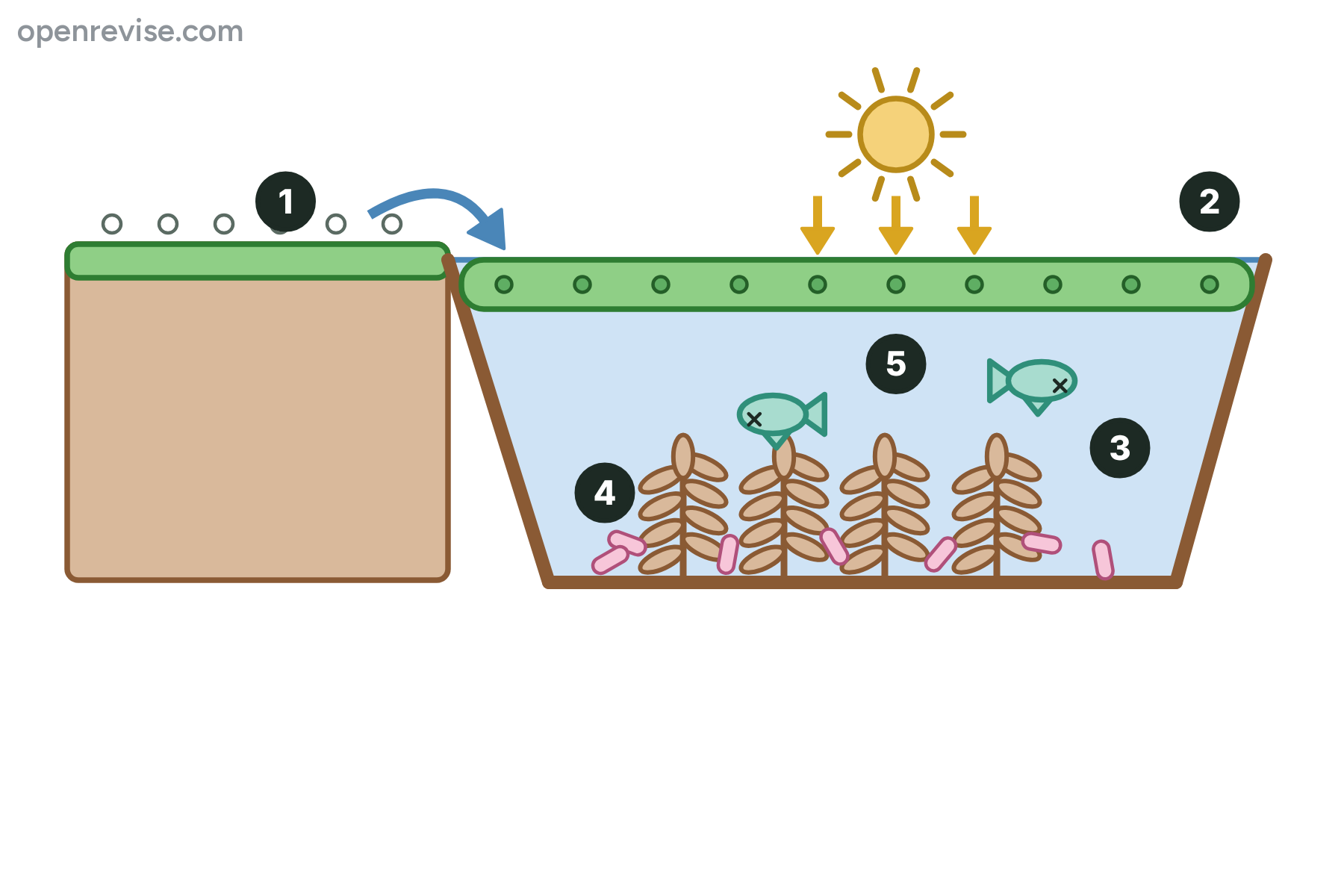 Describe the sequence of events in the diagram, in order.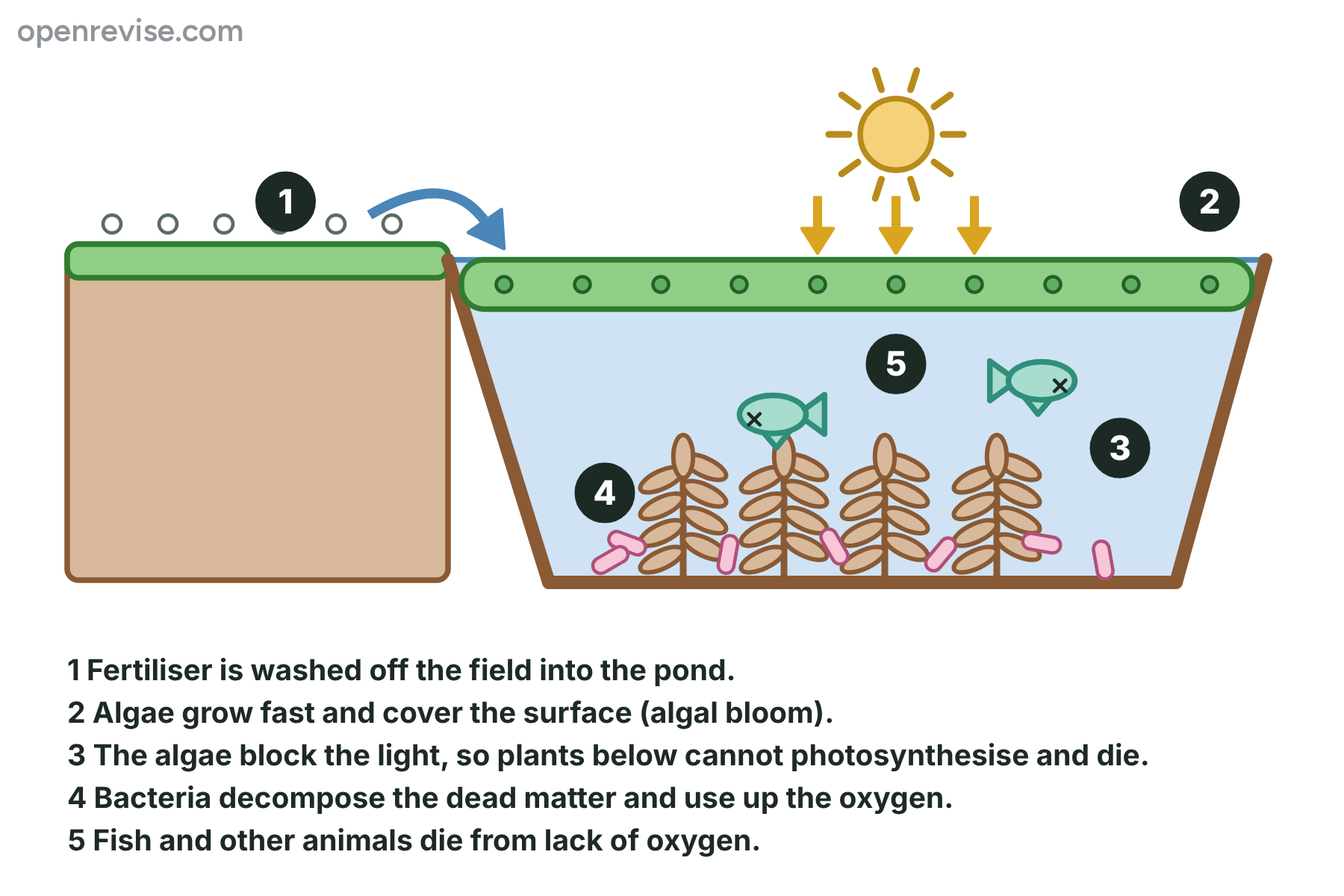
1 Fertiliser is washed off the field into the pond. 2 Algae grow fast and form an algal bloom. 3 The algae block the light, so the plants die. 4 Bacteria decompose the dead matter and use up the oxygen. 5 Fish and other animals die from lack of oxygen.
-
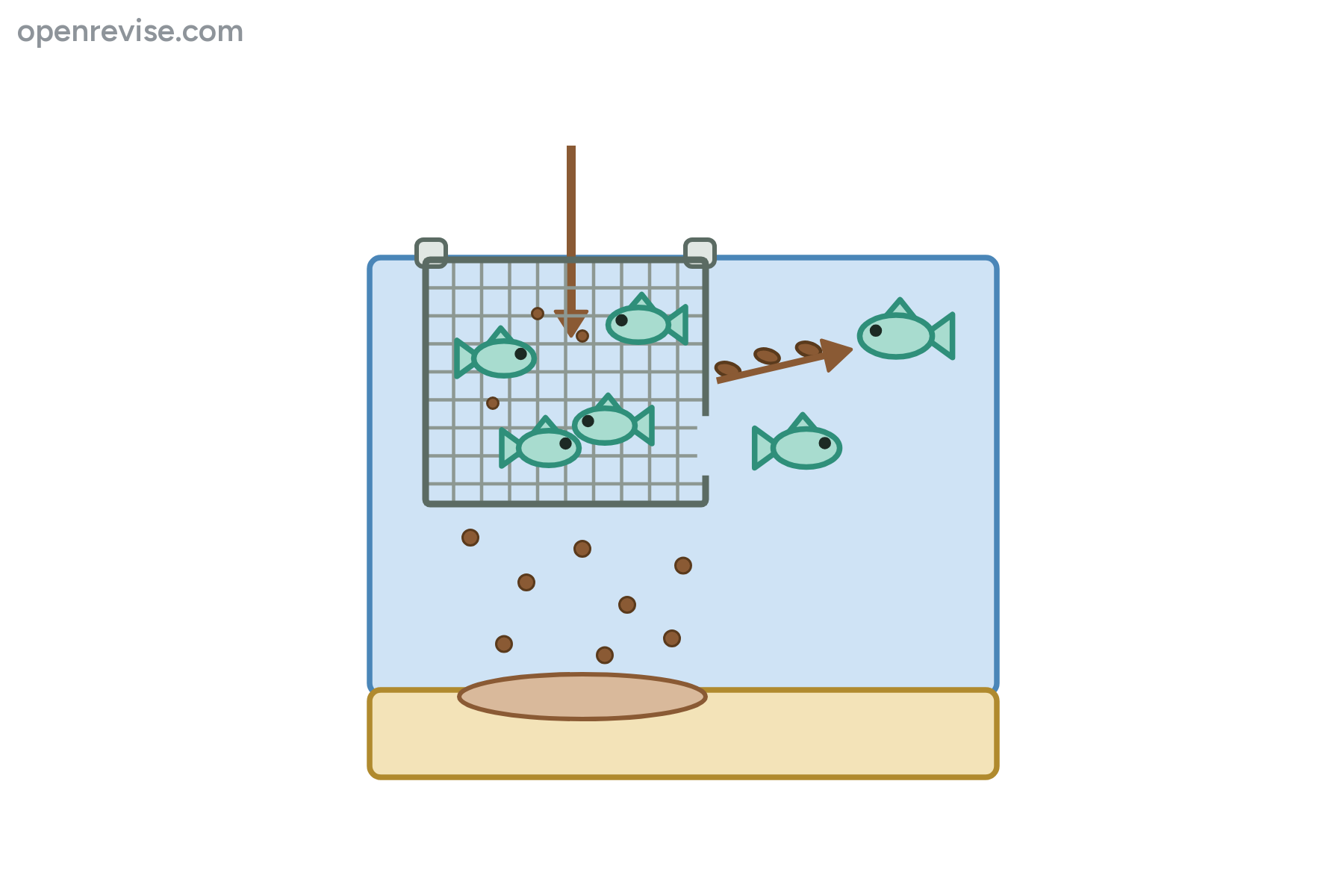 Name the parts of the fish farm and explain two harmful effects.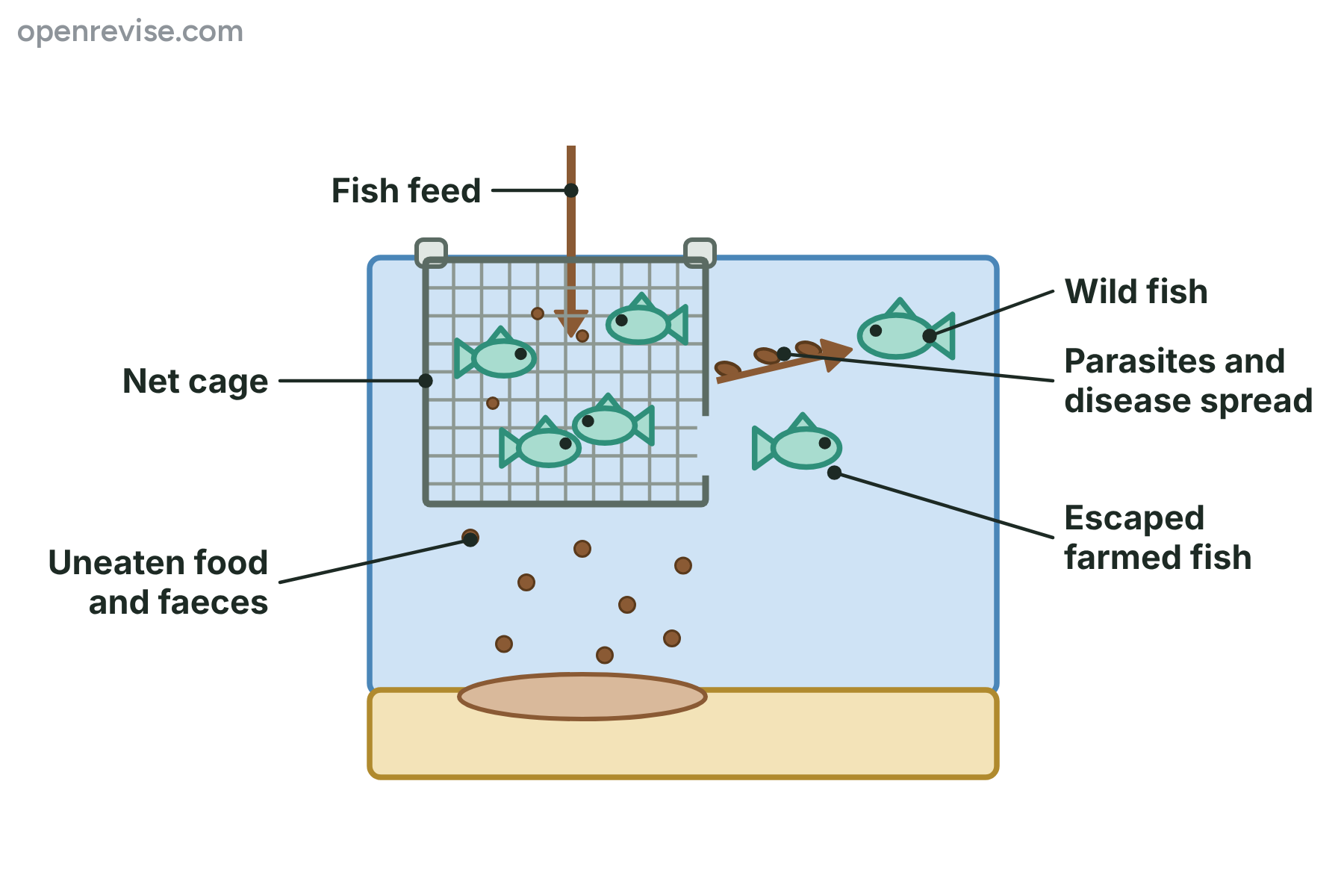
Net cage, fish feed, uneaten food and faeces, escaped farmed fish, wild fish. The waste pollutes the water and seabed (it can cause eutrophication). Parasites and disease spread to wild fish, and escaped farmed fish compete and breed with wild fish.
-
What is local biodiversity?
The variety of species in a small area such as a pond, hedgerow or woodland.
-
What is global biodiversity?
The variety of all the species on Earth.
-
Why is a high biodiversity ecosystem more stable?
There are many food chains, so if one species declines others can fill the gap.
-
What is a gene pool?
All the different alleles in a population or species.
-
Give two benefits to people of maintaining biodiversity.
Any two of: food, medicines, materials, pollination, climate, jobs and tourism.
-
Name a medicine that came from a plant.
Aspirin from willow bark, quinine from cinchona bark, or a leukaemia drug from the rosy periwinkle.
-
Why are wild relatives of crops valuable?
They have alleles for traits such as disease resistance that can be bred into crops.
-
Why is a monoculture vulnerable?
A single disease or pest can destroy the whole crop.
-
What is conservation?
Protecting and managing species and habitats so that species do not die out.
-
Name three ways to conserve an endangered animal.
Protected areas, laws against hunting and trade, and captive breeding.
-
What is captive breeding?
Breeding endangered animals in zoos or centres and releasing young into the wild.
-
Give one problem with captive breeding.
The population may have little genetic variation, or animals may not survive in the wild.
-
What is reforestation?
Planting trees on land that was cleared of forest.
-
How does reforestation reduce flooding?
Roots hold the soil and the trees take up water, so less runs off quickly into rivers.
-
How does reforestation help to slow global warming?
Trees take in carbon dioxide for photosynthesis and store carbon.
-
Why can a plantation of one tree species fail to restore biodiversity?
It gives food and shelter to far fewer species than a mixed native forest.
-
How do you calculate a percentage change?
The change divided by the original value, multiplied by 100.
-
Why is extinction a problem for people?
The species is lost for ever, with any medicines, genes or ecosystem roles it had.
-
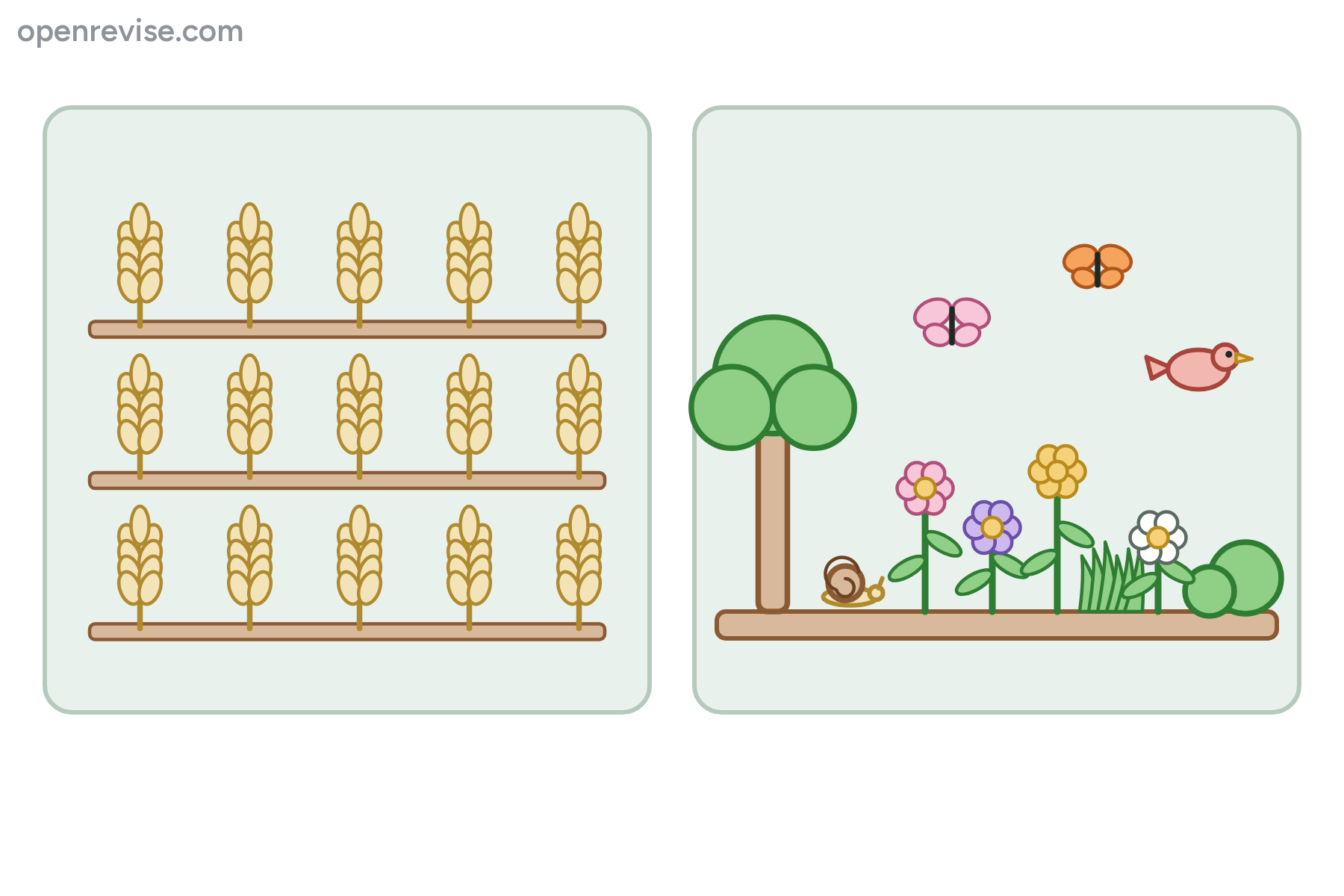 Describe the differences in biodiversity between the two panels, and explain why it matters.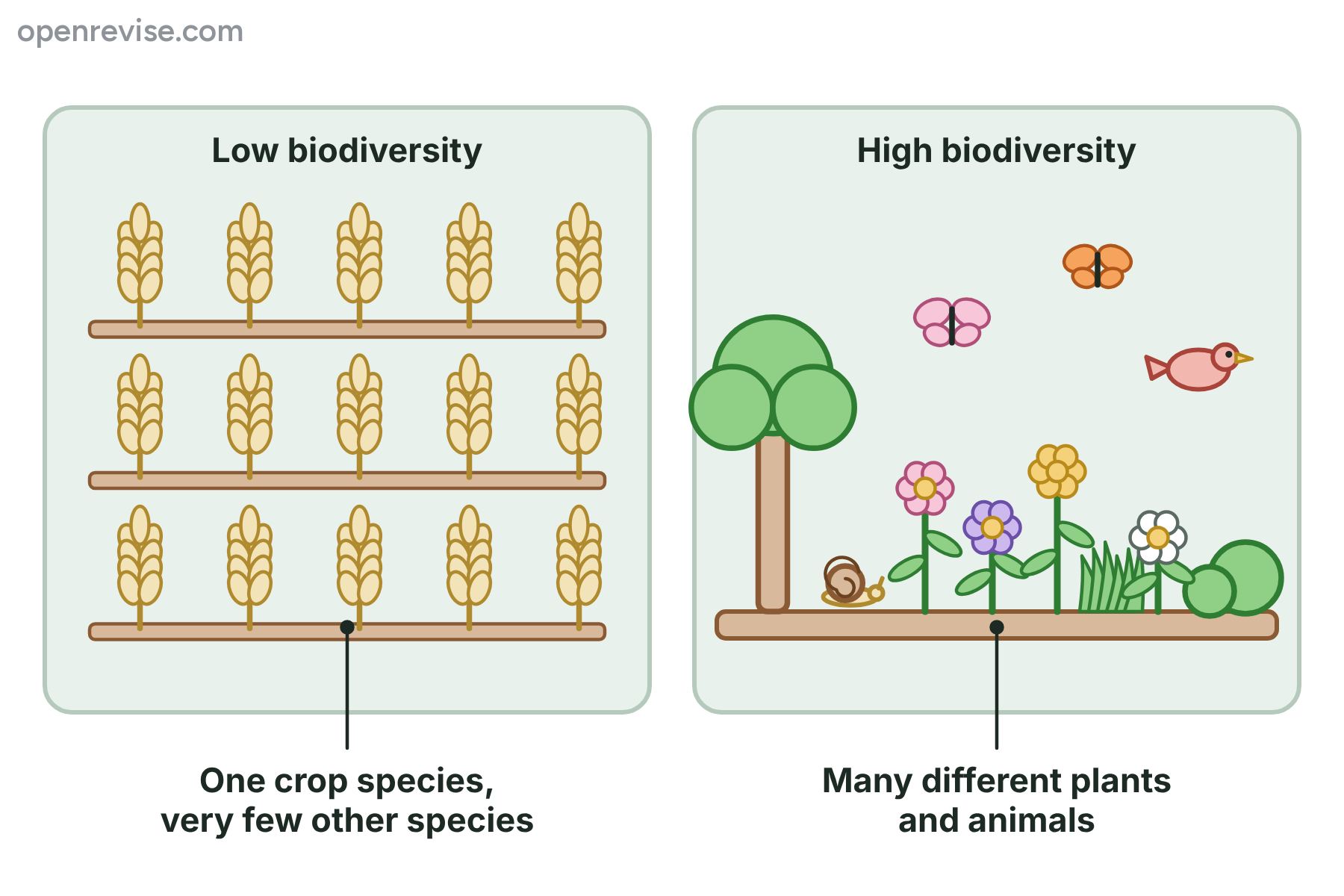
The left is a crop monoculture with low biodiversity: one species, so a single disease or pest could destroy it, and few animals can live there. The right has high biodiversity: many species, more food sources and shelter, so it is more stable and better able to cope with change.
-
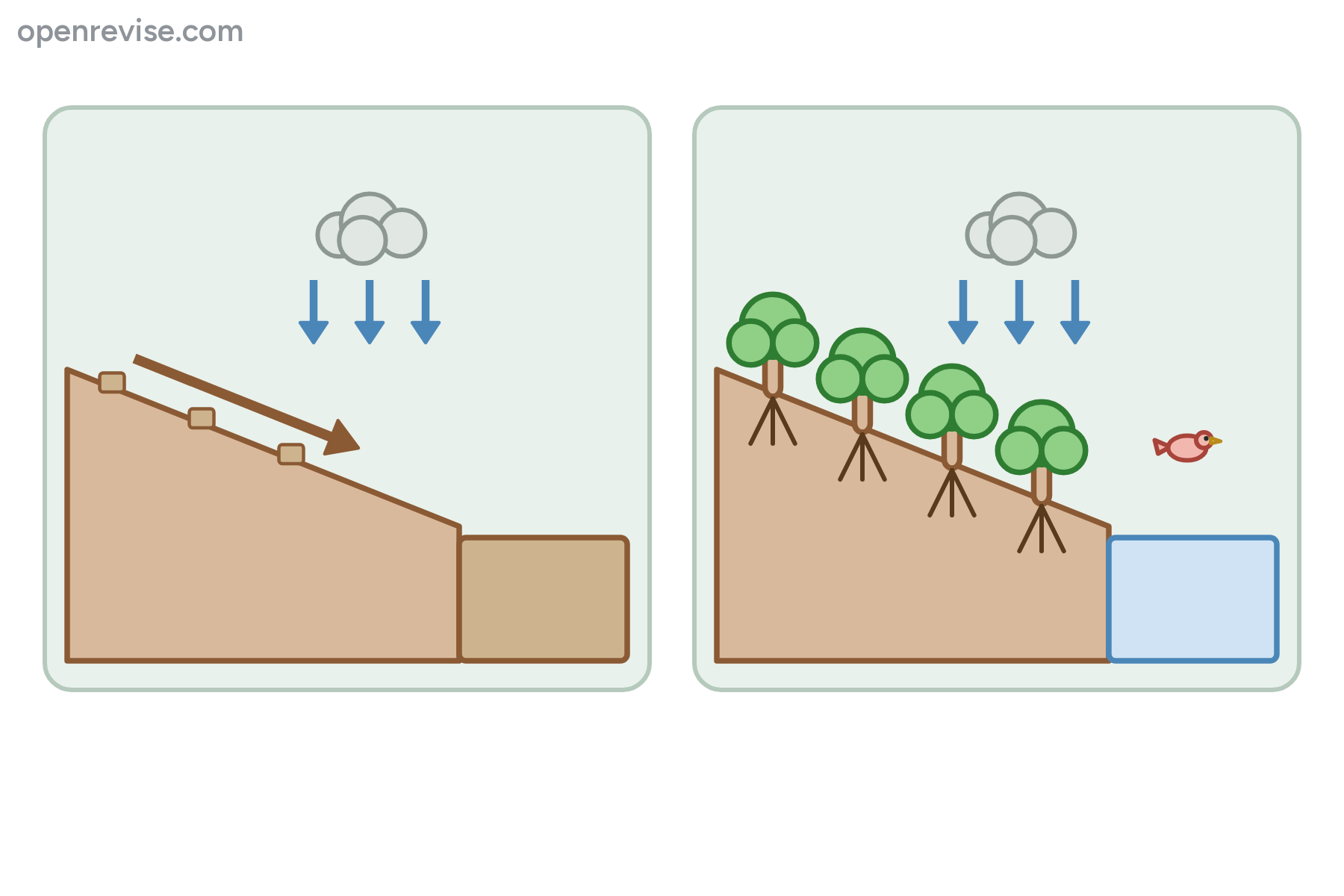 Explain how reforestation changes what happens to the rain.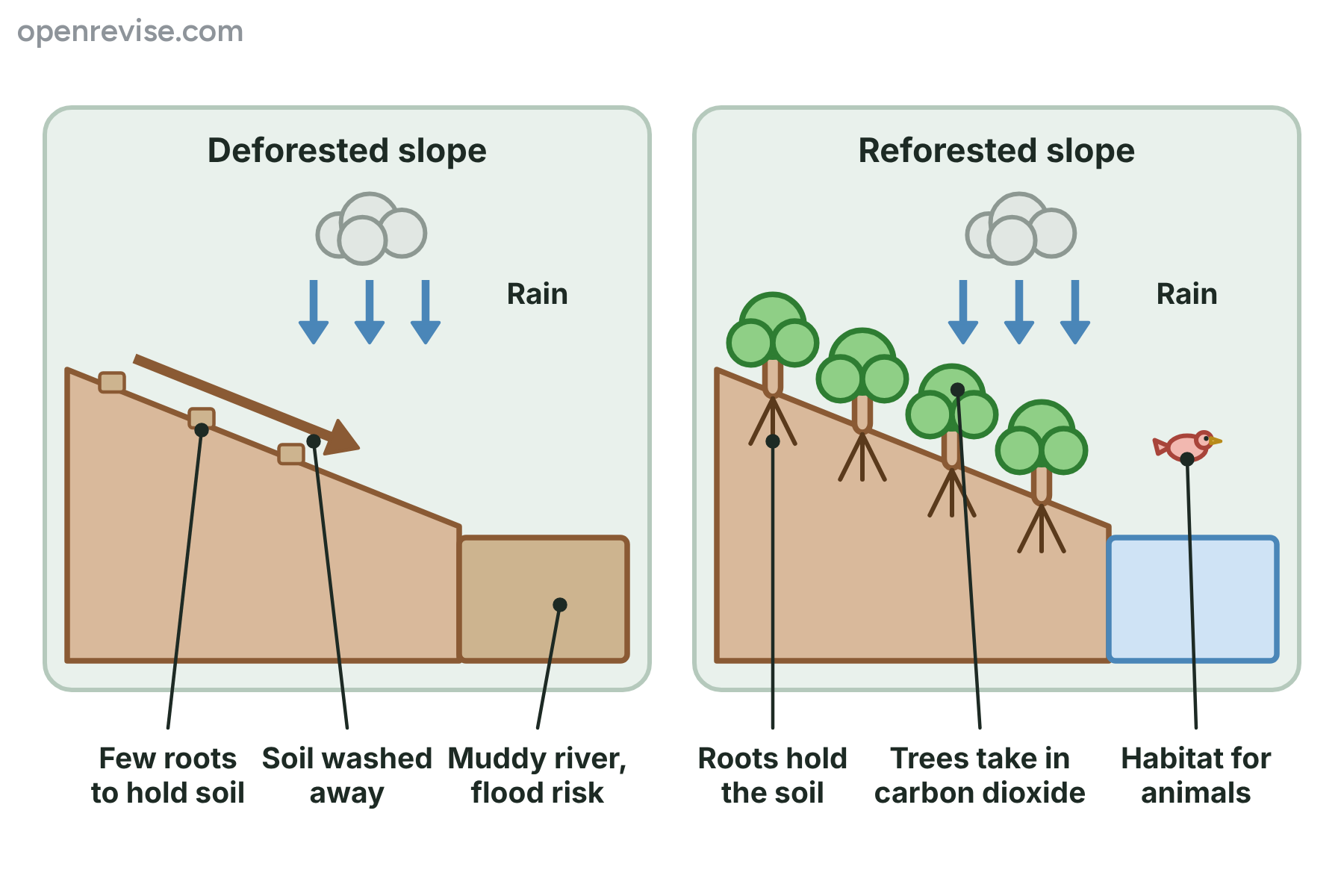
Without trees, the rain runs off and washes the soil away (erosion) into the river, which becomes muddy and may flood. With trees, the roots hold the soil and the trees take up water, so the river stays clear. The trees also take in carbon dioxide and give animals a habitat.