Flashcards · Biology
Plant Structures and Transport
-
How do root hair cells take up water?
By osmosis.
-
How do root hair cells take up mineral ions?
By active transport.
-
Why do root hair cells have many mitochondria?
To release energy from respiration for active transport.
-
How is a root hair cell adapted for absorbing water?
Its long thin extension gives a large surface area.
-
What does xylem carry?
Water and mineral ions from the roots to the stems and leaves.
-
Why are xylem cells hollow?
They have lost their contents and cross-walls, so water can flow through them as continuous tubes.
-
What is lignin for?
It strengthens the xylem walls so they do not collapse.
-
What is transpiration?
The loss of water vapour from the leaves, mainly through the stomata.
-
What is the transpiration stream?
The movement of water from the roots up the xylem to the leaves.
-
Why is transpiration useful?
It brings water for photosynthesis and minerals, cools the leaf and keeps cells firm.
-
What do stomata and guard cells control?
Gas exchange and water loss.
-
How does a higher temperature affect transpiration?
It increases the rate.
-
How does high humidity affect transpiration?
It decreases the rate.
-
How does more air movement affect transpiration?
It increases the rate, by removing water vapour.
-
How does brighter light affect transpiration?
It increases the rate, because the stomata open wider.
-
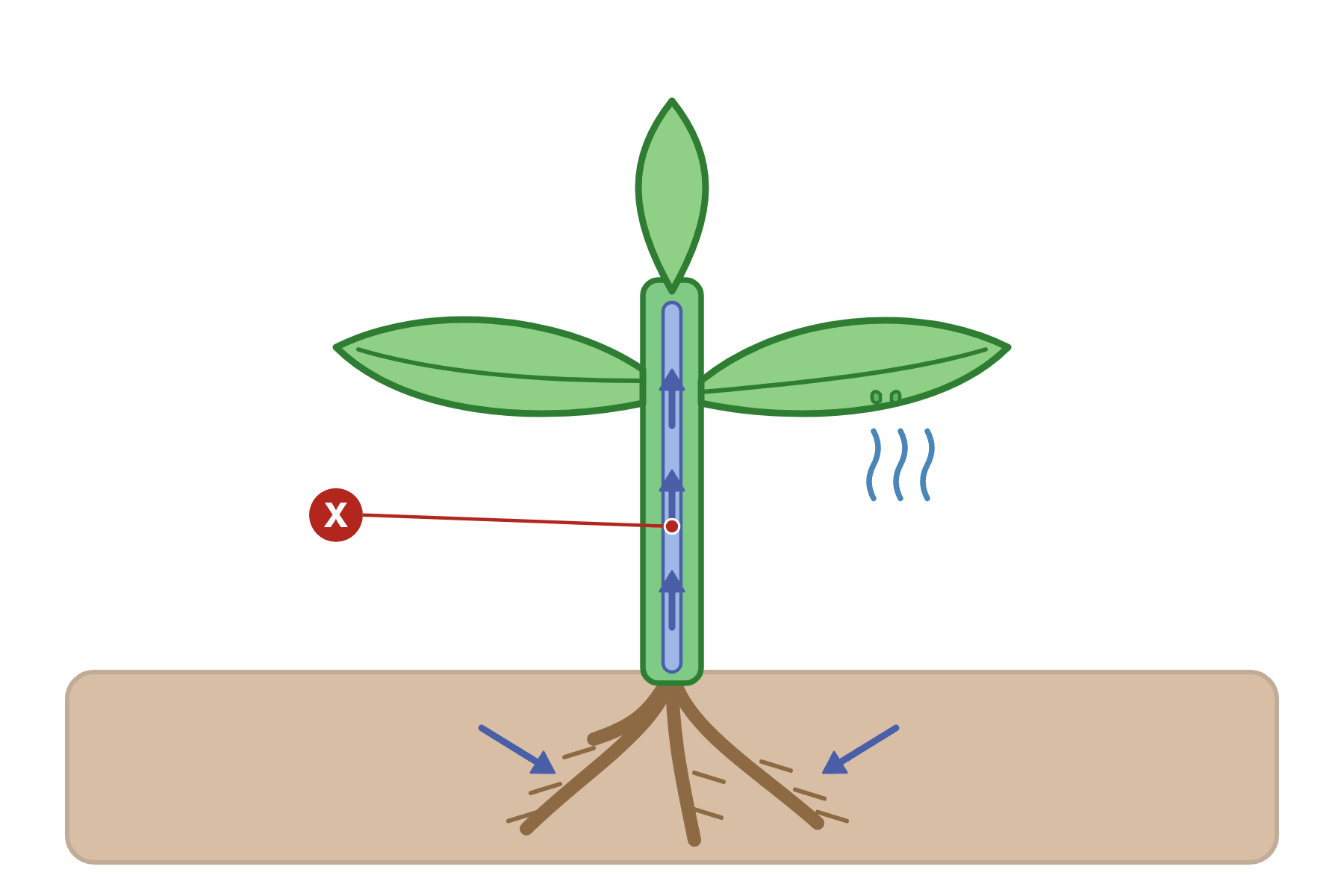 Name the part marked X and say what it carries.
 The xylem. It carries water and mineral ions from the roots to the leaves.
-
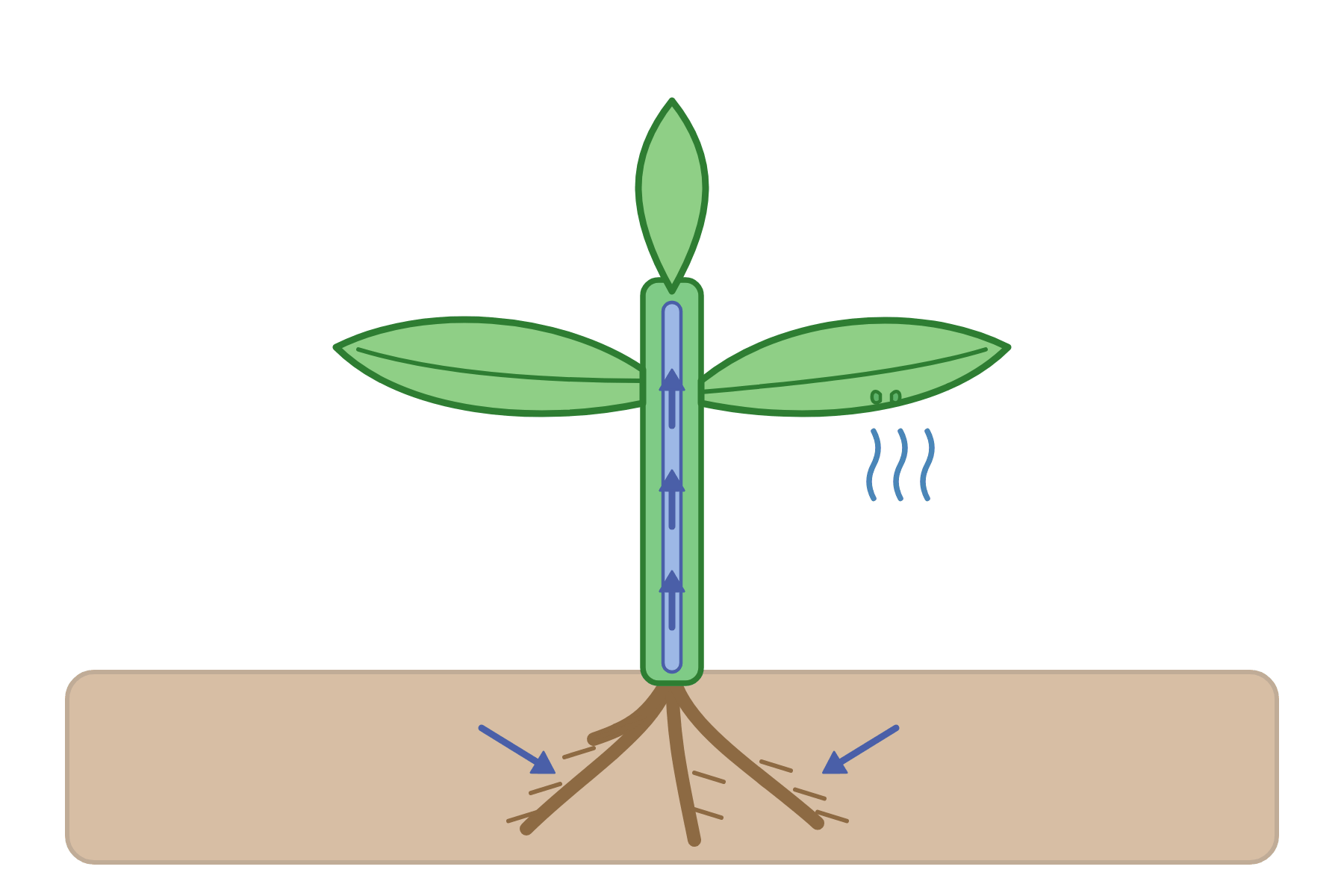 Label the parts of this plant and what moves where.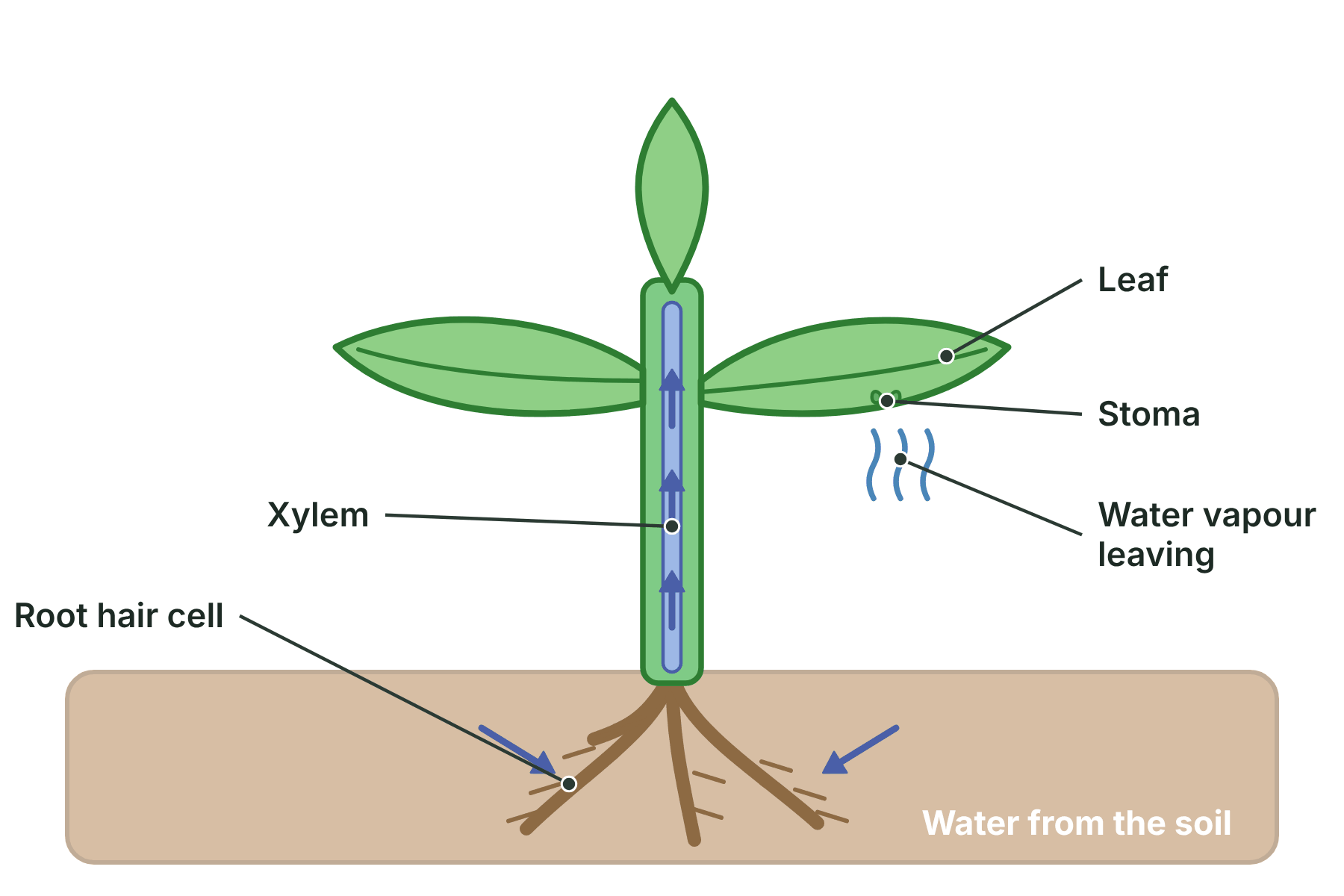
Water from the soil, root hair cell, xylem carrying water and mineral ions up, leaf, stoma, water vapour out.
-
What is translocation?
The movement of dissolved sugars through the phloem.
-
What does phloem carry?
Dissolved sugars (food made by photosynthesis).
-
Where does phloem carry sugars from?
From the leaves, where they are made, to the rest of the plant.
-
Why do roots need sugars from the leaves?
They cannot photosynthesise, but need energy and materials to grow.
-
Name two ways the sugars are used.
For immediate use in respiration and growth, or stored.
-
Is phloem made of living or dead cells?
Living cells.
-
How does cell sap move from one phloem cell to the next?
Through pores in the end walls.
-
In which directions does phloem carry sugars?
Both up and down the plant.
-
What does xylem carry?
Water and mineral ions, from the roots to the leaves.
-
Which tissue is made of dead cells?
Xylem.
-
Which tissue has pores in the end walls?
Phloem.
-
Which tissue is strengthened with lignin?
Xylem.
-
Where can sugars be stored in a plant?
In roots, tubers and fruits.
-
What would happen if the phloem were cut all round a trunk?
Sugars could not reach the roots, so the roots and then the tree would die.
-
Do you need to know the detailed structure of phloem or how it works?
No. It is not required.
-
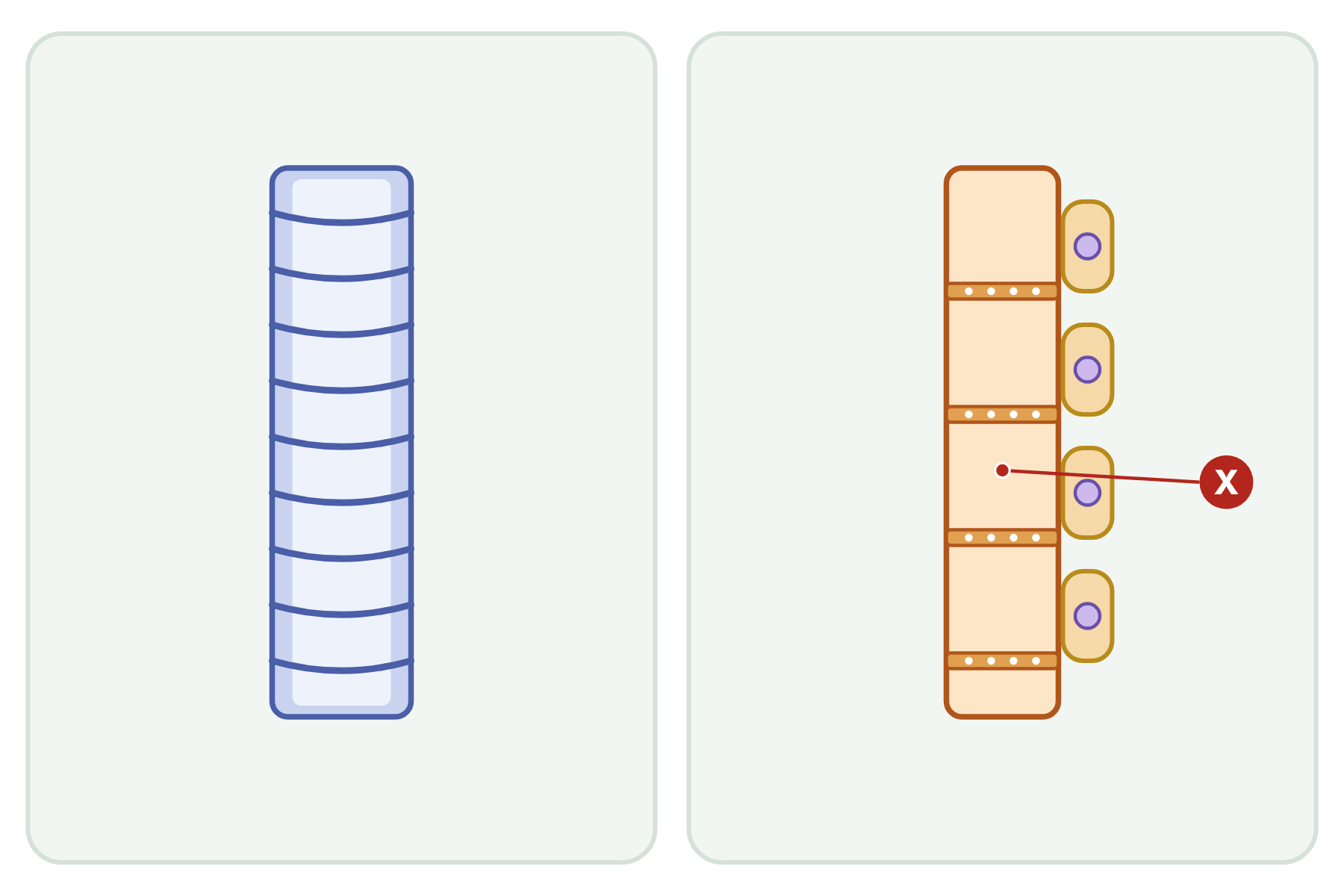 Name the tissue shown on the right, and say what it carries.
 Phloem. It carries dissolved sugars up and down the plant, in a process called translocation.
-
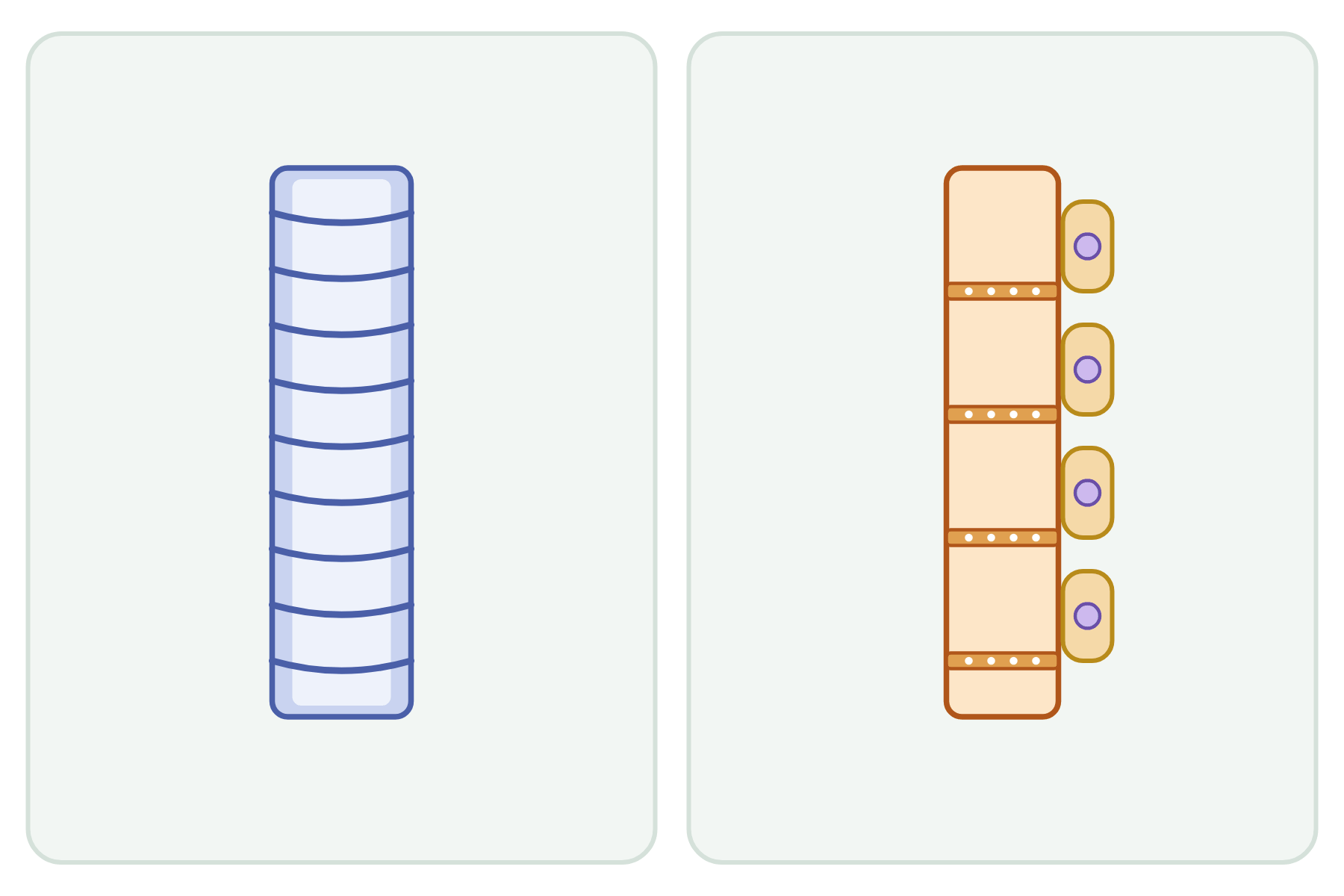 Label the xylem and the phloem.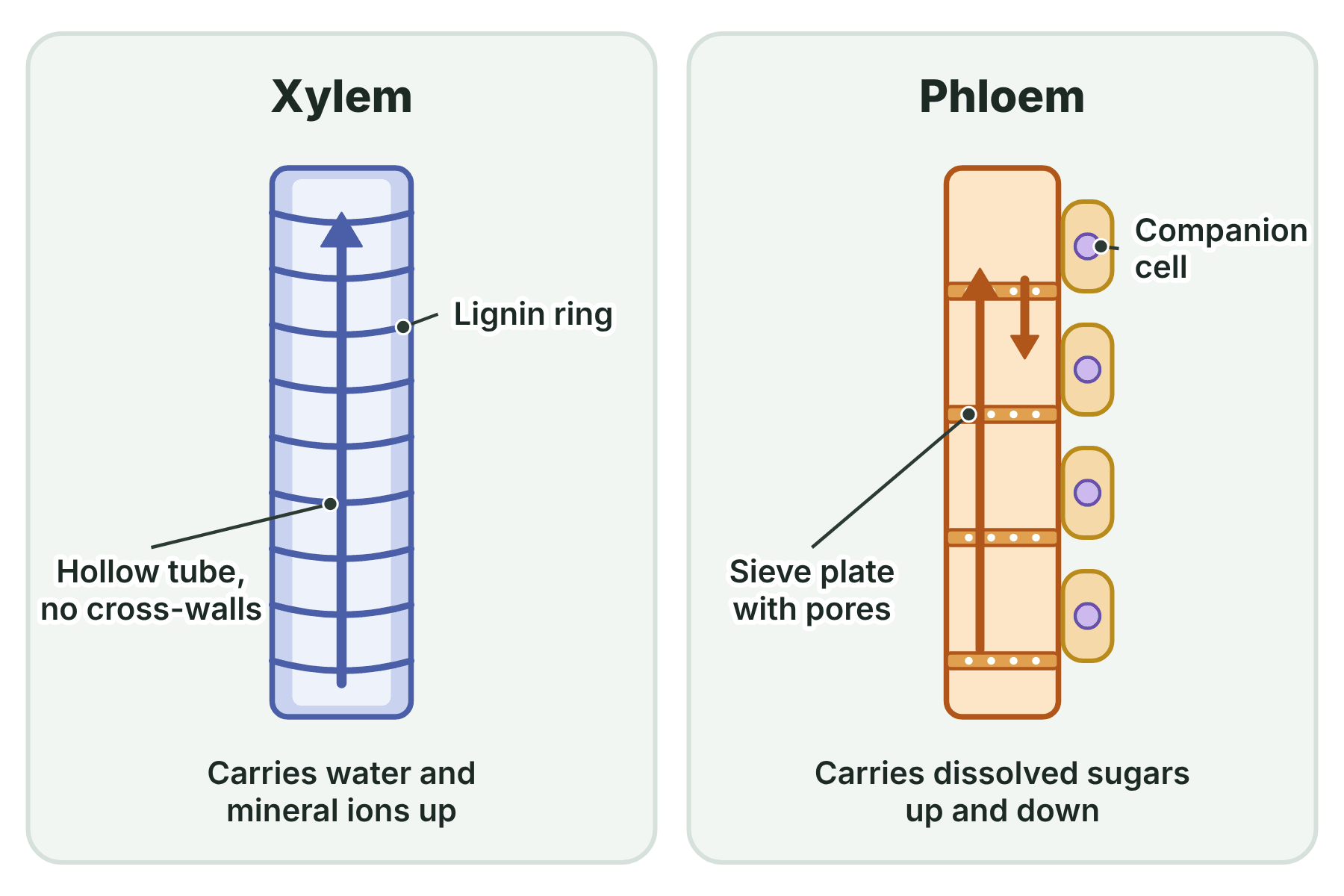
Xylem: hollow dead cells with lignin, carries water and ions up. Phloem: living cells with pores in the end walls and companion cells, carries sugars up and down.
-
What is the leaf?
A plant organ, made of several tissues working together.
-
Which tissue covers the surface of a leaf?
The epidermis.
-
What is the waxy cuticle for?
It reduces water loss from the leaf.
-
Where is most photosynthesis carried out in a leaf?
In the palisade mesophyll.
-
Why is the palisade mesophyll near the top of the leaf?
That is where most light arrives.
-
Why does the palisade mesophyll contain many chloroplasts?
To absorb as much light as possible for photosynthesis.
-
What is special about the spongy mesophyll?
It has air spaces between the cells, which let gases diffuse and give a large surface area.
-
What do the xylem and phloem do in a leaf?
Xylem brings water and minerals in, and phloem carries sugars away.
-
What is a stoma?
A tiny pore in the lower epidermis that lets gases in and out.
-
What do guard cells do?
They open and close the stomata.
-
When do guard cells close the stomata?
When the plant is short of water.
-
Why does closing the stomata help the plant?
It stops more water being lost by evaporation.
-
What is meristem tissue?
Tissue at the tips of shoots and roots whose cells divide and can become any type of plant cell.
-
Why are there more stomata on the underside of a leaf?
It is cooler and shadier, so less water is lost.
-
Why is the upper epidermis transparent?
So that light can pass through to the palisade cells.
-
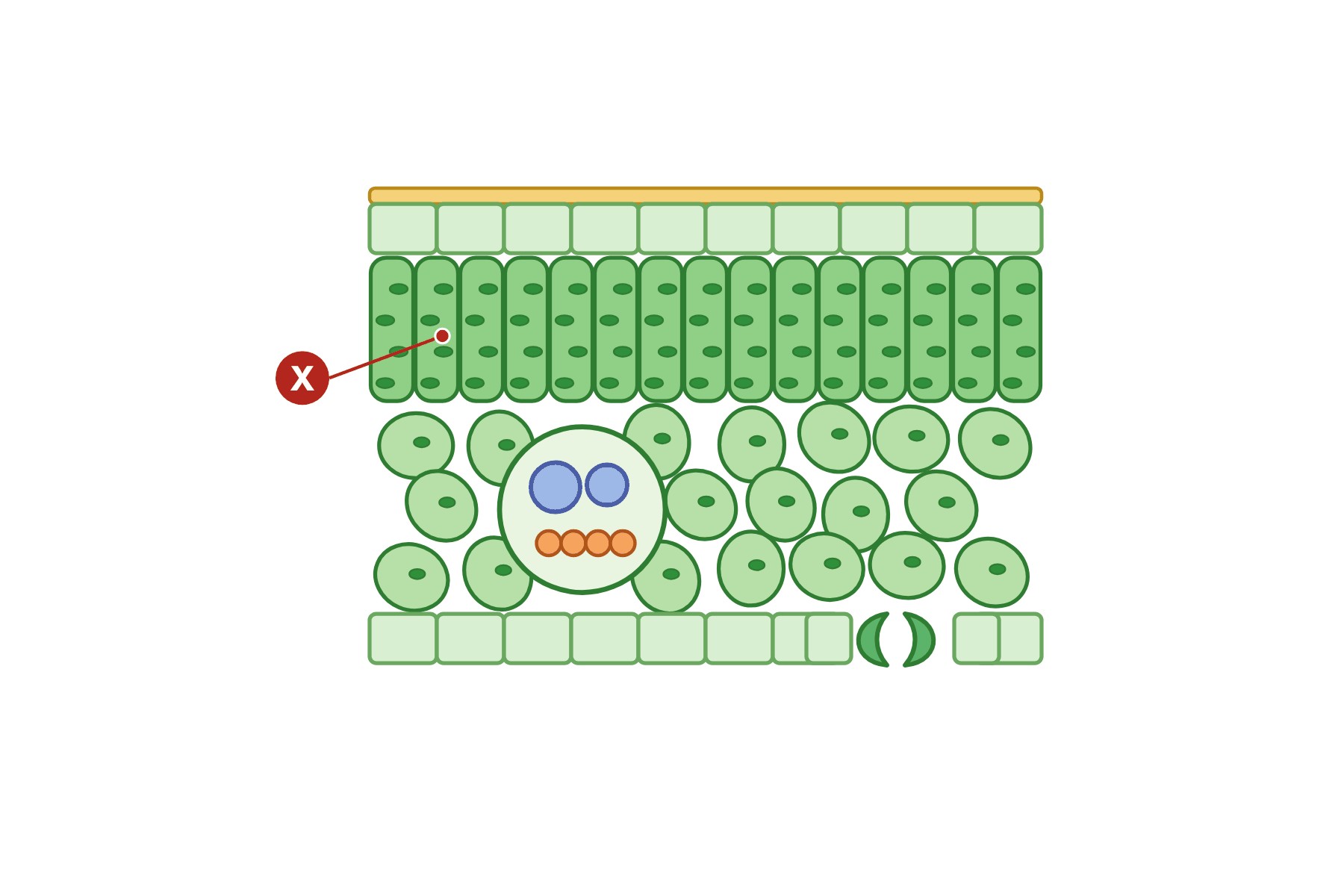 Name the tissue marked X and say what it does.
 The palisade mesophyll. Its tall cells are full of chloroplasts and carry out most of the photosynthesis.
-
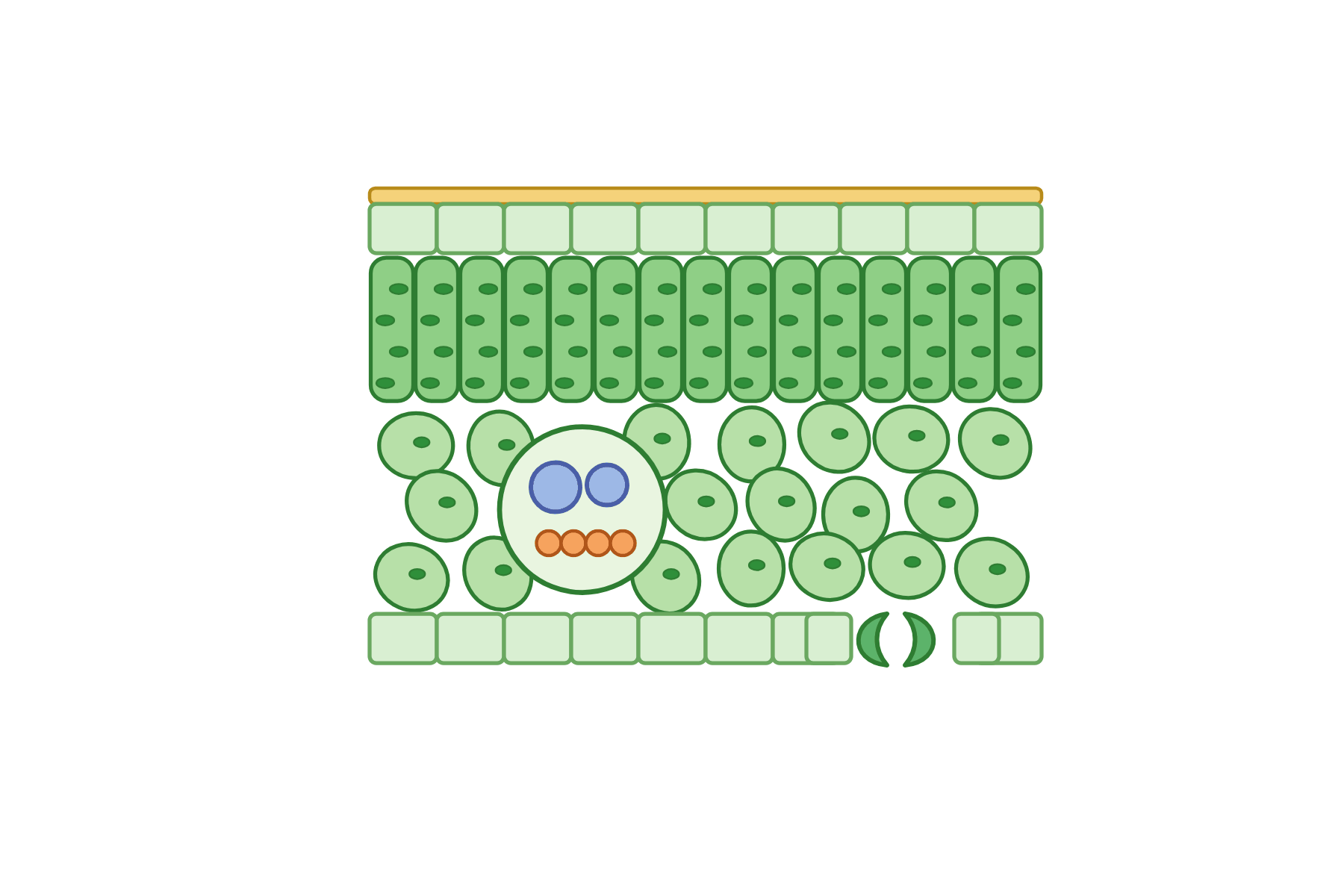 Label every tissue in this leaf.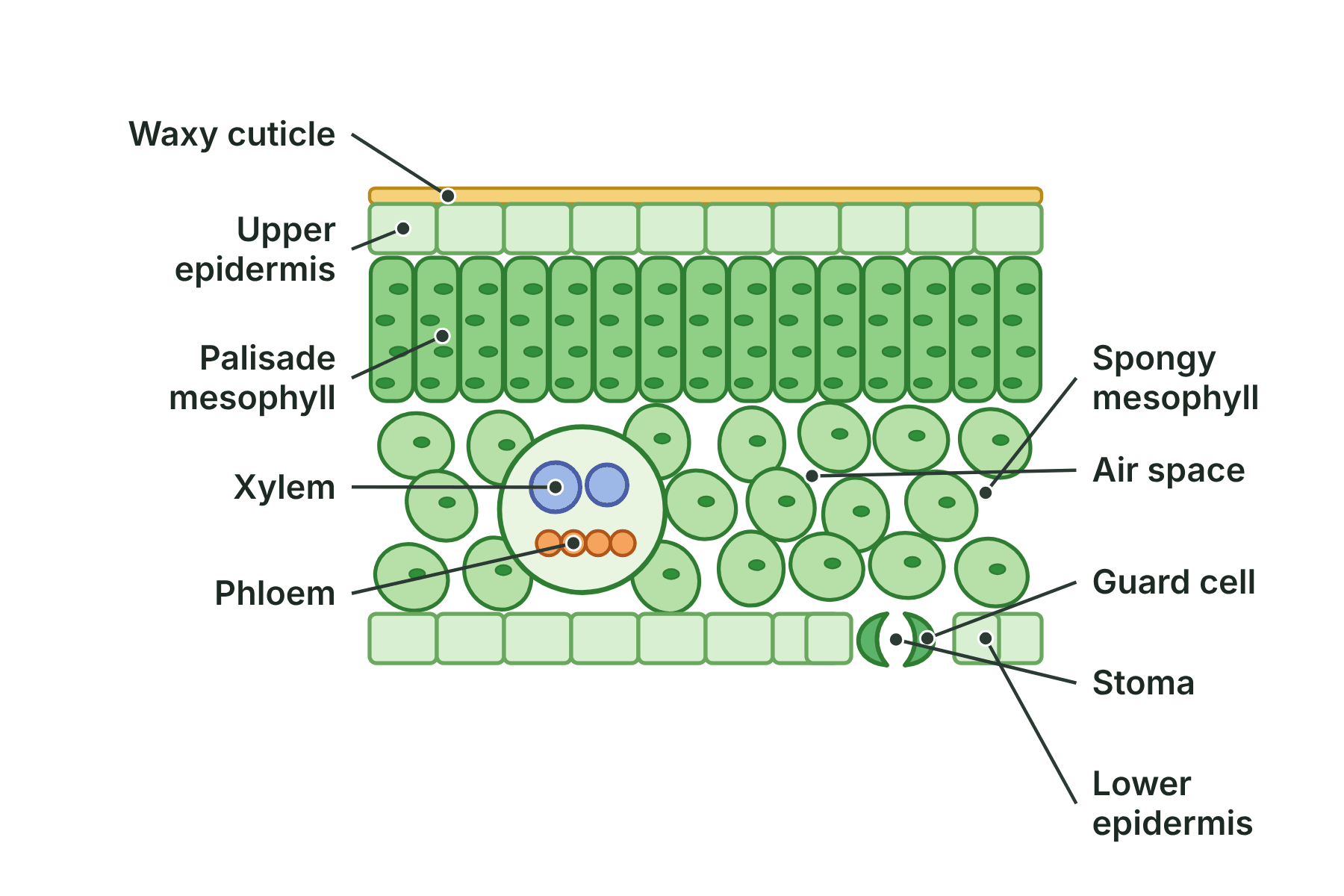
Waxy cuticle, upper epidermis, palisade mesophyll, spongy mesophyll, air space, xylem, phloem, guard cell, stoma and lower epidermis.
-
What does a potometer measure?
The rate of water uptake by a shoot, which estimates transpiration.
-
Why is the shoot cut under water?
To stop air getting into the xylem and blocking it.
-
What does the air bubble show?
How much water the shoot has taken up.
-
How do you work out the rate of uptake?
Distance moved by the bubble ÷ time.
-
What is the independent variable if you move a lamp?
The distance of the lamp (the light intensity).
-
What is the dependent variable in a potometer experiment?
The distance the bubble moves in a set time.
-
Name two control variables.
Any two of the same shoot, same time, same temperature, same light or wind.
-
Why repeat the experiment?
To check the results are reliable and to calculate a mean.
-
How can you increase the humidity around the shoot?
Cover it with a clear plastic bag.
-
Why is water uptake only an estimate of transpiration?
Some of the water is used in photosynthesis and growth.
-
How do you find the volume of water taken up?
π r² × the distance the bubble moves.
-
How do you make an impression of the stomata?
Paint clear nail varnish on the leaf, then peel it off with sticky tape.
-
How do you calculate the stomatal density?
The number of stomata ÷ the area of the field of view.
-
Why must the joints of the potometer be airtight?
So that no air enters, which would move the bubble.
-
What would a fan do to the rate?
Increase it, by removing water vapour from around the leaf.
-
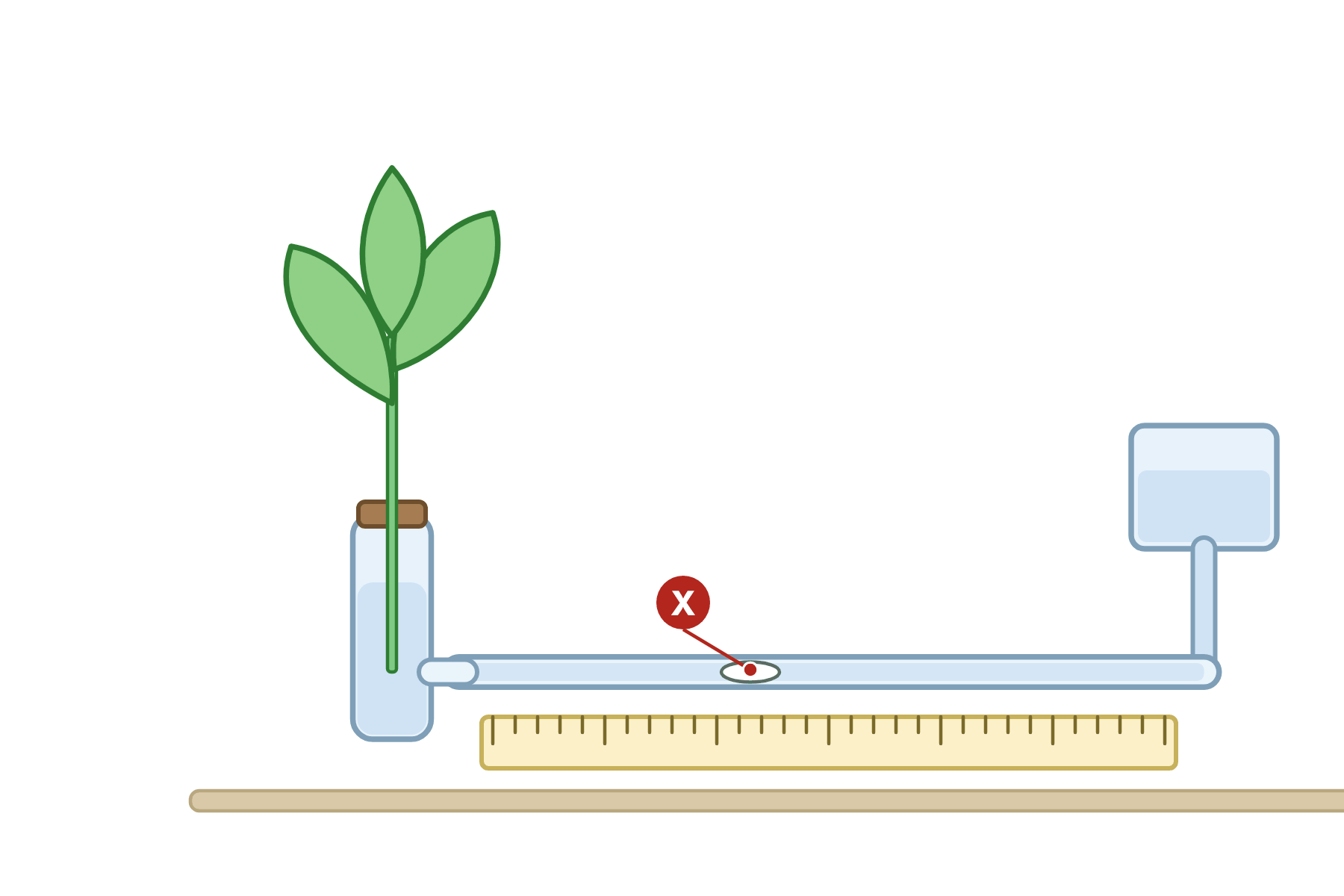 Name the part marked X and say what it shows.
 The air bubble. It moves along the capillary tube as the shoot takes up water, so its distance shows the water taken up.
-
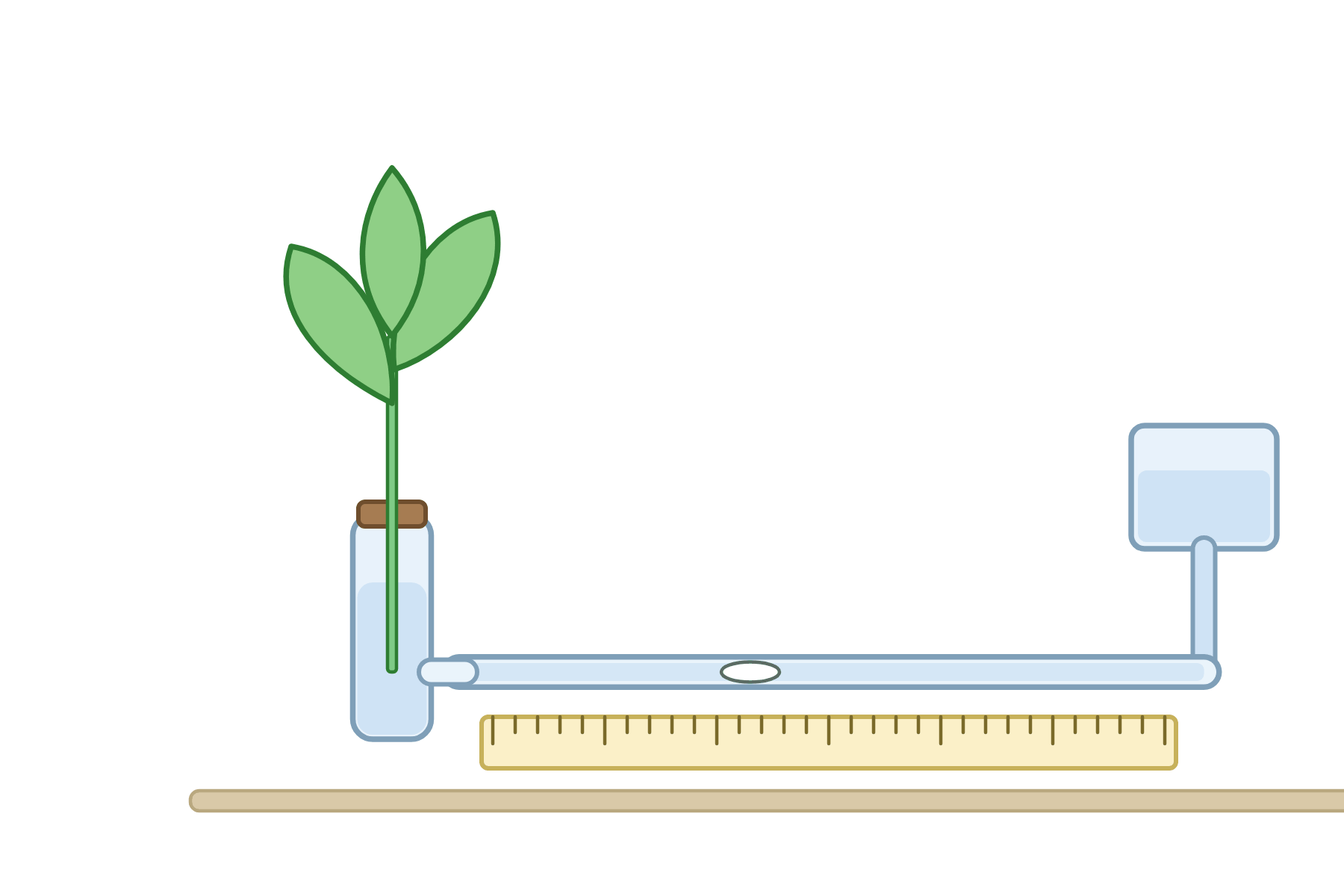 Label the parts of the potometer.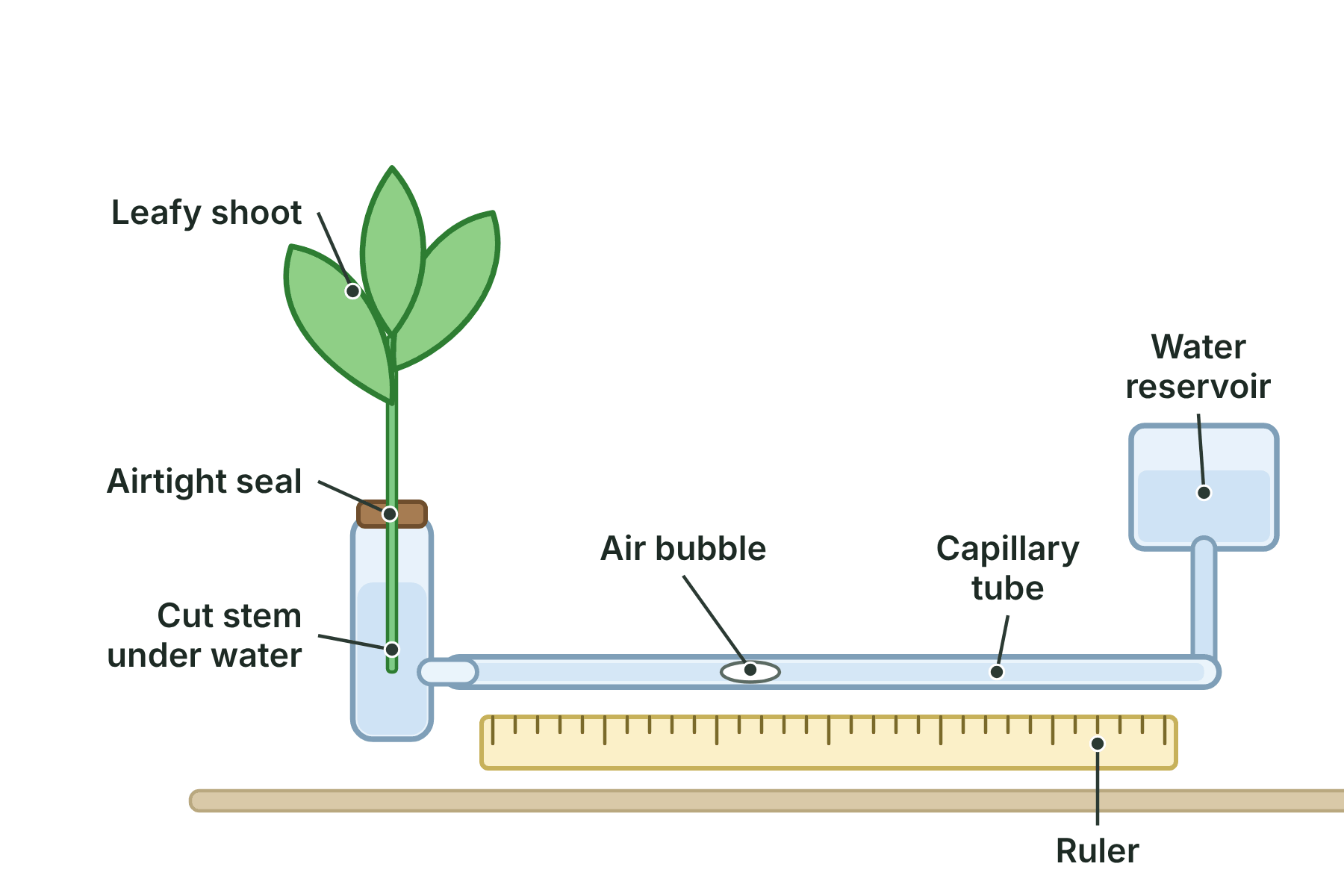
Leafy shoot, cut stem, airtight seal, air bubble, capillary tube, ruler and water reservoir.