Flashcards · Biology
Supplying the Cell
-
What is diffusion?
The spreading out of particles of a gas, or of a substance in solution, resulting in a net movement from a higher concentration to a lower concentration.
-
What does "net movement" mean?
The overall movement in one direction. Particles move both ways, but more move one way.
-
Does diffusion need energy from the cell?
No. The particles move on their own.
-
What is a concentration gradient?
The difference in concentration between two places.
-
Which way do particles move in diffusion?
From a higher concentration to a lower concentration, down the concentration gradient.
-
Name two gases that move by diffusion in gas exchange.
Oxygen and carbon dioxide.
-
Which waste product diffuses from cells into the blood plasma?
Urea.
-
What happens to urea once it is in the blood plasma?
The kidneys remove it so it can be excreted.
-
Which way does oxygen diffuse into a respiring cell, and why?
Into the cell, because oxygen is used up there, so its concentration is lower inside.
-
Why does carbon dioxide diffuse out of respiring cells?
Respiration makes it, so its concentration is higher inside the cell.
-
Name the three factors that affect the rate of diffusion.
The concentration gradient, the temperature, and the surface area of the membrane.
-
What happens to the rate of diffusion if the concentration gradient gets bigger?
It increases.
-
Why does diffusion speed up as temperature rises?
The particles have more energy and move faster.
-
Why does a larger surface area speed up diffusion?
More particles can cross the membrane at the same time.
-
When does diffusion stop?
Never for the particles themselves, but there is no net movement once they are evenly spread.
-
How do you calculate a rate?
Divide the amount that changed by the time it took.
-
A cell takes in 30 units in 6 minutes. What is the rate?
5 units per minute.
-
What keeps the concentration gradient steep in the alveoli?
Breathing brings fresh air in, and flowing blood carries oxygen away.
-
What is the usual mistake about diffusion?
Saying particles move only from high to low. They move both ways, but the net movement is from high to low.
-
Which process moves particles from low to high concentration?
Active transport, which needs energy.
-
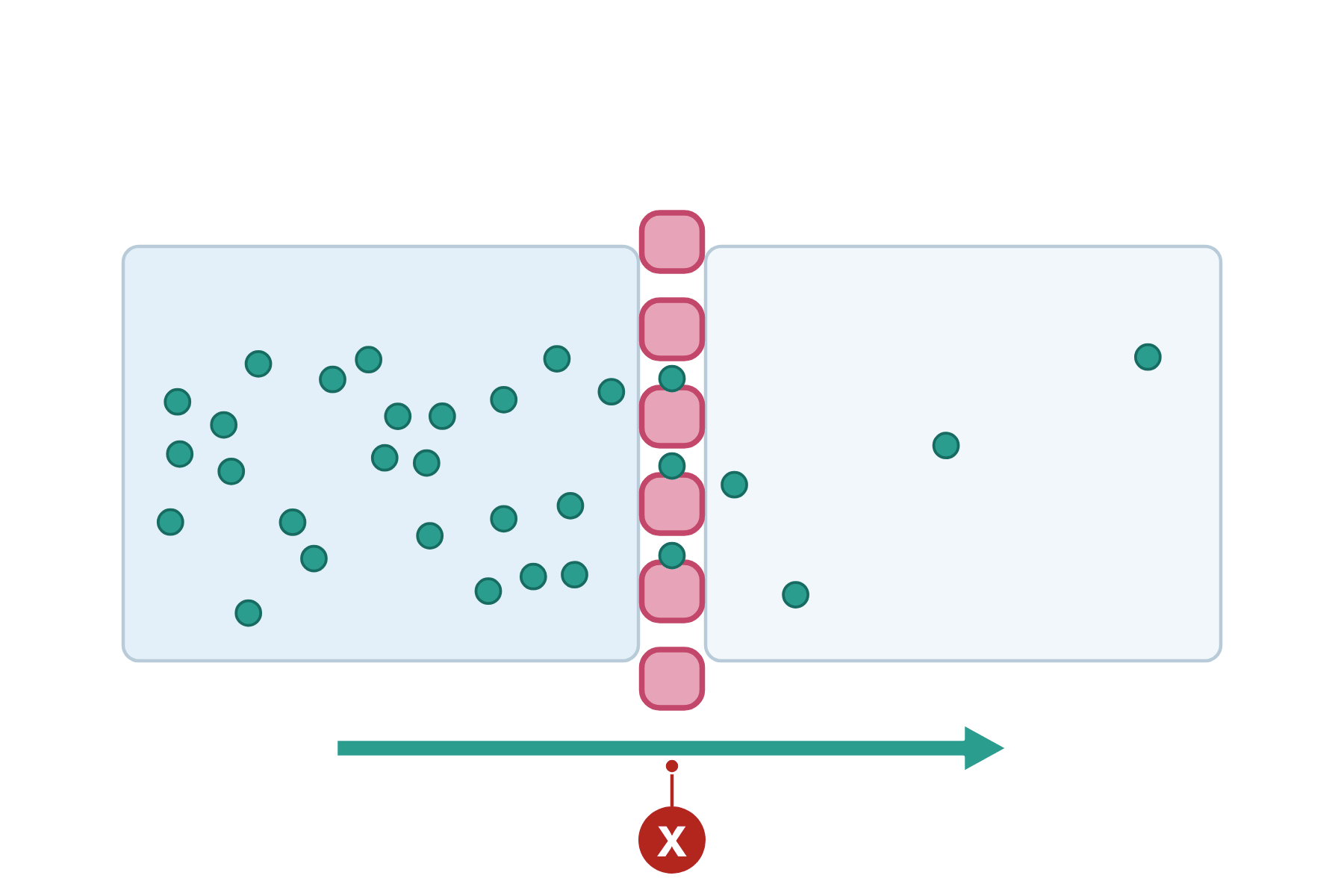 What does the arrow marked X show?
 The net movement of particles across the membrane, from the higher concentration to the lower concentration. This is diffusion.
-
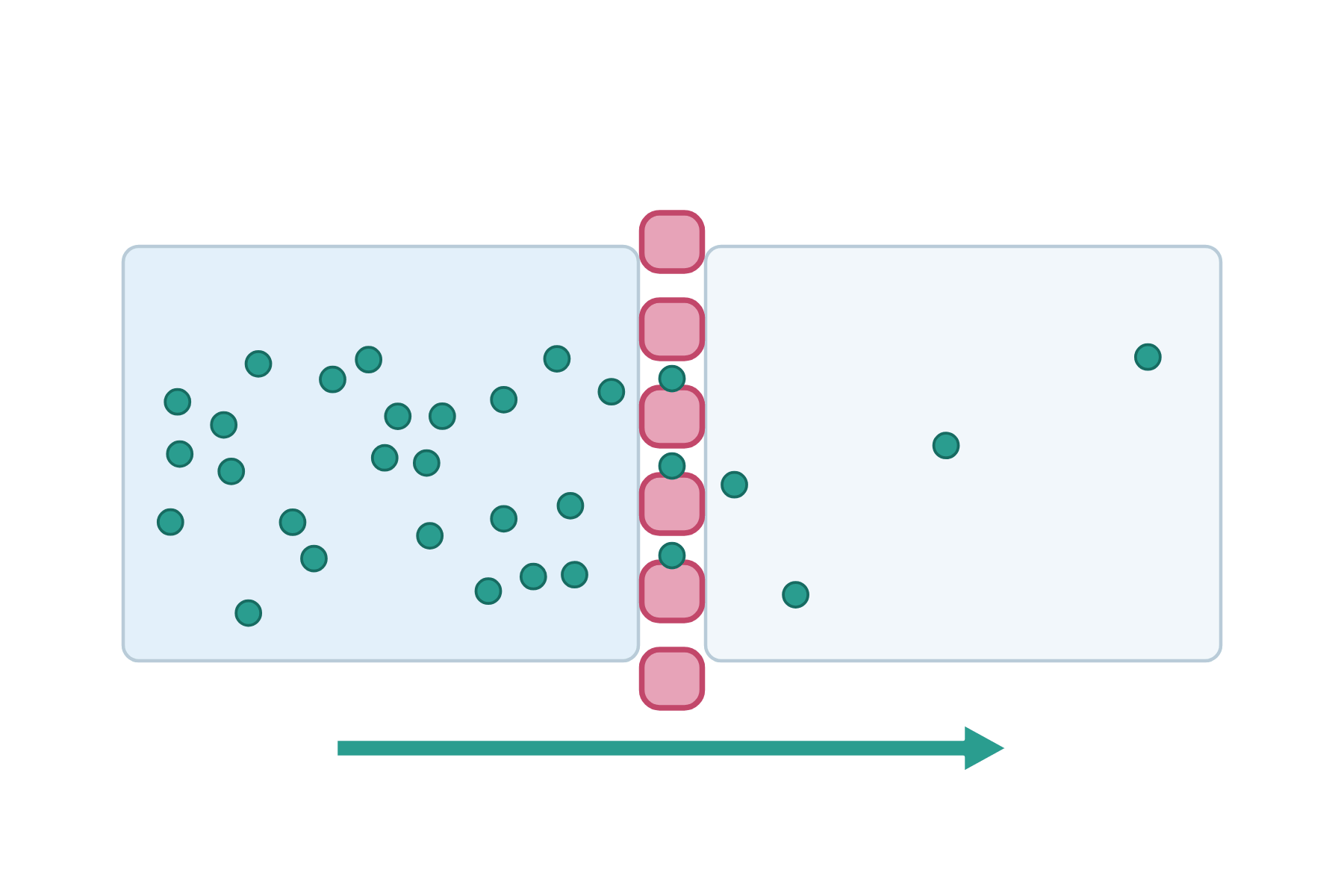 Label this diagram of diffusion across a cell membrane.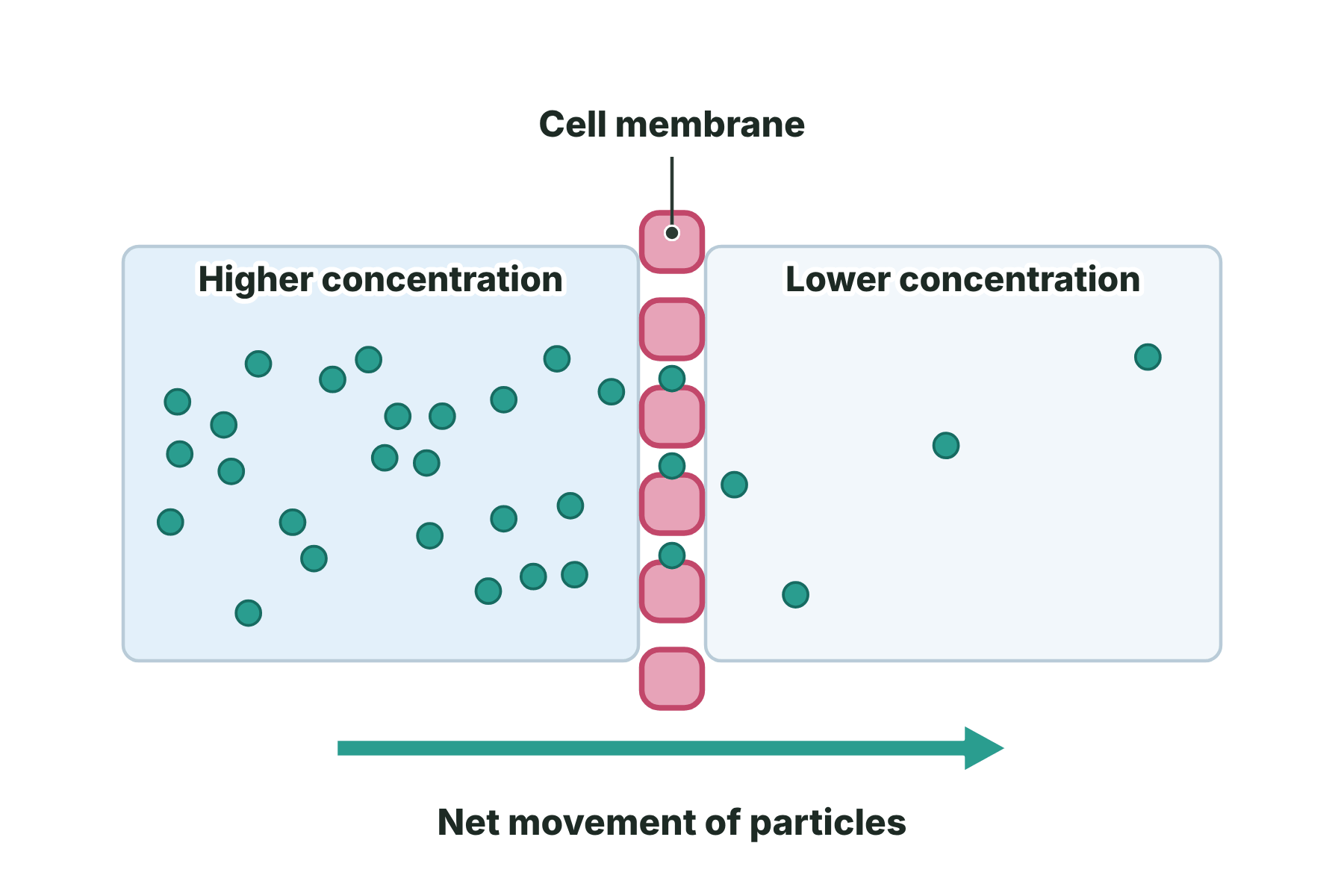
-
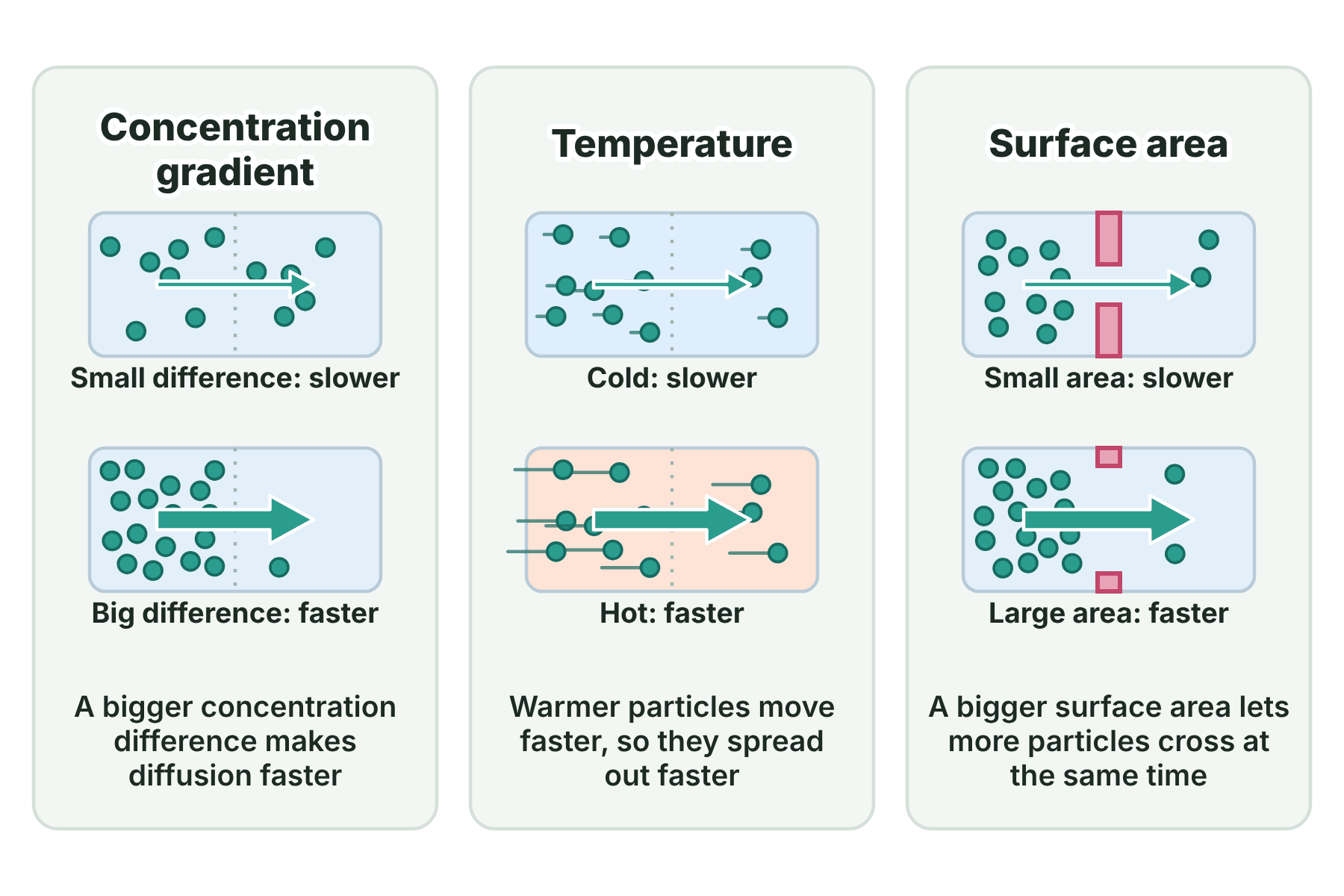 Which of these three changes make diffusion faster?
 All three: a bigger concentration gradient, a higher temperature and a larger surface area of membrane.
-
Which way does water move in terms of water potential?
From a region of higher water potential to a region of lower water potential.
-
Which has the higher water potential, a dilute or a concentrated solution?
A dilute solution.
-
What is osmosis?
The diffusion of water from a dilute solution to a concentrated solution through a partially permeable membrane.
-
What is a partially permeable membrane?
A membrane that lets small molecules such as water through, but not larger dissolved molecules.
-
In which direction does water move by osmosis?
From the more dilute solution to the more concentrated solution.
-
What is a dilute solution?
One with a low concentration of dissolved substance.
-
What is a concentrated solution?
One with a high concentration of dissolved substance.
-
What happens if two solutions have the same concentration?
There is no net movement of water.
-
Is osmosis a type of diffusion?
Yes. It is the diffusion of water through a partially permeable membrane.
-
What happens to a plant cell in a dilute solution?
Water enters by osmosis and the cell becomes turgid.
-
What does turgid mean?
Firm and swollen with water.
-
What stops a plant cell bursting in a dilute solution?
Its strong cell wall.
-
What happens to a plant cell in a concentrated solution?
Water leaves by osmosis and the cell becomes flaccid.
-
What does flaccid mean?
Soft and limp, because the cell has lost water.
-
What is plasmolysis?
When so much water leaves that the membrane pulls away from the cell wall.
-
Why does a plant wilt when it loses water?
Its cells go flaccid, so they cannot hold the stems and leaves up.
-
What happens to a red blood cell in pure water?
Water enters by osmosis, the cell swells and may burst.
-
Why can a red blood cell burst but a plant cell cannot?
An animal cell has no cell wall to resist the swelling.
-
What happens to an animal cell in a concentrated solution?
Water leaves by osmosis and the cell shrinks and shrivels.
-
Which way does water move if a cell is in a more dilute solution than its cell sap?
Into the cell.
-
What is the usual mistake about the direction of osmosis?
Saying water moves towards more water. It moves from more water (dilute) to less water (concentrated).
-
What is an isotonic drink?
One with the same concentration of dissolved substances as the body's fluids.
-
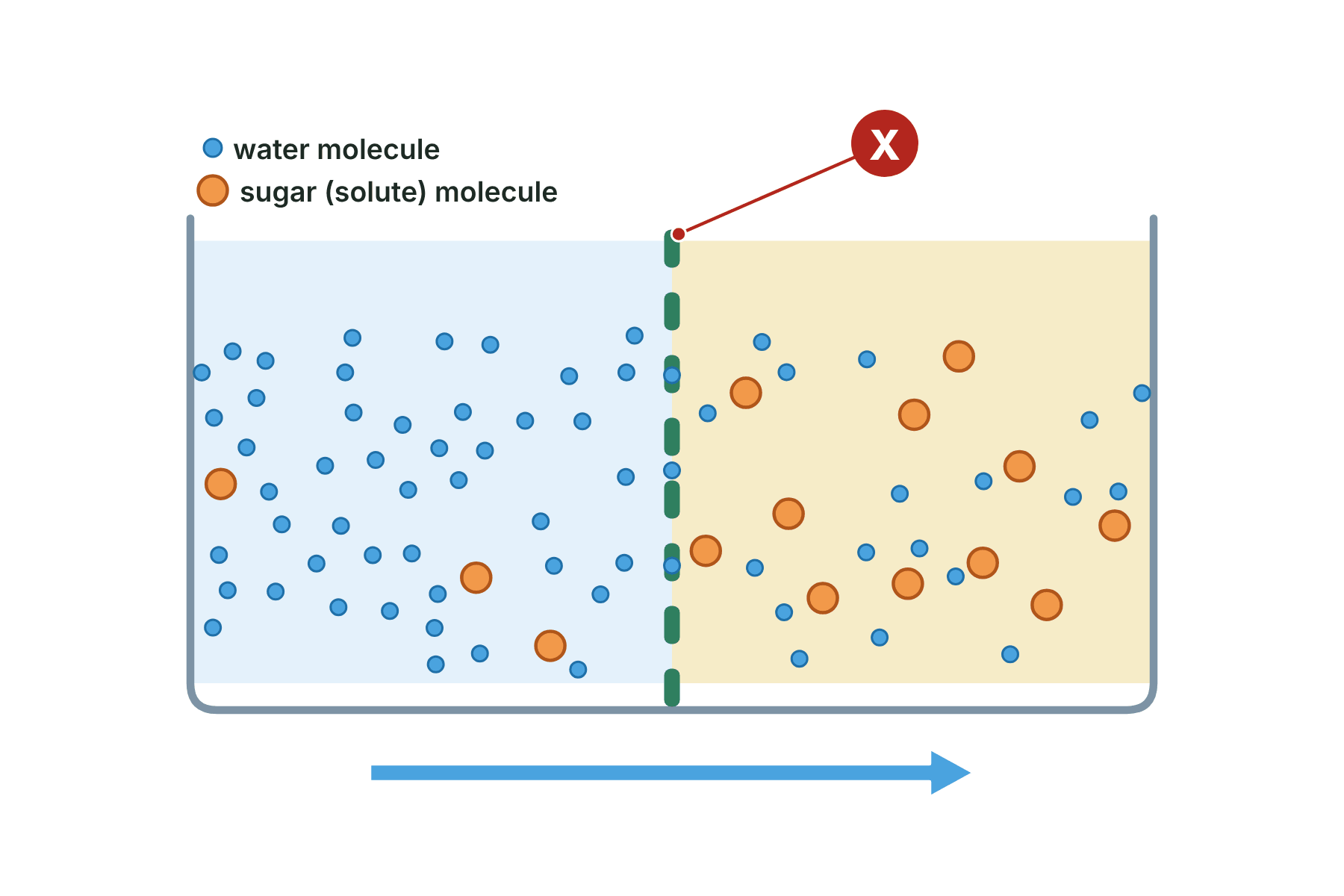 What is the structure marked X, and what does it let through?
 A partially permeable membrane. It lets small molecules such as water through, but not larger molecules such as sugar.
-
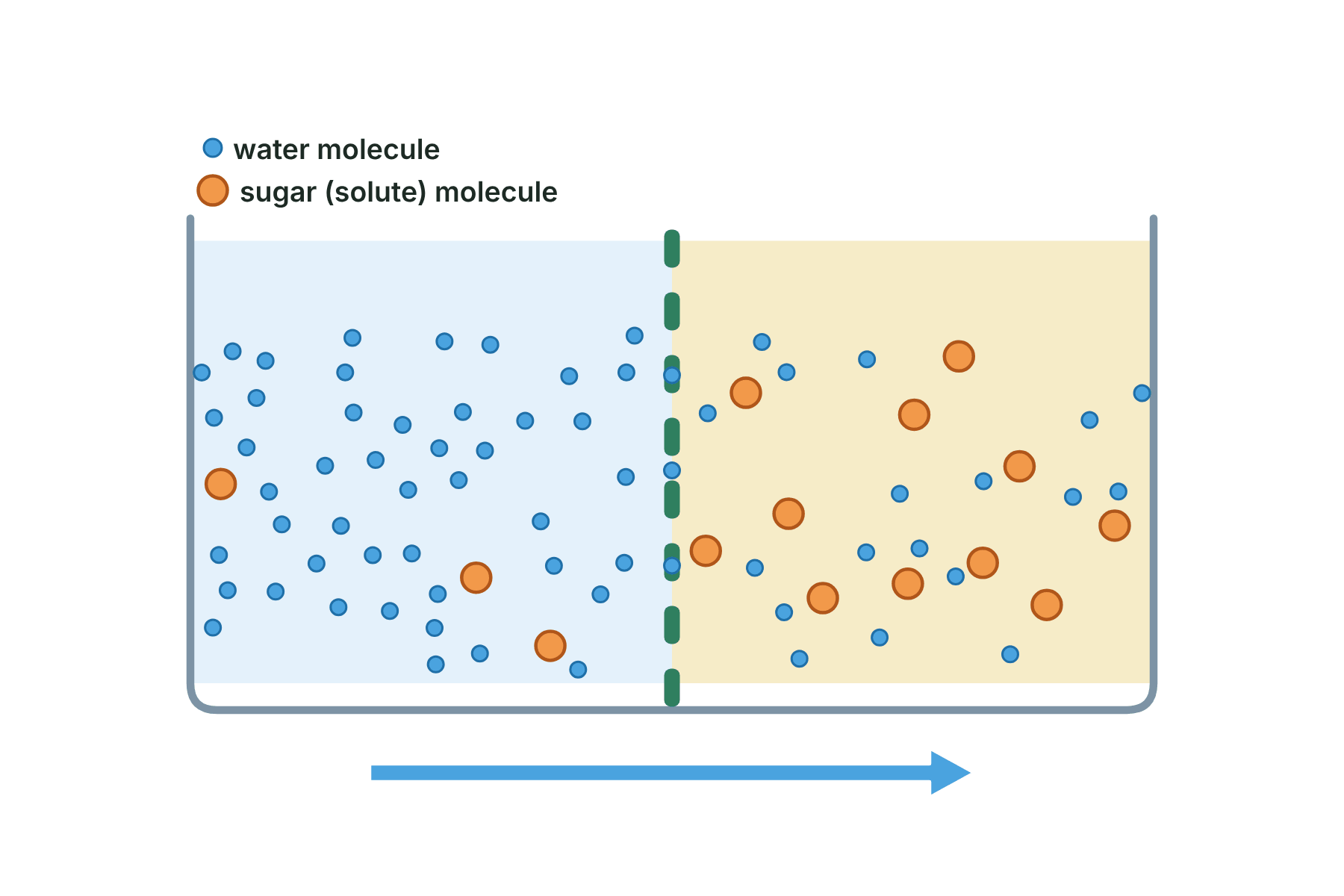 Label this diagram of osmosis and say which way the water moves.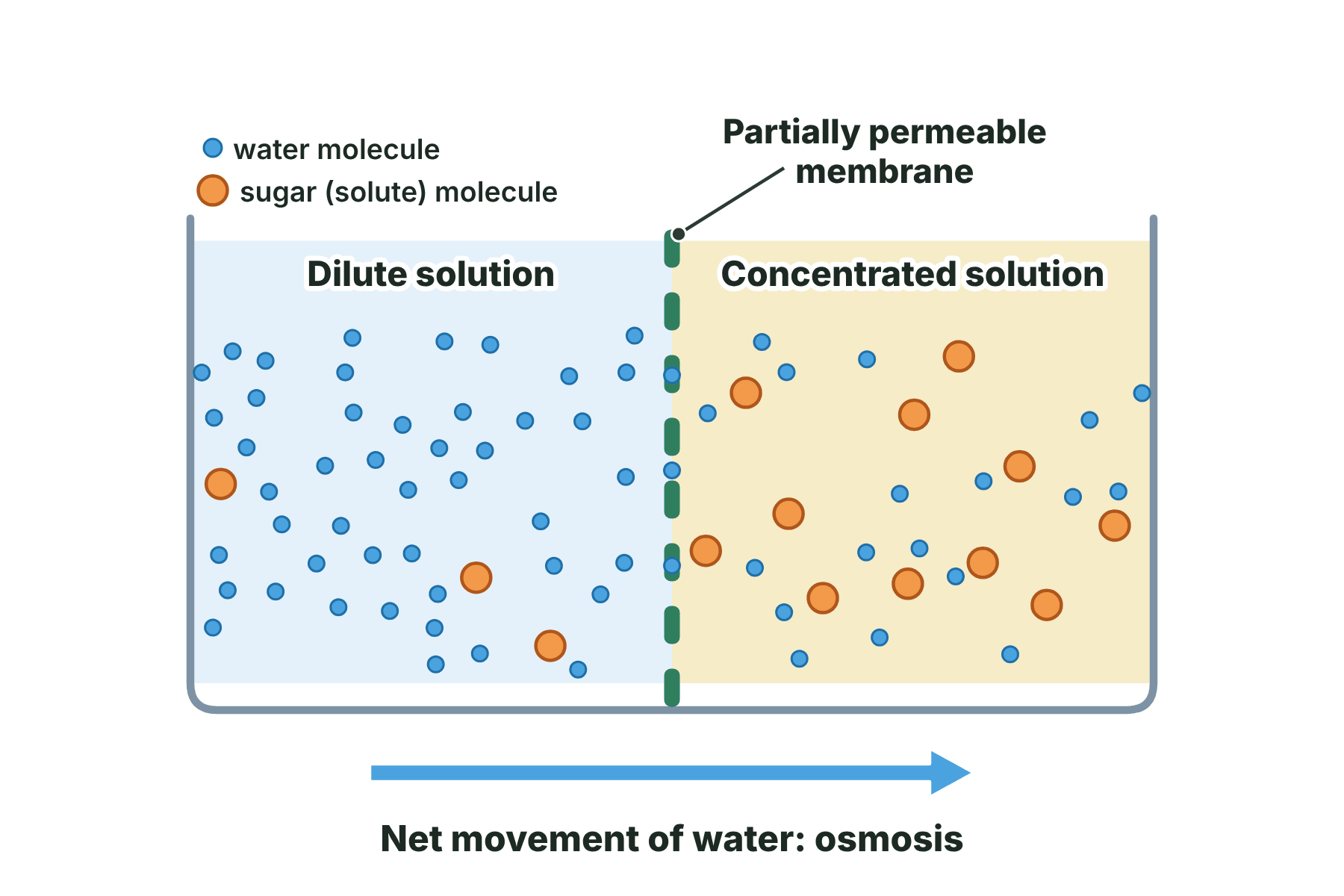
-
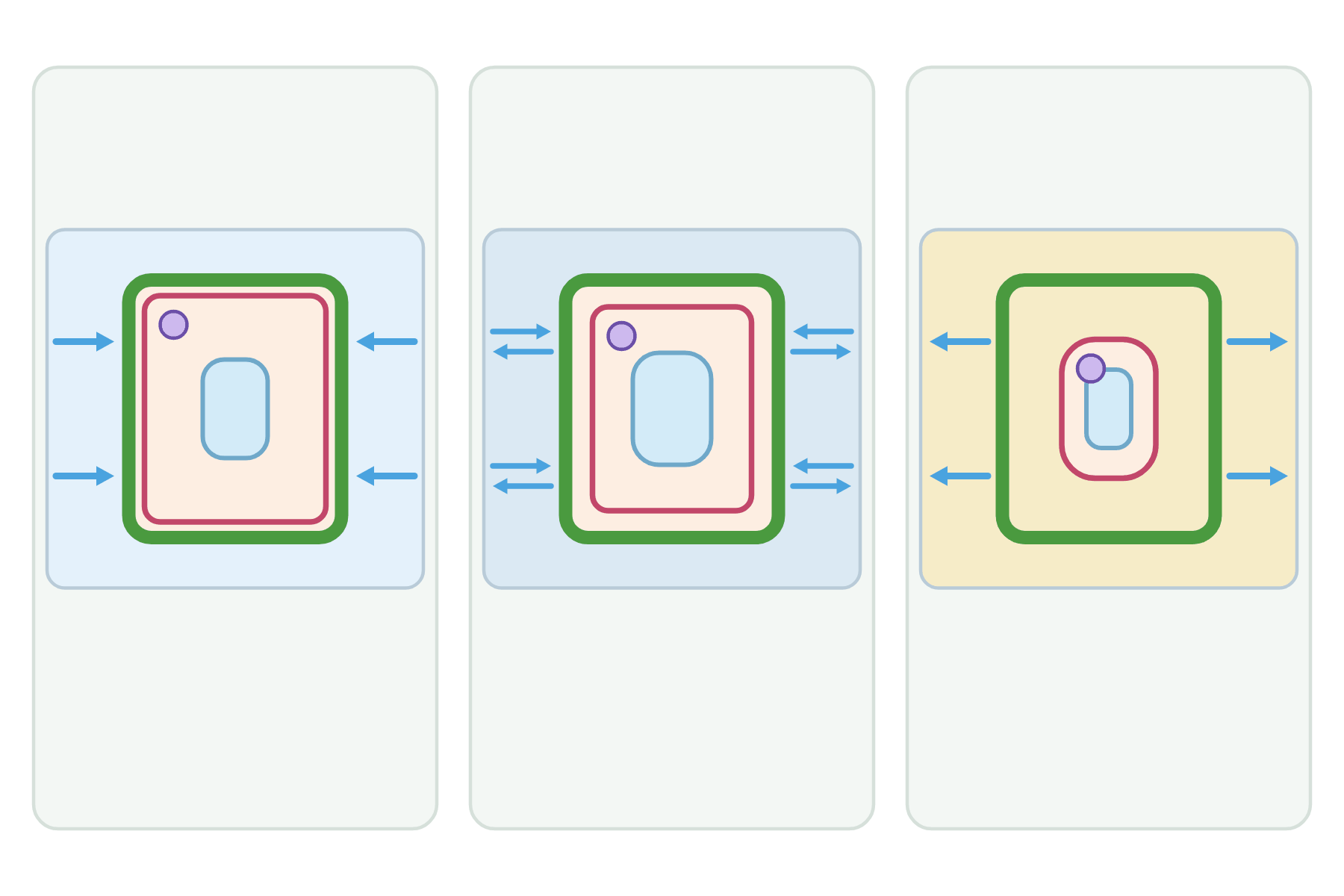 What will happen to a plant cell in each of these three solutions?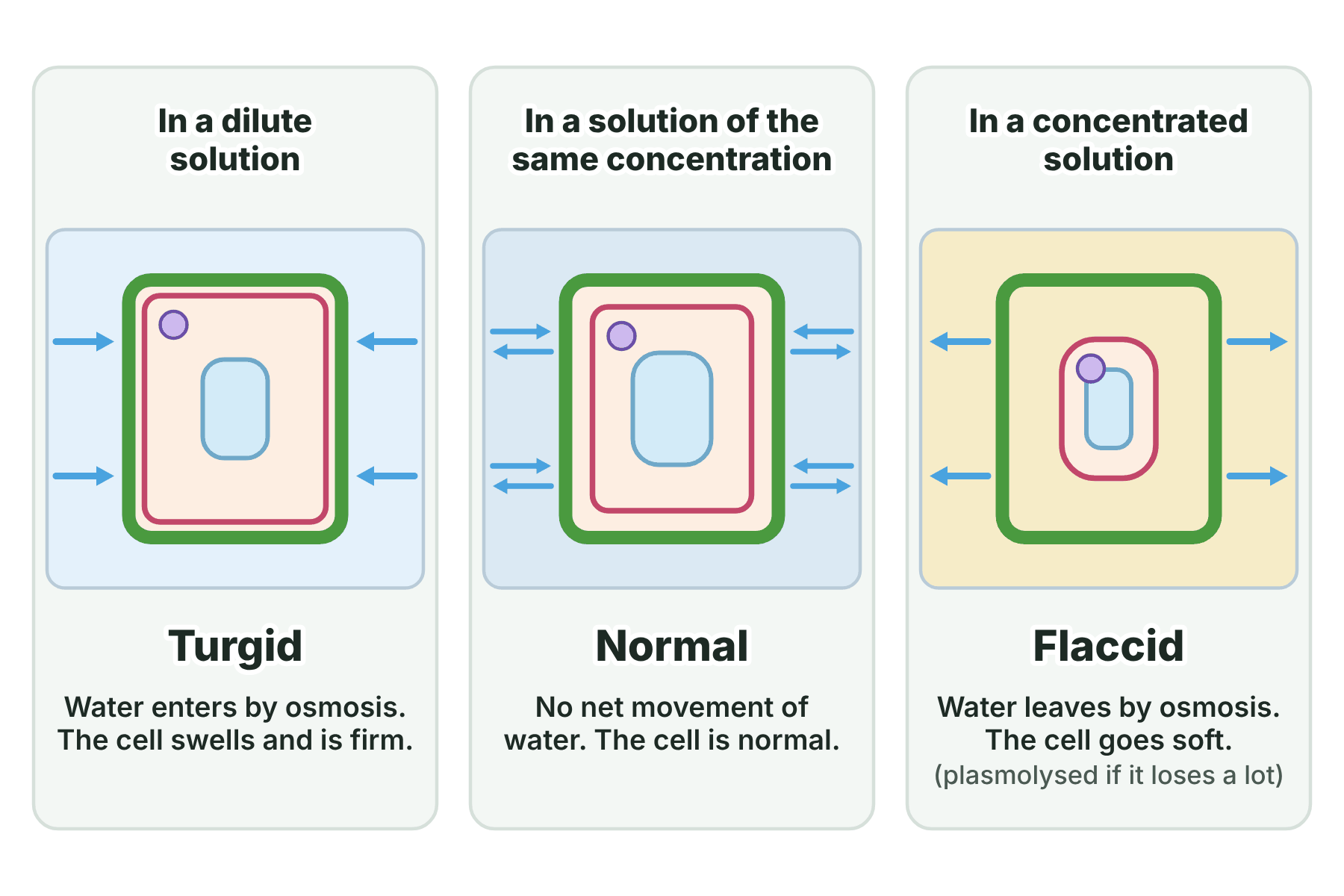
-
Describe what happens to a red blood cell in a dilute solution, in a solution of the same concentration and in a concentrated solution.
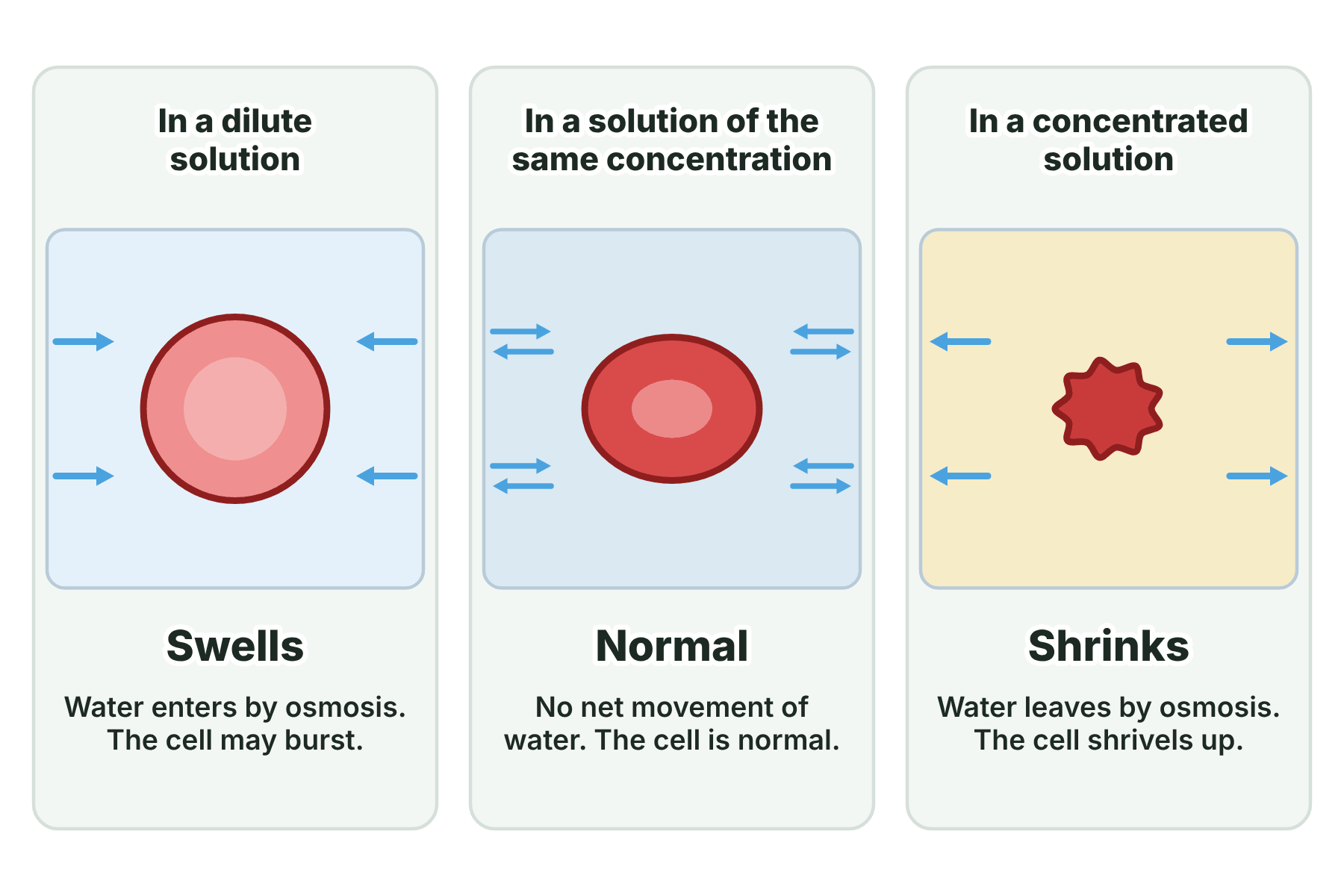
Dilute solution: water enters by osmosis, so the cell swells and may burst. Same concentration: no net movement of water, so it stays normal. Concentrated solution: water leaves by osmosis, so the cell shrinks.
-
What is the aim of the osmosis practical?
To investigate the effect of different concentrations of salt or sugar solution on the mass of plant tissue.
-
Why is potato used?
It is cheap, easy to cut into identical pieces, and made of cells with partially permeable membranes.
-
What tool cuts potato cylinders of equal width?
A cork borer.
-
What is the independent variable?
The concentration of the solution.
-
What is the dependent variable?
The percentage change in mass of the potato.
-
Name three control variables.
The size of the cylinders, the volume of solution, the time in solution (also the temperature and the type of potato).
-
Why do you blot the cylinders dry before weighing?
To remove liquid from the surface, which would add extra mass.
-
What is the formula for percentage change in mass?
(final mass − start mass) ÷ start mass × 100.
-
A cylinder goes from 2.00 g to 2.30 g. What is the percentage change?
+15%.
-
What does a negative percentage change mean?
The potato lost mass, because water left it by osmosis.
-
Why use percentage change and not just change in mass?
The cylinders start with slightly different masses, and percentages make the results fair to compare.
-
What does a gain in mass tell you about the solution?
It is more dilute than the potato cell sap.
-
What does a loss in mass tell you about the solution?
It is more concentrated than the potato cell sap.
-
What does it mean when the graph line crosses zero?
There is no change in mass, so the solution has the same concentration as the cell sap.
-
How do you find the concentration of the cell sap from the graph?
Read the concentration where the line crosses 0% change.
-
Why use pure water as one of the solutions?
It is the most dilute solution, and shows the most water entering the potato.
-
How can you make the results more reliable?
Repeat the test with several cylinders and calculate a mean.
-
What is an anomalous result?
A result that does not fit the pattern of the others.
-
How could you find the cell sap concentration more accurately?
Use extra solutions of concentrations close to where the line crosses zero.
-
Give one safety precaution.
Cut on a tile, with the blade pointing away from your hands.
-
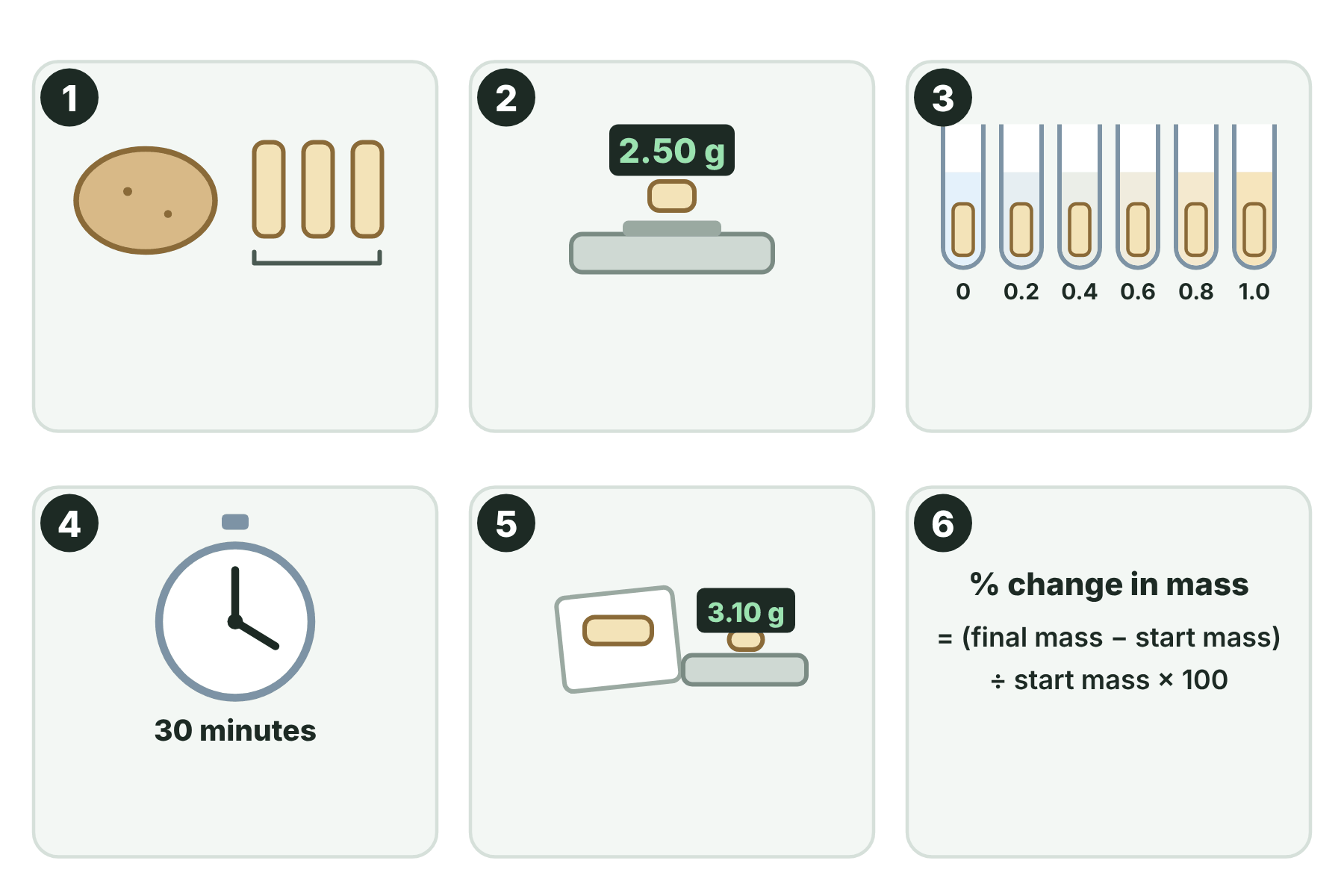 Describe the six steps of the potato osmosis investigation.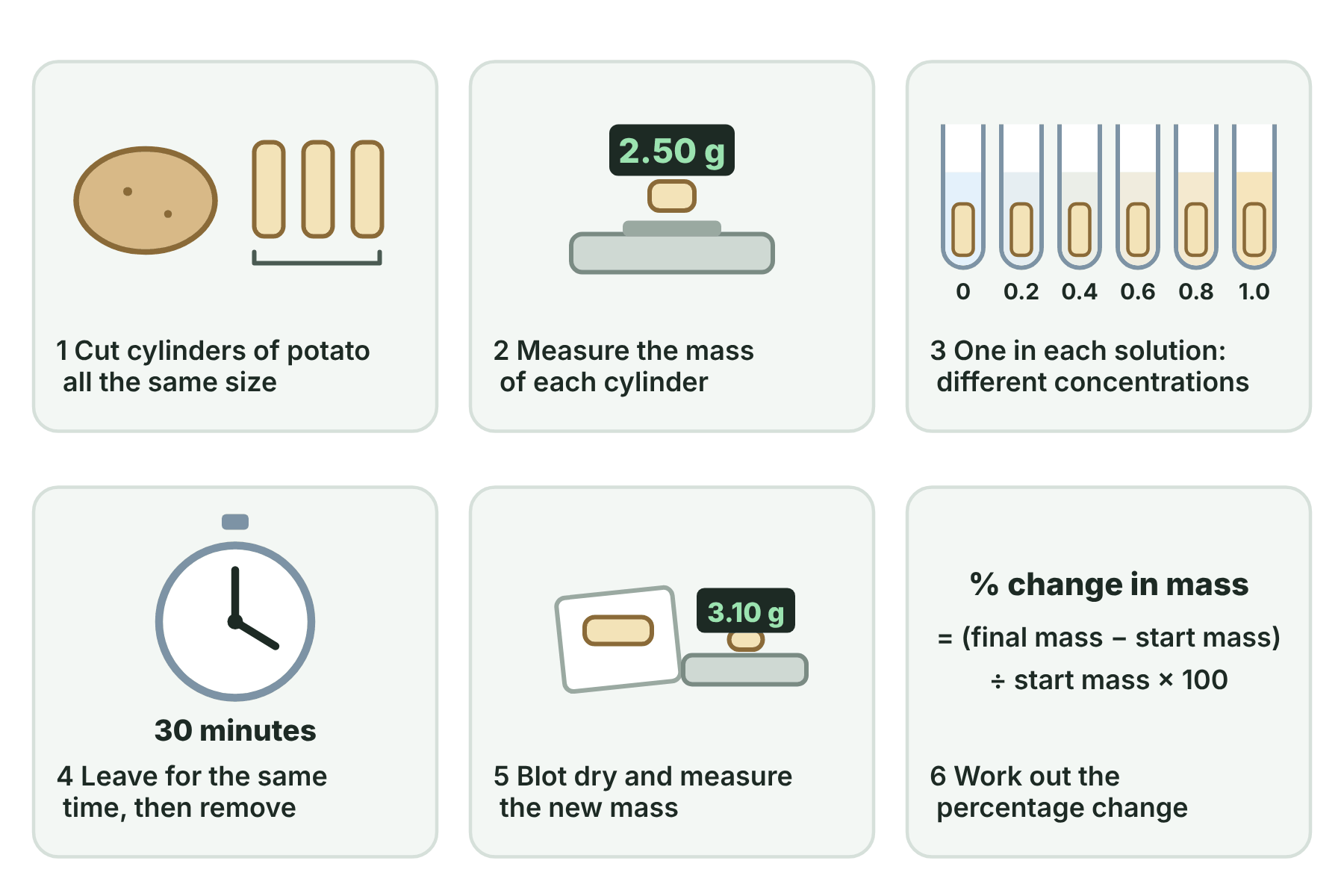
-
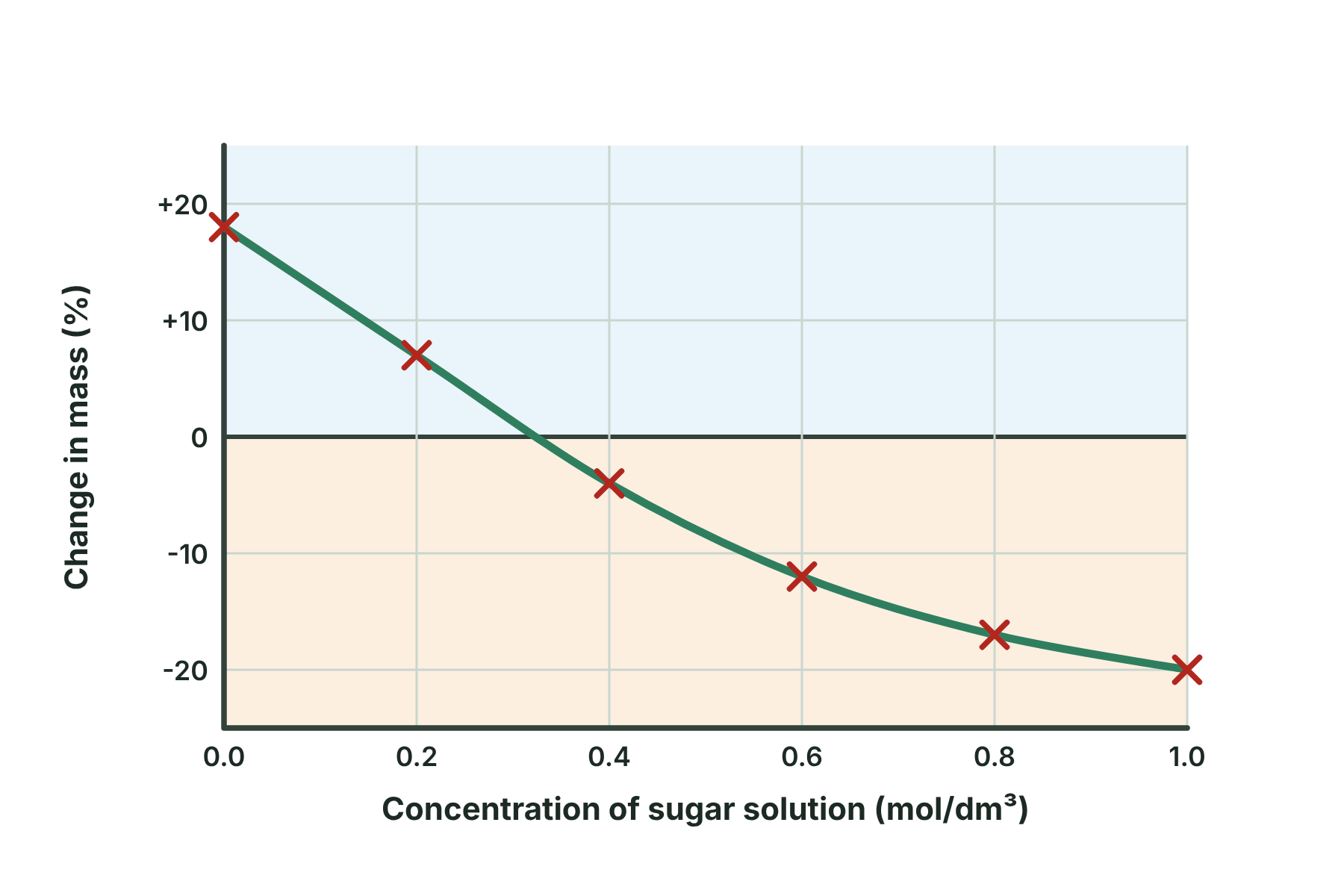 Read the concentration of the potato cell sap from this graph.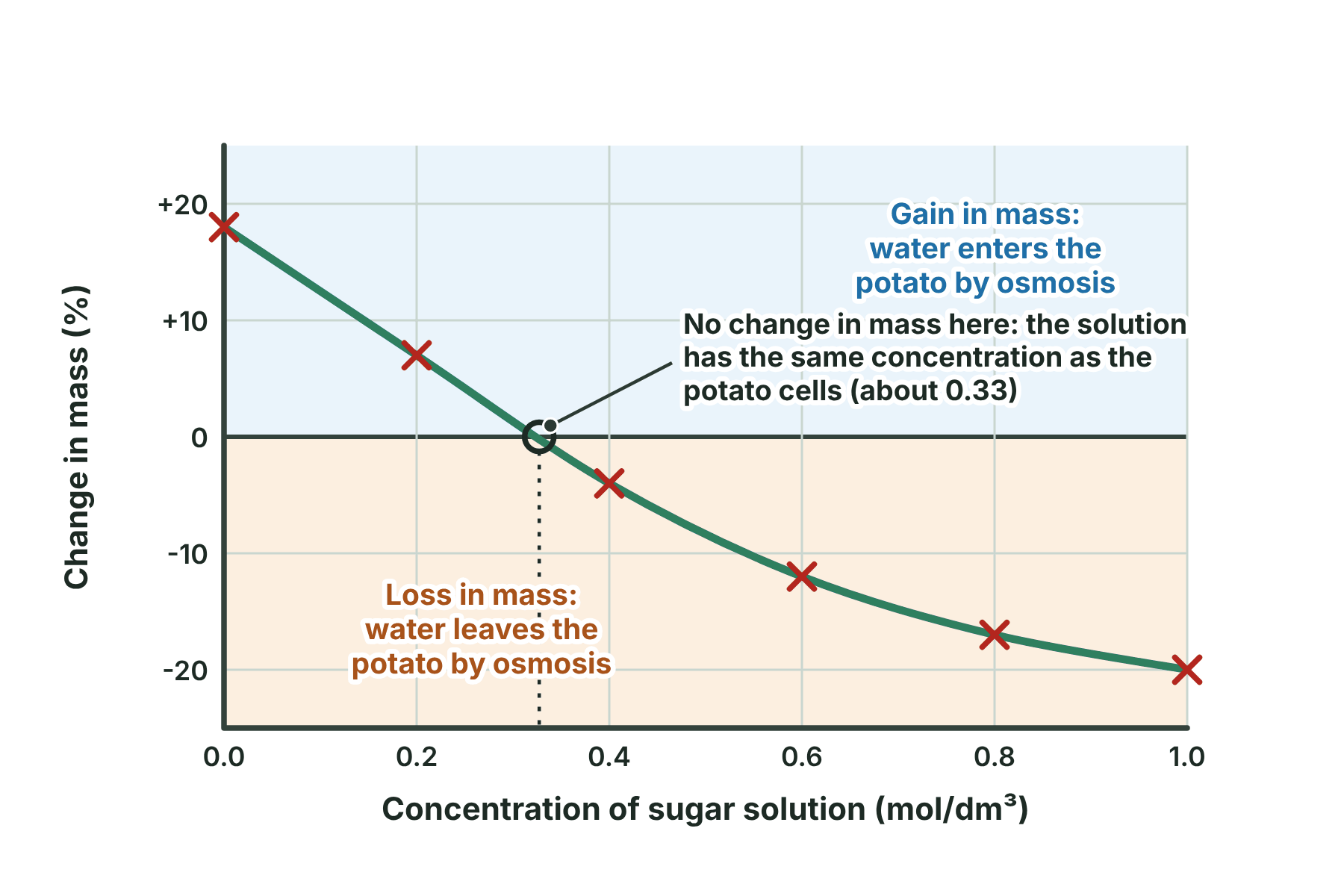
About 0.33 mol/dm³: where the line crosses 0% change, so there is no net movement of water.
-
A cylinder goes from 3.20 g to 2.72 g. What is the percentage change in mass?
−15%. The change is 2.72 − 3.20 = −0.48 g, then −0.48 ÷ 3.20 × 100 = −15%.
-
What is active transport?
The movement of substances from a more dilute to a more concentrated solution, against a concentration gradient, using energy from respiration.
-
What does active transport need?
Energy from respiration.
-
Does active transport move substances up or down the concentration gradient?
Up it: from low concentration to high concentration.
-
Which sub-cellular structures release the energy for active transport?
Mitochondria.
-
Why do cells that do a lot of active transport have many mitochondria?
They release the energy from respiration that active transport needs.
-
What is a carrier protein?
A protein in the cell membrane that picks up a particular substance and moves it across.
-
Give an example of active transport in plants.
Mineral ions being taken into root hair cells from the dilute soil solution.
-
Why do plants need mineral ions?
For healthy growth. For example nitrate for proteins and magnesium for chlorophyll.
-
Why can't root hair cells take up ions by diffusion?
The ions are at a lower concentration in the soil than in the cell.
-
Give an example of active transport in animals.
Sugar being absorbed from the gut into the blood.
-
Why is active transport needed to absorb sugar from the gut?
Sometimes the concentration of sugar in the gut is lower than in the blood.
-
Why must the body absorb sugar?
Sugar molecules are used for cell respiration.
-
What happens to active transport if a cell stops respiring?
It stops, because there is no energy.
-
Why does waterlogged soil reduce ion uptake?
Less oxygen means less respiration, so less energy for active transport.
-
How does active transport differ from diffusion?
It goes against the concentration gradient and needs energy. Diffusion goes down the gradient and needs none.
-
Which processes need no energy from the cell?
Diffusion and osmosis.
-
Which process moves only water?
Osmosis.
-
What does "against the concentration gradient" mean?
From a lower concentration to a higher concentration.
-
What is the usual mistake about active transport?
Saying it is the same as diffusion, or forgetting that it needs energy.
-
Is a ball rolling uphill a good picture of diffusion or active transport?
Active transport: it takes energy to push it up.
-
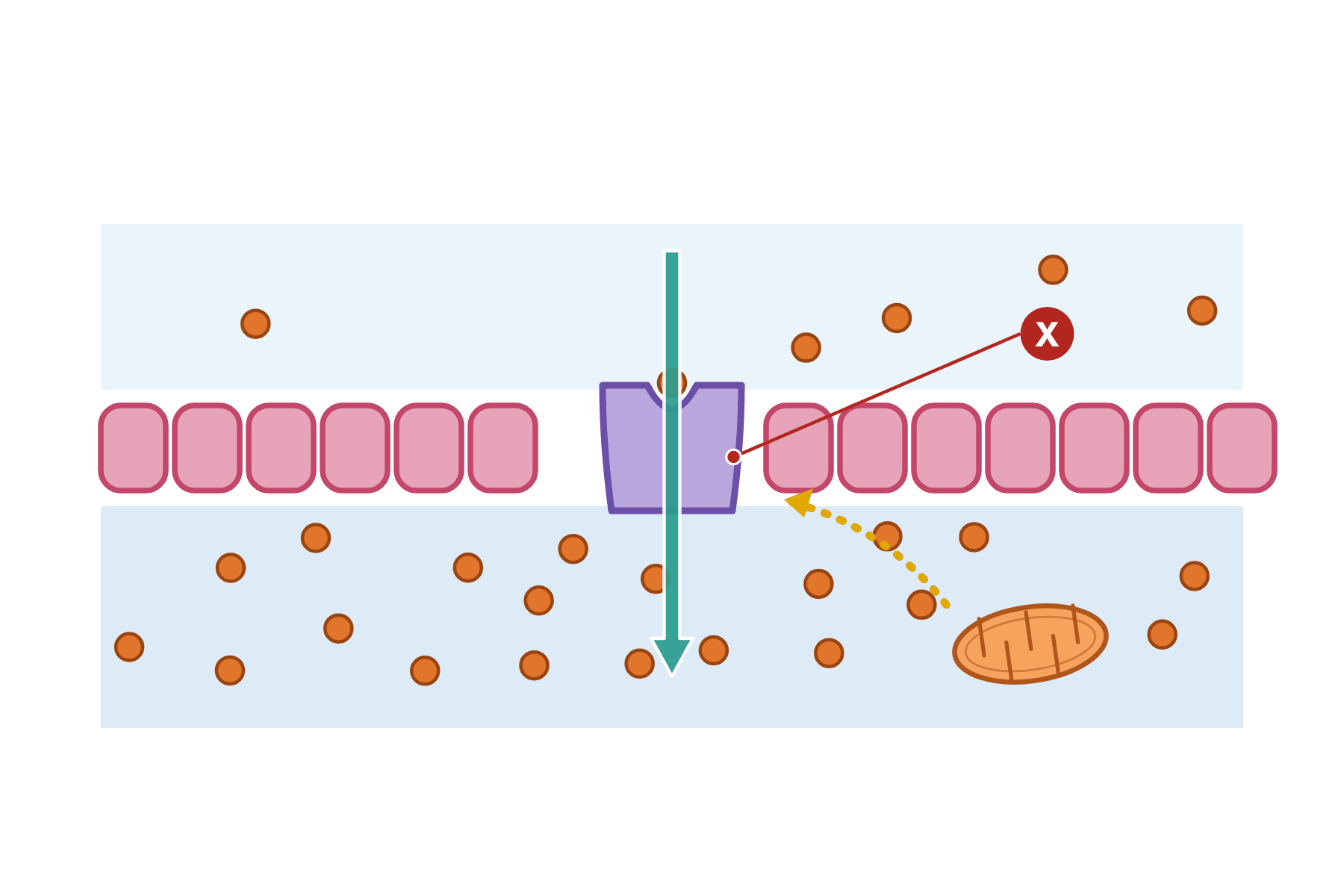 What is the structure marked X, and what does it do?
 A carrier protein. It picks up a substance and moves it across the cell membrane, against the concentration gradient, using energy from respiration.
-
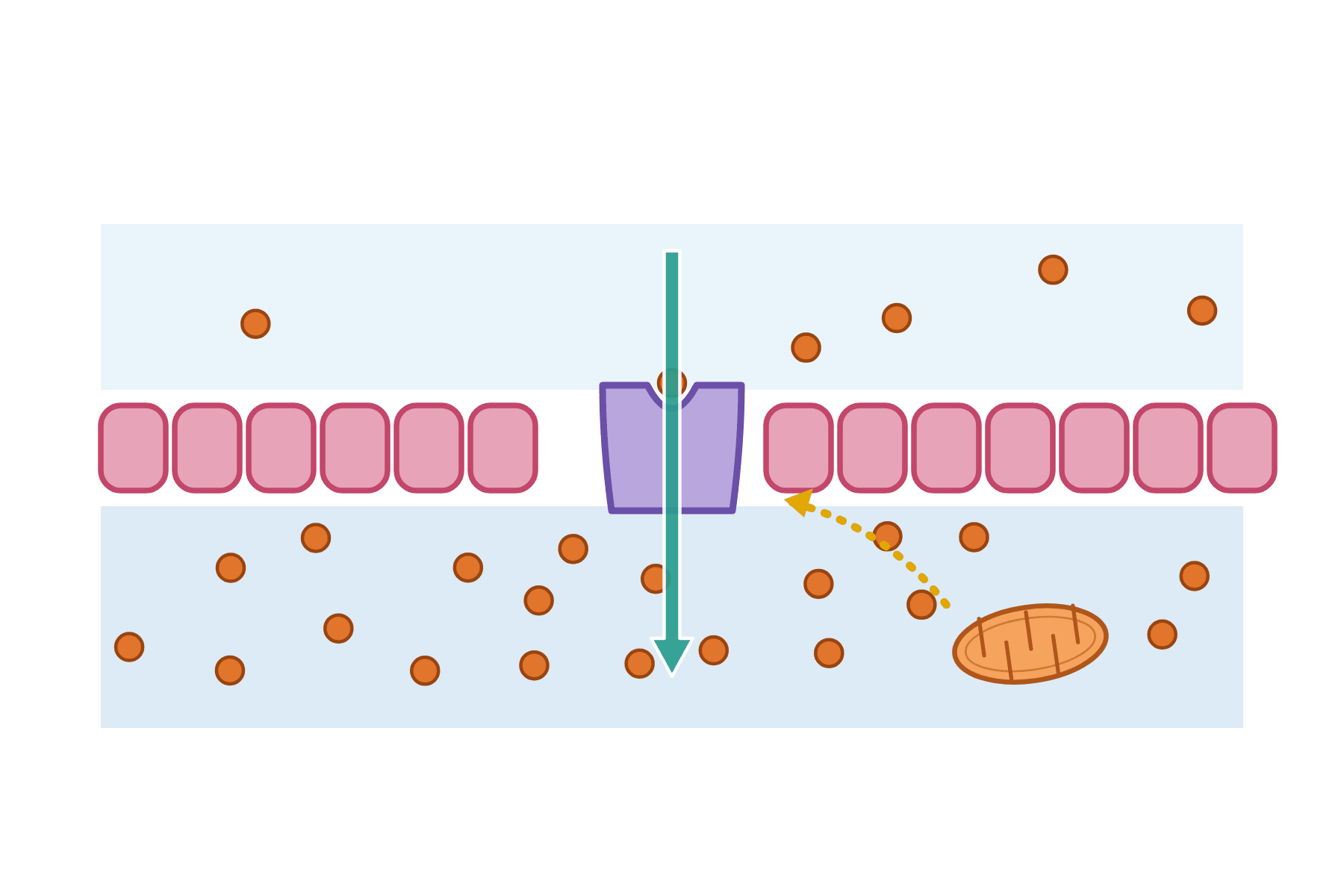 Label this diagram of active transport and say what the mitochondrion is for.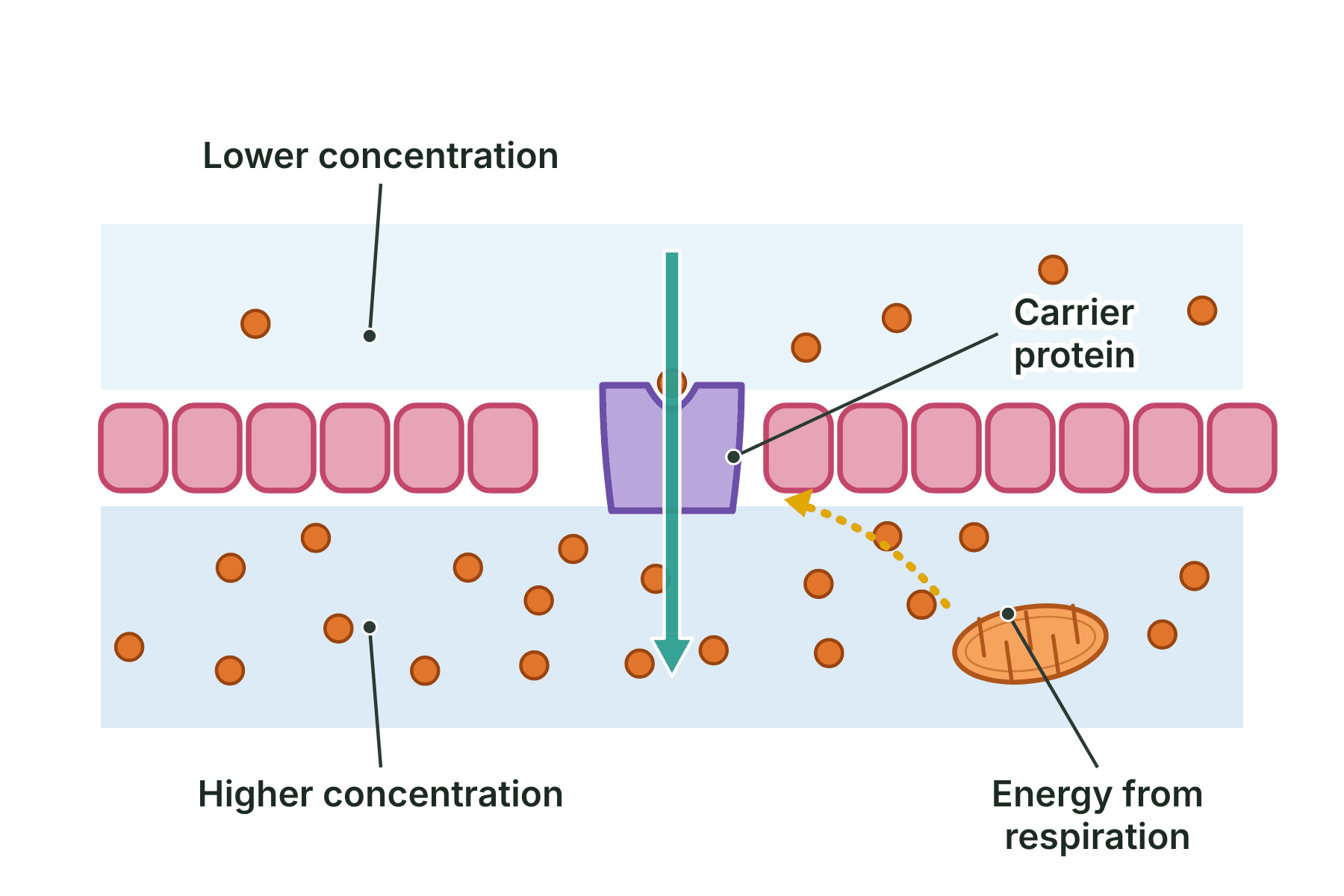
-
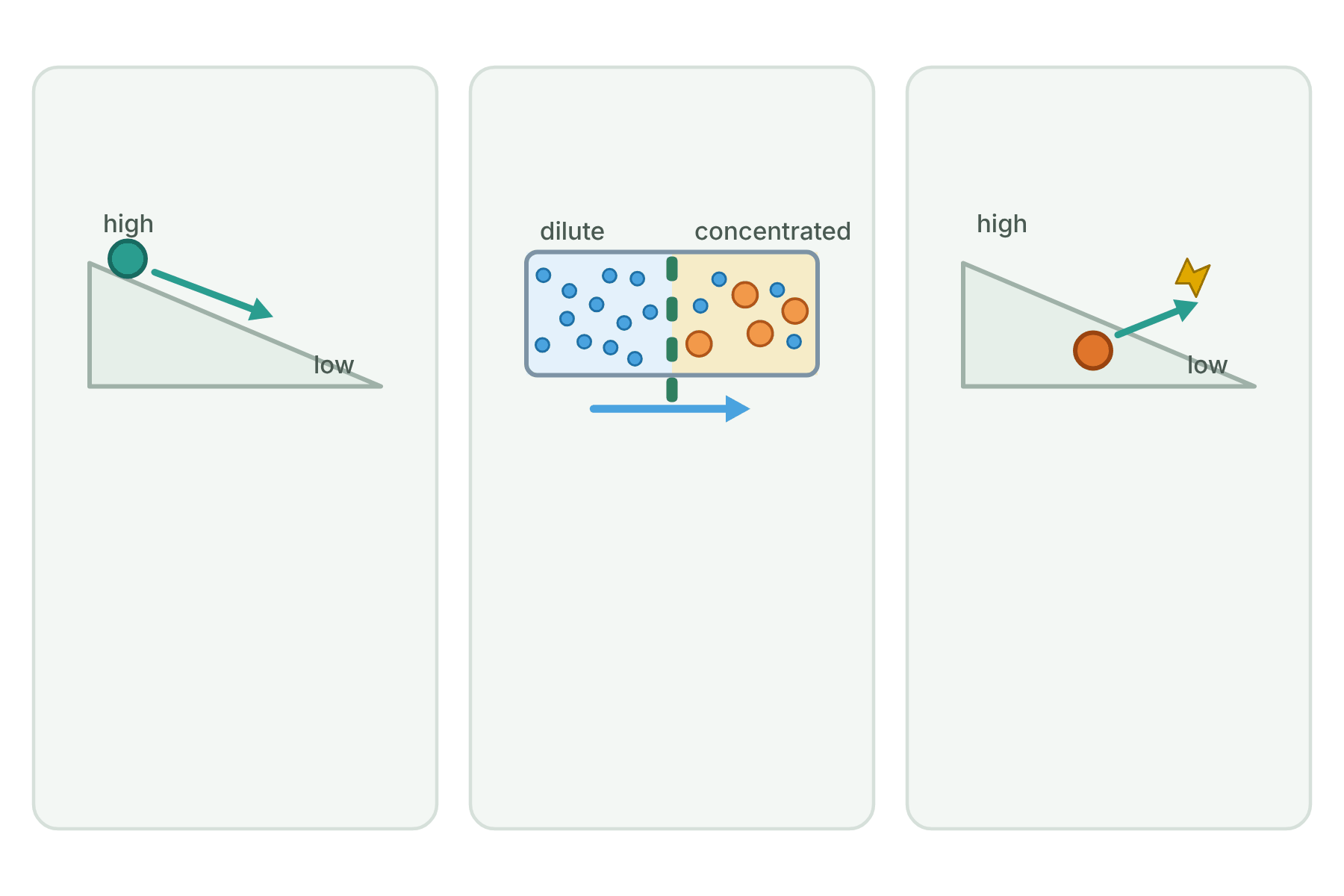 Name each process and say which needs energy.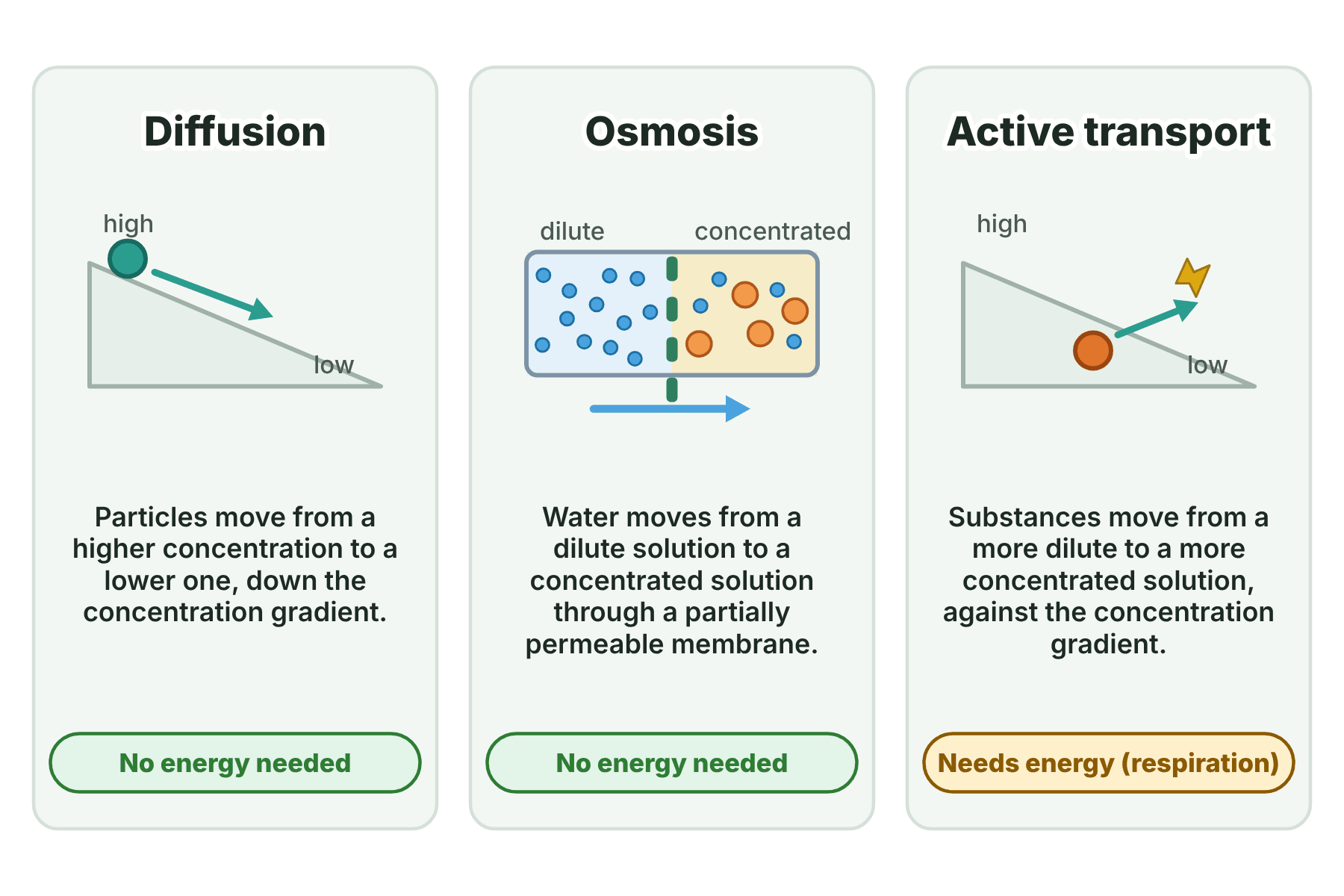
-
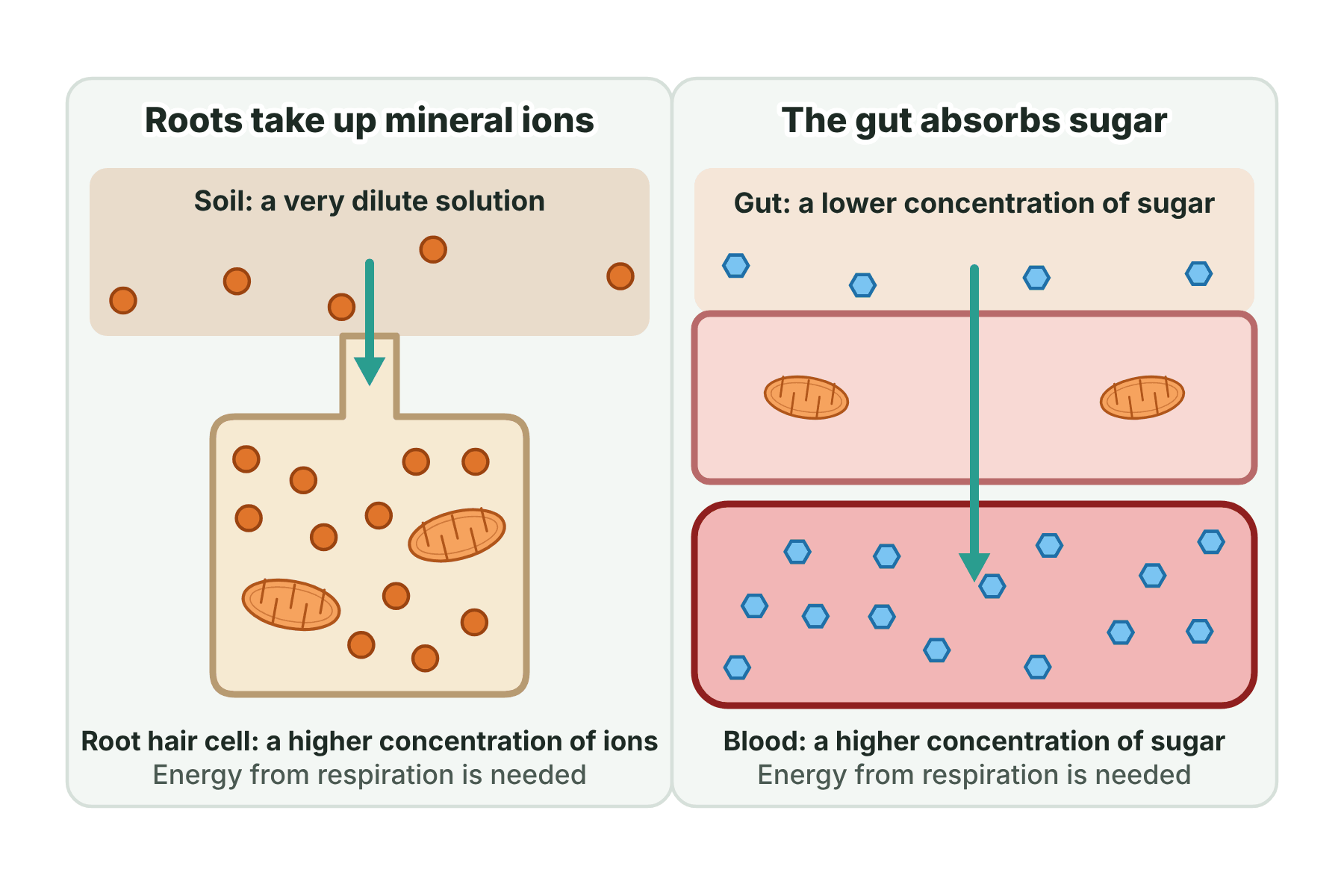 Why can't a root hair cell take in mineral ions by diffusion?
 The mineral ions are at a lower concentration in the soil than in the root hair cell, so they would diffuse out. Active transport moves them in against the gradient, using energy from respiration.
-
What is the cell cycle?
The series of stages a cell goes through to grow, copy its DNA and divide.
-
What are the three stages of the cell cycle?
Growth and DNA replication, mitosis, and division of the cytoplasm and cell membrane.
-
What does the cell grow and make more of before it divides?
Sub-cellular structures such as ribosomes and mitochondria.
-
What happens to the DNA before mitosis?
It replicates, giving two identical copies of each chromosome.
-
What happens to the chromosomes in mitosis?
One set is pulled to each end of the cell, and the nucleus divides.
-
What happens at the end of the cell cycle?
The cytoplasm and cell membrane divide, forming two identical cells.
-
How many cells does mitosis make from one cell?
Two.
-
A human body cell has 46 chromosomes. How many does each cell have after mitosis?
46.
-
What does genetically identical mean?
Having exactly the same genes.
-
Give three reasons why mitosis is important.
Growth and development, repair, and replacement of cells (also asexual reproduction).
-
Which stage of the cell cycle takes the longest?
Stage 1, growth and DNA replication.
-
How many cells are there after 5 divisions, starting from one cell?
32, because \(2^{5} = 32\).
-
What do we call organisms made by mitosis from a single parent?
Clones: they are genetically identical to the parent.
-
Do you need the names of the phases inside mitosis for AQA?
No. You need the three overall stages and what happens in mitosis.
-
Why must the DNA be copied before a cell divides?
So that each new cell gets a full set of chromosomes.
-
What common mistake is made about identical cells?
Saying the cells are identical to the parent in size or shape. It is the genes that are identical.
-
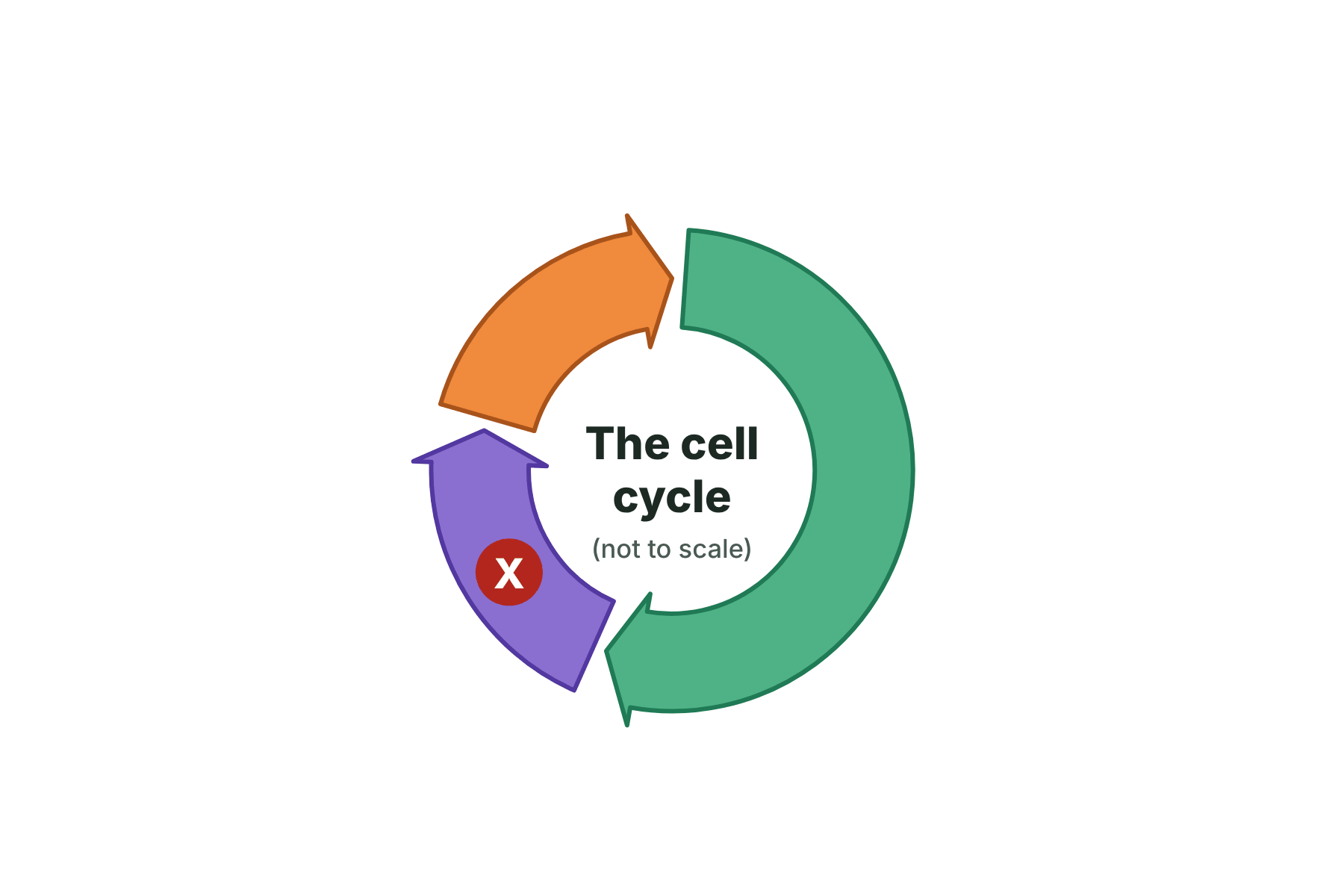 Which stage of the cell cycle is marked X, and what happens in it?
 Mitosis. One set of chromosomes is pulled to each end of the cell, and the nucleus divides.
-
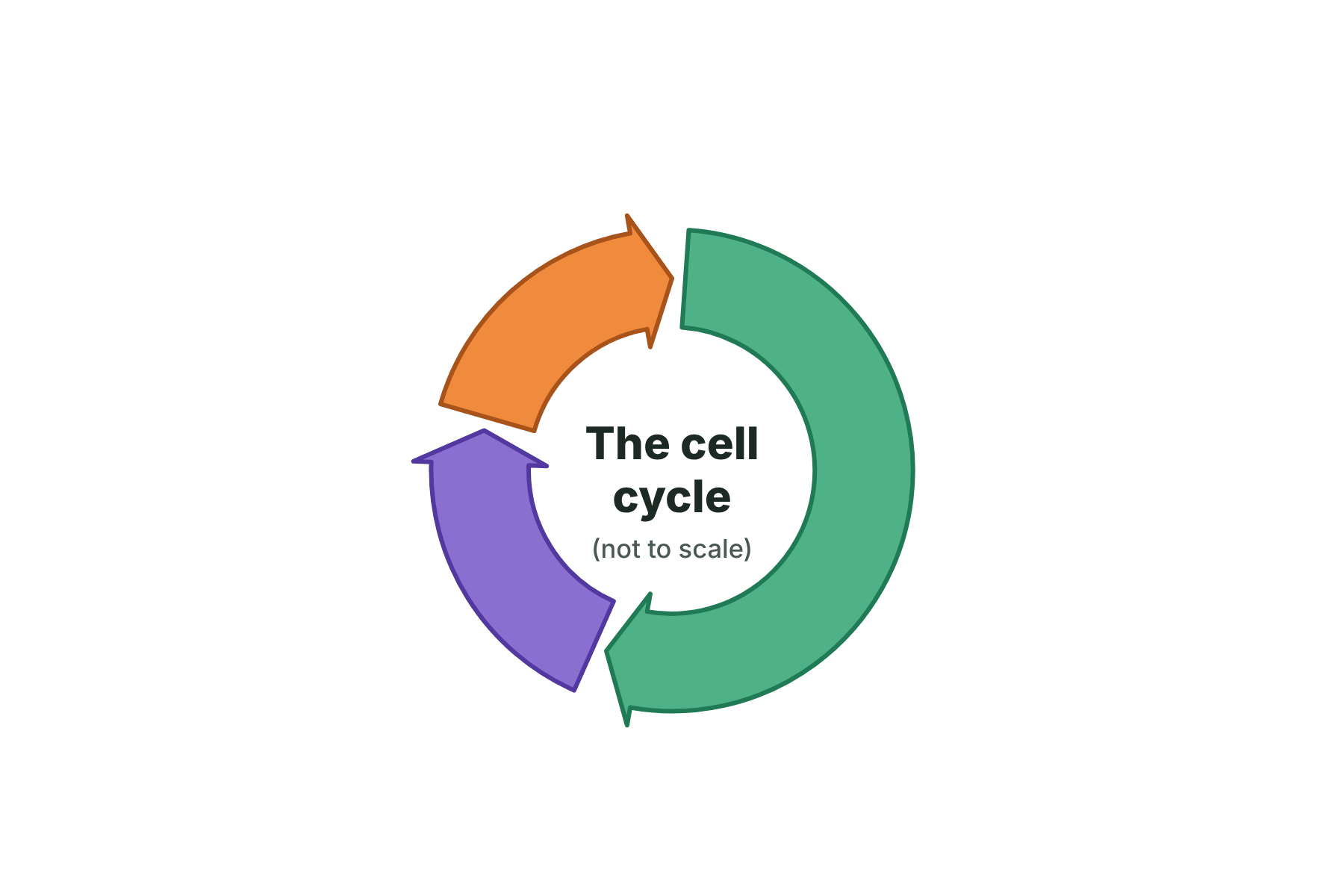 Name and describe the three stages of the cell cycle.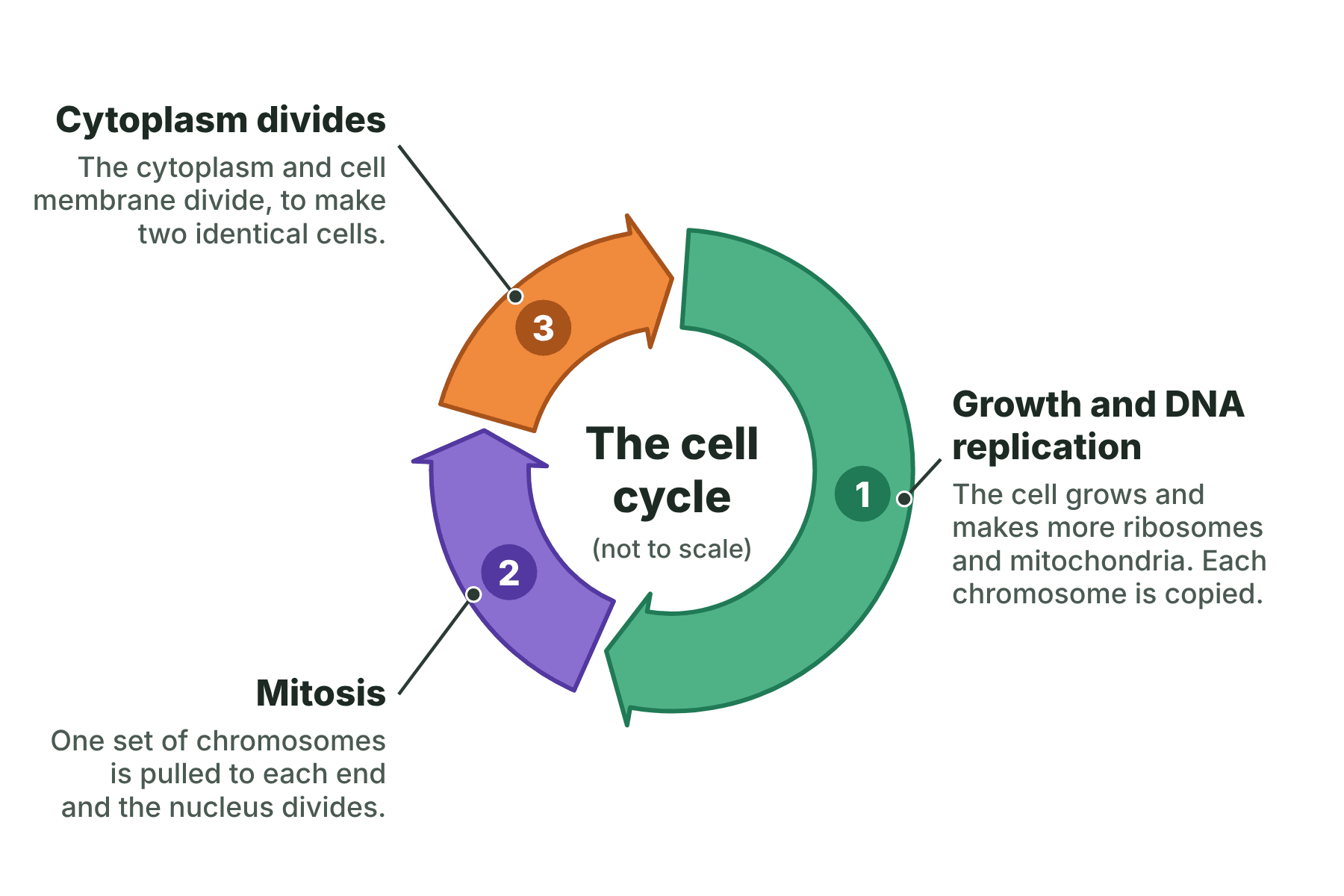
-
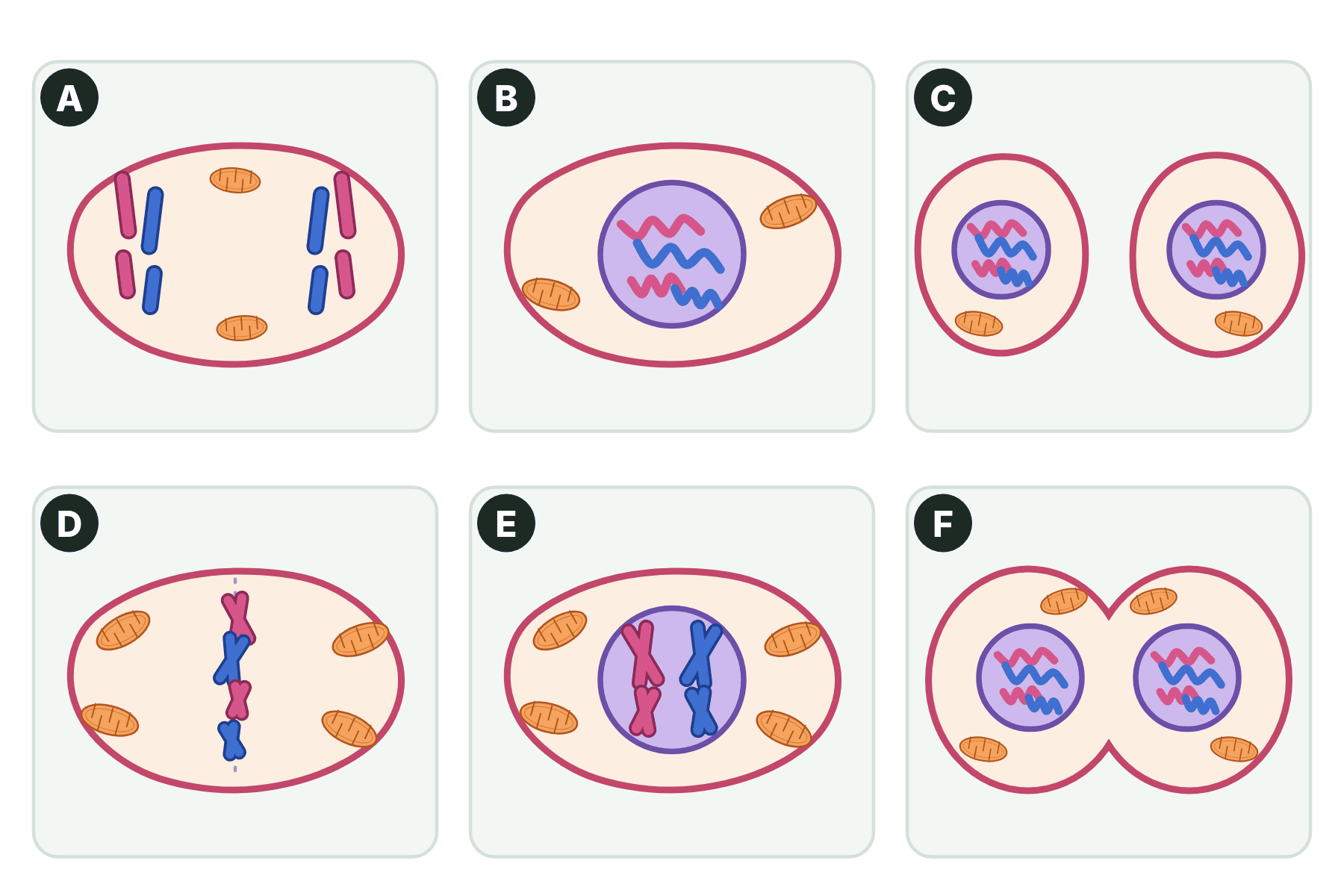 Put these six stages of mitosis into the correct order.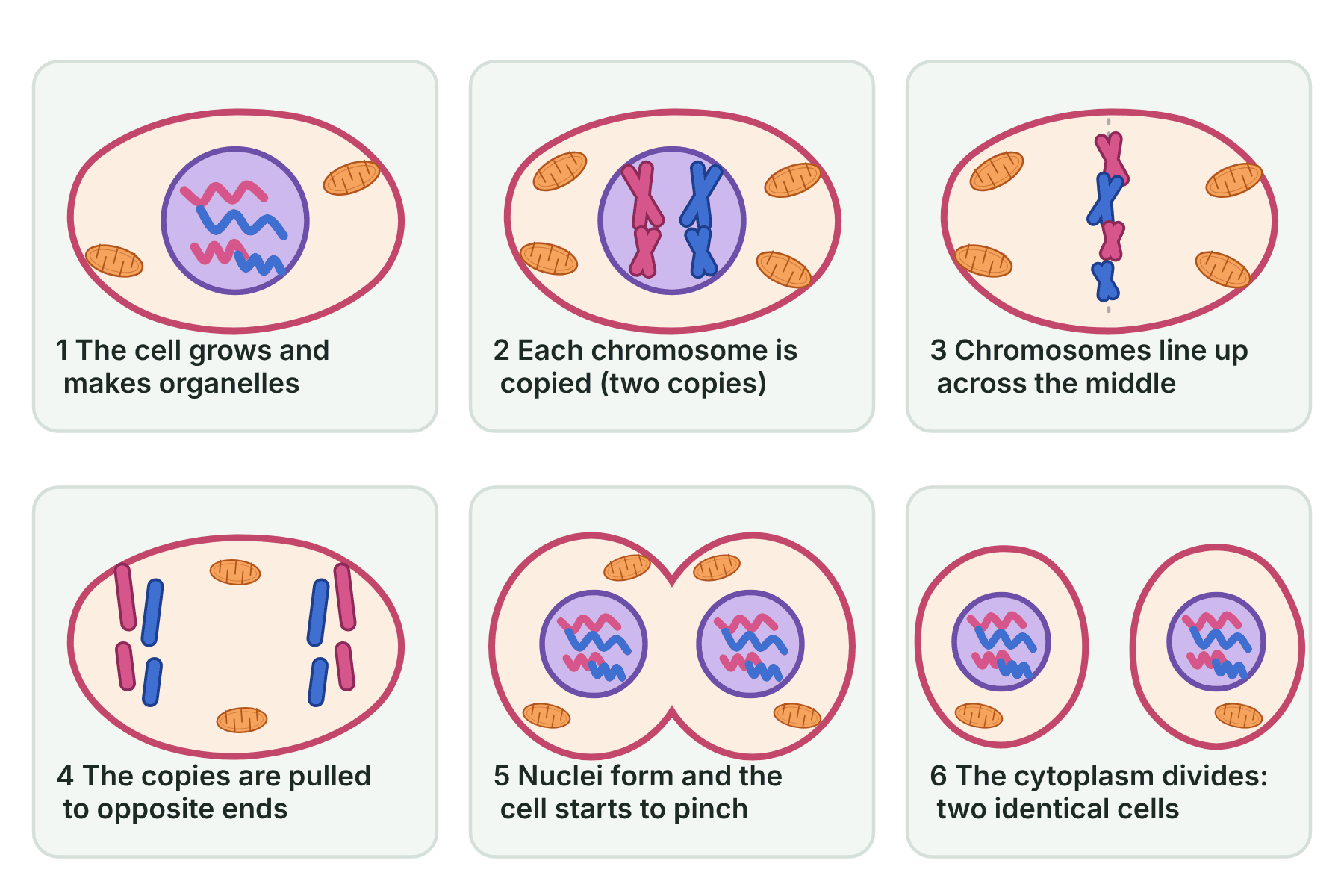
B, E, D, A, F, C.
-
What is a specialised cell?
A cell with a structure that is suited to its particular job.
-
What is differentiation?
The process by which a cell changes to become specialised.
-
Why does a sperm cell have a long tail?
So it can swim to the egg.
-
Why does the middle of a sperm cell contain many mitochondria?
They release the energy needed for swimming.
-
What is the job of the acrosome?
It contains enzymes that digest the outer layer of the egg so the sperm can get in.
-
How is a nerve cell adapted to carry impulses over long distances?
It has a long axon, and a myelin sheath that insulates it.
-
Why do nerve cells have branched dendrites?
They connect to many other nerve cells.
-
What do muscle cells contain that lets them contract?
Special protein fibres that slide over each other, and many mitochondria for energy.
-
How does the shape of a root hair cell help it?
The long projection gives a large surface area to absorb water and minerals.
-
Why do root hair cells have a large permanent vacuole?
It speeds up the movement of water into the cell.
-
What does xylem transport?
Water and mineral ions, from the roots up to the leaves.
-
Why is xylem strengthened with lignin?
The rings stop the hollow tube collapsing and make it strong.
-
What does phloem transport?
Dissolved sugars to wherever they are needed.
-
What are sieve plates?
The walls between phloem cells, with holes that let sugars flow through.
-
What is the job of companion cells in phloem?
Their mitochondria supply the energy for moving sugars.
-
Do animal cells or plant cells keep the ability to differentiate throughout life?
Plant cells. Most animal cells differentiate early.
-
Put these in order, smallest first: organ, cell, tissue, organism.
Cell, tissue, organ, organism.
-
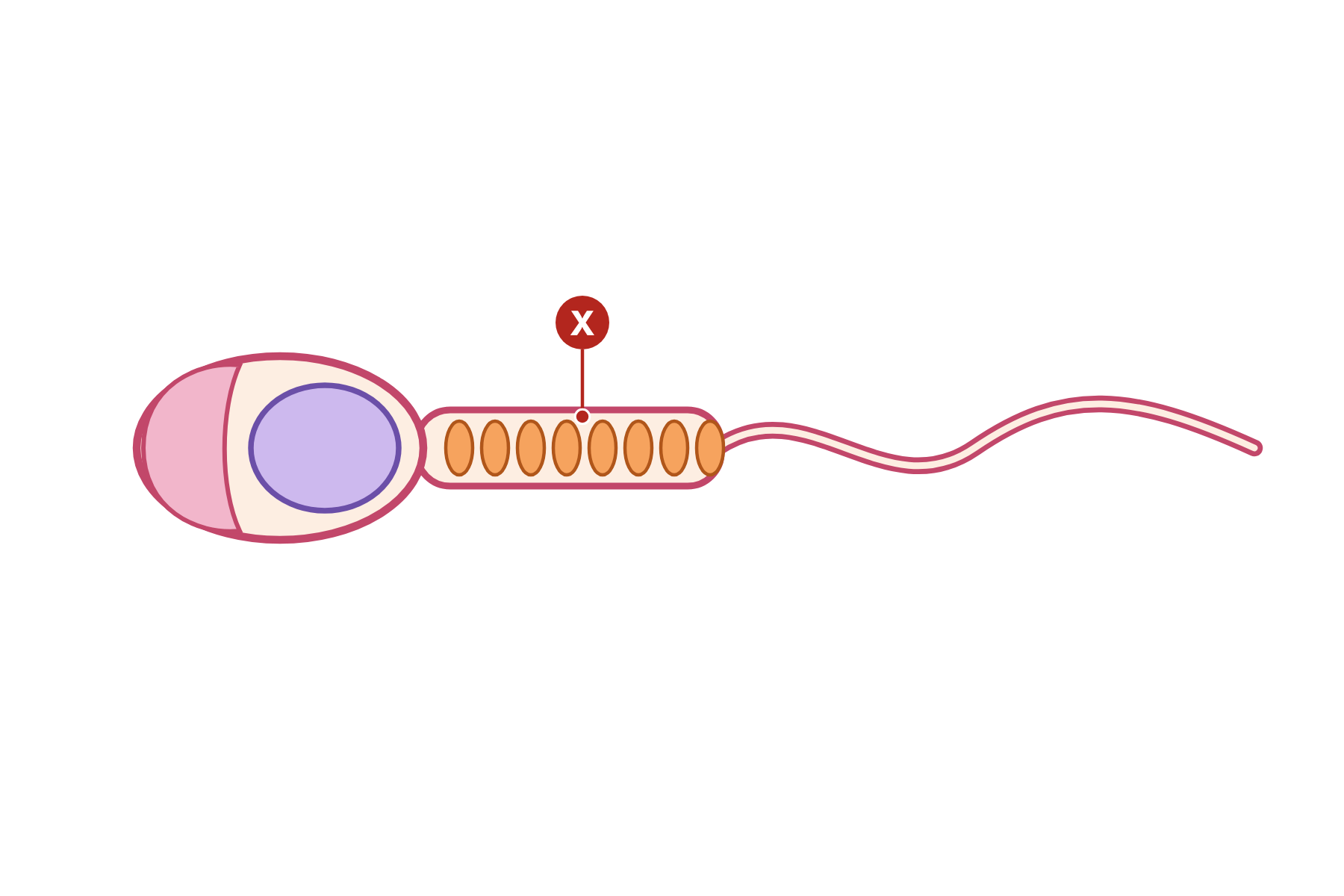 Name the part marked X on this sperm cell, and explain why it is there.
 Mitochondria in the middle section. They release the energy from respiration that the tail needs for swimming.
-
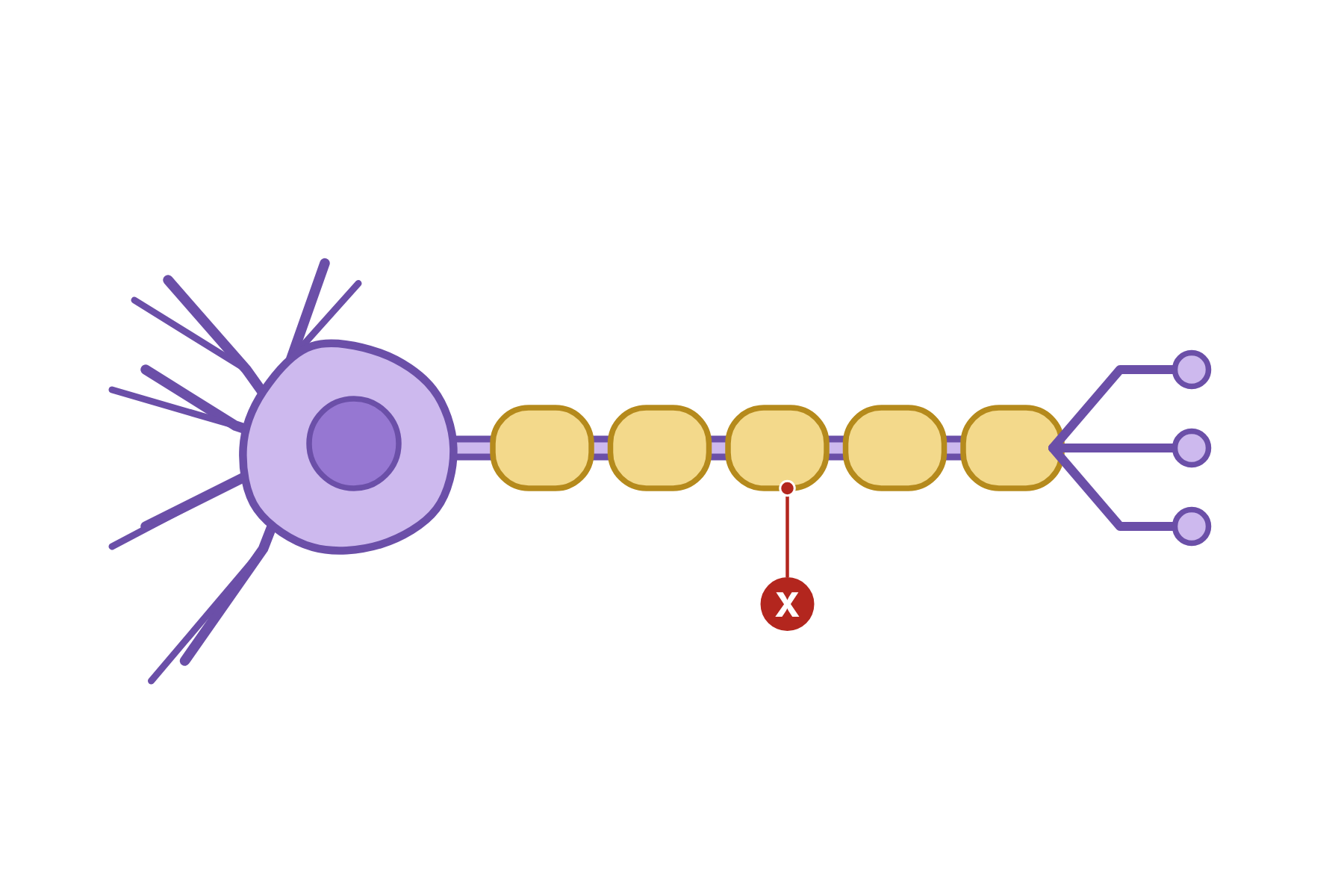 Name the part marked X on this nerve cell and say what it does.
 The myelin sheath. It is a fatty layer that insulates the axon and speeds up the impulse.
-
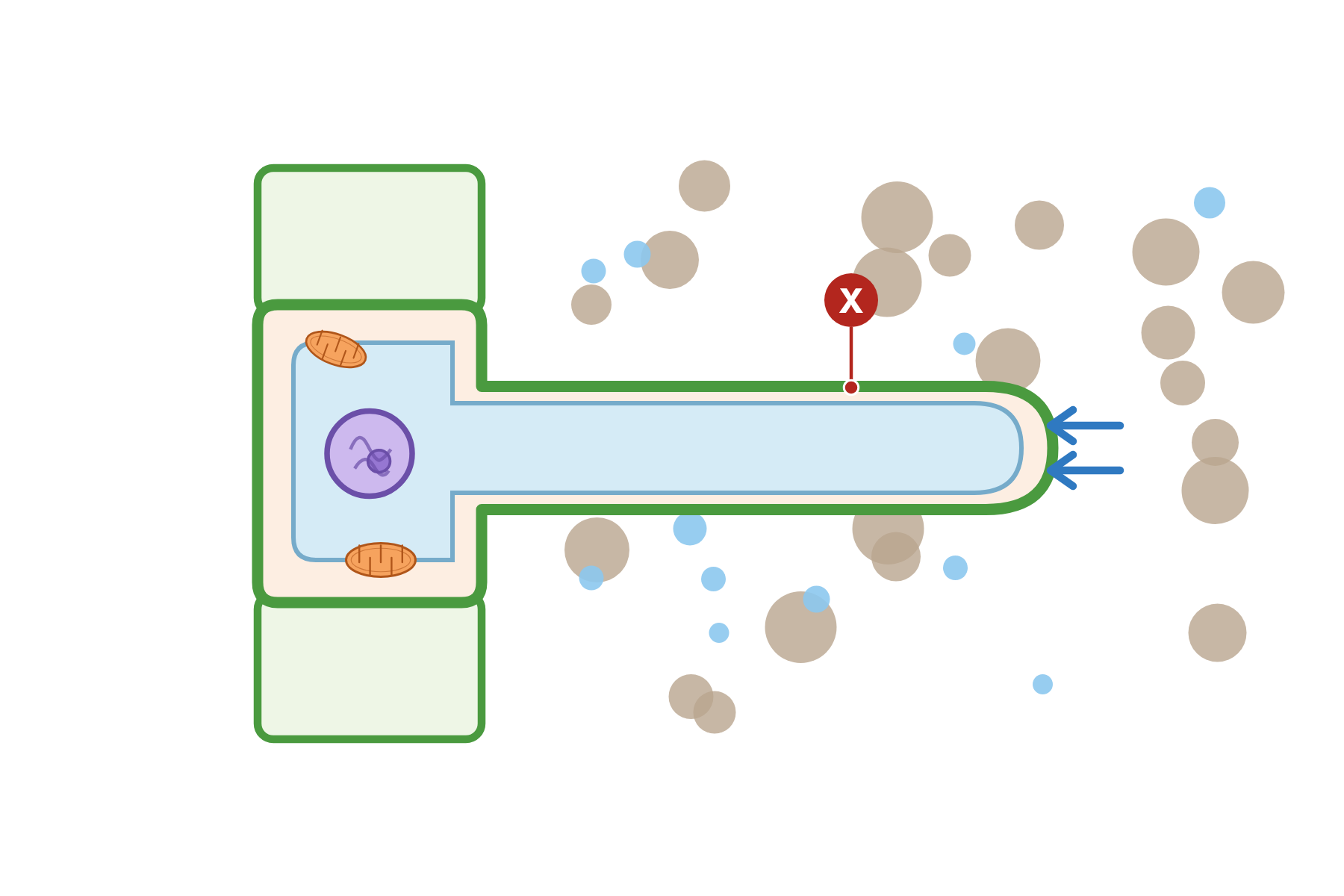 What is the structure marked X on this root hair cell, and how does it help?
 The root hair. Its long, thin shape gives a large surface area for absorbing water and mineral ions from the soil.
-
What is a stem cell?
An undifferentiated cell that can divide to make more cells of the same type, and can differentiate into specialised cells.
-
What does undifferentiated mean?
Not yet specialised for any one job.
-
What is differentiation?
The process by which a cell changes to become specialised for its job.
-
Where are stem cells found in an embryo?
The whole early embryo is made of stem cells, which can differentiate into most types of human cell.
-
What can stem cells from human embryos become?
Most different types of human cell.
-
Where are stem cells found in an adult human?
In places such as the bone marrow.
-
What can adult bone marrow stem cells form?
Many types of cell, including blood cells.
-
What is the job of stem cells in adult animals?
To replace worn-out cells and repair damaged tissue.
-
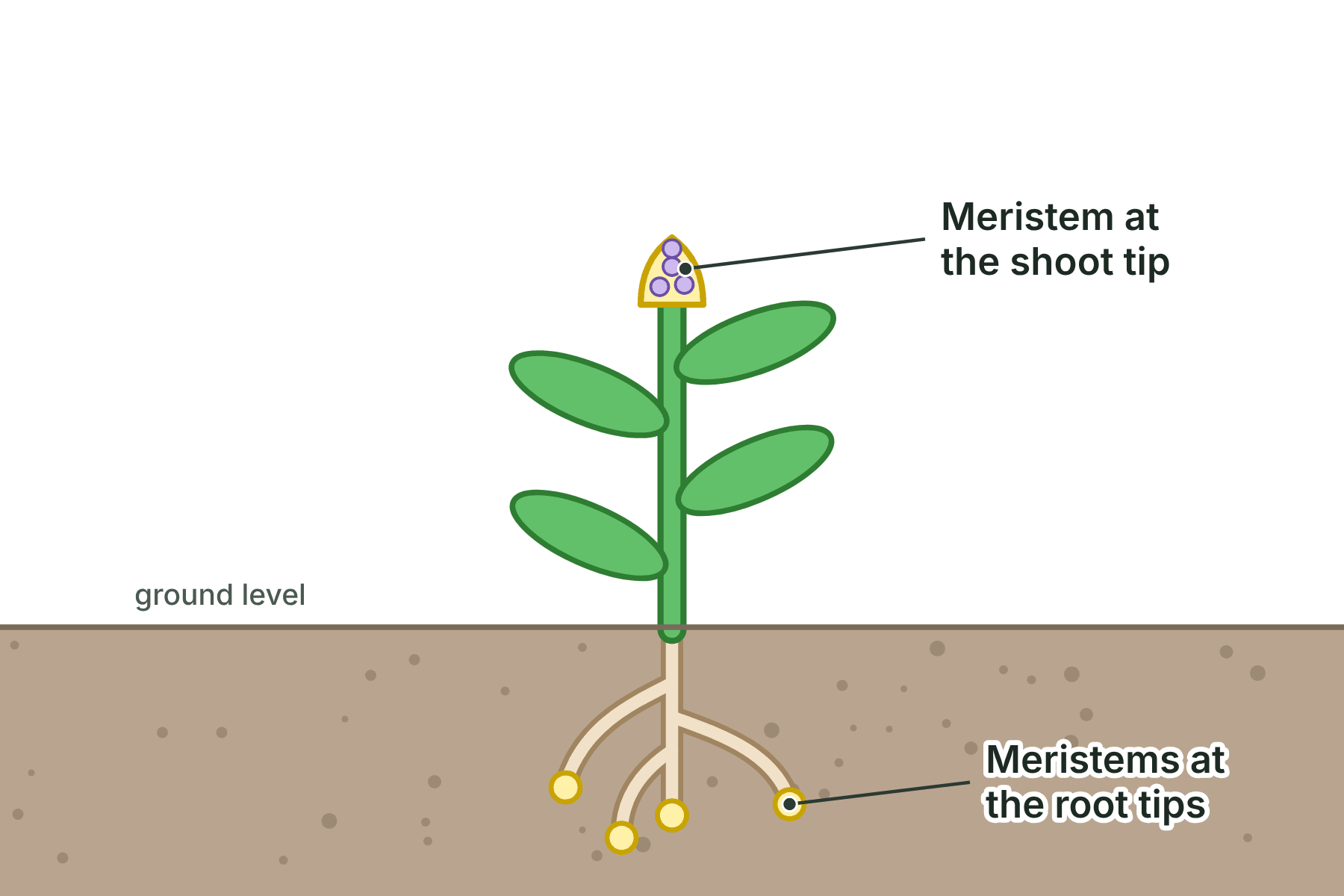
What are meristems?
Tissues in plants that contain stem cells.
-
Where are meristems found in a plant?
At the tips of the shoots and the tips of the roots.
-
What can meristem cells become?
Any type of plant cell, throughout the life of the plant.
-
Why can a plant keep growing all its life?
Its meristems keep dividing and differentiating throughout its life.
-
Why do embryonic stem cells have more uses than adult stem cells?
They can become most types of cell, while adult stem cells can become fewer types.
-
Which has more types of cell it can make: an embryonic or an adult stem cell?
An embryonic stem cell.
-
Can a specialised cell such as a red blood cell become any other cell?
No. It has already differentiated, which is why stem cells matter.
-
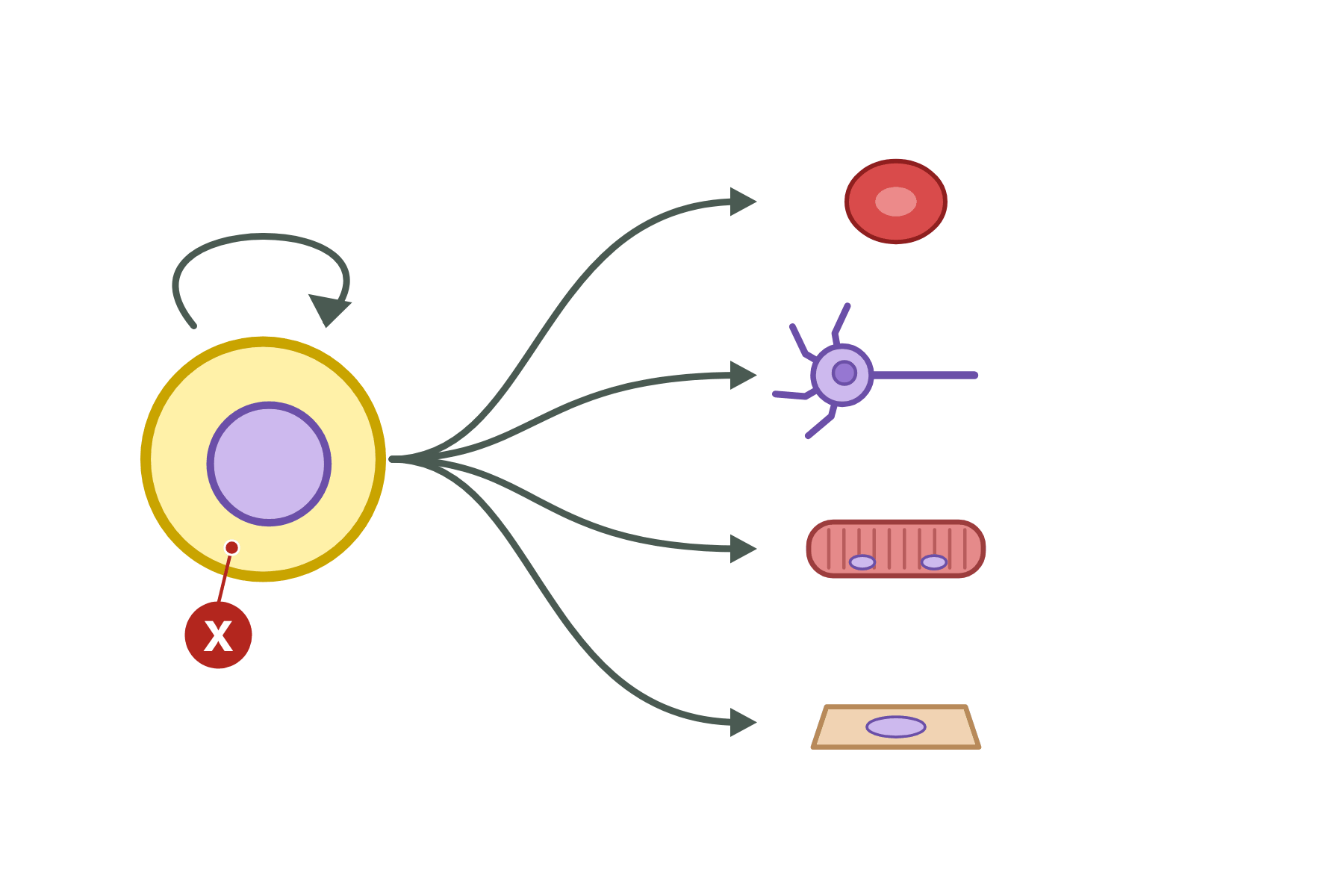 What can the cell marked X do?
 It is a stem cell. It can divide to make more stem cells, and it can differentiate into specialised cells.
-
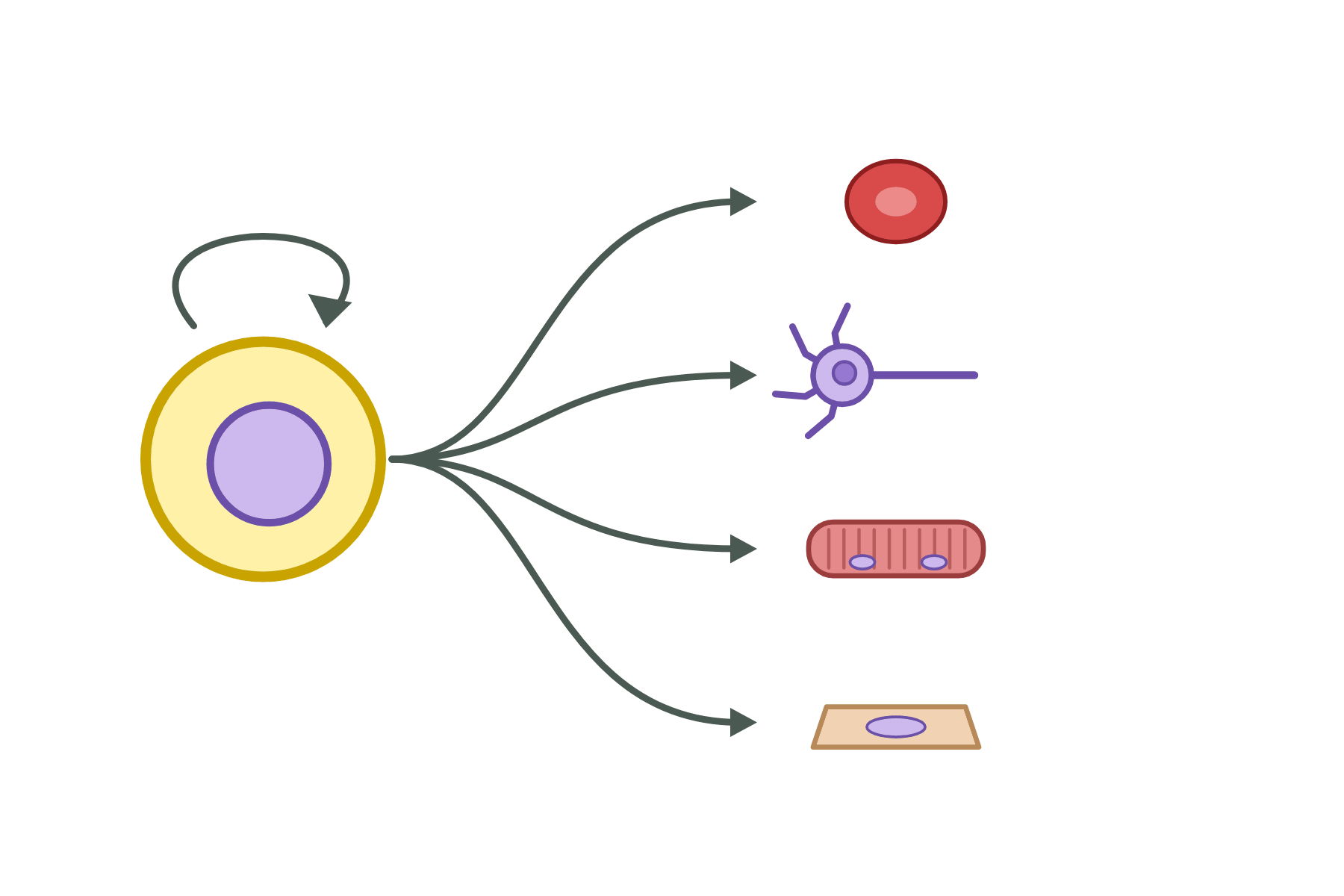 Name this cell and the cells it can become.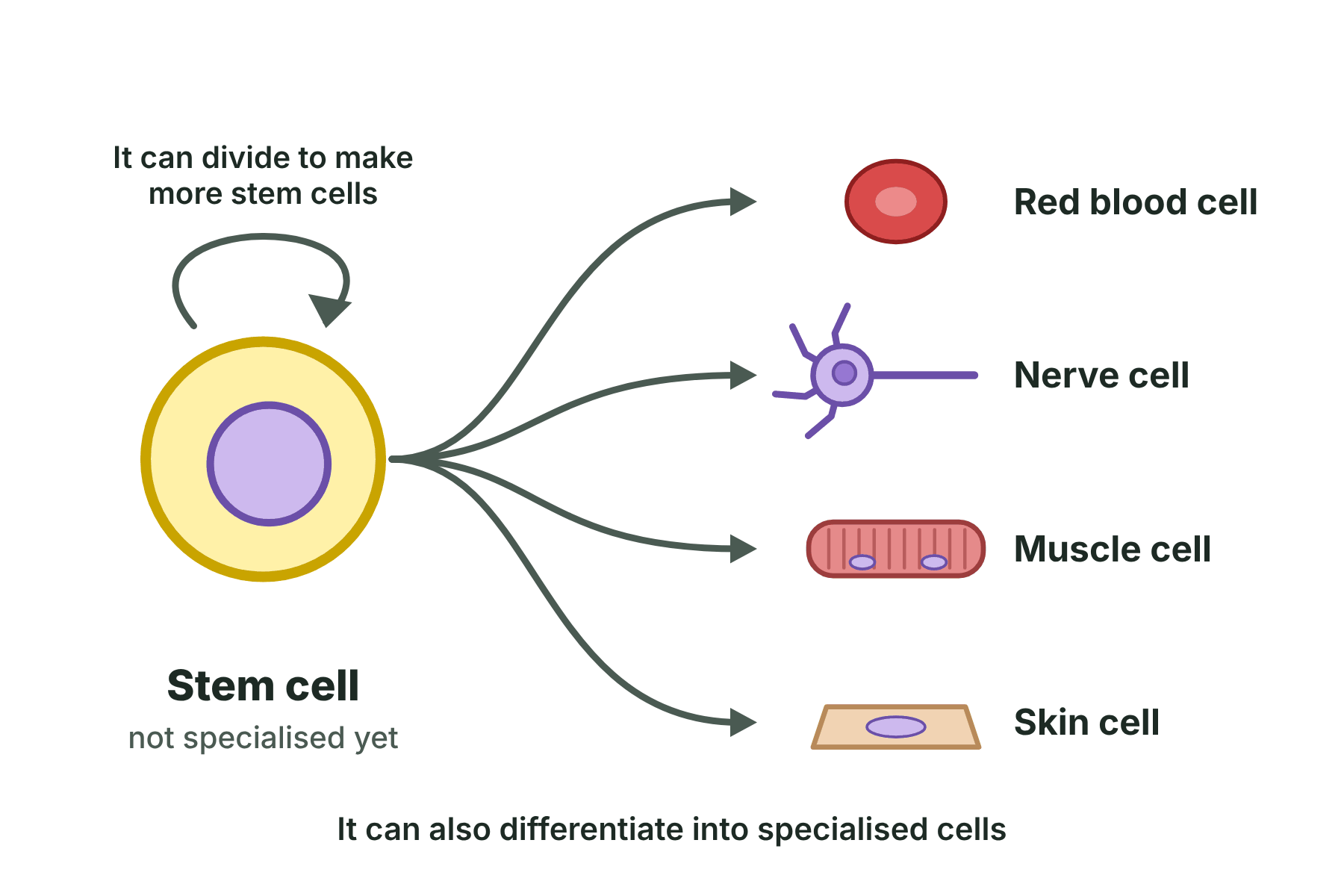
-
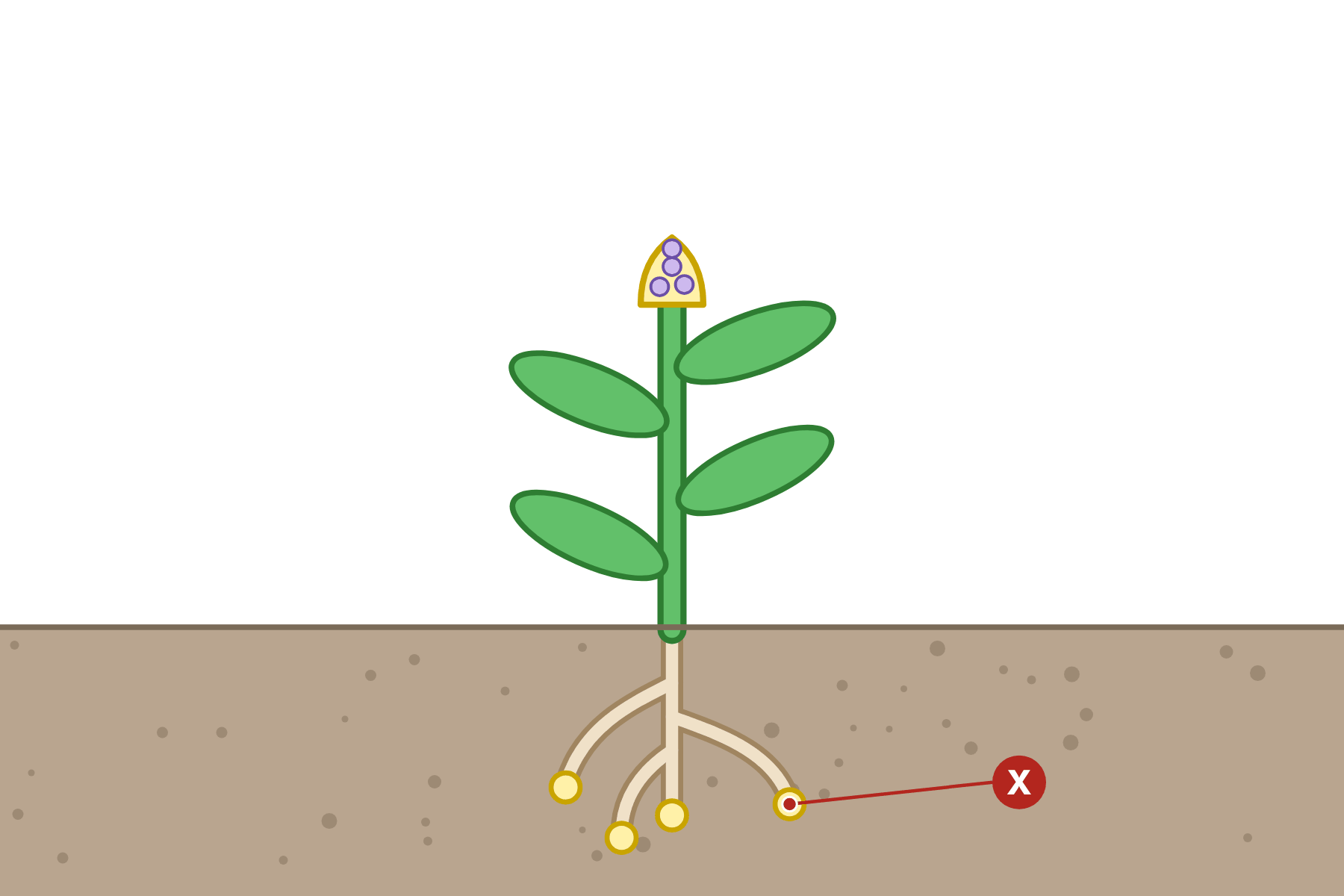 What is the structure marked X in this plant, and what is its job?
 A meristem at a root tip. Its stem cells divide and differentiate, so the root keeps growing.
-
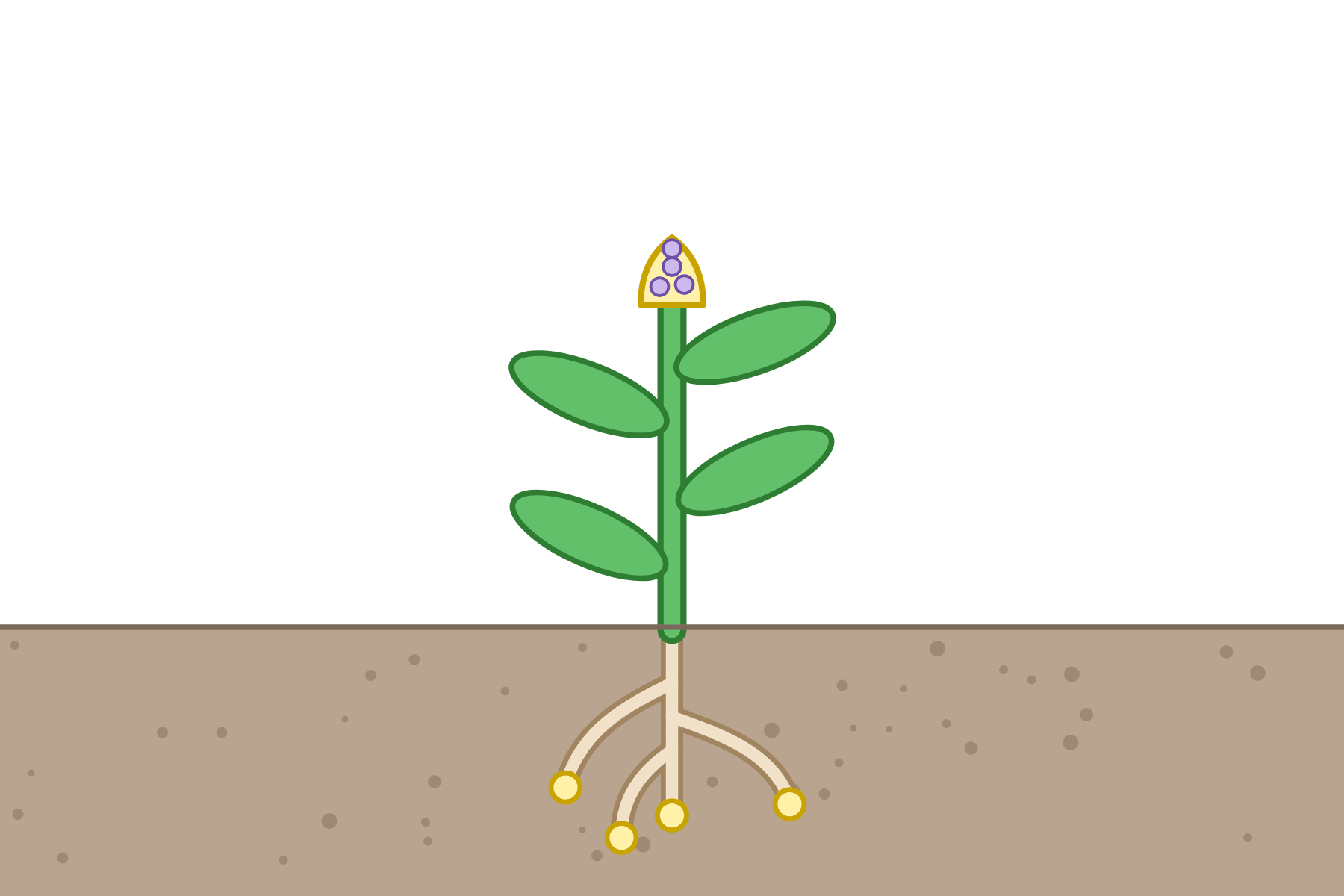 Where are the meristems in this plant?