Flashcards · Biology
Health and Communicable Disease
-
What is health?
A state of physical and mental wellbeing, not only the absence of disease.
-
What is a disease?
A condition that stops part of the body or mind from working properly.
-
What causes a communicable disease?
A pathogen: a virus, bacterium, protist or fungus.
-
Can a non-communicable disease be passed from person to person?
No.
-
Give two examples of communicable diseases.
Any two of flu, tuberculosis, malaria, athlete's foot, HIV.
-
What causes an inherited disorder?
A faulty allele passed from parent to child.
-
Name an inherited disorder.
Cystic fibrosis (or Huntington's disease).
-
What causes a deficiency disease?
A lack of a nutrient in the diet.
-
Which vitamin deficiency causes scurvy?
Vitamin C.
-
Is depression communicable?
No, it is a mental illness and is not caused by a pathogen.
-
Is cancer an infectious disease?
No. Most cancers are not caused by pathogens and cannot be caught.
-
What does HIV do to the immune system?
It infects and damages the white blood cells, so that the immune system is weakened.
-
Why is a person with HIV more likely to get tuberculosis?
The weakened immune system cannot control the TB bacteria.
-
How can HPV lead to cervical cancer?
It changes the cells of the cervix so that they divide in an uncontrolled way.
-
Name two things that could cause an immune deficiency.
HIV, an inherited fault, immunosuppressant drugs or a poor diet.
-
How can mental health affect physical health?
Stress can weaken the immune system, and poor mental health can lead to neglect of the body.
-
How is a percentage of a total worked out?
Divide the part by the total and multiply by 100.
-
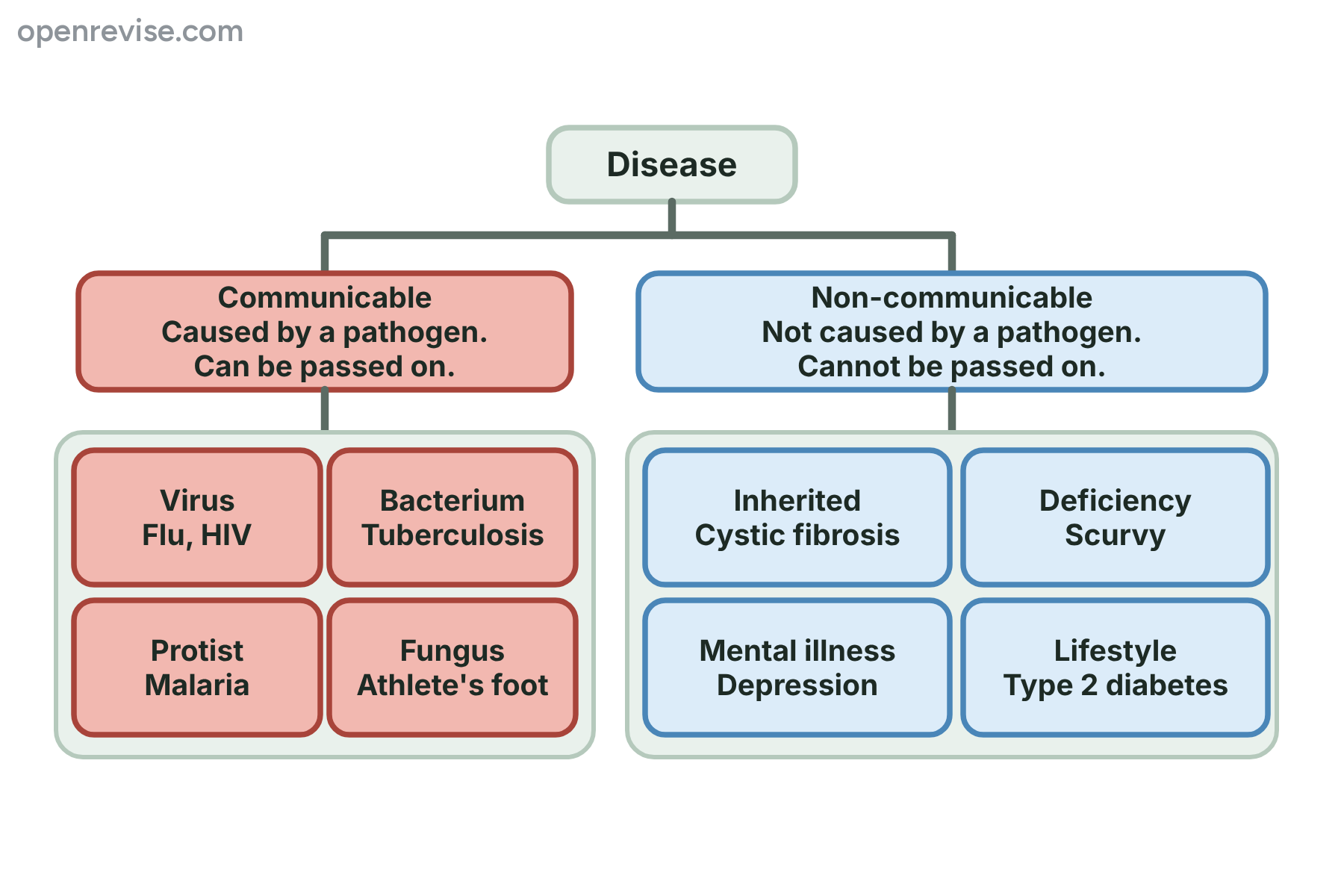 Sort these diseases into communicable and non-communicable: flu, scurvy, malaria, depression.
 Flu and malaria are communicable, as they are caused by pathogens (a virus and a protist). Scurvy (a deficiency disease) and depression (a mental illness) are non-communicable.
-
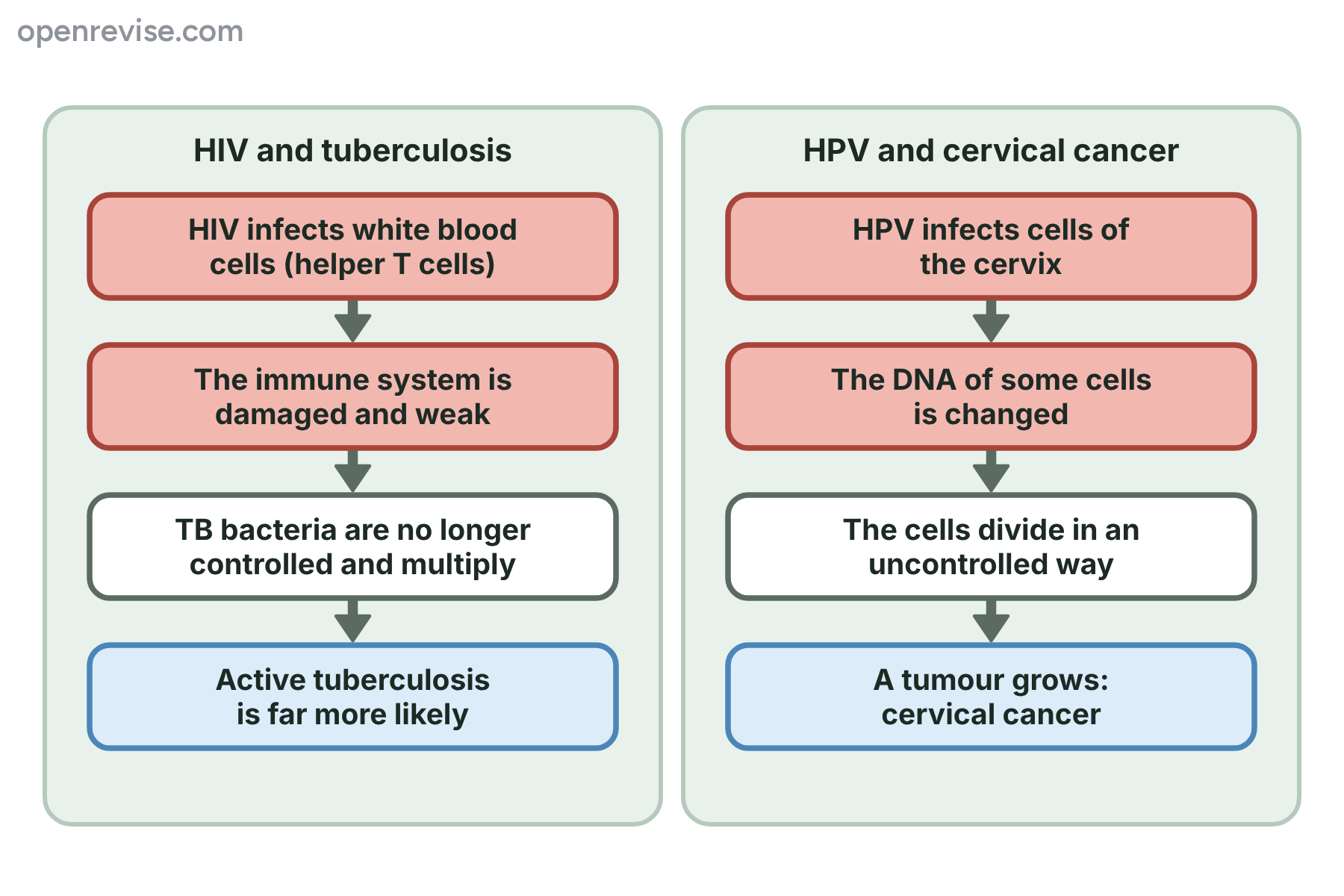 Explain how each virus in the diagram can lead to a second disease.
 HIV infects white blood cells and damages the immune system, so TB bacteria are not controlled and tuberculosis becomes active. HPV changes the DNA of cervical cells, so they divide in an uncontrolled way and a tumour can grow.
-
Name the four types of pathogen.
Viruses, bacteria, protists and fungi.
-
How do viruses reproduce?
They infect a host cell and use it to make more viruses.
-
How do bacteria reproduce?
By binary fission, as asexual reproduction.
-
What is a toxin?
A poison made by a pathogen that damages the host's cells.
-
Which type of pathogen causes malaria?
A protist.
-
What are the thin threads of a fungus called?
Hyphae.
-
How do fungal diseases usually spread between plants?
By spores that are carried by the wind or by water.
-
Name the five routes of spread in animals.
Direct contact, air, water, ingestion of food and vectors.
-
How does flu spread?
In droplets from coughs and sneezes, which are breathed in.
-
Which disease spreads in contaminated drinking water?
Cholera.
-
What is a vector?
An organism that carries a pathogen from one host to another without being harmed.
-
Which vector spreads malaria?
The Anopheles mosquito.
-
How does tobacco mosaic virus spread?
By contact, in the sap of infected plants, on hands and tools, and sometimes by insects.
-
Name a vector that spreads viruses in plants.
Aphids.
-
How did John Snow link cholera to a water pump?
He mapped the deaths, and most of them were around one pump.
-
How many bacteria will there be after 4 divisions from one cell?
16, because \(2^4 = 16\).
-
How do you estimate the number of cases in a population from a sample?
Find the fraction infected in the sample and multiply it by the size of the population.
-
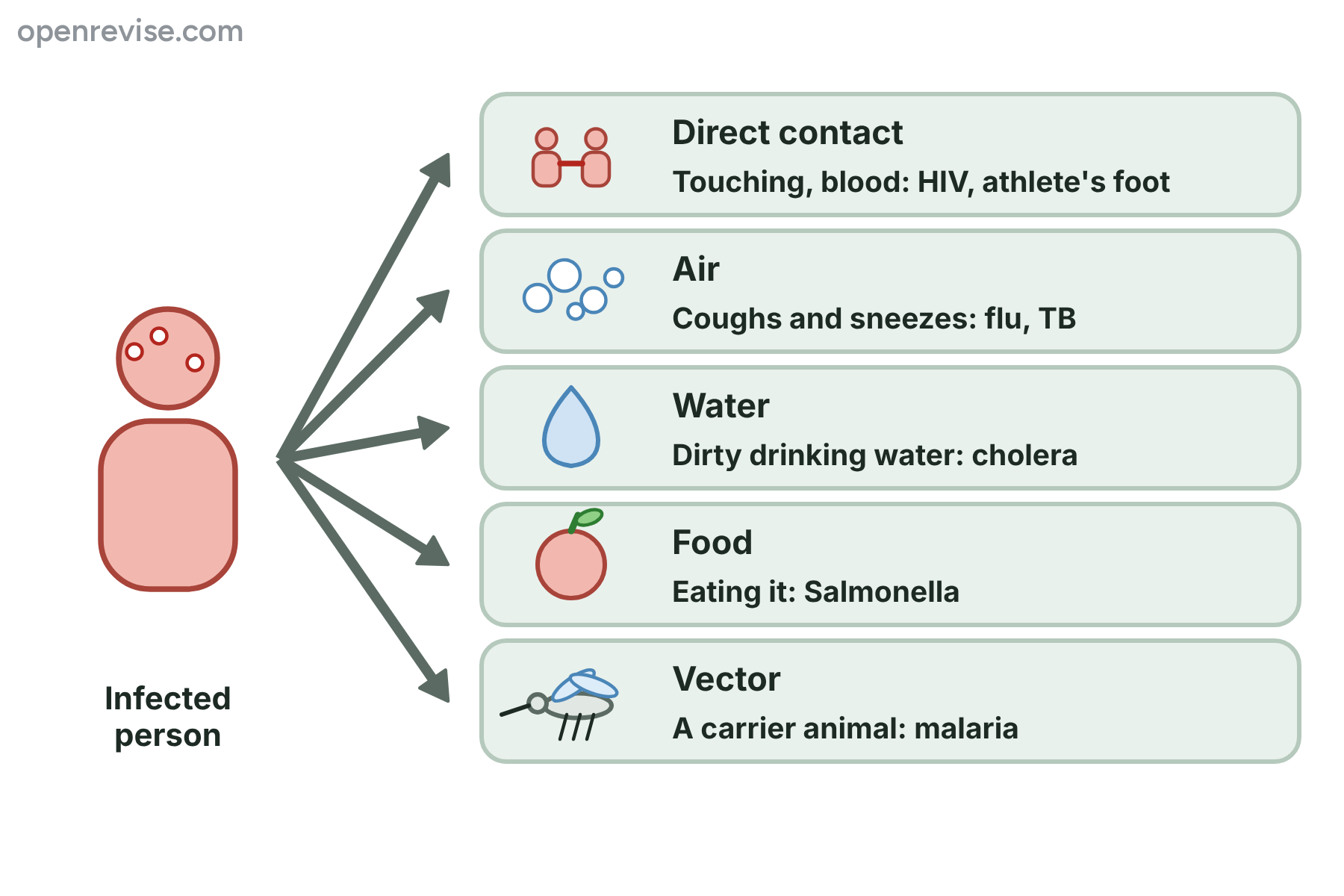 Name the five routes of spread shown, and give an example of each.
 Direct contact (HIV, athlete's foot), air (flu, TB), water (cholera), food (Salmonella) and vectors (malaria, carried by the mosquito).
-
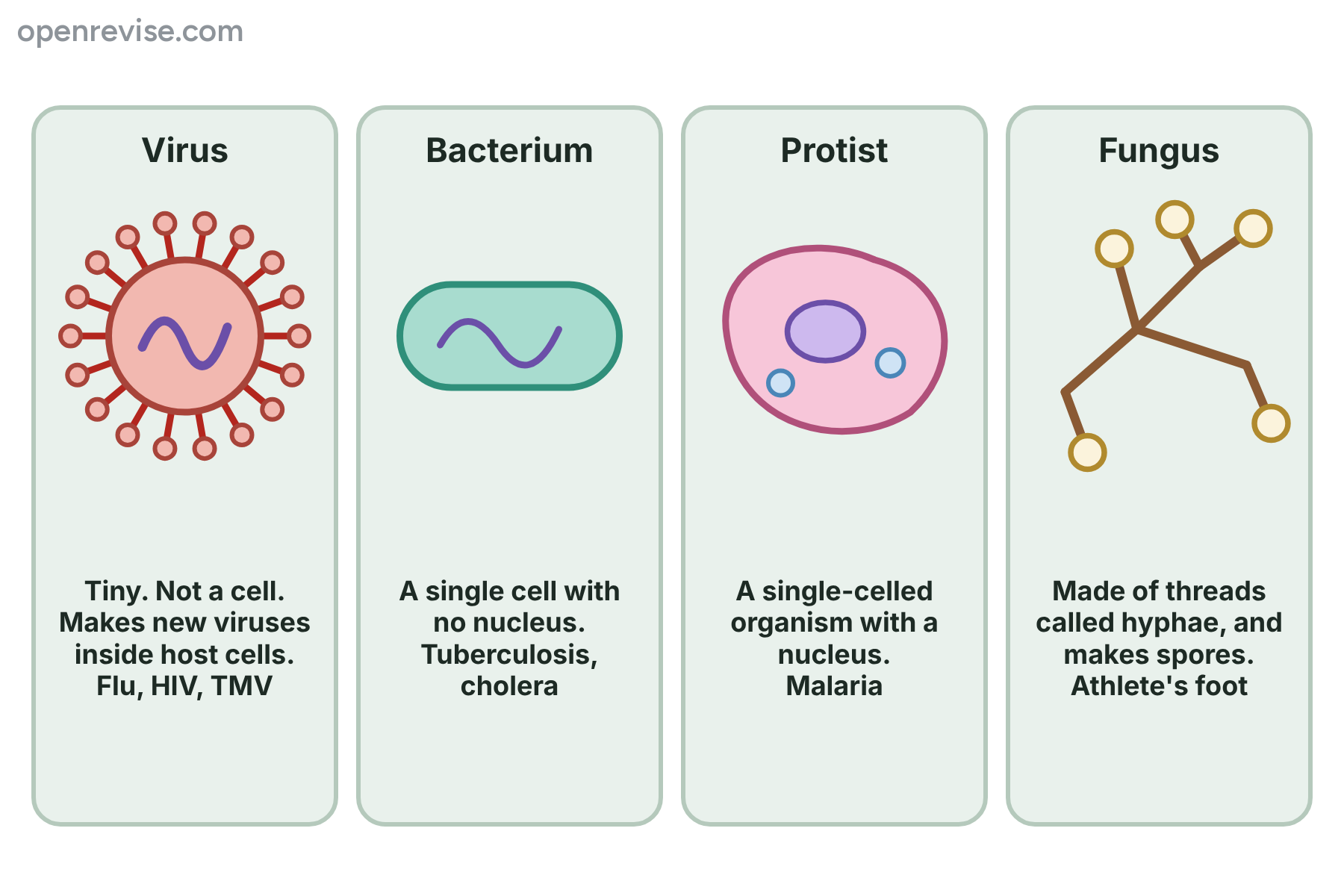 Which type of pathogen is each of these, and what does each cause?
 Virus (flu, HIV, tobacco mosaic virus), bacterium (tuberculosis, cholera, crown gall), protist (malaria) and fungus (athlete's foot, powdery mildew).