Viewing as
Teaching this? The teacher view adds 2 files, the mark schemes and the model answers.
History · Crime and punishment in Britain, c1700-c1900
The Metropolitan Police, 1829
From watchmen and the Bow Street Runners to Robert Peel's Metropolitan Police - why Britain created its first professional police force, and how it spread.
Learning Objectives
- 1Describe law enforcement before 1829, including watchmen and the Bow Street Runners.
- 2Explain why the Metropolitan Police was set up in 1829.
- 3Explain how policing developed after 1829, and why the police were at first unpopular.
Setting the Scene
In 1700 there was still no professional police force. Towns relied on unpaid parish constables and night watchmen, who were often old, poorly paid and easily bribed. As London grew into the largest city in the world, it became clear that this system could not cope.
- 1749 Henry Fielding sets up the Bow Street Runners in London.
- 1805 The Bow Street Horse Patrol guards the roads around London.
- 1829 Robert Peel's Metropolitan Police Act creates the Metropolitan Police.
- 1842 The Metropolitan Police sets up a Detective Department.
- 1856 The County and Borough Police Act makes every area have a police force.
- 1878 The Criminal Investigation Department (CID) is formed.
Law Enforcement Before 1829
A patchy system that relied on individuals rather than an organised force.
-
Watchmen
Night watchmen patrolled towns, but were often old, badly paid and mocked as "Charleys".
-
Constables
Parish constables were ordinary men who served for a year, usually unpaid and untrained.
-
Thief-takers
Private individuals who caught criminals for rewards - some, like Jonathan Wild, were criminals themselves.
-
Bow Street Runners
Set up in 1749 by magistrate Henry Fielding and his half-brother John: a small, paid team who investigated crimes and caught criminals.
Why Was the Metropolitan Police Set Up?
Several pressures came together in the 1820s.
-
A growing city
London's population had grown enormously, and the old system could not cope.
-
Rising crime
Crime appeared to be rising, and the Bloody Code was not stopping it.
-
Fear of unrest
Riots and protests made the government want better control of the streets.
-
Bow Street's success
The Runners showed that a paid, organised force could work.
-
Robert Peel
As Home Secretary, Peel persuaded Parliament to act.
-
Prevention
Peel wanted to prevent crime by having police visible on the streets.
The First Police Officers
The Metropolitan Police began in 1829 with around 3,200 constables. They were deliberately made to look different from soldiers, to reassure a public that feared a military-style force.
The first "Peelers"
- Uniform A blue tailcoat and top hat, not a red army coat.
- Equipment A wooden truncheon and a rattle to call for help.
- Beats Constables walked set routes, or beats, around the clock.
- Discipline Strict rules - many early recruits were sacked for drunkenness.
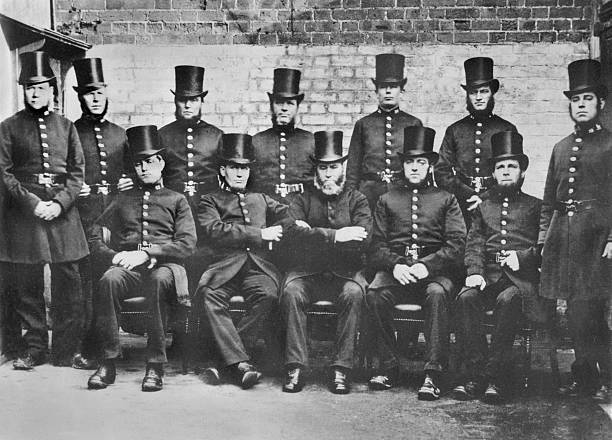
A "Peeler" of the 1830s.
Opposition to the New Police
Not everyone welcomed the "Peelers" or "Bobbies".
-
Cost
People resented paying for the police through local taxes.
-
Liberty
Many feared the police would be used to spy on people, like the police in France.
-
Early problems
Many early recruits were dismissed, often for drunkenness.
-
Gaining trust
Over time, the police's focus on preventing crime and keeping order helped them gain acceptance.
How Policing Spread
The Metropolitan Police became a model for the whole country.
-
1
1829
Metropolitan Police set up in London.
-
2
1839
Counties were allowed, but not forced, to set up police forces.
-
3
1842
The Met set up a Detective Department to investigate crimes.
-
4
1856
The County and Borough Police Act made police forces compulsory across the country.
-
5
1878
The Criminal Investigation Department (CID) was formed.
Summary & Exam Focus
- Before 1829, law enforcement relied on watchmen, constables and thief-takers.
- The Bow Street Runners (1749) showed that paid officers could work.
- Robert Peel created the Metropolitan Police in 1829 to prevent crime.
- By 1856 every area had to have a police force.
Exam focus
Explain why the Metropolitan Police was set up in 1829. (12 marks) (12 marks)
Explain several factors - London's growth, crime, fear of unrest, Peel - and link each one to the decision.
Key terms
The vocabulary this lesson expects you to use. Each one is linked from the first place it appears above.
- Watchman
- A man paid to patrol a town at night, often old and ineffective.
- Parish constable
- An unpaid local man who kept order for a year.
- Thief-taker
- A private individual who caught criminals for rewards.
- Bow Street Runners
- A small paid force set up by Henry Fielding in London in 1749.
- Metropolitan Police
- London's professional police force, set up by Robert Peel in 1829.
- Peelers / Bobbies
- Nicknames for the first police officers, after Robert Peel.
- CID
- The Criminal Investigation Department, formed in 1878.
Downloads
Free to keep, print and annotate.
- The Metropolitan Police 1829.pptx Built from the lesson script on 23 September 2026. View
- The Metropolitan Police 1829 - Completed Notes.docx The full notes for the lesson, every gap filled in - to check against, or to revise from. Built from the lesson script on 23 September 2026. View
- The Metropolitan Police 1829 - Exam Questions.docx Built from the lesson script on 23 September 2026. View
Something here looks wrong?
Tell us what and we will go and look. It goes to whoever writes these pages, nobody else, and we do not ask who you are — so there is nothing to sign and nothing comes back to you.