Maths · Functions, Sequences and Rates of Change
Viewing as
Teacher view: every answer and mark scheme set out in full.
Geometric and Special Sequences
Recognising geometric and Fibonacci-type sequences, and finding the common ratio from two terms.
Learning Objectives
- 1Recognise a geometric sequence and find its common ratio.
- 2Find terms of a geometric sequence, and use the term-to-term rule.
- 3Recognise Fibonacci-type, square, cube and triangular number sequences.
- 4Find the common ratio and first term from two given terms (Higher tier), including a surd ratio.
Sequences that multiply
In an arithmetic sequence, each term is found by adding the same number. In a geometric sequence, each term is found by multiplying by the same number, which is called the common ratio. Geometric sequences grow or shrink very quickly. Basic geometric sequences with a whole-number or fractional ratio can be set on both tiers, but finding a ratio from two terms, and using a surd as the ratio, are Higher tier skills. Other special sequences are also worth knowing, such as Fibonacci-type sequences.
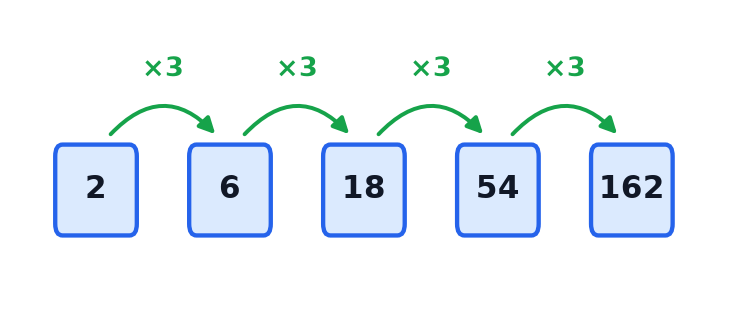
A geometric sequence
Each term is 3 times the term before it, so the common ratio is 3. The rule is "multiply by 3". Each term is found by multiplying the one before by the ratio, and to find the ratio you divide any term by the one before it.
Geometric sequences
- Common ratio \(r = \dfrac{\text{term}}{\text{previous term}}\), such as \(\dfrac{6}{2} = 3\).
- Next terms \(162 \times 3 = 486\).
- A ratio below 1 The terms get smaller, such as \(80, 40, 20, 10\) with a ratio of \(\dfrac{1}{2}\).
- A negative ratio The signs alternate, such as \(2, -6, 18, -54\) with a ratio of \(-3\).
The \(n\)th term of a geometric sequence
To get from the first term to the \(n\)th term you multiply by the ratio \(n - 1\) times.
-
Formula
\(n\)th term \(= a \times r^{n-1}\), where \(a\) is the first term and \(r\) is the common ratio.
-
Example
For \(2, 6, 18, \ldots\), the \(n\)th term is \(2 \times 3^{n-1}\).
-
Check
The 4th term is \(2 \times 3^3 = 54\).
-
Not the same as arithmetic
An arithmetic sequence has an \(n\)th term of the form \(an + b\).
Finding terms
A geometric sequence starts \(5, 10, 20, 40, \ldots\). Work out the 8th term.
Show the solutionHide the solution
- 1 Common ratio \(r = \dfrac{10}{5} = 2\).
- 2 Formula \(n\)th term \(= 5 \times 2^{n-1}\).
- 3 For the 8th term \(5 \times 2^7 = 5 \times 128\).
- 4 Answer 640.
Answer640
Finding the ratio and the first term (Higher tier)
Two terms that are not next to each other are enough to find the ratio.
-
Compare the terms
If the 2nd term is 6 and the 5th term is 48, there are 3 steps between them, so \(r^3 = \dfrac{48}{6} = 8\).
-
The ratio
\(r = \sqrt[3]{8} = 2\).
-
The first term
Divide back: \(6 \div 2 = 3\).
-
A surd ratio
A ratio can be a surd, such as \(2, 2\sqrt{3}, 6, 6\sqrt{3}\) with \(r = \sqrt{3}\).
A surd ratio (Higher tier)
The first three terms of a geometric sequence are \(4, 4\sqrt{2}, 8\). Find the 6th term.
Show the solutionHide the solution
- 1 Ratio \(r = \dfrac{4\sqrt{2}}{4} = \sqrt{2}\).
- 2 Next terms \(8\sqrt{2}\), then \(8\sqrt{2} \times \sqrt{2} = 16\).
- 3 The 6th term \(16 \times \sqrt{2} = 16\sqrt{2}\).
- 4 Check Every two terms multiply by \(\sqrt{2} \times \sqrt{2} = 2\).
Answer\(16\sqrt{2}\)
Other special sequences
Some sequences have names, and you should recognise them.
-
Fibonacci-type
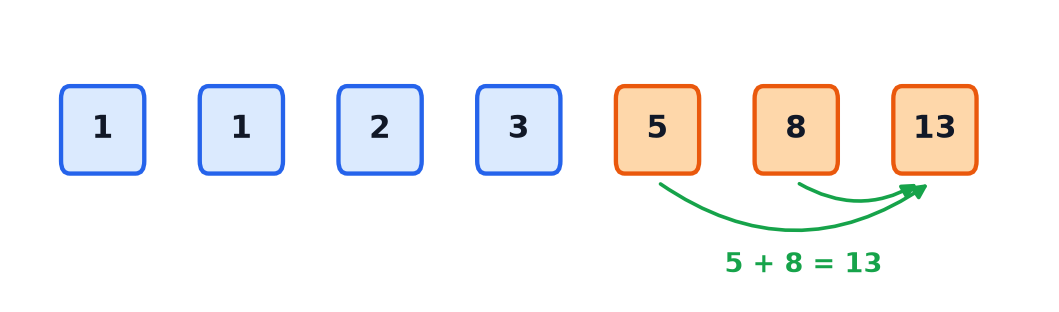
Each term is the sum of the two terms before it, such as \(1, 1, 2, 3, 5, 8, 13, \ldots\).
-
Square numbers
\(1, 4, 9, 16, 25, \ldots\), with an \(n\)th term of \(n^2\).
-
Cube numbers
\(1, 8, 27, 64, \ldots\), with an \(n\)th term of \(n^3\).
-
Triangular numbers
\(1, 3, 6, 10, 15, \ldots\), where each term adds one more than the last increase.
A Fibonacci-type sequence
Each term is the sum of the two terms before it, so \(5 + 8 = 13\). A sequence like this can start with any two numbers, and is called a Fibonacci-type sequence.
Using the rule
- Rule Add the previous two terms.
- Start A sequence can start with any two terms, such as \(3, 5, 8, 13, \ldots\).
- Working backwards A missing term can be found by subtraction, such as \(13 - 8 = 5\).
- Check Each term must equal the sum of the two before it.
Test yourself
-
1
What is the common ratio of \(3, 12, 48, 192\)?
Show answerHide answer
4.
-
2
What is the \(n\)th term of a geometric sequence?
Show answerHide answer
\(a \times r^{n-1}\).
-
3
How do you find the ratio from two terms with \(k\) steps between them?
Show answerHide answer
Divide the terms, then take the \(k\)th root.
-
4
What is a Fibonacci-type sequence?
Show answerHide answer
Each term is the sum of the previous two.
-
5
What are the first four triangular numbers?
Show answerHide answer
1, 3, 6, 10.
Exam technique: sequences
Name the sequence first, and then use the right method.
-
Test the type
Check differences for arithmetic and ratios for geometric.
-
Show the ratio
Write \(\dfrac{6}{2} = 3\) so that the method mark is clear.
-
Check the next term
Test your rule on the terms that you have.
-
Unequal gaps
If the terms are not next to each other, count the steps between them.
Summary and exam focus
- In a geometric sequence you multiply by a common ratio each time.
- The \(n\)th term is \(a \times r^{n-1}\).
- Find a ratio from two terms with \(r^k\) as the quotient, then take the root (Higher tier).
- Know Fibonacci-type, square, cube and triangular sequences.
Exam focus
The 2nd term of a geometric sequence is 6 and the 5th term is 48. Work out the first term. (3 marks) (3 marks)
There are 3 steps from the 2nd to the 5th term, so \(r^3 = \dfrac{48}{6} = 8\) and \(r = 2\). The first term is \(6 \div 2 = 3\).
Key terms
The words this lesson expects you to use. Each one is linked from the first place it appears above.
- Geometric sequence
- A sequence with a common ratio between terms.
- Common ratio
- The number each term is multiplied by.
- Term-to-term rule
- A rule that gives each term from the one before it.
- Fibonacci-type sequence
- A sequence where each term is the sum of the two before.
- Triangular numbers
- The sequence 1, 3, 6, 10, 15, and so on.
- Square numbers
- The numbers 1, 4, 9, 16, and so on.
- Cube numbers
- The numbers 1, 8, 27, 64, and so on.
- Arithmetic sequence
- A sequence with a common difference between terms.
- Surd
- A root that cannot be written as a whole number or fraction.
Questions and answers
15 questions set on this lesson, with the mark schemes and model answers open.
Here are the first four terms of a geometric sequence: \(3, 12, 48, 192\) (a) Write down the common ratio. [1 mark] (b) Work out the next two terms. [2 marks]
Mark scheme — 3 marks available
- (a) \(4\) — B1
- (b) \(768\) — B1
- (b) \(3072\) — B1
Model answer
(a) \(12 \div 3 = 4\). (b) \(192 \times 4 = 768\) and \(768 \times 4 = 3072\).
The first two terms of a sequence are 2 and 7. Each term after that is the sum of the two terms before it. Work out the 6th term. [2 marks]
Mark scheme — 2 marks available
- Continues the sequence, \(9, 16, 25\) — M1
- \(41\) — A1
Model answer
The terms are \(2, 7, 9, 16, 25, 41\), so the 6th term is 41.
The first term of a geometric sequence is 81 and the common ratio is \(\dfrac{1}{3}\). Work out the 4th term. [2 marks]
Mark scheme — 2 marks available
- \(81 \times \left(\dfrac{1}{3}\right)^3\) or \(81, 27, 9\) — M1
- \(3\) — A1
Model answer
\(81, 27, 9, 3\), so the 4th term is 3.
The 2nd term of a geometric sequence is 12 and the 5th term is 324. Work out the first term. [3 marks]
Mark scheme — 3 marks available
- \(r^3 = \dfrac{324}{12} = 27\) — M1
- \(r = 3\) — A1
- \(4\) — A1
Model answer
There are 3 steps from the 2nd to the 5th term, so \(r^3 = \dfrac{324}{12} = 27\) and \(r = 3\). The first term is \(12 \div 3 = 4\).
The first four terms of a geometric sequence are \(4, 4\sqrt{2}, 8, 8\sqrt{2}\). Work out the 6th term. [3 marks]
Mark scheme — 3 marks available
- Common ratio \(\sqrt{2}\) — B1
- \(8\sqrt{2} \times \sqrt{2} = 16\) for the 5th term — M1
- \(16\sqrt{2}\) — A1
Model answer
The common ratio is \(\sqrt{2}\). The 5th term is \(8\sqrt{2} \times \sqrt{2} = 16\), and the 6th term is \(16\sqrt{2}\).
\(2, x, 18\) are three consecutive terms of a geometric sequence. All the terms are positive. Work out the value of \(x\). [3 marks]
Mark scheme — 3 marks available
- \(\dfrac{x}{2} = \dfrac{18}{x}\) — M1
- \(x^2 = 36\) — M1
- \(6\) — A1
Model answer
\(\dfrac{x}{2} = \dfrac{18}{x}\), so \(x^2 = 36\) and \(x = 6\).
What is the common ratio of \(3, 12, 48, 192\)?
Why: \(12 \div 3 = 4\).
What is the next term of \(2, 6, 18, 54\)?
Why: Multiply by 3: \(54 \times 3 = 162\).
What is the next term in the Fibonacci-type sequence \(3, 5, 8, 13\)?
Why: \(8 + 13 = 21\).
What is the common ratio of \(80, 40, 20, 10\)?
Why: \(40 \div 80 = \dfrac{1}{2}\).
What is the 5th term of the geometric sequence \(2, 6, 18, \ldots\)?
Why: \(2 \times 3^4 = 162\).
Which of these sequences is geometric?
Why: Each term is multiplied by 3.
The 2nd term of a geometric sequence is 6 and the 5th term is 48. What is the common ratio?
Why: \(r^3 = \dfrac{48}{6} = 8\), so \(r = 2\).
What is the common ratio of \(2, 2\sqrt{3}, 6, 6\sqrt{3}\)?
Why: \(\dfrac{2\sqrt{3}}{2} = \sqrt{3}\).
A geometric sequence has first term 3 and common ratio 2. What is the \(n\)th term?
Why: The \(n\)th term is \(ar^{n-1}\).