Maths · Functions, Sequences and Rates of Change
Viewing as
Teaching this? The teacher view opens every answer and mark scheme.
Iteration
Using iterative formulae, rearranging equations, and finding roots by a change of sign and trial and improvement.
Learning Objectives
- 1Use an iterative formula \(x_{n+1} = f(x_n)\) to find the next terms from a starting value.
- 2Rearrange an equation into an iterative formula.
- 3Use a change of sign to show that a root lies between two values.
- 4Find a root to a given accuracy by trial and improvement, and find the limit of an iteration.
Solving equations by repeating a process
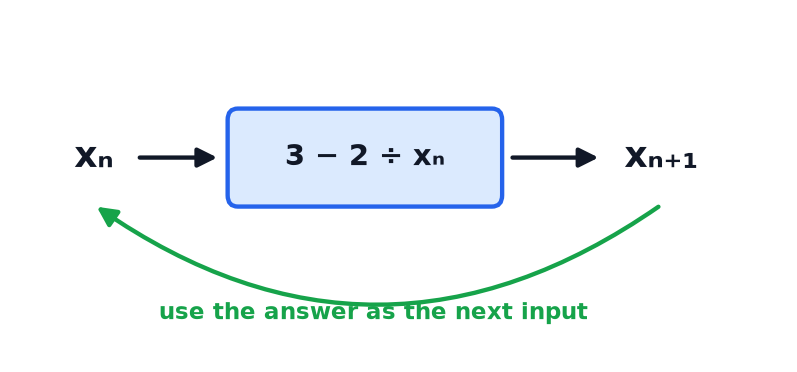
Many equations cannot be solved exactly by a simple method, but their solutions can be found as accurately as you like by repeating a calculation. Iteration starts with a guess, puts it into a formula, and uses the answer as the next guess. If the values settle down towards a single number, that number is a solution of the equation. Iteration is a Higher tier topic on every board. On a non-calculator paper the numbers are chosen to be simple, so that you can work with fractions and easy decimals.
An iterative formula
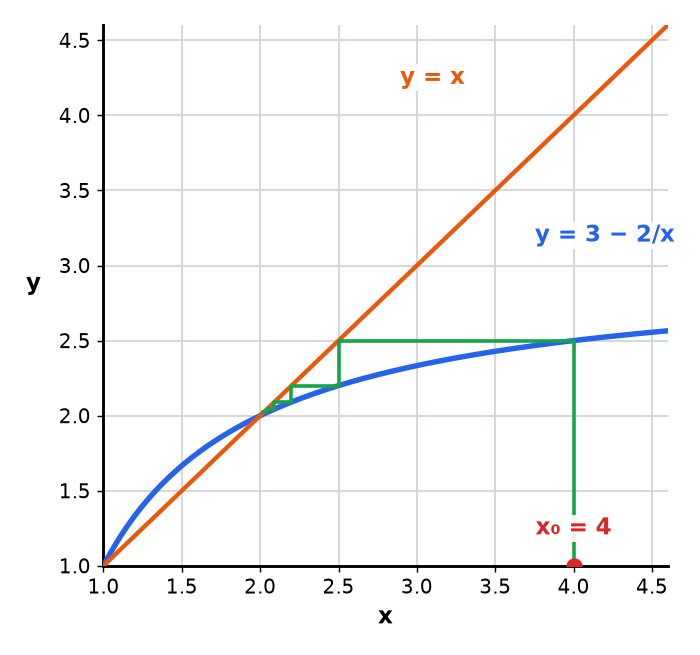
The formula \(x_{n+1} = 3 - \dfrac{2}{x_n}\) takes the current value \(x_n\) and gives the next value \(x_{n+1}\). Starting from \(x_0 = 4\), the first answer is \(x_1 = 3 - \dfrac{2}{4} = 2.5\).
Using an iterative formula
- Start The first value is given, such as \(x_0 = 4\).
- Step Substitute the current value into the right-hand side.
- Next value The answer becomes \(x_{1}\), then \(x_{2}\), and so on.
- Keep going Write down every value, so that a pattern is clear.
Using a formula
\(x_{n+1} = 3 - \dfrac{2}{x_n}\) and \(x_0 = 4\). Work out \(x_1\) and \(x_2\).
Show the solutionHide the solution
- 1 First step \(x_1 = 3 - \dfrac{2}{4} = 3 - 0.5 = 2.5\).
- 2 Second step \(x_2 = 3 - \dfrac{2}{2.5} = 3 - 0.8 = 2.2\).
- 3 Pattern The values are getting closer to 2.
- 4 Next value \(x_3 = 3 - \dfrac{2}{2.2} = 2.0909\ldots\), still moving towards 2.
Answer\(x_1 = 2.5\) and \(x_2 = 2.2\)
The values settle down
Each step goes up to the curve, across to the line \(y = x\), and up to the curve again. The steps get smaller, and the values move towards \(x = 2\), where the curve meets the line. A point where the curve meets \(y = x\) is a solution of \(x = 3 - \dfrac{2}{x}\).
Where the iteration ends up
- Limit The number the values approach, here \(2\).
- Why it works At the limit, \(x_{n+1} = x_n\).
- Equation So the limit \(a\) satisfies \(a = 3 - \dfrac{2}{a}\).
- Solving Multiply by \(a\): \(a^2 = 3a - 2\), so \(a^2 - 3a + 2 = 0\) and \(a = 1\) or \(a = 2\).
Rearranging into an iterative formula
An iterative formula comes from rearranging an equation so that \(x\) is on one side.
-
Start
\(x^2 - 3x + 2 = 0\).
-
Divide by x
\(x - 3 + \dfrac{2}{x} = 0\).
-
Rearrange
\(x = 3 - \dfrac{2}{x}\).
-
Iterative form
\(x_{n+1} = 3 - \dfrac{2}{x_n}\).
A change of sign
A root of \(f(x) = 0\) lies between two values if \(f\) changes sign between them.
-
Method
Work out \(f\) at both values. If one is negative and the other is positive, there is a root between them.
-
Condition
The graph must be a continuous curve, with no gaps.
-
Narrowing down
Try a value in the middle, and keep the interval where the sign changes.
-
To 1 decimal place
Test the midpoint of the last interval, so that you know which way to round.
Trial and improvement
\(f(x) = x^3 + x - 3\). Show that \(f(x) = 0\) has a root between 1 and 2, and find this root to 1 decimal place.
Show the solutionHide the solution
- 1 Test 1 and 2 \(f(1) = 1 + 1 - 3 = -1\) and \(f(2) = 8 + 2 - 3 = 7\). The sign changes, so there is a root between 1 and 2.
- 2 Narrow down \(f(1.2) = 1.728 + 1.2 - 3 = -0.072\), and \(f(1.3) = 2.197 + 1.3 - 3 = 0.497\).
- 3 Interval The root is between 1.2 and 1.3.
- 4 Midpoint \(f(1.25) = 1.953125 + 1.25 - 3 = 0.203\ldots\) is positive, so the root is between 1.2 and 1.25, and rounds to 1.2.
AnswerThe root is 1.2 to 1 decimal place
Test yourself
-
1
What does \(x_{n+1}\) mean in an iterative formula?
Show answerHide answer
The next value, found from \(x_n\).
-
2
What is true at the limit of an iteration?
Show answerHide answer
\(x_{n+1} = x_n\).
-
3
How do you show a root lies between two values?
Show answerHide answer
Show that \(f\) changes sign between them.
-
4
Why do you test the midpoint when rounding?
Show answerHide answer
To see which side of the midpoint the root is, and so how to round.
-
5
How do you find the limit of an iteration exactly?
Show answerHide answer
Replace \(x_{n+1}\) and \(x_n\) with \(a\) and solve.
Exam technique: iteration
Show every value, and write why you reach your conclusion.
-
Write each term
Show \(x_1\), \(x_2\), and so on, so that errors can be spotted.
-
Limit equation
Replace \(x_n\) and \(x_{n+1}\) with \(a\) and solve for \(a\).
-
Choose the right root
The question will usually tell you the values are positive, or give a start value.
-
Conclusion
Write that the sign changes, so there is a root between the two values.
Summary and exam focus
- Iteration repeats a formula, using each answer as the next input.
- The limit \(a\) satisfies \(a = f(a)\).
- A change of sign shows a root between two values, for a continuous function.
- Rearrange an equation to get an iterative formula.
Exam focus
\(x_{n+1} = 1 + \dfrac{6}{x_n}\) converges to a positive number \(a\). Show that \(a^2 - a - 6 = 0\), and find the value of \(a\). (4 marks) (4 marks)
At the limit \(a = 1 + \dfrac{6}{a}\), so \(a^2 = a + 6\) and \(a^2 - a - 6 = 0\). Factorise: \((a - 3)(a + 2) = 0\), and \(a\) is positive, so \(a = 3\).
Key terms
The words this lesson expects you to use. Each one is linked from the first place it appears above.
- Iteration
- A process that is repeated, using each output as the next input.
- Iterative formula
- A formula that gives the next value from the current one.
- Limit
- The value that the terms of an iteration approach.
- Root
- A solution of an equation \(f(x) = 0\).
- Change of sign
- The function is negative at one value and positive at another.
- Continuous
- A graph with no breaks or gaps.
- Trial and improvement
- Testing values to find a solution to a given accuracy.
- Converge
- To get closer and closer to a value.
- Starting value
- The first input of an iteration.
You've finished the notes
Check your understanding
Test yourself while it is fresh. Start with the flashcards, then try the exam questions.
Something here looks wrong?
Tell us what and we will go and look. It goes to whoever writes these pages, nobody else, and we do not ask who you are — so there is nothing to sign and nothing comes back to you.