Maths · Further Algebra
Viewing as
Teaching this? The teacher view opens every answer and mark scheme.
Surds
Simplifying and calculating with surds, expanding brackets and rationalising denominators.
Learning Objectives
- 1Recognise a surd and explain why it is left as a root rather than a decimal.
- 2Simplify surds by taking out square factors, such as \(\sqrt{12} = 2\sqrt{3}\).
- 3Add, subtract, multiply and divide surds, and expand brackets containing surds.
- 4Rationalise a denominator, including one of the form \(a + \sqrt{b}\).
Exact answers
A surd is a root that cannot be written as a whole number or a fraction, such as \(\sqrt{2}\) or \(\sqrt{5}\). Its decimal never ends, so on a non-calculator paper you leave it as a root, which is also exact. Pythagoras and trigonometry produce surds all the time, so this lesson is the algebra that tidies those answers up. Surds are Higher tier content, and every method here rests on one rule: \(\sqrt{a} \times \sqrt{b} = \sqrt{ab}\).
Where surds come from
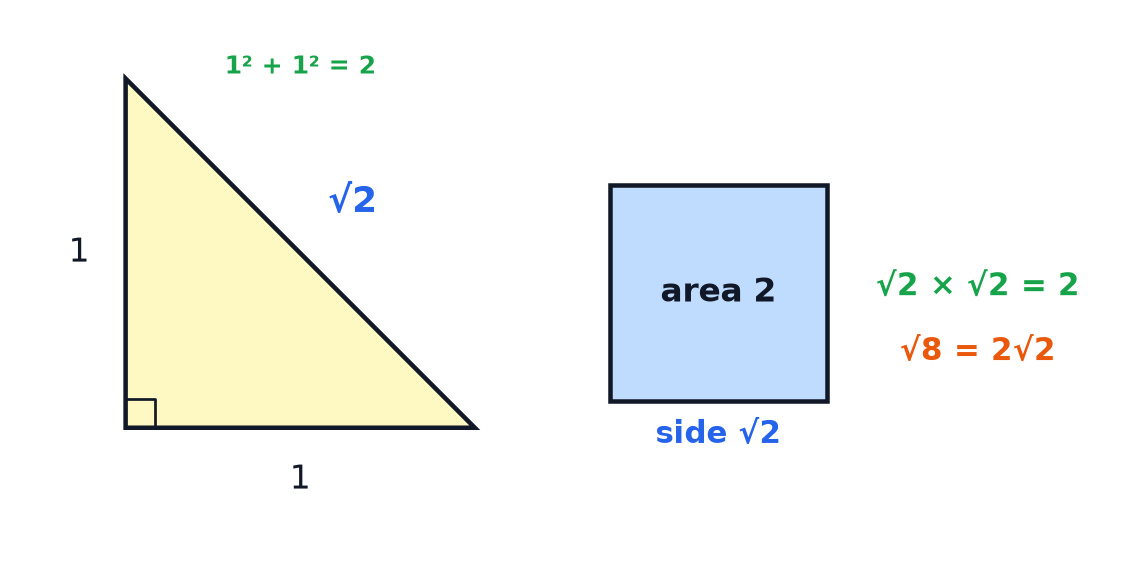
A square of area 2 has a side of length \(\sqrt{2}\), because \(\sqrt{2} \times \sqrt{2} = 2\). The triangle with two sides of 1 has a hypotenuse of \(\sqrt{2}\), which cannot be written exactly as a decimal.
Key facts
- Roots of non-square numbers \(\sqrt{2}\), \(\sqrt{3}\), \(\sqrt{5}\) and \(\sqrt{7}\) are surds. \(\sqrt{4} = 2\) and \(\sqrt{9} = 3\) are not.
- A root times itself \(\sqrt{a} \times \sqrt{a} = a\), so \(\sqrt{5} \times \sqrt{5} = 5\).
- Product rule \(\sqrt{a} \times \sqrt{b} = \sqrt{ab}\).
- Quotient rule \(\dfrac{\sqrt{a}}{\sqrt{b}} = \sqrt{\dfrac{a}{b}}\).
Simplifying surds
Look for the biggest square number that divides into the number under the root.
-
Method
Split the number into a square number times another number, then take the root of the square. \(\sqrt{12} = \sqrt{4 \times 3} = \sqrt{4} \times \sqrt{3} = 2\sqrt{3}\).
-
Squares to know
4, 9, 16, 25, 36, 49.
-
Examples
\(\sqrt{50} = \sqrt{25 \times 2} = 5\sqrt{2}\), and \(\sqrt{18} = \sqrt{9 \times 2} = 3\sqrt{2}\).
-
Simplest form
Use the largest square factor, so \(\sqrt{48} = 4\sqrt{3}\), not \(2\sqrt{12}\).
Simplifying a surd
Write \(\sqrt{72}\) in the form \(a\sqrt{2}\).
Show the solutionHide the solution
- 1 Find a square factor \(72 = 36 \times 2\).
- 2 Split the root \(\sqrt{72} = \sqrt{36} \times \sqrt{2}\).
- 3 Take the square root of the square \(\sqrt{36} = 6\).
- 4 Write the answer \(6\sqrt{2}\).
Answer\(6\sqrt{2}\)
Adding, subtracting and multiplying
Surds behave like letters when they add and like numbers when they multiply.
-
Like surds add
\(3\sqrt{2} + 5\sqrt{2} = 8\sqrt{2}\), just as \(3x + 5x = 8x\).
-
Simplify first
\(\sqrt{8} + \sqrt{2} = 2\sqrt{2} + \sqrt{2} = 3\sqrt{2}\).
-
Unlike surds cannot be added
\(\sqrt{2} + \sqrt{3}\) stays as it is.
-
Multiplying
\(\sqrt{2} \times \sqrt{8} = \sqrt{16} = 4\), and \(3\sqrt{2} \times 2\sqrt{5} = 6\sqrt{10}\).
Expanding brackets with surds
Use the same methods as with algebra, then simplify.
-
Single bracket
\(\sqrt{2}(3 + \sqrt{2}) = 3\sqrt{2} + 2\).
-
Double brackets
\((1 + \sqrt{3})(2 - \sqrt{3}) = 2 - \sqrt{3} + 2\sqrt{3} - 3 = -1 + \sqrt{3}\).
-
Squares
\((2 + \sqrt{5})^2 = 4 + 4\sqrt{5} + 5 = 9 + 4\sqrt{5}\).
-
Difference of two squares
\((3 + \sqrt{2})(3 - \sqrt{2}) = 9 - 2 = 7\), and the surd disappears.
Rationalising the denominator
Leaving a surd on the bottom of a fraction is untidy, so multiply to remove it.
-
A single surd
Multiply top and bottom by that surd. \(\dfrac{6}{\sqrt{3}} = \dfrac{6\sqrt{3}}{3} = 2\sqrt{3}\).
-
A two-part denominator
Multiply by the conjugate, the same two terms with the sign changed. For \(2 + \sqrt{3}\) use \(2 - \sqrt{3}\).
-
Why it works
\((2 + \sqrt{3})(2 - \sqrt{3}) = 4 - 3 = 1\), so the bottom becomes a whole number.
-
Example
\(\dfrac{1}{2 + \sqrt{3}} = \dfrac{2 - \sqrt{3}}{(2 + \sqrt{3})(2 - \sqrt{3})} = 2 - \sqrt{3}\).
Rationalising
Rationalise the denominator of \(\dfrac{10}{\sqrt{5}}\), and simplify your answer.
Show the solutionHide the solution
- 1 Multiply top and bottom by the surd \(\dfrac{10}{\sqrt{5}} \times \dfrac{\sqrt{5}}{\sqrt{5}} = \dfrac{10\sqrt{5}}{5}\).
- 2 Cancel \(\dfrac{10\sqrt{5}}{5} = 2\sqrt{5}\).
- 3 Check \(\dfrac{\sqrt{5}}{\sqrt{5}} = 1\), so multiplying by it changes the look of the fraction but not its value.
Answer\(2\sqrt{5}\)
Test yourself
-
1
What is \(\sqrt{5} \times \sqrt{5}\)?
Show answerHide answer
5.
-
2
Simplify \(\sqrt{12}\).
Show answerHide answer
\(2\sqrt{3}\).
-
3
What is \(\sqrt{2} \times \sqrt{8}\)?
Show answerHide answer
\(\sqrt{16} = 4\).
-
4
What is the conjugate of \(3 + \sqrt{2}\)?
Show answerHide answer
\(3 - \sqrt{2}\).
-
5
What is \((3 + \sqrt{2})(3 - \sqrt{2})\)?
Show answerHide answer
7.
Exam technique: surds
These questions are about method and tidiness.
-
Simplify as you go
Taking out square factors early makes later steps easier.
-
Leave answers exact
Do not give a decimal unless the question asks for it.
-
Show the rationalising line
Writing the multiplication earns the method mark.
-
Check the form
"In the form \(a\sqrt{b}\)" means one surd with a whole number in front.
Summary and exam focus
- A surd is a root that is not a whole number, left exact as \(\sqrt{n}\).
- Simplify with the biggest square factor: \(\sqrt{50} = 5\sqrt{2}\).
- Multiply surds with \(\sqrt{a} \times \sqrt{b} = \sqrt{ab}\), and add only like surds.
- Rationalise a single surd by multiplying by it, and \(a + \sqrt{b}\) by its conjugate.
Exam focus
Write \(\sqrt{48} + \sqrt{3}\) in the form \(a\sqrt{3}\), where \(a\) is an integer. (2 marks) (2 marks)
Simplify \(\sqrt{48} = \sqrt{16 \times 3} = 4\sqrt{3}\) first, and then add \(\sqrt{3}\) to get \(5\sqrt{3}\). Only like surds can be added, and you make them alike by simplifying.
Key terms
The words this lesson expects you to use. Each one is linked from the first place it appears above.
- Surd
- A root of a number that cannot be written as a whole number or fraction.
- Irrational
- A number that cannot be written as a fraction, with a decimal that never ends or repeats.
- Rationalise
- Remove a surd from the denominator of a fraction.
- Conjugate
- An expression with the sign between two terms changed, such as \(2 - \sqrt{3}\) for \(2 + \sqrt{3}\).
- Square factor
- A factor that is a square number, such as 4 or 9.
- Like surds
- Surds with the same number under the root, which can be added or subtracted.
- Exact value
- An answer left in terms of surds or \(\pi\) rather than rounded.
- Square root
- The number that gives a stated number when multiplied by itself.
- Denominator
- The bottom of a fraction.
You've finished the notes
Check your understanding
Test yourself while it is fresh. Start with the flashcards, then try the exam questions.
Something here looks wrong?
Tell us what and we will go and look. It goes to whoever writes these pages, nobody else, and we do not ask who you are — so there is nothing to sign and nothing comes back to you.