Maths · Geometry and Measures
Viewing as
Teaching this? The teacher view opens every answer and mark scheme.
Pythagoras' Theorem
Using Pythagoras' theorem to find sides, test for right angles and solve problems.
Learning Objectives
- 1State and use Pythagoras' theorem to find the hypotenuse or a shorter side of a right-angled triangle.
- 2Recognise Pythagorean triples and use them to avoid calculation.
- 3Use Pythagoras in context: ladders, diagonals of rectangles, and the height of an isosceles triangle.
- 4Leave answers as surds, and apply the theorem to coordinates and 3D shapes (Higher tier).
The longest side
Pythagoras' theorem links the three sides of a right-angled triangle, and it only works when the triangle has a right angle. It is one of the most reliable topics on the non-calculator paper because the numbers are almost always chosen to make square numbers, so you can square, add or subtract and then take a square root that comes out exactly. The secret to the marks is to decide, before you calculate, whether you are finding the longest side or a shorter side.
Pythagoras with squares
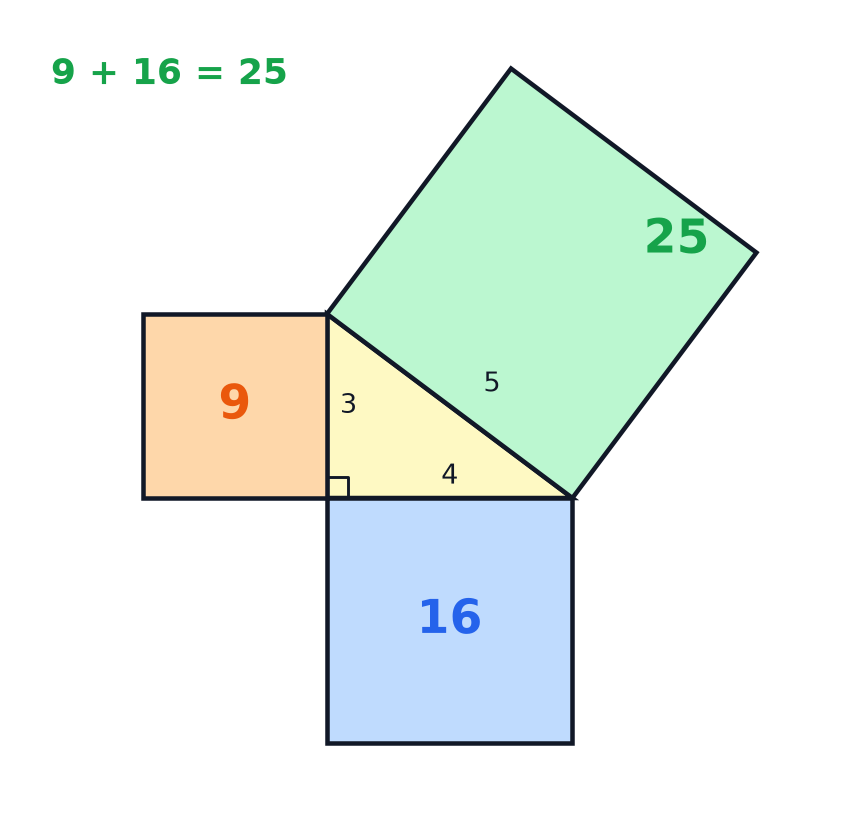
The areas of the two smaller squares, 9 and 16, add up to the area of the biggest square, 25. That is Pythagoras' theorem: the sum of the squares on the two shorter sides equals the square on the longest side.
The theorem
- Formula \(a^2 + b^2 = c^2\), where \(c\) is the hypotenuse.
- The hypotenuse It is the longest side and is always opposite the right angle.
- Only for right angles If there is no right angle, the theorem cannot be used.
Finding the hypotenuse
Add the squares of the two shorter sides, then take the square root.
-
Step 1
Label the sides: the hypotenuse is \(c\), the other two are \(a\) and \(b\).
-
Step 2
Square each shorter side and add: \(a^2 + b^2\).
-
Step 3
Take the square root of the total to get \(c\).
-
Check
The hypotenuse must be the longest side, and shorter than \(a + b\).
Finding the hypotenuse
A right-angled triangle has shorter sides of 9 cm and 12 cm. Work out the length of the hypotenuse.
Show the solutionHide the solution
- 1 Write the theorem \(c^2 = a^2 + b^2\).
- 2 Substitute \(c^2 = 9^2 + 12^2 = 81 + 144\).
- 3 Add \(c^2 = 225\).
- 4 Square root \(c = \sqrt{225} = 15\) cm.
Answer15 cm
Finding a shorter side
This time you subtract. The hypotenuse is always the biggest, so it is the one you start with.
-
Rearrange
\(a^2 = c^2 - b^2\).
-
Subtract the squares
Square the hypotenuse, square the other short side, and subtract.
-
The mistake
Adding the squares when you are looking for a shorter side gives an answer that is too big, bigger than the hypotenuse.
-
Check
Your answer must be smaller than the hypotenuse.
Finding a shorter side
A right-angled triangle has hypotenuse 13 cm and one shorter side 5 cm. Work out the length of the other shorter side.
Show the solutionHide the solution
- 1 Rearrange \(a^2 = c^2 - b^2\).
- 2 Substitute \(a^2 = 13^2 - 5^2 = 169 - 25\).
- 3 Subtract \(a^2 = 144\).
- 4 Square root \(a = \sqrt{144} = 12\) cm.
Answer12 cm
Pythagorean triples
Some whole-number triangles come up again and again. If you recognise them, you save time and avoid mistakes.
-
Four to learn
\(3, 4, 5\) and \(5, 12, 13\) and \(8, 15, 17\) and \(7, 24, 25\).
-
Multiples work too
Doubling \(3, 4, 5\) gives \(6, 8, 10\), and tripling gives \(9, 12, 15\). Multiply every side by the same number.
-
Spotting them
In a question with sides 6 and 8, the hypotenuse is 10 without any calculation, and a hypotenuse of 26 with a side of 10 gives 24.
-
Still show some working
A bare answer might not get full marks unless the question allows it.
Is the triangle right-angled?
You can also use Pythagoras backwards to test a triangle, which is called the converse.
-
The test
Check whether \(a^2 + b^2 = c^2\), where \(c\) is the longest side.
-
If it is equal
The triangle is right-angled.
-
If it is not
The triangle is not right-angled, and the answer is "no" with the two values as proof.
-
Example
Sides 7, 24 and 25 give \(49 + 576 = 625 = 25^2\), so the triangle has a right angle.
The height of an isosceles triangle
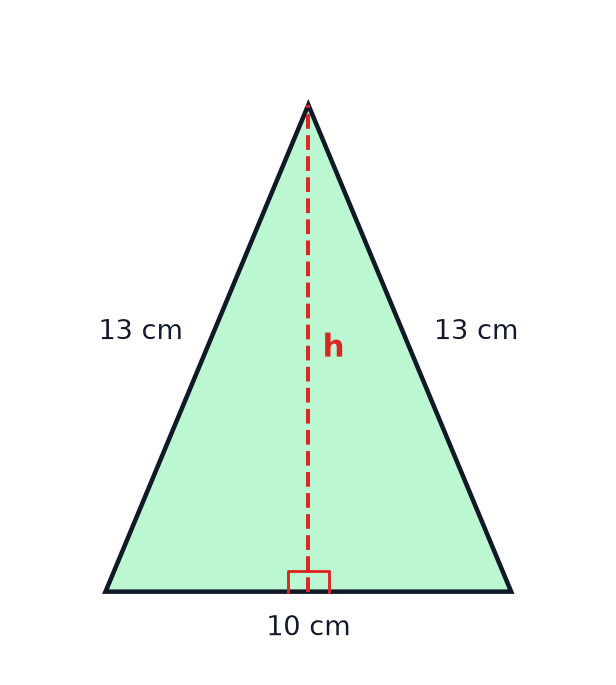
Drawing the height splits the isosceles triangle into two identical right-angled triangles. Each has hypotenuse 13 cm and a base of half of 10 cm, which is 5 cm.
Using the height
- Half the base The base is split in two, so each right-angled triangle has a short side of \(10 \div 2 = 5\) cm.
- Find h \(h^2 = 13^2 - 5^2 = 169 - 25 = 144\), so \(h = 12\) cm.
- Area The area of the whole triangle is \(\dfrac{1}{2} \times 10 \times 12 = 60\) cm\(^2\).
Pythagoras in context
Many exam questions use a story, and the skill is to find the right-angled triangle hidden in it.
-
Ladders and walls
The ladder is the hypotenuse, the wall is vertical, and the ground is horizontal.
-
Diagonals
The diagonal of a rectangle is the hypotenuse of a triangle whose shorter sides are the length and the width.
-
Distances on a grid
Use the horizontal and vertical difference as the two shorter sides.
-
Always draw it
Sketch the triangle and label the sides you know, because it makes the method clear.
A ladder against a wall
A ladder 6.5 m long leans against a vertical wall. The foot of the ladder is 2.5 m from the wall. How high up the wall does the ladder reach?
Show the solutionHide the solution
- 1 Draw the triangle The ladder is the hypotenuse (6.5 m) and the distance from the wall is a shorter side (2.5 m).
- 2 Subtract the squares \(h^2 = 6.5^2 - 2.5^2 = 42.25 - 6.25\).
- 3 Calculate \(h^2 = 36\), so \(h = 6\) m.
- 4 Spot the triple Doubling the sides gives 13, 5 and 12, which is a \(5, 12, 13\) triangle.
Answer6 m
Surds, coordinates and 3D (Higher tier)
The numbers do not always give a perfect square, and Higher tier questions may ask for an exact answer.
-
Leave it as a surd
If \(c^2 = 20\), the exact answer is \(\sqrt{20} = 2\sqrt{5}\), because \(20 = 4 \times 5\).
-
Distance between two points
The distance from \((1, 2)\) to \((7, 10)\) uses the differences 6 and 8: \(\sqrt{6^2 + 8^2} = \sqrt{100} = 10\).
-
Diagonal of a cuboid
Use Pythagoras twice: first for the diagonal of the base, then for the diagonal of the box.
-
Show the exact value
Write \(\sqrt{20}\) or \(2\sqrt{5}\) and only give a decimal if asked.
A surd answer
(Higher tier) A right-angled triangle has shorter sides of 2 cm and 4 cm. Work out the length of the hypotenuse. Give your answer in the form \(a\sqrt{b}\).
Show the solutionHide the solution
- 1 Square and add \(c^2 = 2^2 + 4^2 = 4 + 16 = 20\).
- 2 Square root \(c = \sqrt{20}\).
- 3 Simplify \(\sqrt{20} = \sqrt{4 \times 5} = 2\sqrt{5}\) cm.
Answer\(2\sqrt{5}\) cm
What the AQA exam gives you
AQA gives very few formulae in the exam, so most of the formulae in this lesson have to be remembered.
-
Not given
AQA expects you to know Pythagoras' theorem, \(a^2 + b^2 = c^2\), where \(c\) is the hypotenuse.
-
Also not given
The Pythagorean triples, so learn \(3, 4, 5\), \(5, 12, 13\), \(8, 15, 17\) and \(7, 24, 25\) as well.
Test yourself
-
1
What is Pythagoras' theorem?
Show answerHide answer
\(a^2 + b^2 = c^2\), where \(c\) is the hypotenuse.
-
2
Which side is the hypotenuse?
Show answerHide answer
The longest side, opposite the right angle.
-
3
How do you find a shorter side?
Show answerHide answer
Subtract: \(a^2 = c^2 - b^2\).
-
4
What is the hypotenuse of a triangle with shorter sides 6 and 8?
Show answerHide answer
10.
-
5
How can you tell if a triangle is right-angled from its sides?
Show answerHide answer
Check whether the squares of the two shorter sides add up to the square of the longest.
Exam technique: Pythagoras
Most mistakes come from adding when you should subtract.
-
Hypotenuse first
Decide whether you are finding the longest side before you begin.
-
Square root at the end
Finish with \(\sqrt{\ }\) and do not forget to take it.
-
Reasonable answer
The hypotenuse is always the longest side.
-
Show every step
\(c^2 = 9^2 + 12^2\) earns a mark before you reach the answer.
Summary and exam focus
- Pythagoras' theorem only works in right-angled triangles: \(a^2 + b^2 = c^2\).
- To find the hypotenuse, add the squares and square root. To find a shorter side, subtract.
- Learn the triples \(3, 4, 5\), \(5, 12, 13\), \(8, 15, 17\) and \(7, 24, 25\), and their multiples.
- Split an isosceles triangle down the middle to find its height.
- Exact answers may be surds at Higher tier.
Exam focus
A rectangle is 15 cm long and 8 cm wide. Work out the length of its diagonal. (3 marks) (3 marks)
Draw the rectangle and the diagonal to make a right-angled triangle, with the diagonal as the hypotenuse. Then \(15^2 + 8^2 = 225 + 64 = 289\), and \(\sqrt{289} = 17\) cm. This is an \(8, 15, 17\) triple.
Key terms
The words this lesson expects you to use. Each one is linked from the first place it appears above.
- Right-angled triangle
- A triangle with one angle of 90 degrees.
- Hypotenuse
- The longest side of a right-angled triangle, opposite the right angle.
- Pythagoras' theorem
- In a right-angled triangle, the square of the hypotenuse equals the sum of the squares of the other two sides.
- Pythagorean triple
- Three whole numbers that fit Pythagoras' theorem, such as 3, 4, 5.
- Square root
- The number that gives a stated number when multiplied by itself.
- Converse
- The reverse of a statement, used here to test whether a triangle has a right angle.
- Diagonal
- A line joining two opposite corners of a shape.
- Surd
- A root that cannot be written as a whole number or a fraction, such as the square root of 5.
- Isosceles triangle
- A triangle with two equal sides and two equal angles.
You've finished the notes
Check your understanding
Test yourself while it is fresh. Start with the flashcards, then try the exam questions.
Something here looks wrong?
Tell us what and we will go and look. It goes to whoever writes these pages, nobody else, and we do not ask who you are — so there is nothing to sign and nothing comes back to you.